


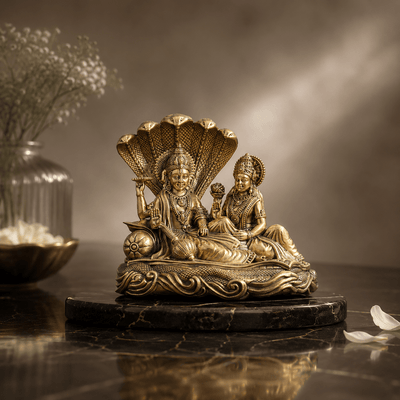
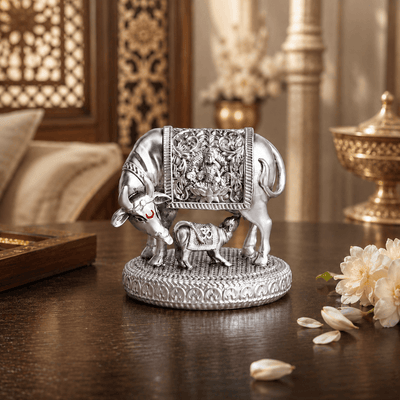

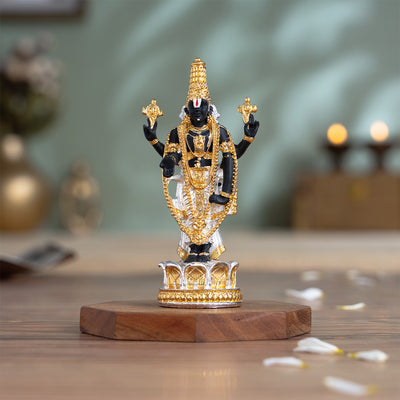


For your home mandir
Choose a seated or standing Lakshmi murti with a stable base and room for lamps, flowers and daily pooja.

 Menu
Menu
Svastika's
श्री लक्ष्मी
Seated on the lotus, standing at the door, flanked by elephants over the lintel, or carrying the flame of a lamp. The form your family keeps is the right one.
Choose a seated or standing Lakshmi murti with a stable base and room for lamps, flowers and daily pooja.
Compare solo Lakshmi, Gajalakshmi, Ashtalakshmi, Charan Paduka and paired collections by purpose and space.
Check the full dimensions, then compare brass, plated, antique and marble-dust finishes by weight and care.
Everything we make bearing Lakshmi, and she appears in more of the house than the mandir alone. With Ganesha she is the most kept deity in Indian homes, and the pairing of the two is the default purchase for a new house and for Diwali.
A spelling note first, because it confuses people: Lakshmi and Laxmi are the same name. The English register takes Lakshmi, the Hindi register takes Laxmi. Both are correct, and Mahalakshmi and Mahalaxmi are the same goddess again.
Murtis in brass, plated metal, antique finish and marble dust, seated and standing, from 3 inch shelf pieces to 10 inch antique statements.
Diyas. The goddess as the lamp rather than the murti, including the Maa symbol diya and the Balaji Lakshmi diya. A lamp gets lit rather than only looked at, which makes it the better Diwali gift for a household that already has murtis. See brass diyas.
Wall pieces, which want a wall the light actually reaches rather than a shelf. See wall decor.
Charan paduka, her sculpted footprints, kept at a shop or office entrance as often as in the mandir.
Pairs and groupings: with Ganesha, with Ganesha and Saraswati, with Vishnu, with Kubera, and the Ashtalakshmi tortoise. Pocket temples for a desk or travel, and combos and hampers for gifting.
The question that stops most purchases, and the answer you will find almost everywhere is wrong.
The claim is that a standing Lakshmi is unsuitable for the home, with the implication that she will not stay. It is repeated across news sites and retail blogs, always attributed vaguely to "Vastu Shastra and religious beliefs", and in the sources we could find, never to a named text, verse or chapter. Every locatable instance is recent digital content.
The tradition's own art contradicts it. Standing Lakshmi is ancient and canonical, carved in stone from the last centuries BCE and appearing on coinage from the same period. In classical iconography the standing posture, sthanaka, is the default for temple images and signifies stability and readiness, the opposite of the claim's premise. And Gaja Lakshmi's canonical position is the lalatabimba, the protective image set directly over the doorway. A goddess whose traditional place is standing above the door is not one the tradition thinks is about to walk out of it.
There is an honest kernel. South Indian temple prescriptions do favour a seated Lakshmi in the sanctum, and that preference is real. But those are rules for a temple sanctum rather than a house, and they prescribe seated positively without prohibiting standing.
One more tell: sellers who stock standing idols push the opposite claim just as confidently, describing standing Lakshmi as active, flowing prosperity. When both sides of a rule are argued by whoever holds the inventory, it is merchandising, not doctrine.
Buy the one you prefer. Seated is more common in Indian homes and reads calmer on a shelf. Standing has the older iconography behind it. Neither is a mistake.
Lakshmi with Ganesh is the most bought configuration by a distance and the conventional Diwali and new-home choice. See Lakshmi Ganesh idols.
Gajalakshmi is the goddess flanked by elephants, connected in the iconography to rain and through rain to abundance. One of the oldest attested forms of Lakshmi in Indian art.
Ashtalakshmi, the eight forms, is kept as a set and is strongest in South Indian households. The eight differ slightly between sources, so check which eight a seller means.
Lakshmi Narayan pairs her with Vishnu, the usual form in Vaishnava households; see Lakshmi Narayan idols. Lakshmi and Kubera are frequently kept together; see Lord Kubera idols.
Brass for a murti that will be actively worshipped or receive abhishek. It darkens between cleanings, which is oxidation rather than damage. See brass idols. Gold and silver plated for display and gifting: real precious metal over a polyresin base, dry cloth only, no abhishek. See gold and silver plated idols. Marble dust holds the finest detail; see the white and gold premium range. Antique finish takes dry dusting only, since paste strips the patina rather than restoring it.
Two to four inches suits a shelf mandir or a desk; five to eight suits most home mandirs and is where the bulk of this collection sits. Check base width as well as height, because a seated Lakshmi on a broad lotus takes more shelf than her height suggests, and a pair or a Gajalakshmi set is wider again.
The northeast, ishanya, is the quadrant associated with the household shrine in the vastu tradition, which has a genuine textual lineage. The specific facing rules are widely followed custom rather than text.
Lakshmi has more occasions attached to her than any other deity we make, and they are regionally distinct.
Varalakshmi Vratam falls on a Friday in Shravana, observed mainly in Andhra Pradesh, Telangana, Karnataka, Tamil Nadu and Maharashtra, largely by married women, with a substantial return-gift tradition. See Varalakshmi pooja return gifts. Published dates vary, so check a panchang.
Kojagari, on Sharad Purnima, is the Bengali, Assamese and Odia observance on the Ashwin full moon, five days after Vijayadashami. Locally she is Lokkhi and the observance Lokkhi Pujo.
Dhanteras and Diwali Lakshmi Puja are the pan-India peak. Diwali Lakshmi Puja leans toward business and material prosperity, Kojagari toward household wellbeing.
A practical note on Dhanteras: the custom of buying metal on the day explicitly includes idols, not only utensils and bullion, which makes it the one occasion where a solid brass murti is the more traditionally apt purchase and a plated one the more decorative. See Dhanteras gifts and Diwali gifts.
A Lakshmi Ganesh pair is the safest gift in this entire catalogue. It suits any Hindu household, needs no knowledge of a family deity, and is the expected thing for a new home. For a household that already has murtis, a diya is the more useful gift. See griha pravesh and housewarming gifts and wedding gifts; for volume, corporate gifts or the bulk order enquiry page. To furnish the mandir, pooja essentials; for the wider pantheon, god idols and figurines.
Add ₹ 4,999 more for A Free Brass "माँ" Diya


