






Where it belongs
Face the murti east or north-east in a clean, quiet corner of your home mandir, raised a little above the floor.

 Menu
Menu

Svastika's
White marble powder, cast and then gilded. Detail finer than carving reaches, and we say plainly what it is.
Face the murti east or north-east in a clean, quiet corner of your home mandir, raised a little above the floor.
Pick a height that suits your altar — a 4–6 inch murti sits beautifully on most home mandirs, while taller pieces anchor a dedicated pooja room.
Wipe gently with a soft, dry cloth. Keep away from water and harsh polish — the finish keeps its lustre for years with a light touch.
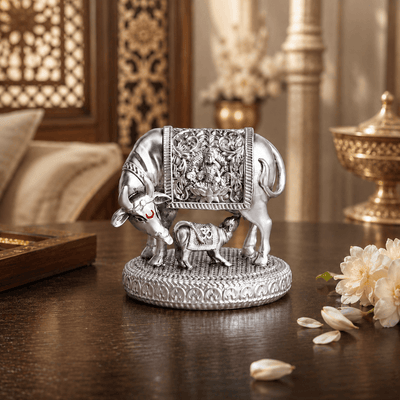
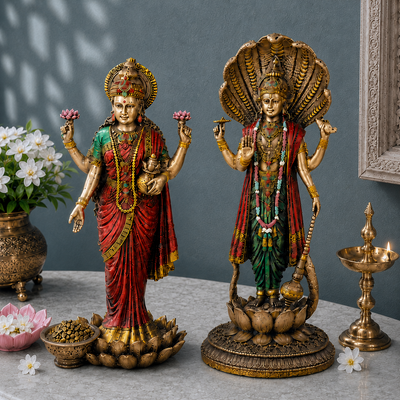
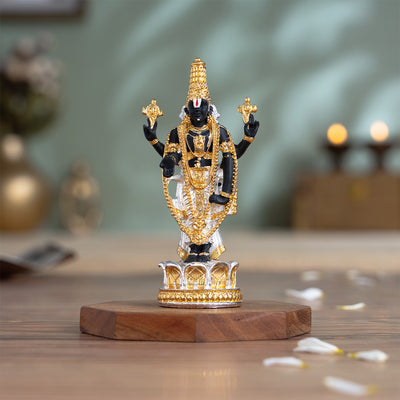
These are marble dust murtis: real marble powder, finely ground, bound and cast in a mould, then finished and electroplated with gold. Cast, not carved. We say that in the first two sentences because much of this market does not say it at all, and you should know what you are buying before you look at the price.
What that gets you is a white, dense, closely detailed surface that takes gold work well, at roughly half to two-thirds the weight of the same piece in quarried stone. What it does not get you is a block of marble.
Quarried marble is a single block of natural stone, carved away. Heavy, expensive, and carving limits how fine and how undercut the ornament can be.
Marble dust composite, which is this collection, is marble powder held in a binder and cast in a mould. Because it is moulded rather than carved, it reproduces fine ornament, jewellery and crown detail far more crisply than carving does at the same price. It is non-porous, takes a high polish, and is markedly lighter.
Plain polyresin has little or no marble in it, and marble finish is paint on some other substrate, containing none at all. Those are different products and cheaper ones.
Why spell this out: it is common in this category to see a piece titled a marble idol with the word resin appearing only in a spec field, or nowhere. A twenty-four inch solid marble Ganesha would weigh tens of kilos and cost several times what these listings ask. Weight gives it away, and price is the second tell.
The gold is electroplated: a real layer of gold deposited onto the finished surface. Not gold leaf, not paint.
Two things follow. It is a surface treatment and behaves like one, so it lasts a long time on a display piece that is dusted and left alone, and it will not survive washing, scrubbing, acidic cleaners or constant handling at the same edge. Any seller promising a gilded surface that never wears is telling you something they cannot know.
Where a karat figure appears on a product page it comes from our supplier's specification rather than an assay we have run ourselves, and we would rather say so than present a number as though we had tested it.
This is the question serious buyers actually have, and the category has largely left it unanswered while some sellers of the more expensive alternative assert that composite idols are not permissible, usually without naming a text.
The classical Shilpa Shastra literature sets out a list of permitted materials for a murti, and it includes gold, silver, copper, stone, wood and earth alongside sudha, a worked stucco or mortar plaster, and sarkara, gravel or grit. Two of those are bound composites rather than monolithic stone. The tradition's own list of acceptable materials includes worked aggregate.
Living practice agrees. The gopurams of South Indian temples carry thousands of stucco-plaster deity figures, ritually renewed and reconsecrated at Kumbhabhishekam roughly every twelve years.
The honest limits, because a one-sided argument would be exactly what this page is trying not to be: gopuram figures are architectural iconography, not the mula vigraha, the principal consecrated image in a sanctum, which is conventionally stone or panchaloha. Classical practice does favour those for that purpose. And modern polymer binder is not one of the named materials, even though marble powder is.
So for a home mandir, for gifting, for a shelf shrine or a devotional display piece, marble dust is appropriate and very widely used. For a formally consecrated primary murti intended for generations of daily abhishek, stone or panchaloha remains the traditional choice. We would rather tell you that than sell you something on a claim we cannot support.
Do not perform abhishek on these pieces, and do not wash them. The plated surface fails first and no care afterwards brings it back. If your practice involves bathing the murti, buy brass idols instead. That is a recommendation against our own premium line and it is the right one.
Everything else is simple. Dust gilded areas with a soft dry cloth. On plain white areas a barely damp cloth with a drop of mild soap is fine, wrung out and dried straight away. Never vinegar, lemon, metal polish or any abrasive, all of which attack both the binder and the plating.
Keep the piece out of sustained direct sun. Prolonged UV can yellow a resin binder over years, which is the one durability point where critics of this material have a fair case. Edges and thin projections, crowns, fingers, a trishul, are where chips happen.
The white and gold palette reads as celebratory rather than solemn, which is why these sell hardest as gifts and around Diwali. The weight makes them practical on a wall-mounted mandir or a shelf where solid stone would be a problem. And the moulded detail is genuinely finer than carving delivers at this price.
For gifting see griha pravesh and housewarming gifts, wedding gifts and Diwali gifts; for volume, corporate gifts, bulk gift items or the bulk order enquiry page.
By deity the range covers Ganesha idols, Maa Lakshmi idols, Lakshmi Ganesh idols, Krishna idols and Shiva idols. For other materials see gold and silver plated idols and antique finish idols. To furnish the mandir around the murti, pooja essentials.
Add ₹ 4,999 more for A Free Brass "माँ" Diya


