A celibate god with a son is a strange thing to explain. And yet almost every child in India who grows up hearing Hanuman stories eventually hears this one: that somewhere below the world, a monkey-faced prince with a fish's tail sat guarding a gate, and that he was Hanuman's own boy.
He does not come from the oldest books. That is the first honest thing to say, and the most interesting thing about him.
Who was Makardhwaja, the son of Hanuman?
The story goes like this. After Hanuman had set fire to Lanka with his burning tail, he flew out over the ocean to cool himself. Sweat ran off his body and a drop of it fell into the water. A makara, a sea creature usually pictured as a crocodile-fish, swallowed it. From that drop she conceived, and the child born of her was Makardhwaja: part vanara, part sea-being, and, by descent, Hanuman's son.
He grew up in Patala, the underworld, where Ahiravana ruled. Ahiravana was a sorcerer and a brother of Ravana, and he made the boy the guardian of his gate. That is where Makardhwaja was standing on the night the story turns. Ahiravana carried Rama and Lakshmana off to Patala in their sleep, lifting the two brothers out of a guarded camp without a sound.
Hanuman came down to get them back. At the gate stood a young warrior who looked, unmistakably, like him.
The fight at the gate
Neither of them knew. Hanuman had never been told he had a son, and had no idea the sweat had gone anywhere. Makardhwaja had been raised on stories of the great Hanuman and had never seen him.
So they fought. It is a long fight in most retellings, because the boy is strong and Hanuman is surprised. When Makardhwaja is finally pinned he tells his father who he is, and why he could not step aside: he had been given a gate to guard, and a guard does not open a gate because the person outside is family.
Hanuman does not kill him. He goes in, rescues Rama and Lakshmana, kills Ahiravana, and on the way out he puts his son on the throne of Patala. That is the ending. The boy who fought for the wrong side is made a king by the man he lost to, because the loyalty was never in question, only the address.
Why was he in Patala at all? The Ahiravana night
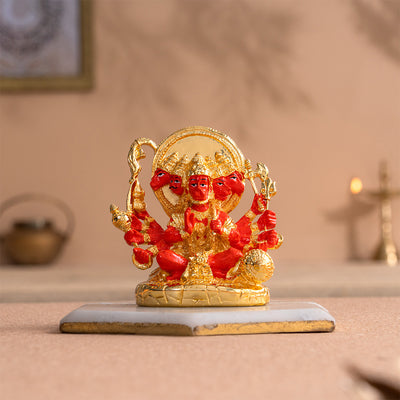
Makardhwaja does not exist on his own. He comes attached to a much larger episode: the abduction of Rama and Lakshmana to the underworld, and the rescue in which Hanuman takes his five-faced form. That whole cycle is what our Panchmukhi Hanuman story covers in detail, and the two really are one night's events split into two tales.
The short version: Ahiravana could only be killed by putting out five lamps burning in five different directions at the same instant. One body, five directions, one moment. It cannot be done, unless you grow five faces. So Hanuman does, taking on the faces of Narasimha, Varaha, Hayagriva and Garuda alongside his own, and blows out all five lamps together.
Makardhwaja is the doorway to that night. He is the obstacle before the rescue, and the fact that the obstacle turns out to be family is what keeps it from being just another demon fight.
The sweat detail is not random
It is easy to read the conception as silliness. It is not. That ocean is the most famous thing about Hanuman. Valmiki gives the crossing a whole opening sarga in the Sundara Kanda, and of the three things that try to stop him mid-flight, only one is beaten by force. Surasa, mother of serpents, has a boon that everything must pass through her mouth, so Hanuman shrinks to thumb-size, goes in, comes out and satisfies the boon without a fight. Simhika the shadow-catcher he beats with a trick. Only Mainaka gets shouldered aside.2
Two out of three solved by thinking. He is usually ranked among the most powerful figures in Hinduism for the wrong reason. The strength is the least distinctive thing about him.
So when the folk tradition needed a birth for him, it went back to that sea, and to the moment right after the most reckless thing he ever did. The sweat is not an accident of the plot. It is the residue of work.
Which texts actually contain this story?
Makardhwaja is not in the Valmiki Ramayana. Not in the Sundara Kanda, where Hanuman burns Lanka and crosses the sea.2 Not in the Yuddha Kanda, where the war is fought. He is not in Tulsidas's Ramcharitmanas either. Neither is Ahiravana. Neither is the five-faced form.
Where the Ahiravana cycle does live is in later regional Ramayanas, chiefly the Bengali Krittivasi Ramayana of around the fifteenth century, in the passage known as the Mahirabonerpala, and a sixteenth-century Telugu Mairavana charitra by Adithya Kavi. Makardhwaja travels with that cycle and with the folk retellings around it. That is roughly two thousand years after Valmiki.
This does not make the story fake. Regional Ramayanas are how the epic stayed alive in each language, and the poets who wrote them were not smuggling in errors. They were adding what their audience needed. It does mean that if someone quotes you chapter and verse for Makardhwaja, they are making it up.
Three things people get wrong about Hanuman's son
1. "Makardhwaja appears in the Ramayana."
He does not, in the sense people usually mean by "the Ramayana," which is Valmiki or Tulsidas. Both are silent on him. What people are remembering is a regional Ramayana, and there are dozens of those, each with its own additions.
2. "This proves Hanuman broke his celibacy."
The story is built to prove the exact opposite. Sweat, seawater and a fish means no woman, no desire, no vow broken. The tradition wanted Hanuman to have a son and engineered a birth that cost him nothing. If anything, the sheer awkwardness of the mechanism tells you how badly the storytellers wanted his chastity intact. The same instinct produced the tradition of a formal, unconsummated marriage, which we look at in who is the wife of Lord Hanuman.
3. "Valmiki calls Hanuman a brahmachari."
He never does. The one place where the question comes up in the original is Sundara Kanda 11, where Hanuman has just searched Ravana's sleeping quarters looking for Sita. He worries about it himself: seeing other men's wives asleep, he says, is a deficit to dharma. Then he settles it, not with a vow but with a state of mind. In his mind, he says, "there indeed was not even a little disturbance," and "my that mind is very steady."3
Valmiki praises composure, not abstinence. The lifelong-brahmachari framing is later devotional emphasis laid over something subtler.
It means the anxiety that produced Makardhwaja's strange birth was not Valmiki's anxiety. It came later.
What Valmiki does say about Hanuman
Valmiki gives Hanuman two fathers on purpose, using two precise legal terms: he is the kshetraja-putra of Kesari, the social and legal son, and the aurasa-putra of Vayu, the one who begot him.1 Neither is a demotion of the other. We go through that whole knot, including the Shiva Purana's competing claim, in who was Lord Hanuman's father.
His name comes from an injury. As a child he leapt at the rising sun thinking it was fruit, and Indra's thunderbolt broke his left hanu, his jaw, as he fell. Kishkindha Kanda 66 says outright that this is where the name comes from. In the same passage Brahma grants him indestructibility by missiles and Indra grants that death will reach him only by his own will. Those two boons are the real basis for calling him deathless, and they are far more specific than the popular version, which we take apart in is Lord Hanuman still alive.
And he is not untouchable. In Yuddha Kanda 59, Ravana strikes him on the chest with an open palm and Hanuman "reeled repeatedly," then hits back so hard that Ravana "shook like a mountain."5 The full accounting of who managed to land a blow is who can defeat Lord Hanuman, and it is a better answer than "nobody."
The one place he speaks about his life after the Ramayana is not a Ramayana at all. In the Mahabharata's Vana Parva, Bhima finds him at Gandhamadana, an old monkey lying across a path, refusing to move his tail. Bhima, the strongest Pandava and himself a son of Vayu, cannot lift that tail with one hand, then cannot lift it with both. Asked to show his old form, Hanuman refuses: "Diminution is going on this age, and I have not that form now."7 Even he says he has shrunk with the yugas.
Why a celibate god was given a son
Over centuries devotion kept adding to Hanuman: a five-faced form, a wife who is not really a wife, a son born without a mother, a place among the chiranjivis who never die.
Each addition is doing a job. The five faces solve a puzzle. The marriage completes a course of study without breaking a vow. And the son gives Hanuman something the epic never gave him: a family of his own. In Valmiki he belongs entirely to Rama. No house, no line, nothing that is his. Folk tradition quietly fixed that, and fixed it in a way that cost him nothing.
There is a neat symmetry in the son, too. He guards a gate, faithfully, for a master he did not choose, against a stranger he has every reason to admire. That is his father's whole character, transplanted into a boy who never met him.
Where you will meet Makardhwaja today
He survives in Ramayana performance traditions across Bengal, Odisha and the Telugu and Tamil regions, almost always inside the Ahiravana episode rather than on his own. Most people meet him once, sideways, during a Hanuman Jayanti katha or a Ramlila night, when the narrator reaches Patala and the crowd works out that the boy at the gate is somebody's son. Nobody recites anything to him. What they recite is to his father: the Chalisa, or on a bad day the Hanuman Bahuk, which Tulsidas wrote around 1607 CE when his own arms hurt too much to sleep.
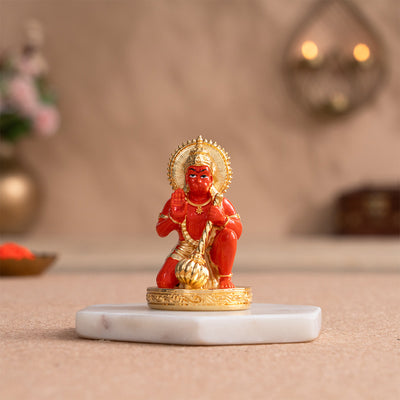
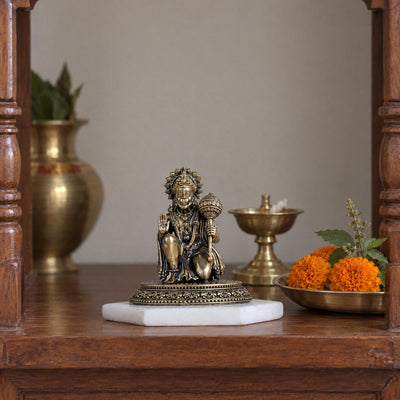
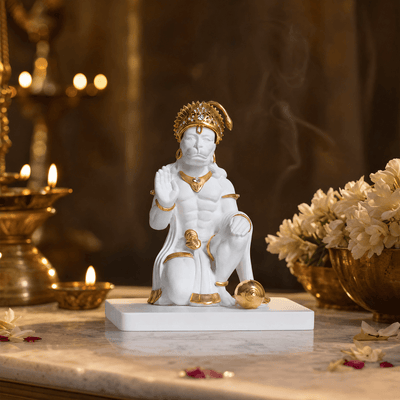
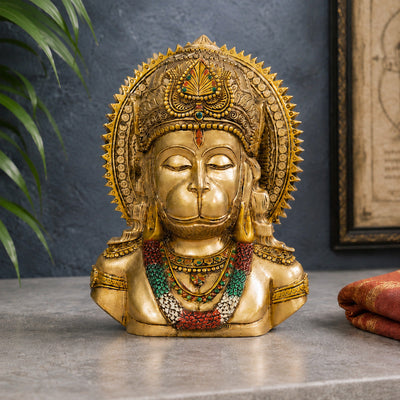
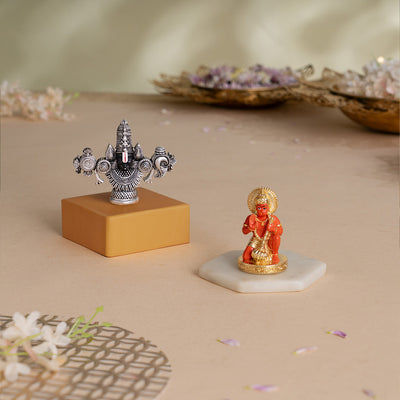
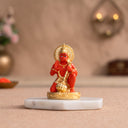
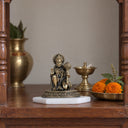
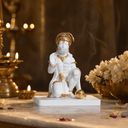
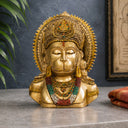
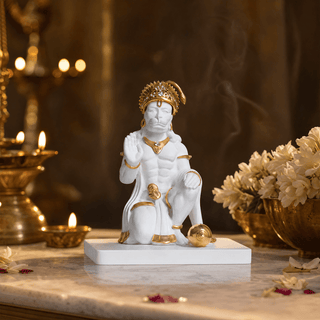
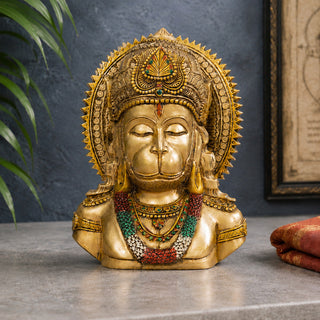
In homes he almost never appears in idol form. What people bring home is his father, a Hanuman murti in one of the recognised forms: the warrior Vira Anjaneya, the servant with folded hands, the mountain-bearer, the five-faced Panchamukhi, or the seated figure with a raised palm in abhaya mudra, the gesture of "do not be afraid." That last one has an odd resonance here, because a raised hand that turns out to be a blessing rather than a blow is exactly how the fight at the gate ends.
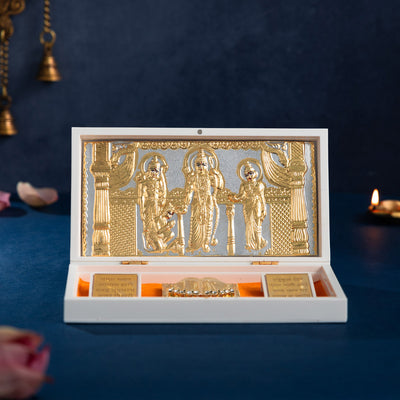
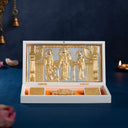
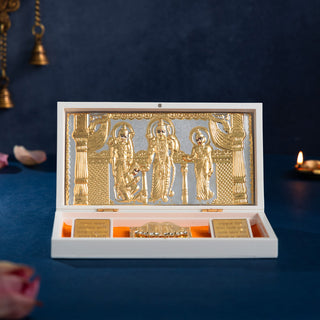
The other common choice is a Ram Darbar, where he kneels at the edge of the court with his hands folded, which is, after all, where he always said he wanted to be, and the piece most often given at Ram Navami and Hanuman Jayanti. In brass these figures darken with the years and end up looking older than they are.
If you are choosing one, our guide on which Hanuman idol is good for home separates the parts that are documented iconography from the parts that are simply regional custom. There is more custom out there than people admit.
So, is the story true?
There is no primary epic source for Makardhwaja. If you want a text and a verse, the answer is no, and anyone printing one is guessing.
If you are asking whether Hindus have genuinely told this story for centuries, in temples and performances and to children at night: yes. It is a real tradition, just a younger one than Valmiki, made by poets who wanted their Hanuman to have a son and were careful, almost tender, about how they arranged it.
Not from a marriage. Not from desire. From a drop of sweat shed while doing the work, which, if you think about who Hanuman is, is the only way he could ever have become a father.
Also read: Panchmukhi Hanuman Story | Wife of Lord Hanuman | Lord Hanuman's Father | What is Hanuman Bahuk | Why Hanuman Jayanti is Celebrated Twice