The first thing that happens on Ugadi morning (before the new clothes, before the payasam) is that somebody hands you a spoonful of something that tastes wrong.
Neem flower. Raw mango. Tamarind. Green chilli. Salt. Jaggery. All of it in one small bowl, and you are meant to eat it in one go and not make a face.
That is the Ugadi pachadi, and it is the entire festival compressed into a spoon. Most write-ups mention it in a line and move on to greeting-card copy. It deserves more than that, because it is one of the very few religious customs anywhere that argues with you physically.
What is Ugadi, and when is it celebrated?
Ugadi is the new year for Telugu and Kannada speakers. In Karnataka you will hear it as Yugadi. It falls on the first day of the bright half of Chaitra, the first month of the traditional luni-solar year, which usually places it in late March or early April.
Yuga is not "year". A yuga is an age: one of the long cycles of time the Puranas describe, running from Krita through Treta and Dvapara to Kali. Adi is a beginning. So the day is not a calendar page turning. It is the start of a cycle, named after the biggest unit of time the tradition has.
That cyclical scheme of time is Puranic material rather than anything you will find in a festival pamphlet. If you want to read it in English, H.H. Wilson's 1840 translation of the Vishnu Purana is the standard open edition. We are pointing you to the book rather than quoting a verse, because we confirmed the edition and not the individual passage. A wrong verse number is worse than none.6
The date moves against the Gregorian calendar every year because the Indian calendar is luni-solar: lunar months, corrected to stay in step with the solar year. Robert Sewell and Sankara Balkrishna Dikshit worked all of this out in The Indian Calendar (1896), which is still the reference people reach for.3 In practice you check your local panchanga, and the tithi may begin on one day and end on the next.
Chaitra is a busy month. The same fortnight that opens with Ugadi also carries Chaitra Navratri, and closes with Ram Navami on the ninth day. The new year does not stand alone: it opens a nine-day run.

Why does the Ugadi pachadi taste like that?
Six tastes, on purpose, in one mouthful.
- Neem flower: bitterness. Sadness, and the things that do not go your way.
- Jaggery: sweetness. Happiness.
- Raw mango: tang. Surprise, the thing you did not plan for.
- Tamarind: sourness. Distaste, the people and situations you would rather avoid.
- Green chilli: heat. Anger.
- Salt: fear.
Recipes vary from house to house. Some add banana, some add a splash of coconut water, and everybody's grandmother has an opinion about how much neem is too much neem. The proportions are not the point. The point is that you swallow all six at once.
Read that as an argument and it is a fairly serious one. Most new-year customs in the world are about wishing for the good and warding off the bad. This one refuses to separate them. It says the year will contain all six, you already know it will, and the healthy thing is to accept the whole plate on the first morning rather than pretend.
What makes the custom more interesting is that it is old, and independently attested. B.A. Gupte, writing in Hindu Holidays and Ceremonials in 1919, records the neem tree in his plant-folklore section and notes flatly that "its leaves are eaten on the New Year's day." He also has an entry under Gudhipadva connecting the same tree to the same day.1 He is not explaining a metaphor. He is describing what people did.
So the bitter-first idea is not a wellness caption invented for social media. A folklorist was writing it down as ordinary household practice a hundred years ago, and it was old then.
Panchanga sravanam: the half of Ugadi nobody writes about
Panchanga sravanam is the custom that makes Ugadi a new year at all, and it gets almost no coverage.
It is the reading of the almanac. A priest or an elder reads out the coming year's panchanga: the year's name in the sixty-year cycle, its planetary rulers, the eclipses due, the expected rainfall, the general outlook for each rashi. It happens at temples, and in many families in the courtyard at home, with everyone sitting and listening.
Panchanga means "five limbs": tithi, vara, nakshatra, yoga and karana. Those five numbers are what fix every muhurat, every fast and every festival date in the year, including this one. Sitting through the reading is how a household ties itself to a way of counting time that is much older than anyone in the room.
It is also, quietly, the most practical thing about the festival. An agricultural community is being told, in public, what the year is likely to bring.
Three things people get wrong about Ugadi
1. "Ugadi marks the day Rama was crowned in Ayodhya."
This one is everywhere, and it does not hold up. Valmiki narrates Rama's return to Ayodhya and his abhisheka in enormous detail. Sarga 128 of the Yuddha Kanda runs to roughly seventy verses of ceremony. It gives no month, no season and no lunar day for any of it. The only time reference in the whole passage is that he then reigned for ten thousand years.4
Valmiki does the same thing with the climax of the war. In Sarga 108, Matali urges the Brahmastra, Rama fixes the arrow, it strikes like a thunderbolt and tears Ravana's heart, the gods rain flowers, and not one tithi is named.5 The same gap sits under the Vijayadashami dating in October.
None of this makes the tradition worthless. Attaching the year's start to a just king's coronation is a beautiful thing for a community to do. It is just later calendrical tradition, not something the epic supplies. The same caution applies to the end of Rama's story, which the epic treats very differently from how popular retellings do.
2. "Brahma created the universe on this exact day."
Traditionally held, and often repeated with a confident verse citation attached. We did not open a Puranic passage dating creation to this tithi, so we are not printing one. What is genuinely Puranic is the cosmology behind it: the cycles of creation and dissolution that also frame the Matsya avatar's flood and the wider scheme of Vishnu's ten descents. If the creator's own role interests you, Brahma's mind-born sons are a better place to start than a festival caption.
3. "Ugadi and Gudi Padwa are different festivals."
They are the same day. Identical tithi, identical new year. What differs is the household grammar: a pachadi and an almanac reading in the Deccan south, a raised gudi at the doorway in Maharashtra and the Konkan. Gupte, notably, files the neem custom under both. If you want the northern-Deccan half of the story, why Gudi Padwa is celebrated covers the pole, the cloth and the inverted kalash in detail.
Regional new years are not competing versions of one festival. India keeps several, on different reckonings: Onam runs on the Malayalam solar calendar entirely, and lands in a different season altogether.
How Ugadi is actually kept at home
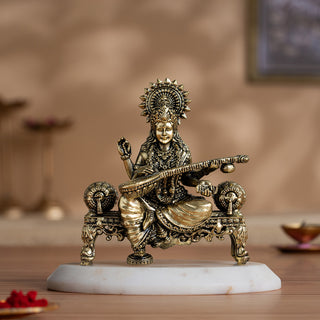
The day starts early and physically. An oil bath (abhyanga snana) before sunrise, then new clothes. The house is cleaned in the days before, the way it is before Navratri or Diwali, and the altar gets a proper going-over rather than a wipe. If you have brass or marble in the shrine, this is the week for it; cleaning a marble idol properly takes longer than people expect.
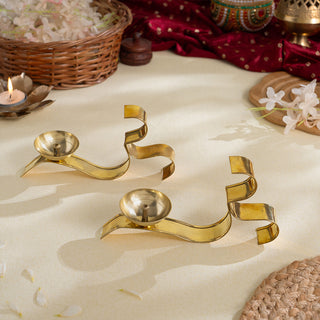
Then the doorway. Fresh mango leaves are strung into a toran and hung across the top of the front door, and a muggu or rangoli is drawn on the threshold in rice flour. Both are welcome-signals: the household telling the year, and anyone walking in, that it is being received properly. Some families also set out a pair of Lakshmi charan paduka facing inward at the entrance. Small brass footprints pointing toward the shrine are a very old way of saying come in. Where exactly to place them is a question in itself, and worth getting right.
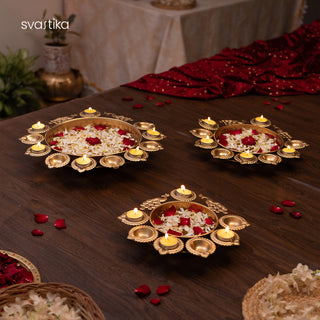
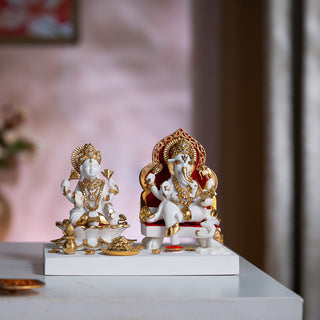
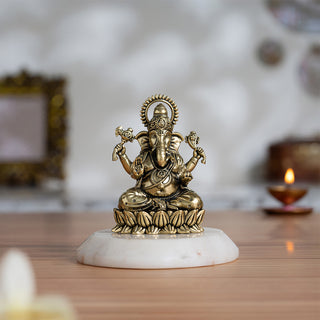
The puja is usually short and household-scale, not elaborate. Lamps lit, the pachadi offered first and then eaten, followed by the day's cooking: bobbatlu or holige, pulihora, and whatever the family has always made. If your shrine is being set up or reset for the year, the placement of the Ganesh and Lakshmi murtis and the general contents of the pooja room are worth thinking through once rather than every year.
In the evening, in many towns, comes kavi sammelanam: a gathering of poets. Verses composed for the new year, read aloud, sometimes competitively. A festival that opens with an almanac and closes with poetry is telling you something about what it values.

Why the bitter spoon still makes sense
Ugadi has been documented as a settled household festival for a long time. S.M. Natesa Sastri gave it a full chapter (Chapter XIX, "The Hindu New Year's Day") in Hindu Feasts, Fasts and Ceremonies in 1903, sitting alongside his chapters on Pongal, the Varalakshmi worship and Vinayaka Chaturthi.2 He was writing as a South Indian describing his own society's calendar, and he treated it as unremarkable. That is the best evidence there is that it was.
What has survived from all that is a single instruction that most of us receive once a year without thinking about it: eat the bitter thing first, in the same mouthful as the sweet one, and start.
Everything else about a new year is optional. The gifts, the lamps at the door, the new clothes, the sweets, those are the celebration. The pachadi is the argument. And it is a better argument than "new year, new me", because it does not ask you to expect a good year. It asks you to be ready for a whole one.
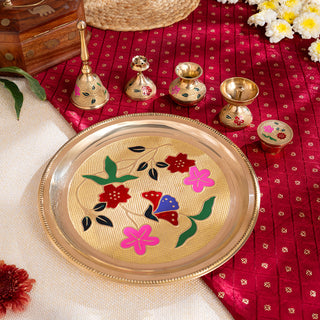
If you are setting up a shrine for the year ahead, or sending something to family for the day, the pooja essentials and new-year collections are built around exactly this kind of household use: the lamp, the thali, the murti that stays out all year and not just for one morning.
Also read: Why Gudi Padwa is Celebrated | Why We Celebrate Chaitra Navratri | Ram Navami: Date, Tithi and Rituals | Onam: Date, Significance and Rituals | Things to Keep in Your Pooja Room