Ask this online and you will get four confident answers about the Sudarshan Chakra. Shiva gave it. Vishwakarma made it. Surya's leftover light became it. Agni gifted it. Each is stated as if it were the only one.
All four accounts are real. They come from different texts written centuries apart, and most are not answering the same question. Two questions are hiding inside one.
Question one: how did Vishnu come to have the chakra? Question two: how did Krishna, living as a human being in the Mahabharata, come to have it in his hands?
The second question has a clean answer from a primary text. Start there.
The passage that settles it
The scene is the Khandava-daha Parva, in the first book of the Mahabharata. Agni has been suffering from indigestion, of all things, and needs to consume the Khandava forest to recover. Indra keeps putting the fire out with rain. So Agni asks Krishna and Arjuna to hold Indra off while he eats.
They agree, but they need weapons that can stand up to a god. Agni calls on Varuna, and the gifts are handed out:
वज्रनाभं ततश्चक्रं ददौ कृष्णाय पावकः।।
In plain English: Then Agni gave Krishna a discus whose hub was made of vajra, adamant.
Mahabharata, Adi Parva, Khandava-daha; critical edition 1.216.21
And a few lines later, from Varuna:
वरुणश्च ददौ तस्मै गदामशनिनिःस्वनाम्।दैत्यान्तकरणीं घोरां नाम्ना कौमोदकीं प्रभुः।।
In plain English: And Varuna gave him a mace that roared like a thunderbolt, terrible, an ender of daityas, called Kaumodaki.
Mahabharata, Adi Parva, Khandava-daha; critical edition 1.216.25
That is the whole answer. Agni gave the disc. Varuna gave the mace. In the same scene Arjuna receives the Gandiva bow, two quivers that never empty, and the chariot with the ape on its banner. It is one big gifting scene, which is why retellings shuffle the weapons between the two.
Two honest notes, because they matter more than a tidy answer.
First, the name Sudarshana is not in this verse. The Sanskrit says only chakram, a discus. Some manuscripts do add a line here calling it Sudarshana, but the Pune critical edition prints that line in its apparatus as a later insertion. The identification of Krishna's disc with the Sudarshana Chakra is made across the wider epic and by long tradition, and it is not seriously disputed. It is simply not in this sentence.
Second, a correction. The standard English Mahabharata (Kisari Mohan Ganguli, 1883 to 1896) renders this line as "a discus with an iron stick attached to a hole in the centre".1 An earlier version of this article repeated that as though it described the weapon. It does not. The Sanskrit is one compound word, vajranabham: the disc has a nave of vajra, adamant. There is no iron and no hole in the text. That phrase is Victorian English, not scripture.
Why the Khandava scene is the right place to look
The Mahabharata shows Krishna receiving weapons because here he is a person in the story, not a distant deity described from outside. He is a cousin, a diplomat, a charioteer. He has a body that gets tired and a life that ends. See what happened to Krishna's body after his death, another question the popular versions dodge.
A person in a story has to acquire things, so the epic shows him acquiring them. That is not a downgrade of his divinity. It is the epic keeping its own rules. The same instinct is why the Ram avatar is told with Rama not knowing he is Vishnu until Brahma tells him at the very end.
Compare how Vishnu's avatars are described in the Puranas, where the chakra simply is there, spinning on a finger, part of the god's description. Two modes of storytelling, two treatments of the same object.
So where did Vishnu get the chakra?
The texts do not agree. There are three main accounts of how Vishnu got the chakra. They grew up in different regions over centuries, so it is better to report them as three than to blend them.
1. Vishwakarma forged it, and Vishnu took it in battle
The Ramayana carries an account in which the divine architect Vishwakarma makes the disc, and Vishnu seizes it from a danava named Hayagriva on Mount Chakravana.2 A straightforward war story: the weapon existed, an asura had it, Vishnu took it.
2. It was cut from the sun's excess light
A Puranic account has Vishwakarma trimming down the unbearable brilliance of Surya, because his daughter (married to the sun) could not withstand it. The shavings of that light are shaped into three things: the Pushpaka Vimana, Shiva's trishula, and Vishnu's chakra. This is the version people find most beautiful, and it is also the one most often repeated without a source.
3. Shiva gave it to Vishnu
Shaiva Purana tradition has Vishnu worshipping Shiva with a thousand lotuses, finding himself one short, and offering his own eye in its place, for which Shiva grants him the discus. This story is real and loved, particularly in Shaiva lineages. It is worth reading alongside the debate over the most powerful god in Hinduism and who can defeat Shiva, because these narratives are partly about lineages honouring each other.
Notice what all three have in common: they are about Vishnu. Not one of them is about Krishna at Khandava.
Four things people get wrong about the Sudarshan Chakra
1. "Shiva gave Krishna the Sudarshan Chakra." This is the big one. The Shiva story is a genuine tradition, but it is about Vishnu receiving the disc, not Krishna. The Mahabharata, the text where Krishna actually gets his weapons, credits Agni. Merging the two silently is how a real tradition turns into a wrong fact.
2. "There is one origin story." There are at least three for Vishnu's chakra and one separate account for Krishna's. Sanskrit literature is not a single book with a single editor. The Puranas were composed in different regions across many centuries, and they disagree openly. Treating that as an embarrassment is the mistake; it is the most interesting thing about the material.
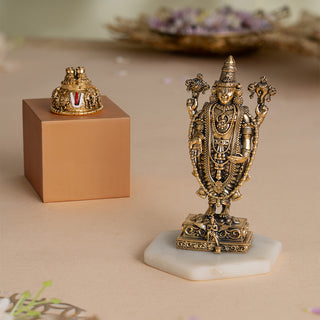
3. "The chakra is only a weapon." In household worship it works far more often as protection than as a weapon. Vaishnava practice treats the shankha and chakra as an emblem: stamped on temple pillars, painted on foreheads, cast into Balaji idols. A small Balaji charan with the shankha-chakra namam in someone's pooja room is the chakra doing its everyday job: standing at the door of a home, not spinning through a battlefield.
4. "Krishna barely used it." He uses it decisively, and the most famous use is against Shishupala, whose insults at the Rajasuya sacrifice run past the count Krishna had promised to forgive. The disc is not decorative in the epic. It is the thing that ends arguments.
What the chakra actually means
The word sudarshana breaks into su (good, auspicious) and darshana (sight, seeing). Good vision. A weapon named for clear seeing is a strange and brilliant thing.
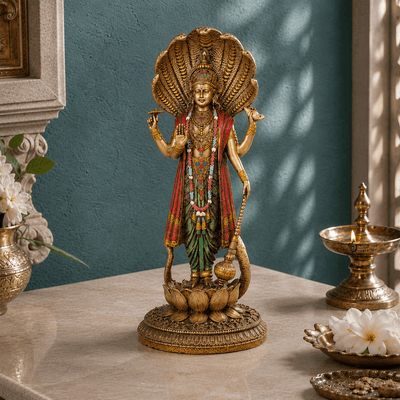
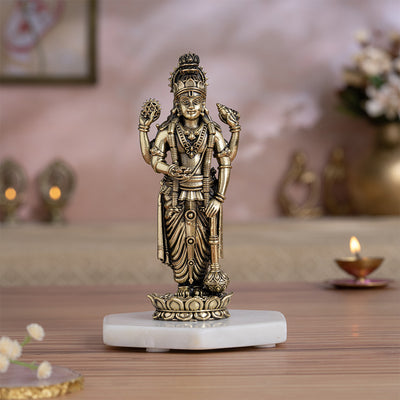
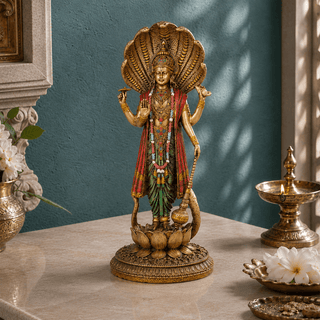
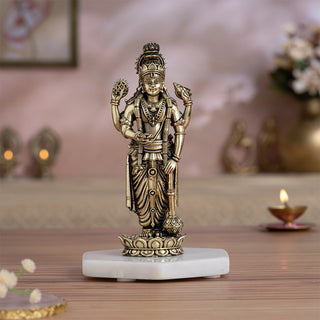
The shape carries its own meaning. A disc with a hole at the centre is a wheel: the wheel of time, the turning year, the cycle a soul moves through. In iconography Vishnu holds four objects: the shankha (conch, sound), the chakra (disc, mind or time), the gada (mace, strength), and the padma (lotus, purity). The chakra is normally in the upper right hand, and on the standing Vishnu murtis in most homes it is the first thing your eye lands on.
An old reading, carried in several Vaishnava commentaries, makes the chakra the mind: the fastest thing there is, back at its source the instant it is released. That explains why the weapon is named for seeing rather than for cutting.

When the chakra is given to a devotee: Ambarisha
Vishnu once gave the Sudarshana Chakra to a devotee as a guard. King Ambarisha was so steady in his devotion that the disc was assigned to protect him. When the sage Durvasa, angry over a broken fast, sent a demon against the king, the chakra destroyed it. Then it chased Durvasa across the worlds until he came back and asked Ambarisha for pardon. Ambarisha belongs to the same devotional literature as Prahlada and Dhruva, the material we looked at when asking who Vishnu's first devotee really was.
That episode is why the chakra shows up on doorframes and lockets and dashboard idols. In household devotion it is not the weapon that killed Shishupala. It is the thing that stands watch.
The short version, if someone asks you
Krishna got the disc from Agni, after Khandava, along with the Kaumodaki mace from Varuna (Mahabharata, Adi Parva). Vishnu's own chakra has at least three origin stories, and the texts do not settle between them. The Shiva version is real, but it belongs to the first question, not the second.
This pattern, one popular answer covering a much more interesting disagreement, repeats across the Vishnu material. The oldest flood story behind Matsya does not involve Vishnu at all. The churning that gives us Kurma also produces Mohini, whom the Bhagavata counts as a separate avatar.3 Brahma did not make a mistake in Hiranyakashipu's boon. And Bali, in the Vamana story, is rewarded rather than punished.7
The Varaha story even has an explanation for why a boar, of all animals: the Vishnu Purana reads the boar as the Vedic sacrifice in bodily form.8 Almost nobody mentions it.
If reading this has made you want a Vishnu or Krishna murti for your own shrine, start with whether a standing Vishnu idol can be kept at home (short answer: yes, and no text says otherwise), and how to decorate a Krishna idol at home. For the Balaji form specifically, where the chakra is most visible, there is the story of Lord Balaji.
Also read: The 10 Avatars of Vishnu | Where is Krishna's Flute Now | Who is Lord Vishnu's First Devotee | Krishna and Sudama | How to Worship Lord Krishna