The invitation says Ritu Kala Samskara across the top and half saree function in brackets underneath, and you cannot tell whether that is one event or two.
It is one. So are voni function, pavadai thavani, manjal neerattu vizha and ritusuddhi.

What the words actually mean
None of these names is a euphemism. Each one describes either the clothes or the bath.
| Language | What families say | What the words mean |
|---|---|---|
| Telugu | Langa voni · voni function · pedda manishi pandaga | langa, a woman's skirt · voni, the half saree itself · pedda manishi, a grown person |
| Tamil | Manjal neerattu vizha · pavadai thavani · poopunitha neerattu vizha | manjal, turmeric · neerattu, bathing · vizha, festival · pavadai, skirt · thavani, a cloth worn by girls |
| Kannada | Ritusuddhi · langa davani | ritu, the monthly cycle · suddhi, purification |
| Sanskrit, on invitations | Ritu Kala Samskara | ritu, the cycle · kala, time · samskara, a rite that marks a passage |
| Malayalam | Thirandu kalyanam · thirandu kuli | thirandu, come of age · kuli, bathing |
| Indian English | Half saree function · puberty function · maturity function | names the garment, or names the event outright |
Telugu
Gwynn's Telugu-English dictionary defines ōṇī without any fuss at all: "half sari, a dress worn by girls on attaining puberty before they begin to wear a full sari."2 The garment is named for the moment it belongs to.
The other Telugu name is the warmer one. Pedda manishi pandaga is the festival of becoming a grown person, and the same dictionary lists peddamanishi as both "gentleman" and "a girl who has attained puberty."2
Tamil
The bath the Tamil name describes is the main event of the day, not a step inside a longer one.

You will also see poopunitha neerattu vizha on Tamil cards. In the University of Madras Tamil Lexicon, pūppu carries two meanings at once: flowering, and menstruation.3 The same lexicon glosses thavani as a cloth worn by girls and pavadai as a skirt, so pavadai thavani is simply the outfit, the way langa voni is.
Kannada and Sanskrit
Ritusuddhi and ritu kala samskara share the word ritu, which Apte's Practical Sanskrit-English Dictionary gives as a season of the year and also as a woman's monthly cycle; the same dictionary gives suddhi as cleanness and as a purificatory rite.4
Worth being honest about the purification framing: it is the older reading, it treats the day as something to be cleansed, and a lot of families are no longer comfortable with it. That is part of why plain "half saree function" has quietly become the default name even in Kannada and Telugu homes that have their own word for it.
Hindi, Marathi and Urdu
There is no name, and that is the answer. Most Hindi-speaking families do not hold this ceremony, so Hindi never needed a word for it. Marathi families usually mark a first period quietly at home, with sweets and elders' blessings rather than a hall and a guest list. Urdu has the vocabulary for maturity but no ceremony attached to it, though Hyderabadi families know the day well from their Telugu neighbours.
Malayalam and Odia
Kerala had this ceremony and then largely gave it up. It was called thirandu kalyanam or thirandu kuli, and Gundert's 1872 Malayalam and English Dictionary already lists both compounds, under a root it glosses as "becoming full, first menstruation" and "to grow marriageable", with kuḷi as bathing.6
Kerala Tourism's own account of Sree Narayana Guru's reforms records why he asked communities to drop it: the rituals were expensive for poor families, and the day "turned a private moment of a girl's physical and mental change into a public celebration, thus destroying their privacy."5 That objection is a century old and still the sharpest thing anyone has said about the day.
Odisha has no personal ceremony of this kind. What it has is Raja, a three-day festival every June built on the belief that the earth herself menstruates: ploughing and digging stop, and unmarried girls are the centre of it.
Is it in the scriptures?
No, and anyone telling you otherwise is decorating.
The classical list of sixteen samskaras (the household ritual manuals, tidied into a fixed count by the later smriti texts) has no coming-of-age rite for girls in it. Naming the baby, the first feeding, the first haircut, the start of formal study, the upanayanam thread ceremony for boys, marriage, the last rites: those are on the list. This one is not. In those texts a girl's passage into adulthood is handled through marriage customs instead.
Two things complicate that, and it is better to hear them here than to be corrected later. The number sixteen is a tidy figure rather than a fixed one: the manuals themselves range between twelve and eighteen, and Gautama's older reckoning counts forty. Some popular modern lists also fold ritusuddhi in alongside keshanta, the first shaving, which is why a search will sometimes return it as one of the sixteen. Neither point rescues the claim that the day is scriptural. No household manual prescribes it.
What does survive in the sources is the household version. Hinduism Today's Rites of Passage describes ritu kala as a home ceremony acknowledging a girl's first menses, at which new clothing, jewellery and her first sari are given.1 That is exactly how families still run it, and it is a description of practice rather than a prescription from a text.
Practically, this means nobody can quote a verse at you. If your family holds it on the third day and your cousins hold it three months later, both are correct.
What age is the half saree function?
Usually eleven to fourteen. It follows the girl's first period, so there is no calendar date to work backwards from.
Families rarely hold it the same week either. They wait for a muhurat that suits the household, the school calendar and everyone's travel, which routinely pushes the function two or three months out. Plenty of urban families now let the two come far apart, hold the function on whatever date suits everyone, and treat it as a celebration rather than a marking of the day itself.
A langa voni on a small girl is just clothes
The langa voni is also ordinary festive wear. Little girls wear pattu langa to weddings and to temple from about two years old, and that has nothing to do with any ceremony. One bought for a nine-year-old is an outfit, and nothing has to be arranged around it.
The function itself cannot be held before the first period, by definition. What some families do is hold it late and quietly, as a party where the reason is understood and not announced. That is a different thing from holding it early, and it is becoming the more common choice.
What actually happens on the day

There is no single procedure, and anyone publishing one as fixed is guessing on your behalf. What is common across most communities:
- The bath. Turmeric water poured over the girl, usually by married women of the family, from a brass pot or urli.
- The new clothes. She changes into the langa voni afterwards and wears it for the rest of the day. This is the moment the whole function is named for.
- The lamp and the blessing. A lit lamp, arti, and elders putting kumkum and rice on her head.
- The maternal uncle's tray. In Tamil Nadu this is the seer varisai or thattu varisai, a tray of clothes, bangles, fruit and sweets brought by the girl's mother's family. Telugu families do the same thing without the name.
- The reception. A hall or a decorated hall-sized front room, a photographer, a meal, and forty to two hundred people.
A function that began as a home bath is now often run like a small wedding, with an event manager and a stage backdrop. If you have been to a godh bharai or seemantham, the shape of the day will feel familiar.
Half saree, lehenga and saree are three different things

A half saree is a long skirt, a fitted blouse, and a short drape worn diagonally across the torso and pinned at the shoulder. Less cloth than a saree, draped in the same direction.
A lehenga is North Indian: skirt, blouse and dupatta, with the dupatta worn loose rather than pleated over one shoulder, and a fuller silhouette. A Kanchipuram langa voni and a Delhi lehenga are not interchangeable, whatever a marketplace listing says.
A saree is a single unstitched length, several metres of it. That is the point of the sequence, and the ceremony exists to mark the move, with the half saree as the step between.
If you have been invited
Do not buy a saree. That gift belongs to the girl's maternal uncle, and it is the one present everybody notices.
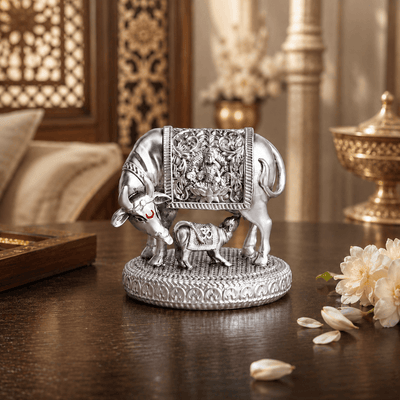
Bring something small she keeps instead: a plated Balaji, Lakshmi or Murugan idol, a charan paduka such as Lakshmi's, a Kamdhenu cow with her calf, or a pocket temple that folds shut and goes to a hostel with her in four years.
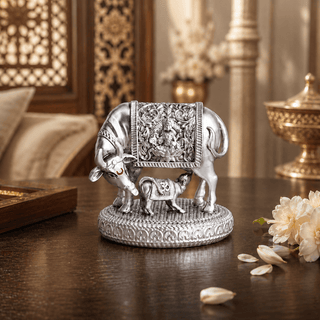

Who gives what, what not to give, and how the budget changes with how close you are: that is all in our half saree function gift guide.
When there is a dhoti function on the same card
Families frequently put a girl's half saree function and a boy's dhoti function on one muhurat, usually siblings or cousins. If both names are printed you are attending two ceremonies and you owe two gifts, and the boy's side runs quite differently.
Everything we keep for the girl's side sits under gifts for a half saree function.
Also read: Half Saree Function Gifts | Godh Bharai, Seemantham and Valaikappu | Return Gifts for a Naming Ceremony | Who Is Balaji? | Where to Place a Charan Paduka | Varalakshmi Pooja Return Gifts