Search for godh bharai and you will be told, with great confidence, that it is held in the seventh month because the scriptures say so. The scriptures are available, they have been translated for well over a century, and they do not say so. What they say is more interesting.
This is what the primary texts actually contain: which month each one names, what the rite was for, what was physically used, and where the bangles came from, because the bangles, the part everyone recognises, are the newest thing in the ceremony.
Godh bharai, seemantham, valaikappu: three names for one rite
The ceremony travels under a different name in nearly every language, and each name describes a different moment of the same afternoon.
- Godh bharai (Hindi, and across the north): literally filling the lap. Godh is the lap; bharai is the filling. The mother sits, and the women of the family pile her lap with fruit, dry fruit, sweets, rice and a coconut.
- Seemantham or simantam (Telugu and Tamil usage, written సీమంతం in Telugu): a straight shortening of the Sanskrit simantonnayana, and the answer if you are asking what godh bharai is called in Telugu. The only regional name that keeps the classical word.
- Valaikappu (Tamil, வளைகாப்பு): valai, bangle, and kappu, guard or protection. The bangle-guard.
- Dohale jevan (Marathi): the meal of the cravings. This one has a medical text behind it, which we come to below.
Four names, four different ideas about what the day is: a lap being filled, a hair-parting, a protective bangle, a meal. All four are describing gatherings that a Sanskritist would file under the same heading.
The same fragmentation happens to the two coming-of-age ceremonies further along a family’s calendar. A girl’s day answers to langa voni, manjal neerattu vizha and ritusuddhi depending on the state (we took those apart in what the half saree function actually means), and a boy’s runs under panchala function, poonal and janeu, which is the subject of what the dhoti function is.
What simantonnayana actually means
Simanta is the parting of the hair. Unnayana is a drawing or leading upward. The rite is named for its central physical act: the husband draws his wife’s hair upward from the forehead, parting it, while reciting verses.4
It sits third in the standard list of prenatal samskaras, after garbhadhana, the rite of conception, and pumsavana, the rite performed early in pregnancy. Those three are a sequence, and they are routinely confused with one another, including in the matter of which tree belongs to which.3
Which month? Seven texts, and they do not agree
Here is the whole disagreement in one table. Each of these is a Grihya Sutra, a manual of domestic ritual belonging to a particular Vedic school, or a smriti of comparable authority.
| Text | Month of pregnancy prescribed |
|---|---|
| Ashvalayana Grihya Sutra I.14.1 | Fourth |
| Apastamba Grihya Sutra 14.1 | Fourth |
| Hiranyakesin Grihya Sutra II.1.2 | Fourth |
| Khadira Grihya Sutra II.2.24 | Fourth or sixth |
| Gobhila Grihya Sutra II.7.2 | Fourth, sixth or eighth |
| Paraskara Grihya Sutra I.15.3 | Sixth or eighth |
| Yajnavalkya Smriti I.11 | Sixth or eighth |
| Shankhayana Grihya Sutra I.22.1 | Seventh |
Read down that column. The fourth month is the plurality answer. The window runs fourth to eighth. The seventh month, the month on which the entire modern practice rests, is named by exactly one text out of eight. The ninth month, which some families now use, is named by none of them.12
A note on one row. P. V. Kane and Hermann Oldenberg do not read Gobhila and Khadira the same way; the months each scholar assigns to those two texts are swapped between them. The printed Sanskrit of the Khadira passage, athasyai chaturthe masi shashthe va simantonnayanam, “in her fourth month or sixth, the simantonnayana”, supports Oldenberg, which is the reading followed in the table above.23
Manu lists the prenatal rites, but does not name this one
Manu is the authority most often invoked in discussions of the samskaras, so it is worth being precise about what he does and does not say. The relevant verse, Manu II.27, prescribes the rites to be performed before and around birth, but it refers to them collectively and does not use the word simantonnayana. In Georg Bühler’s translation the name appears in a footnote, supplied from the commentators rather than from the verse itself.7
That is a small point, and it does not change anything about the rite. It is worth making only because “Manu says” gets attached to a great many specifics that Manu does not in fact state. The detailed instructions for this ceremony (the month, the branch, the words, the order) come from the Grihya Sutras. Manu’s contribution is to confirm that a rite of this kind belonged in the sequence at all.
So why does everyone hold it in the seventh month?
The honest answer is that no classical text explains the shift, and we should not pretend one does.
What can be said is this. Shankhayana is a real, ancient authority, and a single sutra is enough to license a practice. The seventh month is also the point at which a pregnancy is unmistakably visible and, by pre-modern reckoning, established enough to celebrate, a consideration that would have mattered a great deal more when it was written than the calendar of any one school. And in much of India the ceremony now doubles as a send-off, held shortly before the mother leaves for her parents’ house for the delivery, which fixes it late rather than early.
Those are plausible reasons. They are not textual ones. If a source tells you the seventh month is scripturally prescribed, it is quoting one sutra out of eight and leaving out the rest.
The rite was performed on the mother, and only once
This is the finding most likely to be useful to an actual family, and it is the one almost never mentioned.
In the classical scheme, simantonnayana is a samskara of the woman, not of the foetus. The commentators are explicit about the consequence. Vishvarupa, the Mitakshara and Devala all hold that a woman, once consecrated by the rite, remains consecrated: as the position is summarised in Kane, a woman once properly consecrated is to be deemed consecrated for all subsequent conceptions.3
The rite was therefore performed once in a lifetime, at the first pregnancy, and not repeated. Raj Bali Pandey reaches the same conclusion in his survey of the samskaras.4
Modern practice has reversed this exactly. Today a second and third pregnancy each get their own godh bharai, and the ceremony is understood as being for the baby. Neither of those is wrong, since living tradition is allowed to move, but the reversal is worth knowing about, particularly if you have been told that a repeat ceremony is somehow required.
Dauhrida: the two-hearted woman, and why the food matters
The Sushruta Samhita, the classical surgical and obstetric compendium, gives the fourth month a specific significance. At that stage, it says, the foetus acquires consciousness, and from that point the mother is called dauhrida, the two-hearted woman, because two hearts now beat in one body and two sets of desires now speak through one mouth.5
Sushruta’s instruction that follows is clinical, not sentimental: the cravings of a dauhrida woman must be satisfied, and a pregnancy in which they are denied is held to harm the child.
Monier-Williams gives the related noun, dohada or dohala, precisely this sense: the morbid longing of a pregnant woman.6 Follow that word into Marathi and it arrives, barely changed, as dohale. Which is how the Marathi ceremony got its name: dohale jevan, the meal of the cravings.
So the part of the modern ceremony that looks most like a party, feeding the mother whatever she has been wanting for months in front of everyone, is not a later, softer addition. It is the oldest medical logic in the whole observance. It also explains why so many sutras place the rite in the fourth month: that is when dauhrida begins.
What the classical rite actually used, and it was not bangles

The Grihya Sutras are specific about equipment, and none of it is what you would find at a godh bharai today. The husband parts the hair using a branch of the udumbara (Ficus racemosa, the cluster fig) bearing an odd number of unripe fruit. Alongside it the texts variously name darbha grass, a porcupine quill with three white spots, and a full spindle. A fire offering is made. In several versions a lute-player sings, and the mother is fed rice cooked with sesame.124
Bangles appear in none of the seven sutras. They are absent from Kane’s survey of the rite and from Pandey’s. Whatever the bangles are, they did not come from here.34
One correction worth making while we are here, because it circulates widely: the banyan is not the tree of this ceremony. The banyan shoot belongs to pumsavana, the earlier rite. The tree of simantonnayana is the fig.4
Where the bangles came from

Valaikappu is a living regional tradition, principally Tamil, and it should be described as what it is rather than dressed up in sutra numbers it does not have. The bangles are its whole point: the name means bangle-guard, and the reasoning given for them is sound. Glass bangles make a continuous, light sound as the mother moves, and that sound is held to reach the child and to keep her company through the last months. Married women of the family slide them on, wrist to elbow; red and green predominate; the count is usually kept odd.
None of that is in a Grihya Sutra, and it does not need to be. It is documented custom with a coherent internal logic, which is a perfectly respectable thing for a tradition to be. What it is not is ancient scriptural prescription, and the sources that claim otherwise are the same ones that will tell you the seventh month is mandatory.
How the four ceremonies differ in practice
Because they share an ancestor, the four are often treated as interchangeable, and in a great many families they now are. But each has kept a signature element, and knowing which is which is useful if you are attending one rather than reading about it.
| Name | Where | What the name means | Signature element |
|---|---|---|---|
| Godh bharai | North India, Hindi belt | Filling the lap | The lap heaped with coconut, fruit, dry fruit and sweets |
| Seemantham | Andhra, Telangana, Tamil Nadu | From simantonnayana, the hair-parting | Closest to the classical form; often includes a fire offering and the hair-parting itself |
| Valaikappu | Tamil Nadu | Bangle-guard | Glass bangles slid on from wrist to elbow by married women |
| Dohale jevan | Maharashtra | The meal of the cravings | The feast, built around what the mother has actually been craving |
These are tendencies rather than rules, and a single family may do all four things in one afternoon: part the hair, fill the lap, put on bangles and then serve the meal. The one that has travelled furthest from its home region is valaikappu: the bangles now appear at godh bharai ceremonies well outside Tamil Nadu, largely because they photograph beautifully, which is as good a reason as any for a custom to spread.
What actually happens at a godh bharai today
The order varies by community, and the following is a common north Indian sequence rather than a universal one. A Tamil valaikappu or a Telugu seemantham will differ in emphasis, and a family’s own practice outranks any list.
- A muhurat is fixed, and the mother is seated, usually facing east, usually on a decorated low seat.
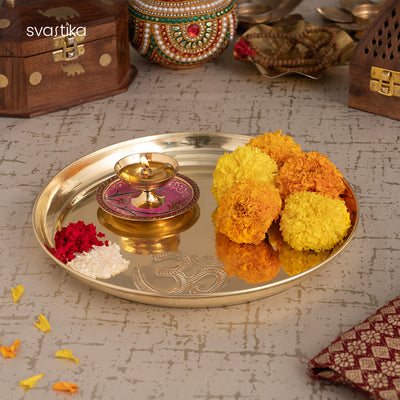
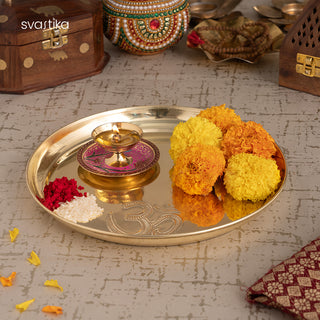
- Married women perform aarti and apply haldi and kumkum. This is the point at which a proper thali earns its place; a plain brass one with a diya does more work here than anything decorative. Handpicked for this story 1 piece
- Bangles are put on, wrist upward: the valaikappu element, which has spread well beyond Tamil Nadu.
- The lap is filled: coconut, seasonal fruit, dry fruit, sweets, rice, and usually a blouse piece or saree.
- The meal, and specifically her cravings, cooked deliberately. This is the dohale element, and it is the oldest part of the day.
- Gifts are given to the mother.
- In much of the south, the mother leaves afterwards for her parents’ home, where she will stay through the delivery.
What to give, if you follow the texts
The classical logic points somewhere very specific: the rite is performed on the mother, so the gift belongs to the mother. Not to the nursery, and not to a child who does not yet exist. Something she keeps afterwards, on her own shelf, is closer to the original sense of the day than anything that will be outgrown in a year.
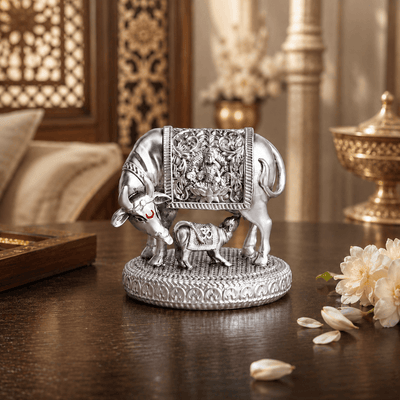
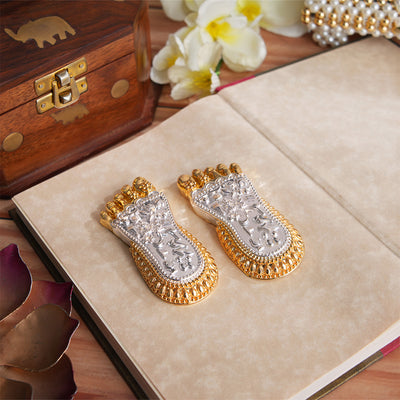
Two that sit naturally with the occasion: the cow-and-calf because it is the oldest mother-and-child image in the tradition, and the charan paduka because it is given for the prosperity of a household about to grow:
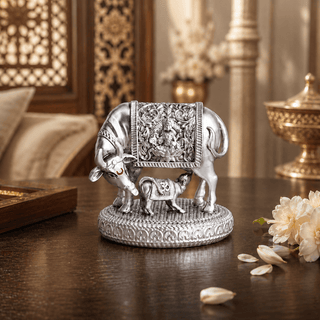

More along the same lines in our baby shower gifts for the mother. If the Kamdhenu is new to you, we have written separately on what the Kamdhenu cow actually is and on whether to keep one at home. For ceremonies of the same kind, see our guide to house warming ceremony gifts, and for another women’s rite whose date is fixed by tithi rather than convenience, Kajari Teej.
What is worth remembering
The ceremony is older than the seventh month, older than the bangles, and was originally about the woman rather than the baby. The one element that has survived intact from the classical texts to the present day is the food: feeding a dauhrida woman exactly what she has been craving, because a text written two thousand years ago said that mattered.
Also read: Best Return Gifts for a Baby Shower | Best Return Gifts for a Naming Ceremony | Half Saree Function Meaning | What Is the Dhoti Function? | Kajari Teej: Katha, Rituals and Tithi
Cover image: Reclining Woman by Raja Ravi Varma, 1908. Public domain, via Wikimedia Commons.