The short answer, and why almost nobody gives it
None of the placement rules come from a text. They come from a century of home advice that borrowed a very old word. Search this question and you get a hundred pages telling you which corner of which room, facing which direction, on which day.
The honest version: keeping a Kamdhenu cow idol at home is fine. No rule against it, no consecration to arrange, no direction to get wrong. What there also isn't is a scriptural instruction to keep one. That absence just changes why you would.
And the real reason is better than the sales pitch. Read what the wish-fulfilling cow actually does in the texts and the object on your shelf stops being a prosperity device.
What the wish-fulfilling cow actually gives
The most detailed wish-cow episode in Indian literature is in the Mahabharata's Adi Parva, and it is not about wealth. Sage Vasishtha has a cow. King Vishvamitra arrives at his hermitage with an army, and Vasishtha wants to feed them all.
The Sanskrit puts it plainly:
तस्याथ कामधुग् धेनुर् वसिष्ठस्य महात्मनः । उक्ता कामान् प्रयच्छेति सा कामान् दुदुहे ततः ॥
In plain English: The great sage Vasishtha had a cow who milked out wishes. Told "grant what is wanted," she gave whatever was asked.
Mahabharata, Adi Parva 1.165.9
And what did she yield?
ग्राम्यारण्या ओषधीश् च दुदुहे पय एव च । षड्रसं चामृतरसं रसायनम् अनुत्तमम् ॥
In plain English: She milked out plants of field and forest, and milk, and a nectar-like elixir of six flavours, the finest tonic there is.
Mahabharata, Adi Parva 1.165.10
Gems and robes turn up only in extra lines some manuscripts add.1
Read that again. The famous wish-fulfilling cow's headline miracle is dinner. Enough food to feed an entire visiting army, produced so a host could look after his guests properly. Not a windfall. Hospitality.
That is a different idea from the one the internet sells. It is also a much better reason to keep a Kamdhenu cow idol in a house where people eat together. If you are reading up on what the Kamdhenu cow actually is, that article goes deeper into the naming problem.
Where did she come from? Not where the translations say
Everyone tells you Kamadhenu emerged from the churning of the ocean. The Bhagavata Purana does say so: the yielder of the sacrificial offering, whom commentators identify as Surabhi the cow of plenty, is the first thing up out of the water (8.8.1).
An earlier version of this article said the Mahabharata flatly contradicts that, because the English translations list no cow. We checked the Sanskrit, and we were wrong. The vulgate has her:
पारिजातश्च तत्रैव सुरभिश्च महामुने। जज्ञाते तौ तदा ब्रह्मन्सर्वकामफलप्रदौ।।
In plain English: And the Parijata tree and Surabhi appeared there too, great sage. Those two were born then, and they grant every wish.
Mahabharata, Adi Parva 1.18.51 (vulgate)
The line after adds kapila, the tawny cow. Both sit in the manuscript apparatus rather than the text modern critical editors settled on, which is why Ganguli's English has no cow.2 The texts were not disagreeing. An editorial judgement became, in translation, a contradiction that was never there.
For the fuller story of that event, the Kurma avatar is where it sits, one of the ten avatars of Vishnu people know by name but rarely by story.
The naming is subtler too. The Mahabharata calls Vasishtha's cow kamadhuk, the wish-milker, at 1.165.9, and names her Nandini at 1.165.16. Kamadhenu is the job description. Nandini is the individual.
Does any text say to keep a cow idol at home?
No. And this is worth being direct about, because the rest of what follows only means something if this part is honest.
The place where the Bhagavata Purana talks most about cows is Canto 10, Chapter 24: the Govardhan episode, where Krishna argues with the villagers about who they should actually be worshipping. His teaching there is strikingly practical. Cow protection is named as a standing occupational duty (10.24.21), and then, in the middle of describing the worship itself, comes this instruction: "grass must be given to the cows and the mountain should be presented offerings" (10.24.28).
Grass. Given to actual cows. As part of the worship, not as a preliminary to it.
That is the textual centre of cow reverence in Hinduism, and it is about animals that eat and need looking after. An idol is not a substitute for that. What an idol can be is a reminder of it, and reminders are not a small thing. Most of us need them daily. If you like the reasoning here, the same honesty problem runs through most Vastu decor advice, where twentieth-century interior tips wear a very old name.
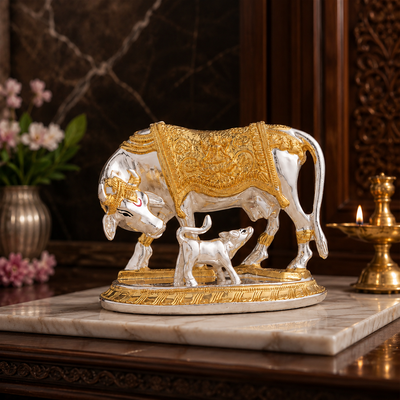
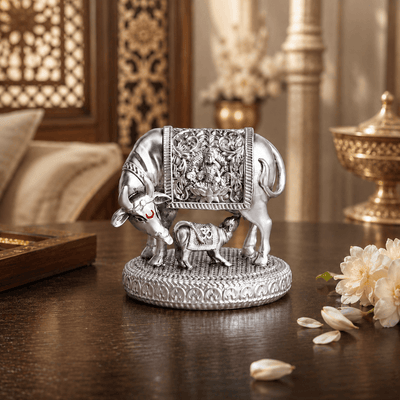
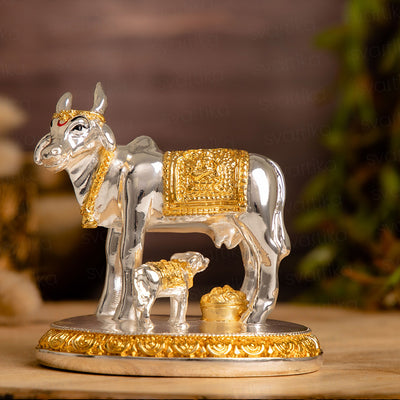
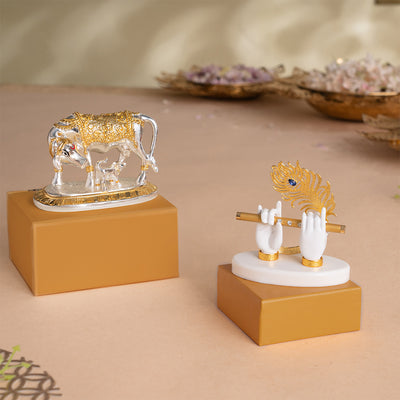
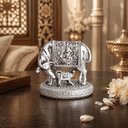
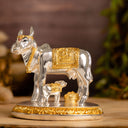
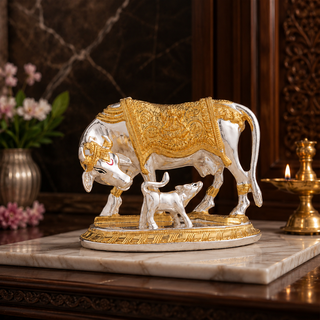
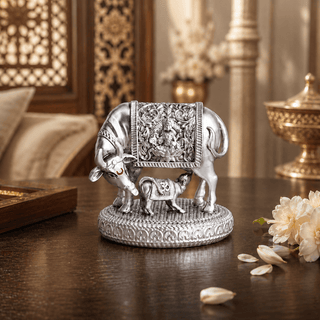
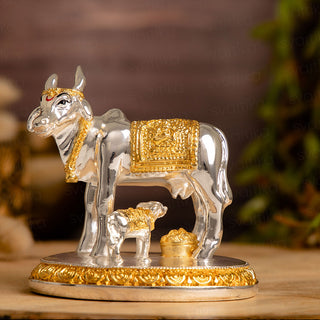
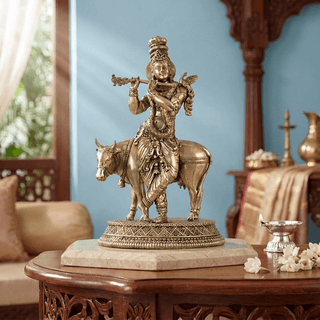
Notice too that almost every Kamdhenu idol shows the cow with her calf. That detail is doing real work. It is the same picture the Mahabharata paints: abundance that exists because something is being fed and cared for. A Kamdhenu cow with her calf reads as a household that has enough to share, which is the actual scriptural idea.
Three things people get wrong about the Kamdhenu cow
1. "The Mahabharata has no cow in the churning." We published this and it was wrong. The English omits her; the Sanskrit does not. Surabhi and kapila both appear at Adi Parva 1.18.51 and 1.18.52 in the vulgate, as lines critical editors treat as later additions. Read the translation and the texts look opposed. Read the manuscripts and they agree.
2. "Kamdhenu is the cow Vishvamitra tried to take from Vasishtha." Her name there is Nandini, and the Ramayana's parallel calls her Shabala. But the same passage also calls her kamadhuk.1 Three cows, one job description, and the epic applies it as freely as we do.
3. "Keeping a Kamdhenu statue brings wealth, according to scripture." This is the one that shows up in almost every product description, and it has no source. No text consulted here prescribes a cow image in a dwelling, and the cow teaching that does exist is about grass and upkeep. It is a lovely object with a real idea behind it. It is not a machine.
The same pattern repeats across this whole category. The seven running horses rule is modern decor convention with Vastu language stuck on afterwards. The crystal-is-strongest Shree Yantra ranking does not appear in the Saundarya Lahari, the text that made the yantra famous.7 And the charan paduka direction rule is domestic custom too: real, warm, widely kept, just not scripture.
So where should you actually put it?
Somewhere clean, somewhere you will see it, somewhere it will not be knocked over or stepped past. That is the whole list, and I would rather give you a short honest one than a long invented one.
If you want a directional rule that does come from a text, there is exactly one, and it points the other way from what you expect. The Bhagavata's chapter on deity worship says to lay the seat with kusha grass pointing east and then to sit facing east or north, or simply to face the deity, whichever way it happens to be (11.27.19). The instruction governs the worshipper, not the image. Nearly every idol-facing rule you have read reverses that.
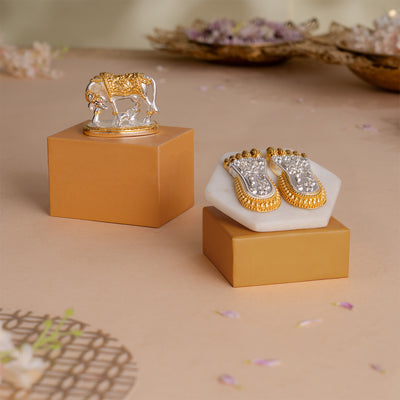
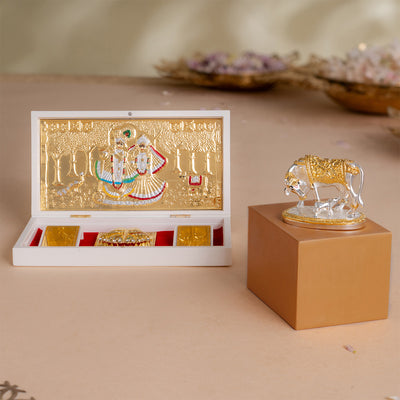
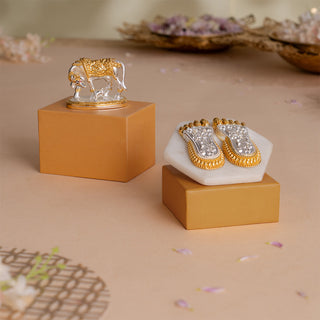
In practice, people place a Kamdhenu cow in the pooja room, on an entrance console, or on a study or office desk. All three are fine. If it lives in your pooja room, it usually sits alongside a Lakshmi murti or a pair of charan padukas, which is why so many households buy the two together around Diwali Lakshmi Puja. That pairing is custom, and good custom, just don't let anyone tell you a verse demanded it. The same logic applies to the Ganesh and Lakshmi arrangement people ask about constantly.
Does the material matter?
Less than the market would like you to believe.
The Bhagavata lists eight legitimate materials for a sacred image: stone, wood, metal, a smearable substance such as clay, painted, sand, jewels, and an image held purely in the mind (11.27.12). Sand and a mental image sit in the same sentence as stone and gems. There is no hierarchy in that list. The ranking of marble over brass over resin is a shop's idea, not a text's.
The same chapter draws a distinction that quietly solves a lot of anxiety. Images come in two classes: the moved and the not-moved. Only the formally installed image is bound to stay where it is: "the installed deity is for His worship not taken away or again brought forward" (11.27.13). A home murti you bought and placed yourself is a portable image by design. You can move it, shift it to another shelf, pack it when you relocate. That is also why car dashboard idols are not a compromise: portability is a category the tradition already had.
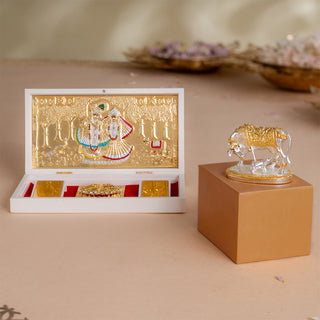
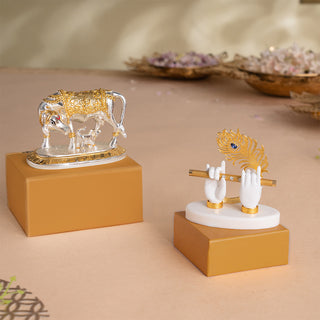
So choose by weight, finish, and how it will look in the light you actually have. Gold and silver plated pieces hold detail beautifully and stay bright with almost no effort. If you prefer stone, marble has its own cleaning routine worth knowing before you buy.
Looking after it
Dust it. That is genuinely most of it.
Plated pieces want a dry soft cloth and nothing wet sitting on them. Keep it away from the spot where oil from a diya spits, because plating and lamp oil do not get along over years. If it sits beside a shankh or on a chowki, wipe the base occasionally too, that is where residue collects.
None of this is ritual. It is respect expressed as maintenance, which is the version of respect that actually shows. And it lines up neatly with the Govardhan teaching: the tradition kept asking people to feed the cow, not to admire the picture of one.
The bottom line
Keep it. Keep it because the wish-cow of the Mahabharata fed an army so a host would not be embarrassed. Keep it because the cow with her calf is a picture of a house with enough. Keep it because you like it, which is a perfectly good reason and does not need a verse behind it.
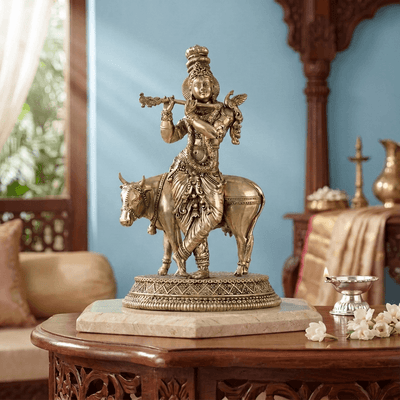
Just don't keep it as a lucky object, and don't let anyone tell you it stops working if it faces the wrong way. The Bhagavata's Krishna, who spent a whole chapter arguing about misplaced worship, would probably have had something to say about that. If you want the practice side, how to worship Krishna and how to decorate a Krishna idol at home are both good places to go next, and the Vastu collection is worth browsing with all of the above in mind.
The texts are less bossy than the internet. That is usually good news.
Also read: What is Kamdhenu Cow: The Story of the Sacred Cow | Can We Keep Horse Statues at Home | Things to Keep in the Pooja Room | Where to Place Laxmi Charan Paduka at Home | Can We Keep a Shiva Statue at Home