Ask almost anyone how many avatars Vishnu has and you get one answer: ten. Temple walls, calendars, school textbooks. Dashavatara: ten descents in order, ending with a horseman who has not arrived yet.
Now open the Bhagavata Purana, the text people quote most often when they discuss avatars at all. Canto 1, Chapter 3 starts listing the Lord's descents and does not stop at ten. It names twenty-two, from the four Kumaras to Kalki. Then at verse 1.3.26 it does something stranger: it says the incarnations are innumerable, "like rivulets from inexhaustible sources."
So the number is not 10. The tradition knows it is not 10. And 10 is still the list everyone learns.
The 10 avatars of Vishnu, in order
- Matsya — the fish. Satya Yuga.
- Kurma — the tortoise. Satya Yuga.
- Varaha — the boar. Satya Yuga.
- Narasimha — the man-lion. Satya Yuga.
- Vamana — the dwarf. Treta Yuga.
- Parashurama — the axe-bearing brahmana. Treta Yuga.
- Rama — the prince of Ayodhya. Treta Yuga.
- Krishna — the cowherd and charioteer. Dvapara Yuga.
- Buddha — the teacher. Kali Yuga. Some lineages put Balarama here instead — and where he appears in a ten, he is the eighth, not the ninth.
- Kalki — the rider still to come. End of Kali Yuga.
The yuga column is the conventional mapping rather than a single scriptural table, and the tenth slot is genuinely contested. Both points are taken up below. Each avatar is then covered in order, with the verse references.

1. Matsya, the fish. A deluge is coming. The fish tells King Satyavrata to load a boat with the seven sages and the seeds of all life, then tows it through the flood, lashed to his horn with the serpent Vasuki as rope (Bhagavata 8.24.45). The detail nobody mentions: while the world drowns, Matsya spends the crossing teaching sankhya-yoga to the king and the sages (8.24.54–56). Fuller version in our piece on the Matsya avatar.

2. Kurma, the tortoise. The gods and asuras need to churn the ocean of milk, and Mount Mandara keeps sinking. Vishnu becomes a tortoise and takes the mountain on his back. The Bhagavata gives his size as a lakh of yojanas (an island, not an animal) then adds the line that makes the story: as the mountain grinds and rotates on his shell, he feels it as a pleasant scratching (8.7.10). More on the Kurma avatar.

3. Varaha, the boar. The demon Hiranyaksha has dragged the earth beneath the waters. The boar dives, finds her, lifts her out on his tusks. He does not begin large: in the Bhagavata he emerges from Brahma's nostril the size of a thumb-tip and swells to elephant size within a moment (3.13.18–19). The Varaha story also carries the oldest answer to "why a boar": the Vishnu Purana treats him as the Vedic sacrifice in bodily form, tusks as the sacrificial stakes, tongue as the fire.11

4. Narasimha, the man-lion. Hiranyakashipu holds a boon that reads like a contract: no death from any being Brahma created, not inside or outside, not by day or night, not on the ground or in the sky, not by any weapon, not by man or animal (7.3.35–38). Every clause is answered in a single verse. The Sanskrit calls the form neither a beast nor a man; the kill happens on the threshold of a doorway, with the demon across the Lord's thigh, opened by fingernails (7.8.17, 7.8.29). Our Narasimha article goes clause by clause.

5. Vamana, the dwarf. A short brahmana boy asks the asura king Bali for three paces of land, then grows to cover earth and sky in two. Bali has nothing left for the third, so he offers his own head (8.22.2). What follows is not a punishment, and it is the single most-misremembered ending in the whole list. See the Vamana avatar in full.

6. Parashurama, the axe-bearing brahmana. Son of Jamadagni and Renuka, he clears the earth of its kshatriya rulers twenty-one times over: the Bhagavata puts it in one compound at 9.15.14. Two things usually get dropped. He is described there as vasudeva-amsha, a portion of the Lord rather than a full descent. And he never dies; he is counted among the seven chiranjeevis, which is how he can meet Rama, an avatar who comes after him.

7. Rama. The one people think they know best. In Valmiki's telling, Rama does not spend the epic aware that he is God. Brahma has to tell him, near the very end, after Ravana falls: "You are the Lord Narayana himself, the glorious god, who wields the discus… Seetha is no other than Goddess Lakshmi, while you are Lord Vishnu" (Yuddha Kanda 117.13, 117.28).10 The grief and doubt earlier are meant to be real. That is the whole point of him. More in the Ram avatar, and on how Ram died.

8. Krishna. In the Bhagavata's own enumeration he is the twentieth descent (1.3.23), not the eighth, a small thing that tells you the two lists were never meant to line up. For a test of how much of what we "know" comes from retellings, try who actually gave Krishna the Sudarshana Chakra. The answer is in the Mahabharata, and it is not who most people say.

9. Buddha. The unstable slot. Bhagavata 1.3.24 frames his purpose in a way most modern readers find uncomfortable, and other Puranas flatly disagree with it.

10. Kalki. The only one still ahead of us, and oddly the most specific. Born in the village of Shambhala to a brahmana named Vishnuyasha, riding a swift horse named Devadatta, sword in hand (Bhagavata 12.2.18–20). Satya-yuga begins with his appearance (12.2.23–24).

Why 10, if the texts count more?
Because the 10 does a job the longer list cannot: it tells one story, in order.
The Bhagavata's 22 is an inventory: sages, kings, teachers, the Kumaras, Kapila, Dhanvantari, Vyasa. Useful, but it is not a story. The Dashavatara is. It runs across the four yugas and it has a shape: water, then amphibian, then land animal, then half-man, then a small man, then a violent man, then a righteous man, then a complete man, then a teacher, then a rider who has not come.
That shape is why the 10 survived. It reads as a progression, not a catalogue. The two lists do not line up: the Bhagavata makes Matsya tenth and Kurma eleventh, while the Dashavatara makes them first and second.1 Both are real. Only one admits to being a selection.
The tenth slot is not fixed either. Several Vaishnava lineages replace Buddha with Balarama, Krishna's elder brother, and their Dashavatara is otherwise identical. The famous 10 is really "10, give or take one, depending on who your teacher was."
Who is the 12th avatar of Vishnu?
Dhanvantari, the physician of the gods who rises from the churned ocean carrying the pot of amrita. The Bhagavata assigns that number itself, at 1.3.17. It is an answer that only makes sense inside the Bhagavata's list of twenty-two, which is numbered quite differently from the Dashavatara — and nearly every contradiction on this subject comes from the two lists being read as though they were one.
Here is the Bhagavata's enumeration in full, with the verse for each. The ordinals are the text's own.1
- The four Kumaras — 1.3.6
- Varaha, the boar — 1.3.7
- Narada — 1.3.8
- Nara and Narayana — 1.3.9
- Kapila — 1.3.10
- Dattatreya, the son of Atri and Anasuya — 1.3.11
- Yajna — 1.3.12
- Rishabha — 1.3.13
- Prithu — 1.3.14
- Matsya, the fish — 1.3.15
- Kurma, the tortoise — 1.3.16
- Dhanvantari — 1.3.17
- Mohini — 1.3.17
- Narasimha — 1.3.18
- Vamana — 1.3.19
- Parashurama — 1.3.20
- Vyasa — 1.3.21
- Rama — 1.3.22
- Balarama — 1.3.23
- Krishna — 1.3.23
- Buddha — 1.3.24
- Kalki — 1.3.25
Set the two lists beside each other and the contradictions resolve themselves. Matsya is first in the Dashavatara and tenth here. Kurma is second there and eleventh here. Buddha is ninth there and twenty-first here. So "the ninth avatar" is Buddha by one reckoning and King Prithu by the other, and each is right about its own list.
Is it 10 avatars or 24? Neither number is the scriptural one. The Bhagavata counts twenty-two and then stops counting: at 1.3.26 it says the incarnations are innumerable, "like rivulets from inexhaustible sources." The ten is the later teaching list, carried by the Garuda, Agni and Padma Puranas. The twenty-four is a devotional expansion built on top of the twenty-two. Which is also why the Bhagavata has no twenty-third or twenty-fourth avatar at all — its enumeration ends with Kalki at 1.3.25.
And the strongest? No Purana ranks the avatars against one another; the question is a modern one. The Bhagavata draws a single distinction, at 1.3.28: every name on the list above is a plenary portion or a portion of a portion, and Krishna is the Personality of Godhead himself. Narasimha is the form most often invoked for protection, which is a different claim from being the most powerful. We take the wider question apart in who is the most powerful god in Hinduism.
The thread that turns the list into a story
Four of the 10 avatars are fighting the same two souls. Varaha, Narasimha, Rama and Krishna all face Jaya and Vijaya, Vishnu's own gatekeepers, working off a curse across three births.
In the Bhagavata, Hiranyaksha and Hiranyakashipu (killed by Varaha and Narasimha) are not two brothers who happened to be evil. They are Jaya and Vijaya, cursed by the four Kumaras after being refused entry to Vaikuntha. The Lord approves the curse rather than reversing it, tells them that yoga practised even in anger will bring them back to him quickly, and they enter Diti's womb (3.16.26, 3.16.31, 3.16.35).
The same journey continues into Rama's era with Ravana and Kumbhakarna, then Krishna's with Shishupala and Dantavakra. Three birth-pairs, one debt being worked off.
One honest note. The famous version (where Jaya and Vijaya are offered a choice between three lives as Vishnu's enemies or seven as his devotees) is not how the Bhagavata's account reads. That neat either-or dialogue circulates widely in retellings, but it should not be attributed to Canto 3.8
Four things people get wrong about the Dashavatara
"Brahma left a loophole and Narasimha exploited it." Read the boon again. It is airtight: no created being, not inside or out, not day or night, not ground or sky, not by weapon, not by man or animal, not by deva, asura or serpent. Nothing is broken in 7.8.29: every clause is honoured at once. That is a theological point, and it is why Narasimha is worshipped as a protector rather than feared.
"Vamana crushed Bali and sent him to hell." The Bhagavata's Bali is honoured. He is given Sutala, a realm built by Vishvakarma and described as free of misery, fatigue and defeat. He is told he will one day be Indra. And the Lord's closing promise is "I shall always be with you and give you protection in all respects" (8.22.31, 8.22.32, 8.22.35). The story is not about a trick landing. It is about a man warned by his own guru, who understood exactly what was happening and kept his word into ruin. Kerala's Onam has the mood of that right, though Bali's yearly return is regional tradition rather than Canto 8.
"Mohini and Shiva's union produced Ayyappa." The Bhagavata carries the encounter: Shiva asks to see the woman-form, sees her playing with a ball, loses his composure. Then it states the outcome plainly: wherever his discharge fell, mines of gold and silver appeared (8.12.32–33). No child is named in that chapter. The Hariharaputra identification comes from the Brahmanda Purana and Kerala tradition: real, living, enormously important, and later. Worth adding: Mohini is counted as a descent in her own right at 1.3.17. She is not a costume Vishnu wore for an afternoon.
"Buddha was included to show Hinduism embracing Buddhism." The texts are split, and mostly less warm than that. Bhagavata 1.3.24 says he appears to delude those hostile to the faithful, and the Agni Purana is sharper still. But the Varaha Purana treats him positively, and pre-14th-century Hindu temples carry Buddha reliefs shown with the same reverence as the other nine. A genuine disagreement, and more interesting reported as one. For the man rather than the slot, see what Buddha actually preached.
Does the Dashavatara predict evolution?
No. No Purana says the sequence describes biological descent. The fish-turtle-boar-man reading is a modern one, from the 19th and 20th centuries.12 It caught on because it flattered the tradition at a time when it was being called unscientific.
That does not make it worthless. The order really does move from water to land to human. But it moves that way because it follows the yugas, not because anyone was tracking speciation, and the analogy breaks immediately after Vamana, since Parashurama, Rama and Krishna are not evolutionary stages but moral ones. "An interesting resemblance" is solid ground. "The Puranas knew about evolution" is not.
Which avatar belongs in a home shrine?
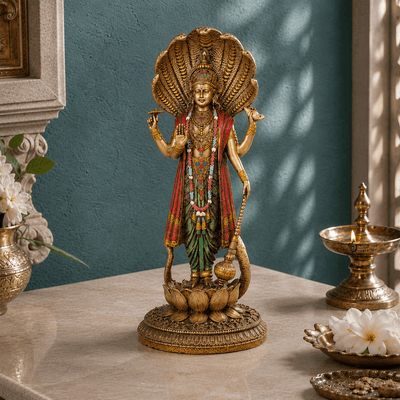
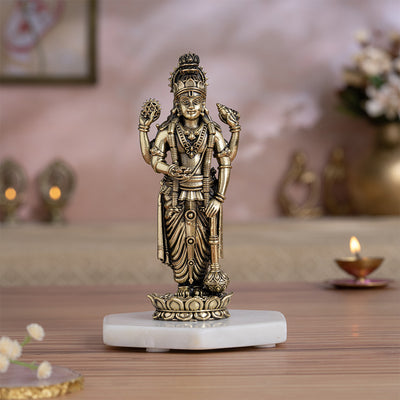
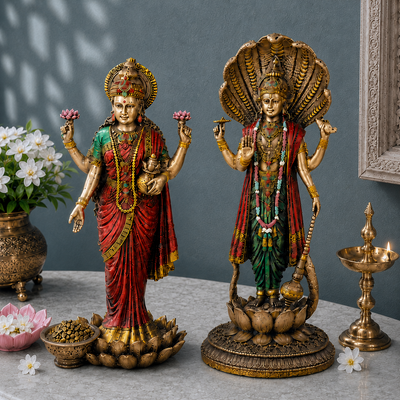
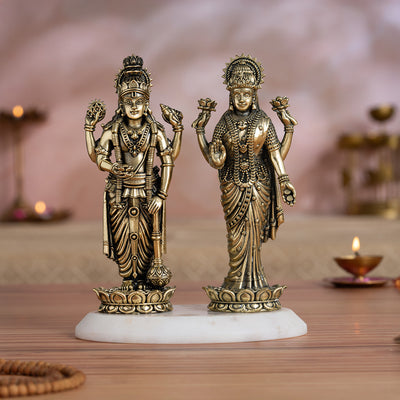
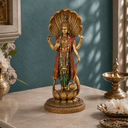
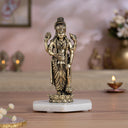
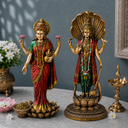
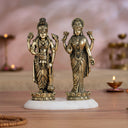
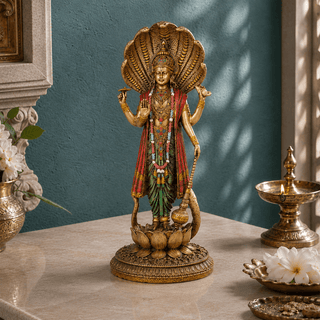
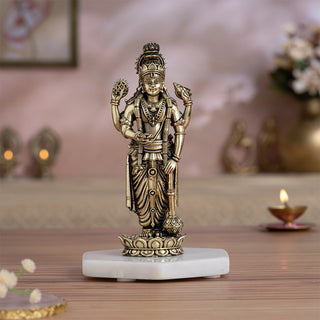
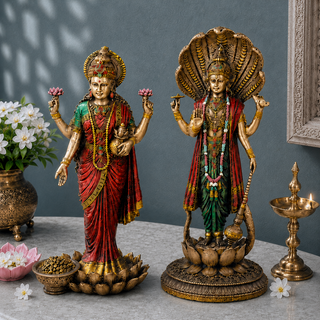
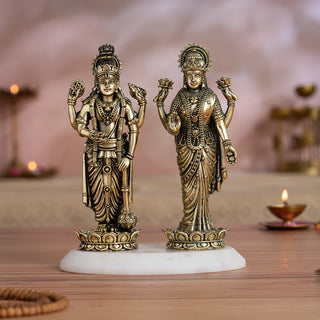
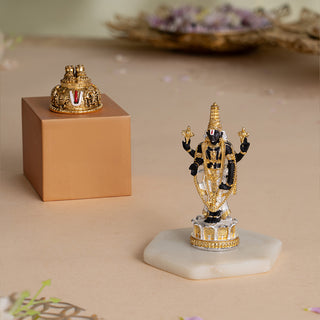
Most household worship of Vishnu is not aimed at a specific avatar. It is aimed at Vishnu himself (four-armed, holding conch, discus, mace and lotus) or at Vishnu with Lakshmi, the more common domestic pairing. The avatar forms usually belong to temples with a particular lineage: Narasimha shrines, Varaha shrines, Rama temples.
The Shilpa Shastra's way of sorting images is worth knowing, because it is not what the internet tells you. It divides by mood and setting, not posture. A yoga-murti, the deity in meditation, is prescribed for riverbanks, forests and mountain tops, away from habitation. A bhoga-murti, the deity in a domestic situation, is prescribed for temples in towns and inhabited places. Standing (sthanaka) is a fully prescribed pose with its own technical subdivisions, and Vishnu is one of the deities most commonly shown in it.13 So a standing Vishnu murti at home is entirely normal, whatever a consultant may have told you. We went through the texts on that in can we keep a standing Vishnu idol at home.
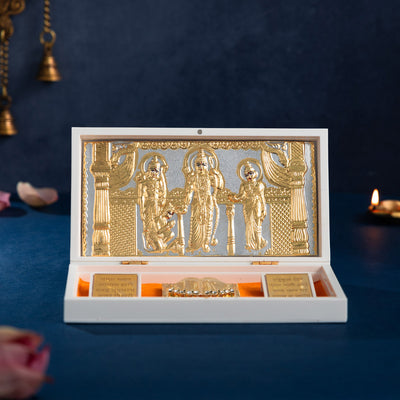
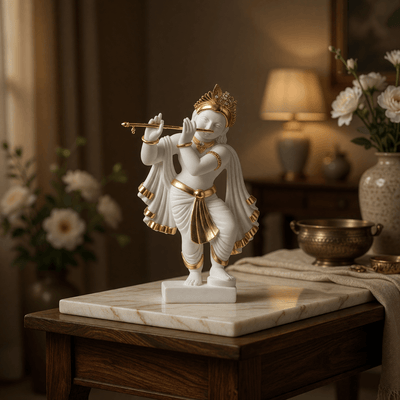
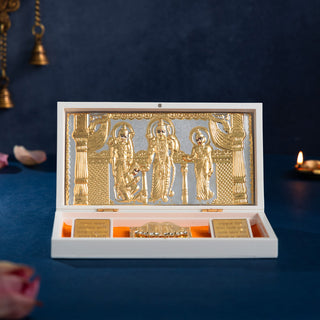
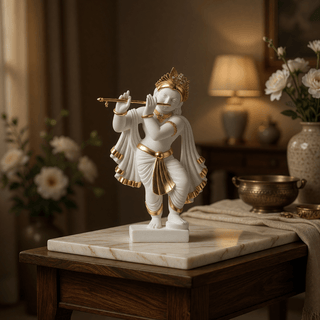
Among the avatars themselves, the two that actually fill Indian homes are Rama, usually as the Ram Darbar with Sita, Lakshmana and Hanuman, and Krishna, in more forms than any other deity.
So what is the right answer: 10, 22, or countless?
All three, and the tradition is comfortable with that in a way we usually are not.
10 is the teaching list. 22 is the Bhagavata's working list. Countless is what the Bhagavata says at 1.3.26, when it stops counting. A tradition that needed one fixed number would have had to throw the other lists away. It did not. It kept them side by side and let each do the job it was good at.
If you want a sense of how open these questions stay even inside one text, try the deceptively simple who Vishnu's first devotee was: the Bhagavata has a ranked list of twelve authorities on devotion, and Prahlada is seventh on it.
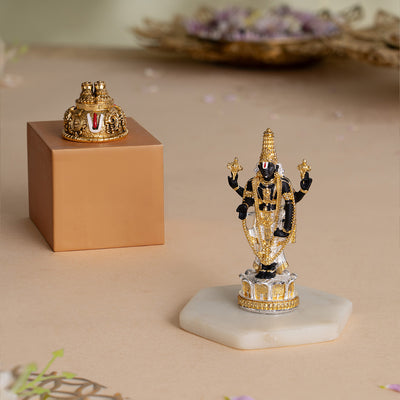
As for the tenth: by every Puranic reckoning we are in the Kali Yuga, and Kalki has not come. Which is why the form of Vishnu most worshipped in India right now is not on the list at all. It is Balaji at Tirumala: Vishnu understood as present, in this age, standing and waiting. The list, it turns out, was never closed.
Also read: The Story of Matsya Avatar | Narasimha Avatar of Vishnu | Vamana Avatar and King Bali | Who Gave the Sudarshan Chakra to Krishna | Who Is the Most Powerful God in Hinduism