Most retellings make Brahma look careless. A demon asks for immortality, Brahma hands over a boon with a hole in it, and Vishnu finds the hole. Neat, and not what the text says.
Read the boon in the Bhagavata Purana and it is airtight. It is drafted like a contract by someone who has thought hard about every way a person can die. The interest of the Narasimha story is not that a rule got broken. It is that no rule got broken.
Lord Narasimha is worshipped as Ugra-Narasimha, Yoga-Narasimha and Lakshmi-Narasimha. His devotee is Prahlada, Hiranyakashipu's own son, and the account sits in Canto 7 of the Bhagavata Purana.
Who was Hiranyakashipu, and why did he want this?
Hiranyakashipu is an asura king, and his hatred of Vishnu is personal. His brother Hiranyaksha had dragged the earth into the cosmic ocean and was killed by the boar.6 That is the Varaha avatar, and the two stories are stitched together on purpose.
The Bhagavata goes further back. Both brothers are the cursed gatekeepers of Vaikuntha, Jaya and Vijaya, sent down after the four Kumaras cursed them. In Canto 3 the Lord approves the curse, tells them that yoga practised even in anger will bring them back to him quickly, and they enter Diti's womb (3.16.26, 3.16.31, 3.16.35).5 The Kumaras themselves are among Brahma's mind-born sons.
So Hiranyakashipu is not a random villain. He is a doorkeeper of Vishnu's own house, working his way home through rage. That turns three stories (Varaha, Narasimha and later Rama) into one long arc rather than a run of monster fights.
After his brother's death he does severe penance and asks Brahma for a boon. This is where the story usually gets flattened.
What the boon actually said
He does not ask to be immortal. Brahma cannot grant that, and Hiranyakashipu knows it. So he closes every door instead. The Bhagavata sets out the terms at 7.3.35-38: let me not die at the hands of any living being created by you; not inside a residence or outside it; not during the day or at night; not on the ground or in the sky; not by any weapon; not by any human being or animal; not by any deva, asura or great serpent.1
Read that list slowly. Time, space, weapons and every category of being are covered. It is clever work, and Brahma grants it exactly as asked.
What he does not cover is something outside all his categories. Not because he was sloppy, but because his categories are how a mind works. You can only fence out what you can name.
Prahlada is the reason this story exists
Prahlada is Hiranyakashipu's son, and the boy is the reason Narasimha appears at all. His father becomes ruler of the three worlds and bans the worship of Vishnu. Prahlada will not stop saying the name.
The teachers try. The father tries. The Purana runs through what is done to the child (poison, weapons, fire, being thrown from a height, being trampled) and none of it touches him. Prahlada does not fight back and does not argue much either. He just keeps answering the same way: the Lord is everywhere.
Most versions rush past this to reach the pillar. Prahlada is not a plot device. When the Bhagavata later lists the twelve great authorities on devotion (the mahajanas) it names him seventh, in the company of Brahma, Narada, Shiva, Kapila, Bhishma and Shukadeva (6.3.20-21).4 That list is also why the popular claim that Prahlada was Vishnu's first devotee needs qualifying: the Bhagavata's own ranking opens with Brahma, not Prahlada.
What Prahlada is, plainly, is the first person in these stories to stay a devotee against everything around him. A child holding a position his whole world punishes him for. That is why he outlives the demon in memory.
The pillar, and a form that is neither
Vishnu comes out of a pillar in a form that is neither man nor animal. It starts with one question. Hiranyakashipu asks where this Vishnu is, if he is everywhere. Is he in this pillar? Prahlada says yes.
The king strikes the pillar and it splits. What comes out, the Bhagavata says at 7.8.17, is a form that is neither a beast nor a man. Not half-and-half. Neither. Translators soften this into "half man, half lion", which loses the point twice. The Sanskrit does not say lion. The word is mriga, animal.
The boon excluded man and animal. It did not anticipate a third thing. And a being that came out of a pillar rather than out of a womb is not, in the ordinary sense, one of Brahma's created beings either.
सत्यं विधातुं निजभृत्यभाषितं व्याप्तिं च भूतेष्वखिलेषु चात्मनः। अदृश्यतात्यद्भुतरूपमुद्वहन्स्तम्भे सभायां न मृगं न मानुषम्
In plain English: He appeared in the pillar, in the middle of the hall, carrying a form beyond wonder: not a beast, not a man.
Bhagavata Purana 7.8.17
One verse that answers every clause
The kill is compressed into a single verse, 7.8.29, and it answers every clause of the boon at once.
Narasimha sits at the dvāri, the threshold of the doorway. Not inside the house, not outside it. It is dusk, the seam between day and night. He lifts Hiranyakashipu onto his thigh, so the demon is neither on the ground nor in the sky. And he opens him with his nails, which are not a weapon. They grew. Nobody forged them.

Then, at 7.8.31, the heart is torn out.2
Every condition holds. Nothing is loopholed. The boon is honoured to the letter and the demon dies anyway. That is a theological statement, not a plot trick. The divine does not need to break its own word to act. It is simply not contained by the terms a frightened mind can imagine.
That is also how Narasimha is worshipped. He is a terrifying image prayed to almost entirely for protection: of children, of homes, of people in trouble they cannot argue their way out of. The violence in the story is aimed at a threat to a child.
Three things people get wrong about Narasimha
1. "Brahma made a mistake in the boon."
He didn't. The terms at 7.3.35-38 cover every category the asking mind had. The Bhagavata never says Brahma erred, and never treats the outcome as an exploit. The loophole reading comes from outside the text, and it makes the story smaller than it is.
2. "Narasimha is the fourth avatar of Vishnu."
Fourth in the Dashavatara list, yes, the fixed set of ten carried by the Garuda, Agni and Padma Puranas. But the Bhagavata Purana, the text most people are quoting when they discuss avatars, gives its own list in Canto 1, Chapter 3. It names twenty-two, with Narasimha fourteenth (1.3.18). Then at 1.3.26 it says outright that the incarnations are innumerable, "like rivulets from inexhaustible sources."3 The ten avatars are a selection, not a census, which is also why Mohini and Dhanvantari are counted as full descents in the Bhagavata but drop out of the popular ten.
3. "It happened at an exact astrological minute."
The text is specific about dusk and the doorway. It says nothing about clock time. The precise hour-and-minute claims that circulate around Narasimha Jayanti (observed on the chaturdashi of Vaishakha, at twilight) are ritual convention built on the story. That is a real and living practice, but it is not narrative scripture. Worth keeping the two apart.
Where Narasimha sits among the avatars
In the Dashavatara sequence the order runs by cosmic time: Matsya the fish, Kurma the tortoise, Varaha the boar, then Narasimha, then Vamana the dwarf. Narasimha is the hinge. Before him the forms are fully animal. After him they are fully human. He is the only one that is neither, and he sits exactly where the list turns.
You do not have to read evolution into that shape (that reading is a nineteenth and twentieth century idea, not a Puranic claim) but the placement is clearly deliberate.
There is also a Shaiva counter-story, and it should be labelled as one. Some Shaiva Purana material has Shiva take the Sharabha form to calm Narasimha's rage afterwards. Vaishnava traditions do not accept it, and it is absent from the Bhagavata's account entirely. It belongs to the long conversation between the two traditions, which also runs through questions like who the most powerful god is and who can defeat Shiva. Report it as a tradition, not as the ending.
Narasimha in the home shrine
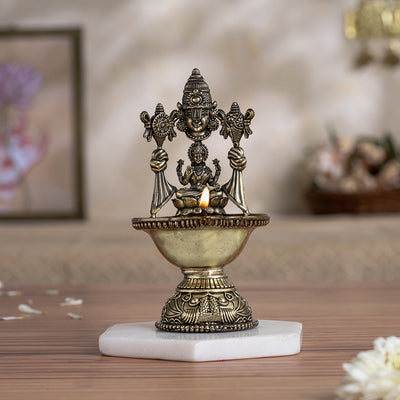
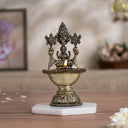
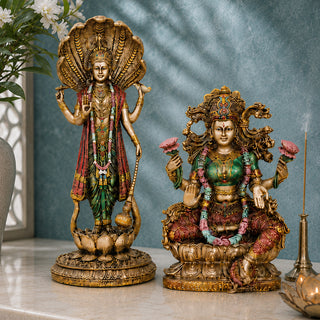
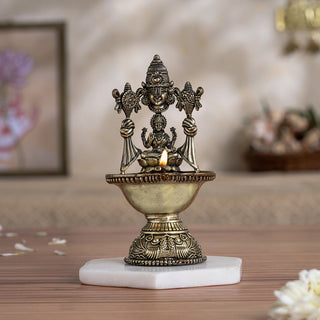
Narasimha murtis come in different moods, and the difference matters. Ugra-Narasimha is the moment of the kill. Yoga-Narasimha is the same form seated in meditation, calm. Lakshmi-Narasimha has the goddess on his knee, and this is the form usually kept in houses: the fury settled by her presence.

The Shilpa Shastra's logic for what belongs where is about mood and setting, not posture. A yoga-murti, the deity in meditation, is prescribed for riverbanks, forests and mountain tops away from habitation.8 A bhoga-murti, the deity in a domestic setting, is prescribed for temples in towns and inhabited places.9 That is the real distinction, and it is why the fierce battlefield form has been temple work rather than living-room work.
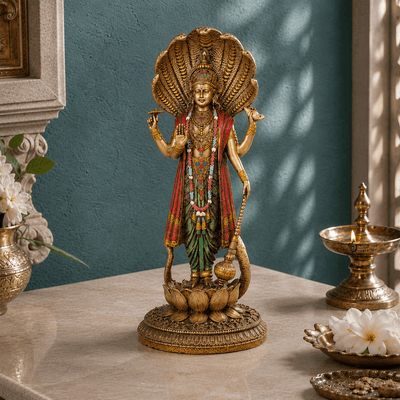
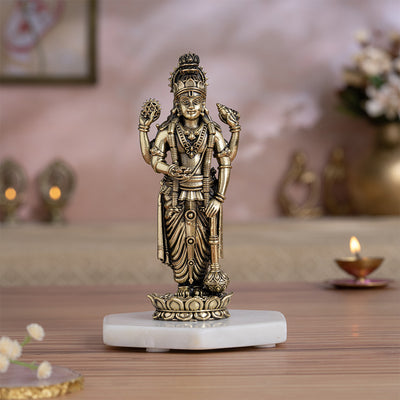
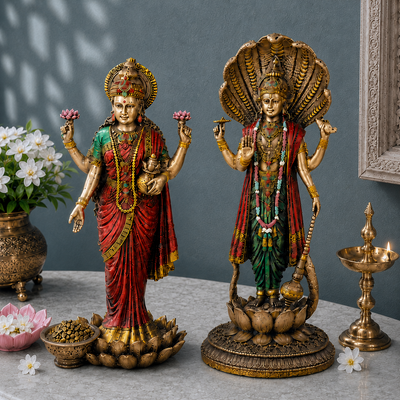
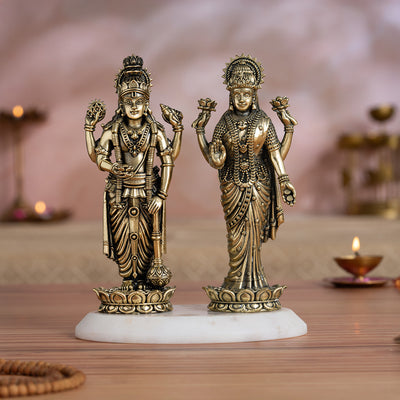
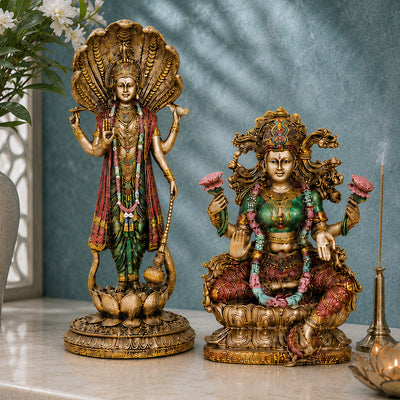
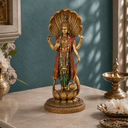
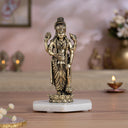
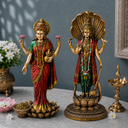
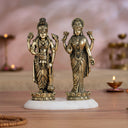
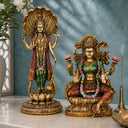
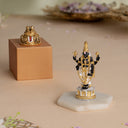
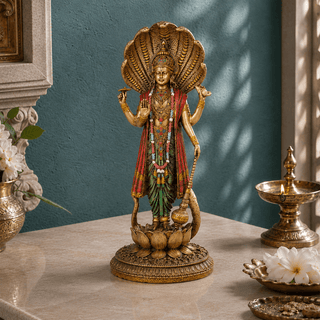
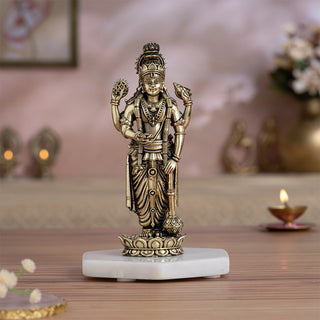
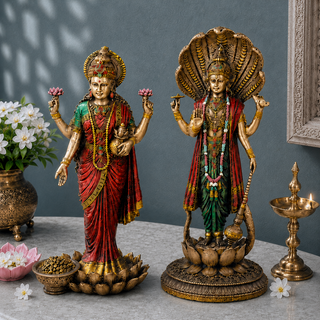
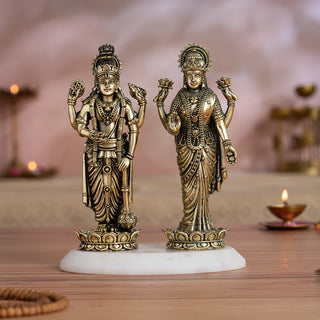
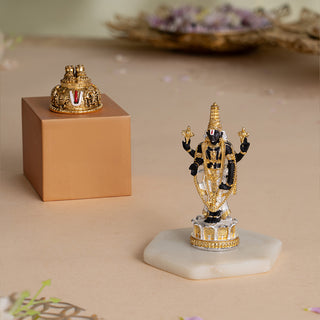
For most households, the settled forms of Vishnu are the natural choice: from the Vishnu murtis in standing Narayana form to the Vishnu-Lakshmi pairs that carry the same idea of protection paired with abundance. A standing brass Vishnu murti holding the shankha, chakra, gada and padma is the everyday counterpart to the man-lion: the same protector, at rest. If you have been told a standing image is unlucky at home, that is worth reading up on properly: no Shastra says any such thing.
Whatever you keep, the tradition cares more about consistency than material. A clean, settled place, lit regularly. If you use marble or stone, clean it correctly rather than aggressively, and think about what else shares the shelf.
Why the Narasimha story still holds
Strip out the pillar and the nails and what remains is a story about a man who could not be reasoned with, and a child who kept saying one true thing while being punished for it. The boon is really a plan to make himself unaccountable. The answer is not cleverer legalism. It is that reality was never bound by his categories in the first place.
That is also why Narasimha shows up on doorframes, on amulets, and in prayers said for children. He arrives from the direction nobody was watching.
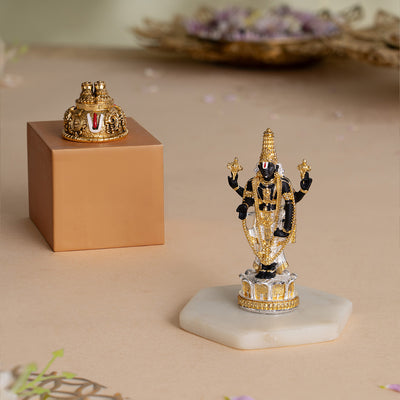
The same shape repeats across the descents. Krishna's discus, the three strides of Vamana, the boar's tusks, and the household forms people live with, from Balaji at Tirupati to the story behind that form, are the same protector arriving in whatever shape the moment needs.
Also read: The 10 Avatars of Vishnu | Varaha Avatar Story | Vamana Avatar of Vishnu | Who Was Vishnu's First Devotee | Can We Keep a Standing Vishnu Idol at Home | Kalki Avatar: What the Texts Actually Say | Parashurama: The Sixth Avatar of Vishnu