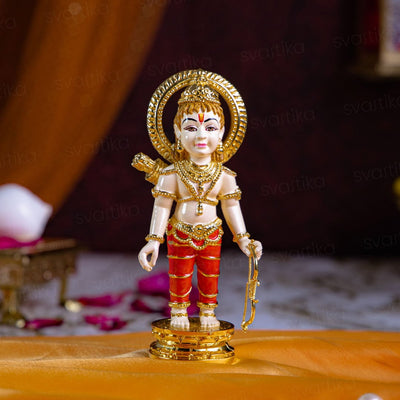
When Rama wept over Sita's absence in the forest, was he acting?
Most of us grew up assuming yes. He is Vishnu, after all. He knows how it ends. The grief is theatre, a god going through the motions so the lesson lands.
Valmiki does not tell it that way. In the oldest surviving Ramayana, Brahma tells Rama who he is, in one scene, near the end. Once you notice that, the whole epic changes shape.
The scene where Rama is told who he is
It happens in the Yuddha Kanda, sarga 117. Ravana is dead. Sita has come through the fire. Rama is standing there, and the gods gather, and Brahma speaks to him directly:
भवान् नारायणो देवः श्रीमांश्चक्रायुधः प्रभुः। एकशृङ्गो वराहस्त्वम् भूतभव्यसपत्नजित् ॥
In plain English: You are the god Narayana, the glorious lord who carries the discus. You are the one-tusked Boar, who defeats every enemy, past and to come.
Valmiki Ramayana, Yuddha Kanda, sarga 117
A note on that speech. English versions of it usually name the sword Nandaka. The Sanskrit of this sarga says only khadgadhrit, "holder of the sword". The name comes from the commentators, not from Valmiki here.1
And then, a few verses later, the line that people rarely quote:
सीता लक्ष्मीर्भवान् विष्णुः देवः कृष्णः प्रजापतिः । वधार्थं रावणस्येह प्रविष्टो मानुषीं तनुम् ॥
In plain English: Sita is Lakshmi and you are Vishnu, the god Krishna, Prajapati. You entered a human body here to kill Ravana.
Valmiki Ramayana, Yuddha Kanda, sarga 117
Read who that speech is aimed at. Not the audience. Not the assembled armies. Rama. Brahma is informing him. The discus, the Sharnga bow, the sword, even a nod to the Varaha avatar: the whole Vaishnava identity kit is handed to a man who has spent fourteen years walking barefoot through forests without it.
Some later traditions soften this. Tulsidas's Ramcharitmanas, which most North Indian families grew up hearing, is far more open about Rama's divinity throughout. Both are real. But the earliest text says Rama had to be told.
Where Rama sits among Vishnu's avatars
In the familiar Dashavatara sequence, Rama is seventh, after Matsya, Kurma, Varaha, Narasimha, Vamana and Parashurama, and before Krishna.
But that tidy list of ten is a later standardisation. The Bhagavata Purana, which is the text people quote most often when they talk about avatars, runs its own enumeration in Canto 1, Chapter 3, and it names twenty-two, not ten. In that list Rama is the eighteenth (1.3.22). Then, at 1.3.26, the text says the incarnations are innumerable, "like rivulets from inexhaustible sources."2
So "seventh avatar" is true of one list and not of another. Our piece on the ten avatars of Vishnu goes into how the count got rounded down, and where a form like Mohini quietly disappeared from the popular tally despite the Bhagavata counting her.
The deeds, kept close to Valmiki
Rama is born at Ayodhya to Dasharatha and Kausalya, the eldest of four. Bharata, Lakshmana and Shatrughna follow. The way Rama's brothers behave through the exile is the best proof in the epic that this family was remarkable long before anyone spoke of avatars.
The first public deed is the bow. Sage Vishvamitra takes the young princes to Mithila, where Janaka has set a condition for his daughter's marriage: string the bow of Shiva. Rama does not merely string it. He breaks it. Sita is his. (Who Sita's real father is has its own long answer, since she was found in a furrow and not born in a palace.)
Then the turn. On the eve of his coronation, Kaikeyi calls in two old boons: Bharata crowned, Rama exiled for 14 years. Rama accepts inside a single conversation. No argument, no delay. Dasharatha dies of the grief. Bharata refuses the throne and rules with Rama's sandals placed on it. That is where charan paduka as an object of surrender gets its weight in Indian homes.
In the forest at Panchavati, Shurpanakha approaches Rama, is refused, and is disfigured by Lakshmana. Her brother Khara comes with an army and dies. Then Ravana takes the insult personally.
The abduction is a two-man con. Maricha becomes a golden deer; Rama chases it; a false cry pulls Lakshmana away; Ravana takes Sita. The old vulture Jatayu fights him in the sky and is cut down. He lives long enough to tell Rama which way south they went. It is one of the few deaths in the epic that Rama performs the last rites for himself.
Hanuman, the bridge, and the fall of Ravana
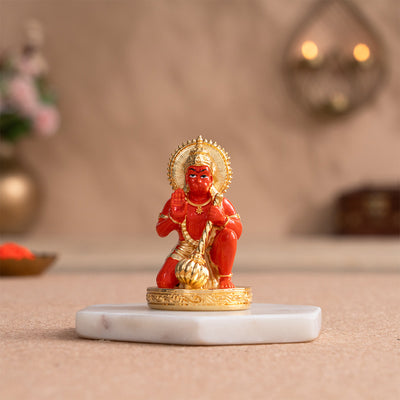
Rama allies with Sugriva, the vanara king. Hanuman crosses the ocean, finds Sita in the Ashoka grove, gives her Rama's ring, and burns Lanka on his way out. The entire Sundara Kanda is one devotee's day at work, and it is the section most families still read aloud.
Then the setu, the causeway built by the vanaras across the sea. Then the war. Kumbhakarna, Indrajit, and finally Ravana himself, who is not written as a thug. He is a scholar, a Shiva devotee, a king of great learning. Ravana's own brothers include Vibhishana, who walks away from him on principle. The epic wants the enemy to be worth defeating.
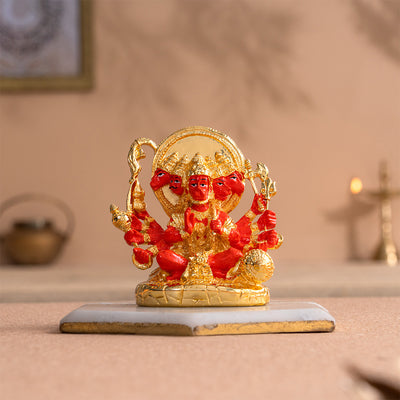
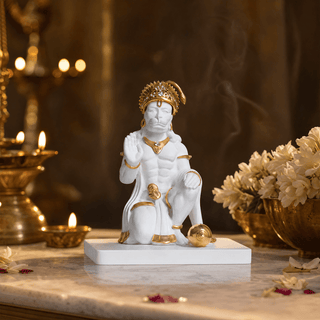
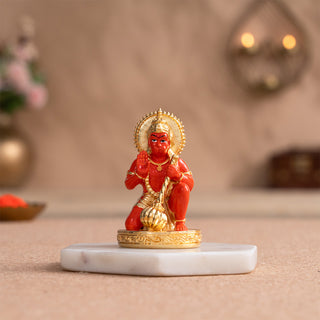
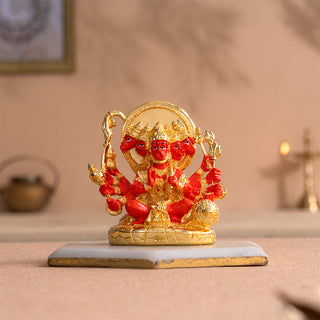
Hanuman is the thread that survives everything. He is counted among the seven chiranjeevis, the deathless ones, and the tradition that Hanuman is still alive is not a fringe idea: it follows directly from a boon in the text. His five-faced form, which people meet through the Panchmukhi Hanuman story, belongs to the Ahiravana episode of later retellings rather than to Valmiki.1
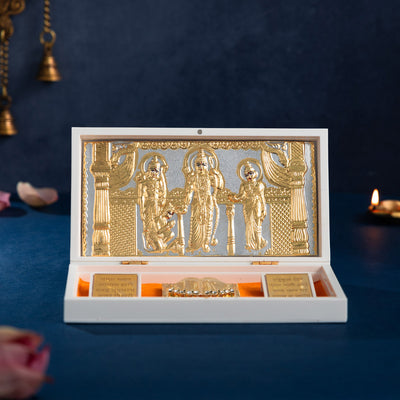
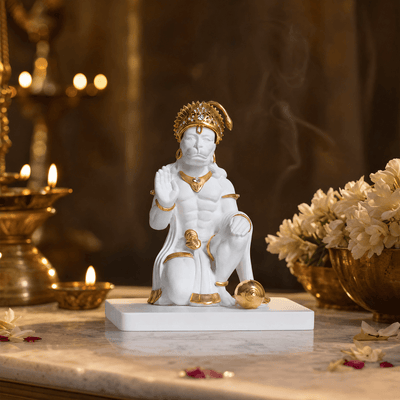
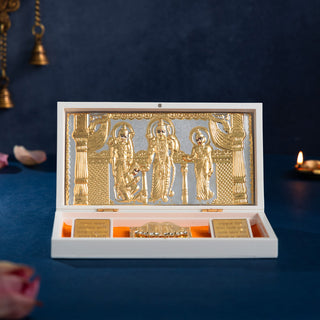
This is why a Ram Darbar is the shape Rama usually takes in a home shrine rather than a solitary idol. Rama, Sita, Lakshmana, and Hanuman kneeling: the court, not the individual. It is a picture of relationships, which is what the epic is actually about.
Four things people get wrong about the Ram avatar
1. "Rama always knew he was Vishnu."
Covered above, but worth stating flatly: in Valmiki, he is told at Yuddha Kanda 117, after the war. Everything before that (the grief for Sita, the doubt, the exhaustion) is written to be real. A god performing sadness is a much smaller story than a man carrying it.
2. "The Ramayana we all know is Valmiki's."
Often it isn't. Much of what Indian readers picture (the devotional texture, several beloved episodes, much of the phrasing) comes from Tulsidas's Ramcharitmanas (16th century) or from regional Ramayanas like Kamban's Tamil version. These are great works with their own authority. They are just not the same text, and blending them quietly is how confusion spreads.
3. "The Uttara Kanda is settled scripture."
Many scholars hold that the final book (Sita's banishment, Luv and Kush, and Rama's departure) was added later than Valmiki's original, on grounds of language and structure. This is a scholarly position, not a settled fact, and we report it as one. It matters, because the episodes people find hardest to square with Rama's character sit almost entirely in that book. Our article on how Rama died deals with that ending in more detail.
4. "Rama defeated Parashurama, so an avatar beat an avatar."
The meeting happens, and Rama does take the Vaishnava bow from him. We tell that same scene from Parashurama's side, where it reads as a handover rather than a defeat. But the Bhagavata is precise about Parashurama's status: he is vasudeva-amsham, a portion of the Lord rather than a full descent (9.15.14).3 The scene is less a duel than a handover: one form of Vishnu's power passing to the next.
Why "maryada purushottama" is the real title
Rama is called maryada purushottama, the best of men, within the limits. That phrase does a lot of quiet work.
Krishna bends rules with a smile and the tradition adores him for it. Rama does the opposite. He keeps the promise that ruins him. He accepts exile without negotiating. He treats a vulture like family and a monkey king like an equal. And in Valmiki's telling, he does all of it without knowing he is God, or that this ends well.
That is a different offer from the one Krishna makes. Krishna gives you a teacher and a friend. Rama gives you a standard. Many homes keep a Vishnu murti for stillness and a Hanuman idol for courage. They keep Rama for something closer to conscience.
It also connects to a question we get often: who counts as Vishnu's first devotee. The honest answer there, as here, is that the texts are less tidy than the internet.
Worship, and what stays with people
Rama Navami, in Chaitra, marks his birth; the fuller calendar and rituals are in our guide to Ram Navami. Diwali is celebrated in much of India as the day Ayodhya lit lamps for his return, which is why Diwali diya decoration still leans on the Ramayana rather than anything abstract. Dussehra marks Ravana's fall.
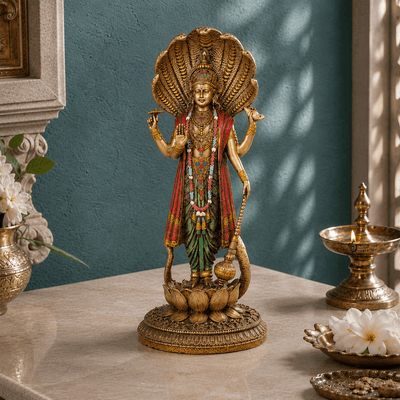
If you keep a murti of him at home, the practical questions are the ordinary ones: a settled place, daily consistency, cleanliness. Not posture rules. The common advice that a standing form should not be kept in a house has no textual basis. We checked what the Shilpa Shastra actually says in can we keep a standing Vishnu idol at home.
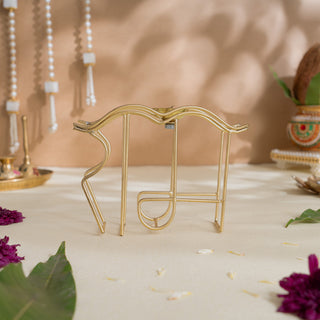
The thing that stays with me about the Yuddha Kanda scene is how late it comes. Fourteen years of forest, a stolen wife, a war, a brother nearly dead, and only then does someone finally say: by the way, you are Narayana.
Whatever else the Ramayana is doing, it wanted us to watch a man do the right thing without a safety net. The divinity is confirmed at the end, like a receipt. The story happened before it.
Also read: The 10 Avatars of Vishnu | How Did Ram Die | Lord Rama's Brothers | Is Lord Hanuman Still Alive | Who Gave the Sudarshan Chakra to Krishna