Of all the avatars of Vishnu, Varaha is the one people quietly skip. A fish is elegant. A tortoise is patient. A man-lion is terrifying in a way you can respect. But a boar, tusks dripping mud, hauling the planet out of black water: that one takes some explaining.
The odd thing is that the texts explain it, very precisely. It just never makes it into the retellings.
Why did the earth sink in the first place?
The demon Hiranyaksha dragged her down. The Bhagavata Purana sets this at the start of a kalpa, a fresh cycle of creation. Brahma is doing his work of unfolding the worlds when the earth slips down into the Garbhodaka ocean, the water that lies beneath everything.
Hiranyaksha ("golden-eyed") is an asura of enormous strength who has been roaming the universe looking for someone willing to fight him and finding nobody.
Here is the part that makes the story bigger. Hiranyaksha is not just a monster who wandered in. In the Bhagavata he is one of two doorkeepers of Vaikuntha, Jaya and Vijaya, cursed by the four Kumaras and born into Diti's womb as asuras (3.16.35). The Lord approves the curse and tells them that yoga practised even in anger will bring them back to him quickly (3.16.26, 3.16.31).
That single thread ties three avatars together. Hiranyaksha is killed by Varaha. His brother Hiranyakashipu is killed by Narasimha. The same pair returns later as Ravana and Kumbhakarna, which is why Rama's story is not a separate story at all. The Dashavatara only looks like a list. Underneath, a good deal of it is one long argument between a doorkeeper and the door.
The boar that started out the size of a thumb
The boar begins the size of a thumb-tip, and almost nobody remembers that part.
Brahma is worried. He is praying. And then something comes out of his nostril. The Bhagavata is exact about the size: angustha-parimanakah, about the length of the top joint of a thumb (3.13.18).1
Brahma watches it hover. Within a moment it swells to the size of an elephant (3.13.19). Brahma and the sages with him start wondering aloud what this creature is, and whether it could be Vishnu himself, playing.
Then the boar roars, and dives.
He goes down through the water, finds the earth lying there, and lifts her out on the tips of his tusks (3.13.30). Hiranyaksha meets him in the water and is killed there. And when the boar surfaces, he places the earth on the water and she stays (3.13.46).
What I like about this sequence is the direction it moves in. The avatar people find crudest is also the only one that starts smaller than a fingertip. It grows into the job.
Why a boar? The answer the Vishnu Purana gives
The Vishnu Purana, in H.H. Wilson's 1840 translation, does not treat the boar as a costume. It reads him as the sacrifice itself, walking around. The technical name for this is yajna-varaha, the sacrificial boar. The Vedas are his gait. His tusks are the stakes to which the offering is tied. His tongue is the fire. His body is described limb by limb as the parts of a Vedic ritual. Wilson notes in his own footnote that this reading is carried across many of the Puranas, not just this one.7
Sit with that for a second and the animal stops being strange.
A boar digs. It puts its snout into ground nobody else will touch and comes back up with what was buried. The Vedic sacrifice was understood to do the same: to reach into the unseen and haul something back into the world of the living. Give that idea a body and the boar is not an odd choice. It is the obvious one.
So the answer to "why a boar" is not "because boars are strong." It is: because lifting something out of the depths is what a sacrifice does, and Varaha is that act with a face on it.
What the Earth actually says to him
In the Vishnu Purana the earth is not a prop. She speaks, and her hymn contains a line worth reading twice.
श्रीपृथिव्युवाच । नमस्ते पुण्डरीकाक्ष शंखचक्रगदाधर । मामुद्धरास्मादद्य त्वं त्वत्तोऽहं पूर्वमुत्थिता
In plain English: I bow to you, lotus-eyed one, holder of the conch, the discus and the mace. Lift me out of this today. It was from you that I rose, long ago.
Vishnu Purana 1.4.12-13
The next verse is plainer still: by you I was lifted up before. She is telling him this has happened already.
That one clause reframes Varaha from a rescue mission into a maintenance job. The world does not get saved once and stay saved. It sinks, it is lifted, it sinks again, and the lifting is a recurring feature of how time works here rather than a one-off emergency.
Then the closing image, the best sentence in the whole Varaha material: the boar sets the earth on the ocean and she rests there like a great boat, mahati nauriva (1.4.46).
Not planted. Not anchored. Floating. A boat.
Worth saying plainly: the Bhagavata and the Vishnu Purana are not telling identical stories. The Bhagavata's boar comes out of Brahma's nostril at the opening of a kalpa. The Vishnu Purana frames the raising of the earth as a recurring cosmic act. Both are real accounts and they should be read side by side, not blended into one tidy timeline.
Four things people get wrong about the Varaha avatar
1. "Vishnu has exactly ten avatars."
The Bhagavata Purana (the text everyone quotes when they talk about avatars) gives its own list, and it names twenty-two, not ten. It runs from the four Kumaras to Kalki (1.3.6-1.3.25). Varaha is the second name on it, at 1.3.7, right after the Kumaras. And then the text does something remarkable: at 1.3.26 it says the incarnations are innumerable, "like rivulets from inexhaustible sources."3
The fixed set of ten is a later tidying-up, carried by the Garuda, Agni and Padma Puranas. It is a real and useful scheme. It is just a selection, and the Bhagavata itself never pretended otherwise.
2. "Varaha killed Hiranyakashipu."
Two brothers, two very similar names, and the internet mixes them constantly. Hiranyaksha is the one who drags the earth into the water and dies fighting Varaha. Hiranyakashipu is his brother, the one with the famously airtight boon, killed much later on a threshold at dusk by Narasimha's fingernails (Bhagavata 7.8.29).4 Same curse, same womb, different avatar.
3. "Jaya and Vijaya were offered three demon lives or seven devotee lives."
This one is everywhere, and it is not how the Bhagavata's own account reads. There, the Lord approves the Kumaras' curse, tells the gatekeepers that yoga practised even in anger will unite them with him and bring them back quickly, and they enter Diti's womb (3.16.26, 3.16.31, 3.16.35).2 No menu, no bargaining scene. The choice-of-two framing circulates widely in retellings and turns up in some Puranic variants, but it should not be put in the Bhagavata's mouth.
4. "The boar is the crude avatar."
Covered above, but it deserves to sit in this list. The Puranas do not treat Varaha as a rough draft on the way to better forms. They treat him as the sacrifice embodied: arguably the most theologically loaded of the animal descents, not the least.
The two Varahas you will see in stone
Walk through any old temple site in India and you will find Varaha carved two completely different ways. Both are correct.
Yajna-varaha is the full boar. Four legs, animal head, animal body, the earth balanced on a tusk or resting against the snout. The colossal boar at Khajuraho is the one people photograph: a solid stone animal covered edge to edge in tiny carved figures of gods and sages. It is the sacrifice-form made literal.

Nri-varaha is the boar-headed man. Human body, powerful stance, one foot often raised on the coils of the serpent of the deep, the earth goddess seated in the crook of his elbow like someone being carried out of a flood. The Udayagiri panel in Madhya Pradesh is the famous example.

The second type is doing something clever. A pure animal cannot look tender. A boar-headed man can. He can carry her, and you can see that he is carrying her.
Where Varaha sits among the ten
In the Dashavatara sequence Varaha is third, after Matsya the fish and Kurma the tortoise, before Narasimha.
Read the first three together and a shape shows up. Matsya saves seeds, sages and scripture from a flood by towing a boat. Kurma holds up a sinking mountain so the ocean can be churned. Varaha goes into the water after the earth herself. Three water stories in a row, and in each one Vishnu's job is to stop something essential from being lost underneath.
After Varaha the emergencies change shape. Vamana handles a king who is too generous to fight. Mohini handles a theft with a distraction. The threat stops being the ocean and starts being other people.
One caution while we are here. The idea that the Dashavatara "predicts evolution" (fish, amphibian, boar, man-lion, dwarf, man) is a nineteenth and twentieth century reading, not a claim any Purana makes. It is an interesting observation. It is not scripture, and it is worth being honest about which is which.
Bringing Vishnu home
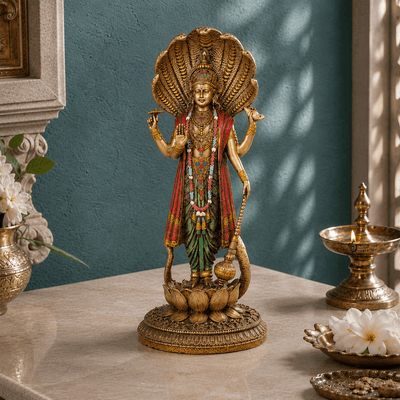
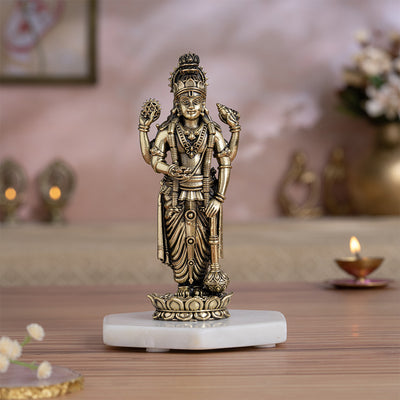
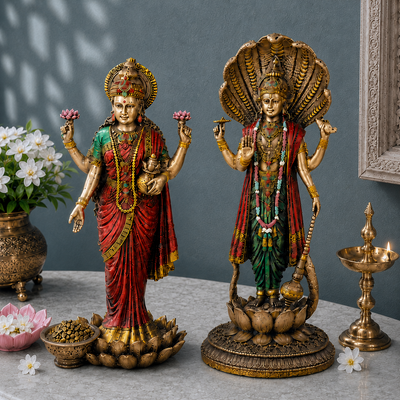
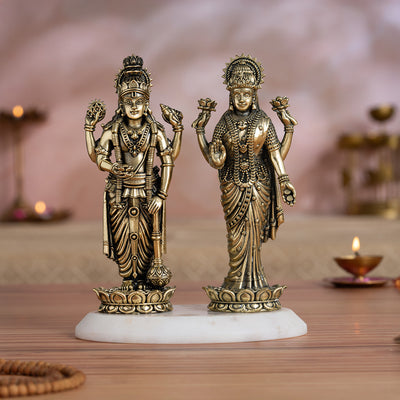
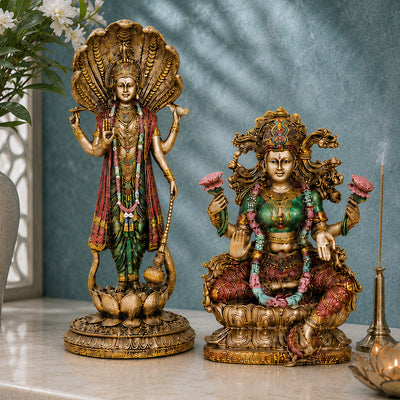
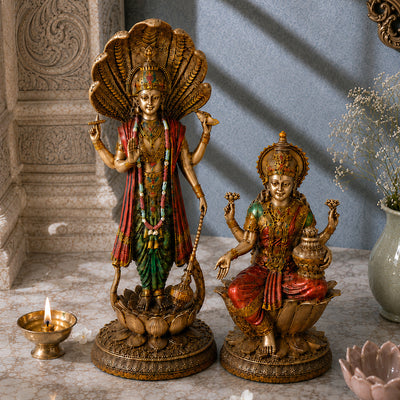
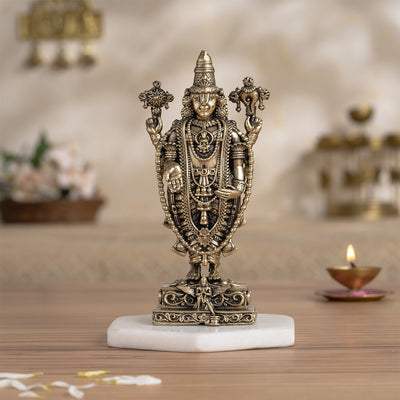
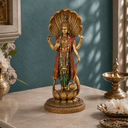
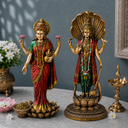
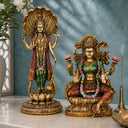
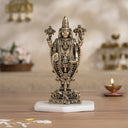
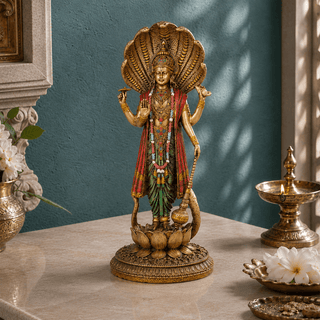
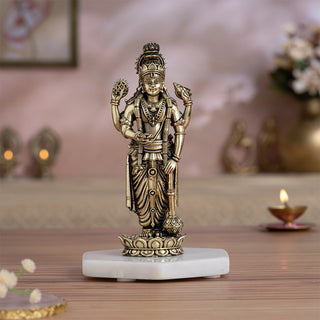
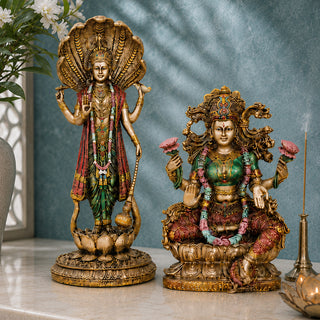
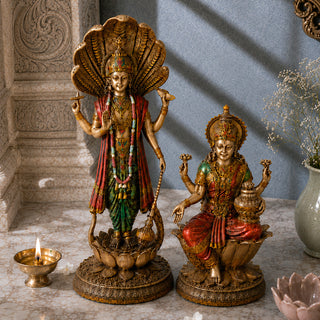
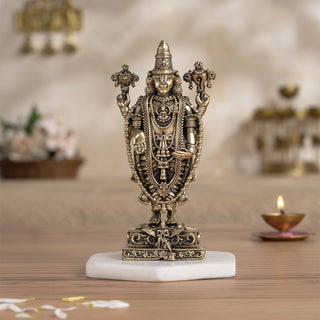
Varaha murtis are rare in home shrines. What most households keep is Vishnu in his own four-armed form, holding the conch, the discus, the mace and the lotus, the same discus whose origin story is genuinely disputed across three different texts, or as Balaji at Tirumala.
People often ask whether a standing Vishnu idol is allowed at home. It is. Standing, sthanaka, is a fully prescribed pose in the Shilpa Shastra with its own technical subdivisions, and Vishnu is one of the deities most often shown in it.8 A tall standing Vishnu murti is exactly the form the texts describe.
Where the Shastras do sort images by setting, they sort by mood, not posture. A yoga-murti, the deity in meditation, is prescribed for riverbanks, forests and mountain tops, away from people.10 A bhoga-murti, the deity shown in a domestic situation, is prescribed for temples in towns and inhabited places.9 That is the real logic, and a home shrine sits squarely on the bhoga side of it.
What tradition asks for is ordinary: a settled place, a clean and considered pooja room, and consistency. Brass and antique-finish murtis need occasional attention too: the same care you would give any murti at home.
Why this story still lands
Varaha is not a story about winning a fight. Hiranyaksha dies in a few verses and the text moves on almost immediately.
The story is about retrieval. Something that held everything up went under, and someone went down after it, not gracefully, not in a shape anyone would have chosen, but effectively. He came back up filthy and carrying it.
There is a reason the tradition put the sacrifice inside that particular animal. Digging is not beautiful work. It is just the work that gets the thing back.
Also read: The 10 Avatars of Vishnu | Narasimha Avatar | Who Was Vishnu's First Devotee | Most Powerful God in Hinduism | Kalki Avatar: What the Texts Actually Say