Read the story the way it usually gets told and it sounds like a con. A giant pretends to be small, asks a generous man for almost nothing, and then takes everything. The king loses his kingdom and gets shoved underground.
That is not what Canto 8 of the Bhagavata Purana actually says. In the text, Bali is warned in advance by his own guru that the boy is Vishnu. He understands. He gives anyway. And the ending is not a punishment: it reads much more like a promotion.
This is the fifth of the ten descents in the Dashavatara, and the first one where Vishnu appears in fully human shape. It is also the one where the earliest layers of the tradition are the most visible, if you know where to look.
What actually happens in the Vamana story
Bali, grandson of Prahlada, has beaten the devas and taken the three worlds. He is performing a great sacrifice, and during such a sacrifice he has vowed to refuse no one who asks.
A small brahmana boy walks in. Short, radiant, carrying a wooden umbrella and a water pot. Bali receives him properly, washes his feet, and asks what he wants. Villages? Gold? Cows? Anything.
The boy asks for three paces of land, measured by his own feet.
Bali laughs at how little it is and tells him to ask for more. The boy declines. A man who cannot be satisfied by three paces will not be satisfied by three continents: that is roughly his argument, and it lands.
Then the form changes. The dwarf becomes the cosmic body. One stride crosses the earth. The second crosses the sky and reaches the top of the universe. There is no third place to put a foot.
And Bali, who has just lost everything, offers the only thing still his. In the Bhagavata's own wording he asks the Lord to place the third step on his head (8.22.2). Not as a defeat. As the last thing he owns and can still give.
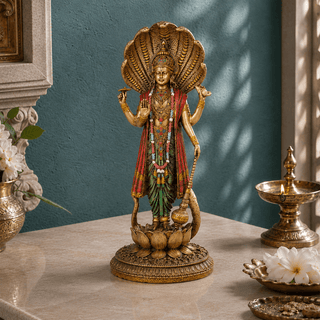
The three steps are much older than the dwarf
The three strides are Vedic, and much older than the dwarf. In the Rigveda (1.22.16–18, and again in the Vishnu hymn 1.154), Vishnu measures out the worlds in three steps. But there is no dwarf in those verses, and there is no King Bali.5 Vishnu is a striding solar figure who covers space, and that is the whole image.
The dwarf shows up later, in the Brahmana literature. The Shatapatha Brahmana says plainly, "Now Vishnu was a dwarf" (1.2.5), in a passage where the gods win back the earth from the asuras by measuring out a space the size of a small body. The Taittiriya Samhita (2.1.3) carries a related idea.7
So the two halves of the story (the striding and the dwarfing) begin in different places. They are welded into one continuous narrative much later, most clearly in the Harivamsa and then in the Puranas, where the asura king finally gets a name and a personality.
That is not a flaw. It is how the tradition grew: by accretion, over centuries, with earlier material never thrown away. The same layering is visible in the Matsya story, where the oldest surviving flood account does not identify the saving fish with Vishnu at all.
Bali was warned. He gave anyway.
Shukracharya, guru of the asuras, sees through the disguise immediately. He tells Bali: this is Vishnu, he has come for the devas, do not make this promise. Refuse him.
Bali refuses his guru instead.
His reasoning is the moral spine of the whole episode. He has given his word during a sacrifice. Vishnu himself has come to his door as a beggar. He can keep the promise and lose the worlds, or break it and keep them. The second is worse. A king who lies is already finished.
So he pours the water of the gift over the boy's hand and completes the vow, knowing exactly what it will cost.
Once you see that, the story stops being about a trick working. It becomes a story about a man who could see the trick clearly and honoured his word into ruin. That is why Bali is remembered in the tradition as one of the chiranjeevis, and why the Bhagavata later lists him among the twelve great authorities on devotion (6.3.20–21), tenth on a list that begins with Brahma and includes his own grandfather Prahlada. That list is worth reading before anyone tells you confidently who Vishnu's first devotee was.
 16% off
What Bali actually receives
The Bhagavata does not describe a hell. Bali is given Sutala, a realm built for him by Vishvakarma, and the text is specific about it: a place free of mental and bodily misery, fatigue, exhaustion and defeat (8.22.32). He is told he will become the Indra of a future age, under Manu Savarni (8.22.31).
And then the promise, which is the emotional centre of the chapter:
रक्षिष्ये सर्वतोऽहं त्वां सानुगं सपरिच्छदम् । सदा सन्निहितं वीर तत्र मां द्रक्ष्यते भवान् ॥
In plain English: I will protect you completely, you and your followers and everything you own. And there, brave one, you will always see me close by.
Bhagavata Purana 8.22.35
A king who loses a kingdom and gains the permanent nearness of God has not been punished. He has been moved. Reading it that way is not a devotional softening: it is what Canto 8 says.
It also fits the pattern across the avatars. Even the demons Vishnu kills are not simply destroyed. Hiranyaksha of the Varaha story and Hiranyakashipu of the Narasimha story are, in the Bhagavata, the cursed gatekeepers of Vaikuntha working their way home the hard way (3.16.26–35).
Four things people get wrong about Vamana
1. "Vamana crushed Bali and pushed him into hell." No. He is given Sutala, a realm explicitly described as free of misery and defeat, plus a future post as Indra, plus the Lord's own presence. The Bhagavata's language is honour, not humiliation.
2. "Vishnu then had to serve as Bali's doorkeeper until Lakshmi tied him a rakhi and won him back." This is a much-loved devotional story and it is not in Canto 8.1 The Bhagavata's version ends with a promise of protection, not with Vishnu stationed at a gate. If you tell the rakhi story, tell it as tradition: it is beautiful, and it is later.
3. "The three strides have always been the Vamana story." They have not. The Rigveda has the strides with no dwarf and no asura king.6 The Shatapatha Brahmana has the dwarf but still no Bali.8 The full story we know is a later joining of separate material.
4. "Vamana deceived Bali." The text refuses this reading, because it makes Shukracharya say the quiet part out loud. Bali is informed. He proceeds. What looks like a deception from outside is, inside the story, a test that Bali passes.
There is a fifth one worth naming while we're here, because it turns up in every avatar list: the idea that Vishnu has exactly ten avatars. The Bhagavata's own primary enumeration names twenty-two (1.3.6–1.3.25) and then says outright that the descents are innumerable, "like rivulets from inexhaustible sources" (1.3.26). In that list, Vamana is fifteenth, not fifth. The familiar ten (carried by the Garuda, Agni and Padma Puranas) is a selection, and a good one, but it is a selection.
 14% off
Onam, Kerala, and why a "later" story still matters
In Kerala, Bali is Mahabali, and no villain at all. He is the good king whose reign was so just that there was no theft, no lying and no want, and Onam is the festival of his yearly return to see whether his people are still happy.
You will not find that annual visit in the Bhagavata. It is regional tradition, enormously old, alive and specific: the flower carpets, the sadya, the boat races, the songs that address him directly. Onam's whole visual language is built around a returning king, not a defeated one.
Being honest that something is tradition rather than scripture is not the same as dismissing it. Kerala read the same episode we just read and drew the obvious conclusion: a king this good does not simply vanish. The text gives him Sutala and a divine promise. The tradition gives him a homecoming. They are not fighting.
How Vamana is shown, and why he is usually standing
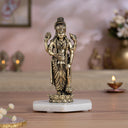
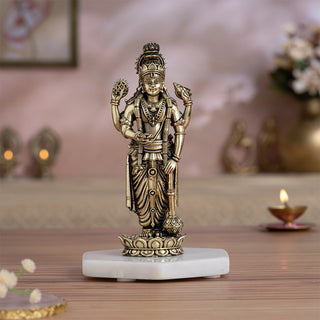
In sculpture Vamana appears in two modes. There is the small brahmana boy: umbrella, water pot, sacred thread, modest and self-contained. And there is Trivikrama, the three-step form, one leg raised high across the frame, mid-stride, the moment the universe stops being ordinary.
Both are canonical. The little figure poses the question. Trivikrama gives the answer.
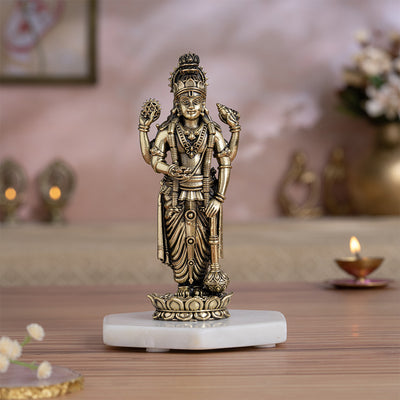
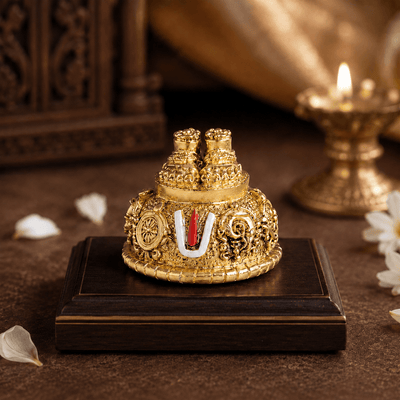
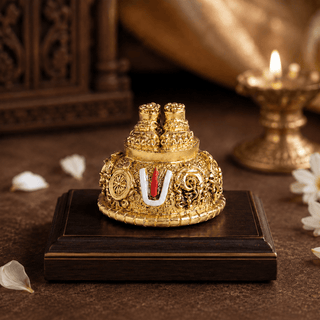
The raised-leg form is also why Vamana imagery leans on feet. His foot is the measuring instrument of the whole story, and the third step lands on a devotee's head. That idea (the divine foot as the thing you place above yourself) is exactly what a charan paduka is for, and why footprint forms are kept in so many household shrines alongside a full Vishnu murti.
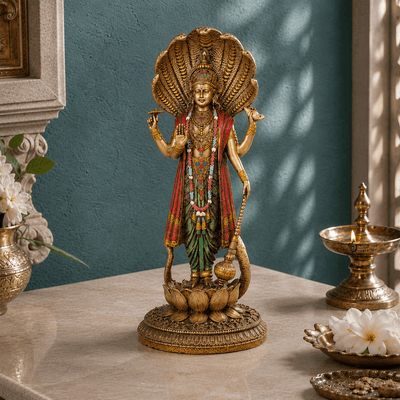
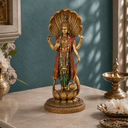
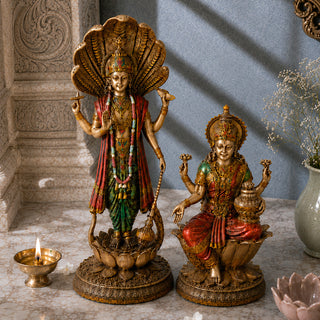
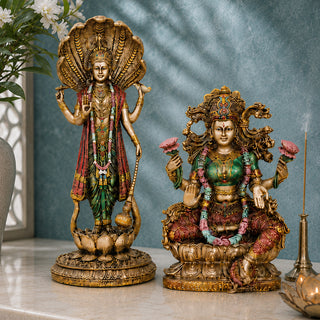
Which raises the question people actually search for: is a standing Vishnu fine at home? Yes. Standing, sthanaka, is a fully prescribed pose in the Shilpa Shastra, and Vishnu is one of the deities most often shown in it.10 The Shastras sort images by mood and setting, not posture. A yoga-murti in meditation belongs on riverbanks and mountains away from habitation.12 A bhoga-murti, the deity in a domestic situation, is the one prescribed for towns and homes.11 We covered that in detail in can we keep a standing Vishnu idol at home, and the short version is that the "no standing idol at home" rule is modern consultancy advice, not textual law.
What the tradition does care about is simpler and duller: a settled place, a clean one, and worship that actually happens. What you keep in the pooja room matters far less than whether you go there.
 8% off
Where Vamana sits among the avatars
In the Dashavatara sequence he is fifth, arriving after Kurma and Narasimha and before Parashurama, Rama and Krishna. He is the hinge: the first descent in complete human form, and the last one that is still openly cosmic. After Vamana the avatars mostly stay human-sized and let their humanity carry the weight.
The method changes too. Matsya rescues, Kurma supports, Varaha lifts, Narasimha tears open a demon at a doorway. Vamana simply asks a question and lets a man answer it. Even Mohini, who works by enchantment, uses force less than persuasion. The weapons of the later Vishnu (the disc, the mace, and the long argument about who gave the Sudarshana Chakra to Krishna) do not appear here at all.
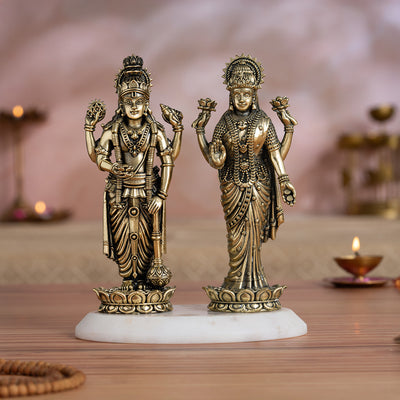
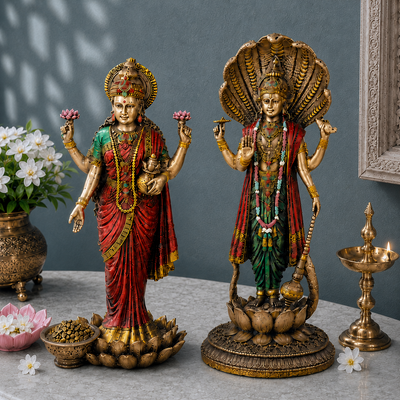
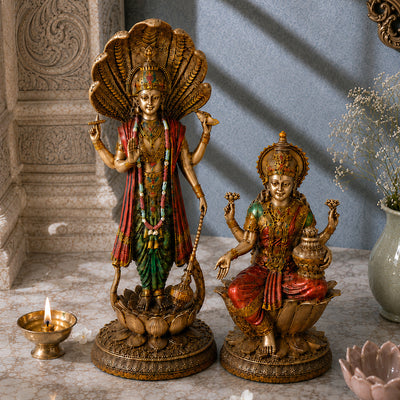
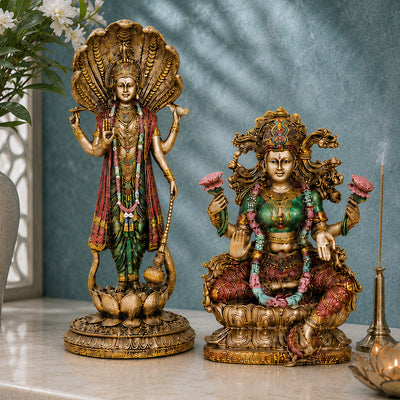
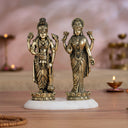
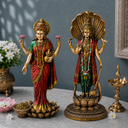
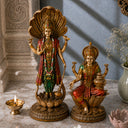
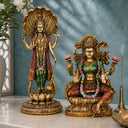
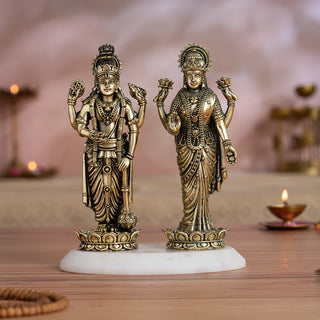
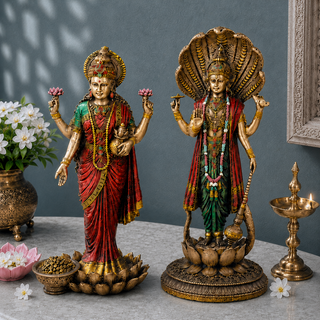
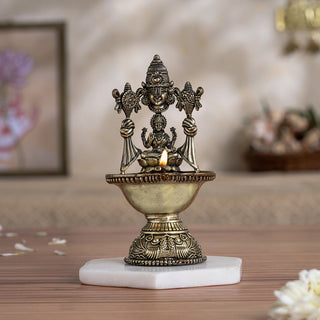
Bali's line survives too, in a way. Vishnu keeps a standing relationship with his household, which is one reason the Vaishnava south folds so much of this into the worship of Balaji at Tirumala, where the deity's feet and the act of giving are once again the whole point. Households that keep brass murtis of Vishnu with Lakshmi are, in a small way, keeping the end of this story rather than its middle.
The short version, if you remember nothing else
A dwarf asked for three paces. A king who had been warned gave them. The dwarf became the universe. And the king, with nothing left, offered his head. In exchange for the three worlds, he was given a realm without sorrow, a future throne, and the permanent company of the one who took everything from him.
Read like that, Vamana is not a story about a clever god. It is a story about what a promise costs, and what it is worth.
Also read: The 10 Avatars of Vishnu | Narasimha Avatar | Varaha Avatar | Mohini Avatar | Can We Keep a Standing Vishnu Idol at Home | Parashurama: The Sixth Avatar of Vishnu