Parashurama is the most uncomfortable figure in the Dashavatara, and the discomfort is the point. Every other avatar arrives to stop something. He arrives and does not stop.
He is also the avatar most flattened by retelling. The story is usually given as a straight line — a king steals a cow, a sage is killed, a son takes revenge twenty-one times over — and the questions a reader actually has are left alone. Why did he kill his mother? Did she come back? How do you exterminate a class twenty-one times? What did he lose to Rama? This is what the Mahabharata, the Bhagavata Purana and the Ramayana say, with the chapter numbers, including the places where they contradict each other.
Who he was, before any of it
Parashurama is Rama of the Bhrigus — Rama Jamadagnya, or Bhargava Rama — and the axe in the name is not his birthright. Parashu means axe; he acquired it. The Mahabharata says he gratified Mahadeva on the mountains of Gandhamadana and begged weapons from him, the axe above all, and that it was the axe that made him unrivalled on earth.5
That detail is worth holding onto, because it complicates the tidy version. The great weapon of Vishnu’s sixth avatar is a gift from Shiva. His father was the sage Jamadagni; his mother was Renuka; his great-grandfather was Bhrigu, whose name the whole line carries. He was born a brahmin and he never stopped being one. That is the engine of everything that follows.
Later writers gave the contradiction a name: brahmakshatriya, the brahmin who lives as a warrior. It is a label for a problem, not a solution to it. In the classical scheme of the four orders, fighting is the kshatriya’s duty and study and sacrifice are the brahmin’s, and Parashurama spends his entire career on the wrong side of that line while never once losing the standing that makes him untouchable — which is precisely why, at the end, Rama will not kill him.
It starts with a cow

Kartavirya Arjuna, king of the Haihayas, had worshipped Dattatreya and received a thousand arms, along with beauty, influence, fame and the mystic powers of yoga. The Bhagavata says he roamed the universe without opposition, like the wind.1
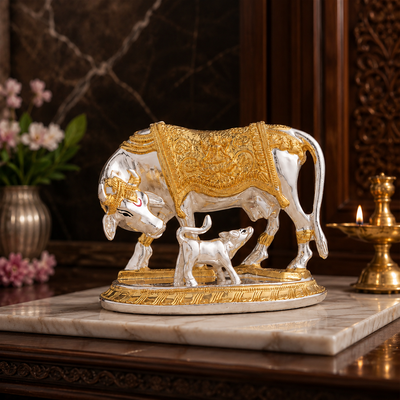
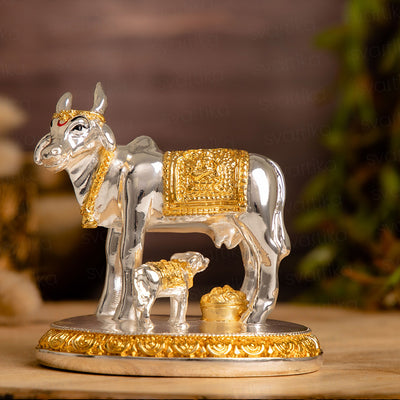
Hunting one day, he came to Jamadagni’s hermitage, and the sage fed him — the king, his soldiers, his ministers and his carriers — because he possessed a kamadhenu, the cow that supplies whatever is asked of it. And that is where it turns. In the Bhagavata’s account Kartavirya works out that a forest ascetic is now, in the only sense that matters to him, wealthier than an emperor. His men drive the cow away to Mahishmati, and the text is careful about one detail: they took her along with her calf, and she was crying.1
Parashurama came back to an empty shed. The Bhagavata says he became as angry as a trampled snake.
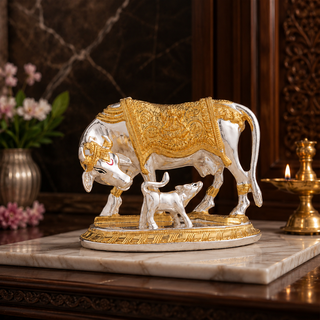
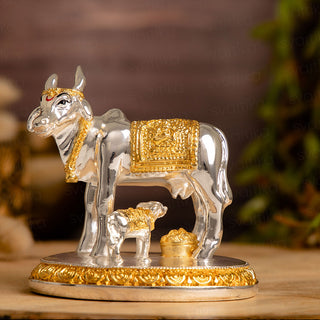
The cow-and-calf is not incidental scenery. It is the oldest image of provision in the tradition, and the story chooses it deliberately: the theft is of the thing that feeds everyone.
 27% off
Why he killed his mother — and whether she came back

This is the single most searched question about him, and the answers in circulation contradict each other flatly. Here is what the Bhagavata actually says, at 9.16.
Renuka went to the Ganges for water and saw Chitraratha, king of the Gandharvas, garlanded with lotuses and sporting in the river with celestial women. In the text’s words she was somewhat inclined toward him, and failed to notice that the hour for the fire sacrifice was passing. She came back late, put the waterpot down and stood with folded hands. Jamadagni understood what had happened in her mind, and ordered his sons to kill her.1
Two things need saying plainly. The first: the offence is mental. She did nothing. The Bhagavata is describing a moment of attention, and a missed ritual hour. The second: the elder brothers refused. Parashurama did it, and killed his brothers too when they would not.
And then — this is the part most retellings drop — he asked Jamadagni for a boon, and used it to bring them back. The Bhagavata states it directly in its own summary of the chapter: Parashurama killed his mother and brothers, and later, by dint of the austerities of Jamadagni, they were revived.1
So the answer to “did Renuka come back” is yes, in the Bhagavata, and by her son’s choice. If you have read otherwise, you have read a retelling that stopped one paragraph early. Whether obedience of that kind is admirable is a question the text leaves open and every later tradition has argued about.
The unbaked pot, and the erased memory
Two details dominate the popular telling and neither is in Bhagavata 9.16, so it is worth being exact about where the line falls.
The first is the pot. In the version most widely repeated, Renuka’s chastity was so complete that she could carry water from the river in a vessel of unbaked clay, or in some tellings roll the water into a ball with no vessel at all; the moment her attention slipped, the pot dissolved and she came back empty-handed, which is how Jamadagni knew. It is a wonderful image and it makes the offence visible rather than telepathic. It is also regional and folk, not scriptural. The Bhagavata has no pot: Jamadagni simply perceives what passed through her mind.
The second is the memory. Retellings often add that Parashurama asked for his mother back with no recollection of what had been done to her. The Bhagavata grants the revival and says nothing about her memory. That addition is doing something the text does not ask for — sparing the reader, and the son, the aftermath.
Neither embellishment is illegitimate. Living tradition adds; that is what living tradition is for. But if you came here to find out what the scripture says, the scripture says a distraction, a missed hour, an order, an obedience and a restoration — and no pot.
Across the Deccan, meanwhile, Renuka outgrew the story entirely. She is worshipped as Yellamma, a goddess in her own right, and the severed head is not edited out of her cult but built into it: at Saundatti and elsewhere the beheading is the origin, not the embarrassment. The question of how Renuka became Yellamma has an honest answer — a local goddess and an epic character were identified with each other, and the join is the beheading, which both stories already had.
The twenty-one purges

Kartavirya’s sons came back for Jamadagni while Parashurama was away, and killed him at his meditation. When his son returned and saw it, he went out to clear the earth.1
The Mahabharata does not soften what followed. It says he slaughtered them quickly, not sparing the very children; that the earth was strewn with the bodies of kshatriya children of premature birth; and that as soon as kshatriya children were born, he killed them.5 The Bhagavata adds a judgement of its own that is easy to miss: their offence, it says, was not very severe, and he killed them to lessen the burden of the world.1
That is a strange sentence to find in a text that counts him an avatar. It is not an endorsement. The Puranas are perfectly capable of noticing that their own hero has gone too far.
How do you destroy a class twenty-one times?
Every retelling asserts the twenty-one. Almost none of them answer the question any reader has within two seconds of hearing it: if he exterminated the kshatriyas, what was there to exterminate the second time, let alone the twenty-first?
The Mahabharata answers it. Adi Parva LXIV:
the Kshatriya ladies, desirous of offspring, used to come to the Brahmanas... And thus sprang the Kshatriya race from Kshatriya ladies by Brahmanas of ascetic penances.
He killed the men. The widows went to the brahmin sages for children, and the class regenerated — brahmin-fathered, kshatriya-born — and grew back into something for him to destroy again. The text adds that the new generation was long-lived and thrived in virtue, and that the four orders were re-established with the brahmanas at their head.3
Read it twice, because it quietly inverts the whole story. The twenty-one purges did not end the warrior class. They re-founded it out of brahmin descent. Whatever else that is, it is a claim about who the kshatriyas owe their existence to, made in a text brahmins compiled.
The Mahabharata is not even consistent with itself here, and the inconsistency is worth knowing. In Shanti Parva, the Earth tells Kashyapa that there were kshatriyas she had concealed among women, and that they should be brought out to protect her.5 So the epic gives two different mechanisms for the same survival — one where the line is re-fathered, one where it was hidden all along. Nobody harmonises them. They sit in the same text.
The five lakes, and the field they became

The Mahabharata opens by explaining a place name, and the explanation is Parashurama. At Samantapanchaka he made five lakes of blood, and standing in them offered the blood to his ancestors. His forefathers appeared, Richika at their head, and offered him a boon.2
What he asked for is the most human moment in the whole cycle: to be absolved of the sin of having annihilated the kshatriyas in anger, and for the lakes to become holy places. The ancestors granted both and told him to be at peace.2
Then the epic delivers its quietest and hardest line. That same ground, between the Dvapara and Kali ages, is where the armies of the Kauravas and Pandavas met, and where eighteen akshauhinis of soldiers were slain on the spot.2 Samantapanchaka is Kurukshetra. The field he filled with kshatriya blood is the field the Mahabharata is about. The epic tells you this on its second page, and then spends a hundred thousand verses filling it again.
He gave the earth away, and was ordered off it

The end of the killing is not a victory, and this is where the popular version is furthest from the text.
Having made the earth destitute of kshatriyas thrice seven times, Parashurama performed a horse-sacrifice and gave the whole earth away to Kashyapa as the sacrificial fee. Kashyapa took it — and then, to preserve what remained of the kshatriyas, pointed with the hand that still held the sacrificial ladle and told him: repair to the shores of the southern ocean. It behoveth thee not, O Rama, to reside within my dominion.5
He was evicted from the earth he had just donated. And at those words, the Mahabharata says, Ocean created for him, on its other shore, a region called Shurparaka.5
That is the textual root of every claim that Parashurama made the Konkan and Kerala by driving back the sea. In the epic it is not a conquest and not a gift. It is somewhere to put a man who no longer has a right to stand anywhere else. The coastal strip below the Western Ghats is, in the Mahabharata’s telling, a place made for an exile.
What follows is bleaker still: with no kshatriyas to protect her, the text says, the earth sank under misrule until Kashyapa held her on his lap — uru — which is why she is called Urvi.5 The purge did not produce order. It produced anarchy, and the earth had to ask for a king back.
Rama, and the two bows

The encounter every reader wants settled is usually described as a duel. In Valmiki it is not a duel at all. It is a bow being handed over, and the outcome was decided before either man was born.
Parashurama arrives on the road from Mithila, storm and darkness ahead of him, after Rama has broken Shiva’s bow at Janaka’s court. He brings a second bow and issues a challenge. Then he explains what the two bows are, and the explanation is the whole point.6
Both were made by the same divine artificer. One was given to Shiva, who destroyed Tripura with it — the bow Rama had just snapped. The other was given to Vishnu. Long before, the gods had staged a contest between Shiva and Vishnu to settle which was greater; Shiva’s bowstring, Valmiki says, twanged in vain, and the gods gave Vishnu preeminence. Shiva in his anger passed his bow to the sage Devarata, an ancestor of Janaka, which is how it came to be in Mithila. Vishnu lent his to Richika — Parashurama’s own great-grandfather.6
So Parashurama hands the young Rama the bow of Vishnu and dares him to string it. Rama strings it. And having strung it, he declines to kill: Parashurama is a brahmin, and there is Vishvamitra to consider. Instead he tells him to choose what to lose — the power of motion his penances have won him, or his heavenly worlds.6
Parashurama chooses to keep the power of motion, and gives up heaven. The reason he gives is the detail that makes the two epics lock together: when long ago I gave away the whole broad land to Kashyapa’s sway, he charged me never to remain within the limits of his reign. He cannot rest on earth by night. He needs the power to move because he has been banished, and Valmiki’s canto is titled, flatly, Debarred from Heaven.6
Before he goes he says the thing outright: I know thee Lord of Gods. The sixth avatar recognises the seventh, hands over the weapon, and walks off to a mountain. It reads less like a defeat than a shift change. For where the numbering of the avatars comes from and how the lists differ, see our guide to the ten avatars of Vishnu in order.
Which disposes of the question people actually type: who was stronger, Rama or Parashurama? Valmiki never stages it as a contest of strength, and no blow is struck. The bow decides it, and the bow had been decided long before — in the trial where Shiva’s bowstring failed against Vishnu’s and the gods ruled accordingly. Parashurama is not beaten. He is holding the weaker of two weapons in a match whose result was settled by the gods before either of them was born, and he is the first to say so.
The curse he put on Karna
This episode is missing from most accounts of his life, which is strange, because it is the one that reaches furthest forward. It is told by Narada in the Mahabharata, Shanti Parva III.4
Karna came to him for the Brahma weapon, claiming to be a brahmin, because Parashurama taught brahmins only. One day the teacher, tired from fasting, slept with his head on his pupil’s lap. A worm bored into Karna’s thigh. Rather than wake his preceptor he let it, and did not move — until the blood reached Parashurama’s skin and woke him.4
The epic describes the creature precisely: hog-shaped, eight-footed, keen-toothed, covered in bristles pointed like needles, and named Alarka. It dies the moment Parashurama looks at it, and rises as a rakshasa — the asura Dansa, who had violated Bhrigu’s wife in the Krita age and been cursed to live as a blood-drinking worm until a Rama of Bhrigu’s line released him.4 If you have seen this told with a scorpion or a bee, that is not the Mahabharata.
Then Parashurama turns on his student: no Brahmana could endure such agony. Thy patience is like that of a Kshatriya. Karna confesses to being a suta. And the curse, when it lands, is precise rather than theatrical — the Brahma weapon will not come to his memory when he faces a warrior his equal.4 It is not a withdrawal of the knowledge. It is a guarantee that it will fail at the one moment it matters.
Is Parashurama still alive, and where is he now?

By the texts’ own logic he is alive, and both epics give the same address: Mahendra, identified with the Mahendragiri range on the Odisha–Andhra border.
The Ramayana is explicit about it. When Parashurama surrenders his heavenly worlds he says he will go, swifter than thought, to Mahendra’s height — and the reason he needs that speed is Kashyapa’s ban on his sleeping anywhere on earth.6 The Mahabharata sends him to the same mountain after the twenty-one purges, to begin his penances.3 Two epics, two authors, one location, and neither ever brings him back down.
He is never given a death anywhere. The Mahabharata has him teaching Bhishma, Drona and Karna generations after the Ramayana, in a different age entirely. A figure who spans both epics as a living teacher is not being described as a memory. He is one of the chiranjeevis, the deathless ones — a group we cover separately in the seven chiranjeevis of India.
One claim in wide circulation deserves a flag. You will often read that he waits on Mahendra in order to train Kalki, the tenth avatar, at the end of the Kali age. Neither the Ramayana nor the Mahabharata says anything of the kind; they give him a mountain and no future assignment. The teacher-of-Kalki role belongs to later material in the Kalki cycle, and it is worth knowing which shelf it comes off.
The Ramayana’s own wrinkle is better than the embellishment anyway. What Rama’s arrow destroyed was his access to the worlds won by penance. So the tradition leaves him deathless and shut out of heaven, kept on a mountain by a command he will not break. He is the avatar who did his work and was not allowed to leave.
Why is Parashurama not worshipped like Rama or Krishna?
This gets asked constantly, and the premise needs correcting before the question can be answered: he is worshipped. Parashurama Jayanti falls on Akshaya Tritiya. There are temples, and a major pilgrimage at Parashurama Kund on the Lohit. Along the Konkan and in Kerala — the coast the Mahabharata says was made for him — whole communities hold him as their founding figure.
What he does not have is the household presence of Rama, Krishna or Hanuman. Three reasons are usually given, and they are worth separating by how much weight each actually carries.
The classification. Later Vaishnava theology sorts the avatars, and Parashurama is generally not placed in the same rank as Rama and Krishna, who are treated as complete descents. He is read instead as an empowered or partial one — a specific mission rather than a full life. And the Ramayana scene above is the reason that reading exists: he arrives holding Vishnu’s bow and leaves without it, having addressed the man he handed it to as the Lord of Gods. The text stages a transfer. It is hard to build a household cult around the figure who hands the power on.
The texts’ own hesitation. This is the part almost never said, and it is the best-evidenced of the three. The Bhagavata records that the kshatriyas’ offence was not very severe.1 The Mahabharata says that once he had finished, the earth sank under misrule and had to ask for a king back.5 His own ancestors, at the lakes of blood, grant him absolution and tell him to be pacified.2 These are not the sentences a tradition writes about a figure it wants in every home shrine. The reservation is in the scripture, not in modern squeamishness.
He is a guru, not a departed god. A chiranjivi is present rather than remembered. The tradition treats him as a living ascetic on a mountain — someone to be invoked, and in some accounts sought out, rather than memorialised in a sanctum. The relationship on offer is a different one.
The honest summary: the first and third are traditional reasoning, and reasonable. The second is what the primary sources actually say, and it is the one that explains the rest.
Why the story keeps its grip
Because it refuses to resolve. He obeys his father and beheads his mother, then spends a boon undoing it. He avenges a murder and keeps going until he is killing infants. He wins the earth and is ordered off it. He is a brahmin who does nothing but fight, in a scheme where fighting is somebody else’s duty entirely.
The texts do not tidy any of that up. The Bhagavata says the kshatriyas’ offence was not very severe. The Mahabharata says the earth sank once he had finished protecting it. The Ramayana takes his heaven away and has him thank the man who did it. Three works, three different reservations about the same figure, and not one of them removes him from the list of avatars.
That is a harder and better story than the one where a wronged son gets his revenge, and it is sitting in the primary sources, chapter and verse, waiting to be read.
More on the cow at the centre of it in what the Kamdhenu cow actually is, and on the seventh avatar’s own ending in how Rama died. Our Vishnu idols collection sits alongside these.
Also read: The 10 Avatars of Vishnu | The 7 Chiranjeevis of India | Who Broke the Tooth of Lord Ganesha? | The Legend of Ram, Avatar of Vishnu | Kalki Avatar: What the Texts Actually Say
Cover image: a statue of Parashurama in Kerala. Photo: Indianbeauty, CC BY-SA 4.0, via Wikimedia Commons.