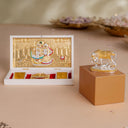
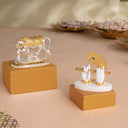
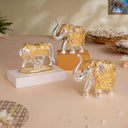
Ask ten people where Kamdhenu came from and nine will say the same thing: she rose out of the ocean when the gods and demons churned it. It is stated as settled fact on almost every page you will find on the subject.
An earlier version of this article said the Mahabharata contradicts that, because the English everyone quotes lists no cow. We went back to the Sanskrit. We had got it wrong, and the correction is better than the error.
The cow is in the Mahabharata's manuscripts, at exactly the point you would expect. She just did not survive into the English.
What does the name Kamadhenu actually mean?
Kama is desire or wish. Dhenu is a milch cow. Put together, Kamadhenu means the cow that yields what you wish for. That is a description, not a name: the way "the wish-granting tree" describes the Kalpavriksha rather than naming an individual.
A description can be applied to more than one being, and it was. Surabhi, Nandini and Shabala are all called the wish-yielding cow across the texts. Writing about "the Kamdhenu story" as though there is one quietly collapses three.
The churning of the ocean: what each text actually says
The Samudra Manthan is one of the great set pieces of Hindu narrative: Mount Mandara as the churning rod, Vasuki the serpent as the rope, and Vishnu as the tortoise Kurma holding the mountain up from below.1 It appears in several texts, and the accounts do not match.
Kisari Mohan Ganguli's translation, made between 1883 and 1896, is the standard complete English Mahabharata and the one nearly every website quotes. His list of what emerged runs: the Moon, Lakshmi in white, the goddess of wine, the white horse Uchchaihsravas, the Kaustubha gem, Dhanvantari with the nectar, the elephant Airavata, the Kalakuta poison. No cow.2
The Sanskrit is not so tidy. Two lines further on, the printed vulgate reads:
पारिजातश्च तत्रैव सुरभिश्च महामुने। जज्ञाते तौ तदा ब्रह्मन्सर्वकामफलप्रदौ।।
In plain English: And the Parijata tree and Surabhi appeared there too, great sage. Those two were born then, and they grant every wish.
Mahabharata, Adi Parva 1.18.51 (vulgate)
Surabhi is the cow of plenty. The next line adds kapila, the tawny cow.
So why is she missing in English? Because these lines sit in the manuscript apparatus rather than the settled text. The Bhandarkar Oriental Research Institute's critical edition records both as variant readings and leaves them out. Ganguli did not translate them.
The Bhagavata's eighth canto has no such hesitation. It names havirdhani, the yielder of the offering, meaning the cow whose ghee feeds the sacrificial fire. The horse follows, then Airavata, then Lakshmi, who surveys the gods, finds none worthy, and chooses Vishnu, who makes His chest her residence.4
The two texts were never in conflict. An editorial decision about which lines belong became a disagreement in translation.
Then who was the cow Vishvamitra tried to steal?
The most vivid wish-cow episode in the Mahabharata (the one everybody retells as a Kamdhenu story) belongs to a cow with a different name.
King Vishvamitra visits the hermitage of the sage Vasishtha. Vasishtha feeds him and his entire army, effortlessly, and the king realises the sage owns a cow who can produce anything. He wants her. He offers a fortune, then he tries force.
The Mahabharata calls her two things, and both matter:
तस्याथ कामधुग् धेनुर् वसिष्ठस्य महात्मनः । उक्ता कामान् प्रयच्छेति सा कामान् दुदुहे ततः ॥
In plain English: The great sage Vasishtha had a cow who milked out wishes. Told "grant what is wanted," she gave whatever was asked.
Mahabharata, Adi Parva 1.165.9
The phrase is kamadhuk dhenu, the wish-milking cow. That is the compound behind the word Kamadhenu. Seven verses later she gets a personal name, Nandini.3 So the epic uses both: Kamadhenu is what she does, Nandini is who she is.
What she yields is not what you would expect from a symbol of wealth: plants wild and cultivated, milk, and a nectar-like elixir of six flavours. Gems and robes appear only in variant lines.
But the heart of the episode is a meal. A sage feeds an army because his cow makes hospitality limitless. The wish-fulfilment in the original is dinner for everyone, not a windfall for one man. That is a warmer idea than the version that ended up on prosperity posters, and it is the one actually in the text.
The Ramayana carries a parallel telling in which Vasishtha's cow is called Shabala. Same shape of story, different name again, which is exactly the pattern. The episode also matters because it sets Vishvamitra on the path from king to sage, the same Vishvamitra who later takes a young Rama into the forest in the Ramayana's opening movement.
Three things people get wrong about Kamdhenu
1. "The Mahabharata says there was no cow in the ocean."
We said this ourselves, and it is wrong. The English omits the cow because the lines naming Surabhi and kapila were judged later additions and left in the apparatus. They are still in the manuscripts, at Adi Parva 1.18.51 and 1.18.52 of the vulgate. If someone says the two texts disagree, ask which edition they read.
2. "Kamdhenu is the cow Vishvamitra tried to seize."
Her personal name in the Mahabharata is Nandini, and the Ramayana calls her Shabala. But the epic also calls her kamadhuk in the same passage. The description travels between cows; the names do not.
3. "Scripture says a Kamdhenu statue at home brings wealth."
No text I could open says anything of the kind. What the Bhagavata actually teaches about cows is startlingly practical. In the tenth canto, during the Govardhan episode, Krishna names cow protection as a standing occupational duty, and instructs that grass be given to the cows as part of the worship itself.5 The reverence in the text is aimed at living animals and their upkeep. Not at images of them.
That does not make a Kamdhenu murti meaningless. It just means the meaning comes from the idea it holds, and it is worth being honest about which is which. We go into this properly in can we keep a Kamdhenu cow at home.
 27% off
 16% off
Why the cow, of all animals?
Look at what a cow did in an agrarian household: milk, curd, ghee, dung for fuel, bullocks for the plough. She was not a luxury, she was the working capital. A cow who gives without being depleted is the cleanest image of abundance that does not run out.
The ghee detail is the giveaway. It ties her to ritual rather than riches, since ghee is what feeds the sacrificial fire. She is infrastructure for worship before she is a symbol of money.
This is also why cows sit so close to Krishna. He is Govinda and Gopala, the cowherd, and the practice of worshipping Krishna is thick with cows, calves and pasture: several of the best-known Krishna mantras address him by a cowherd name. When Govardhan Puja comes around during the Diwali sequence, cattle are still garlanded and fed in many households. That is the tradition doing exactly what the text asked for.
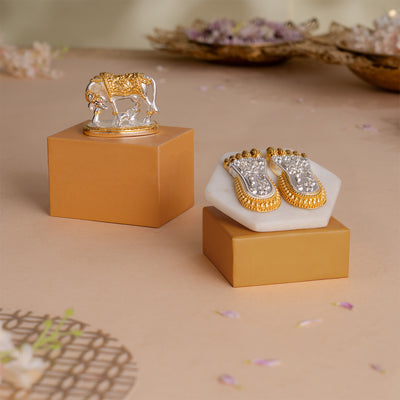
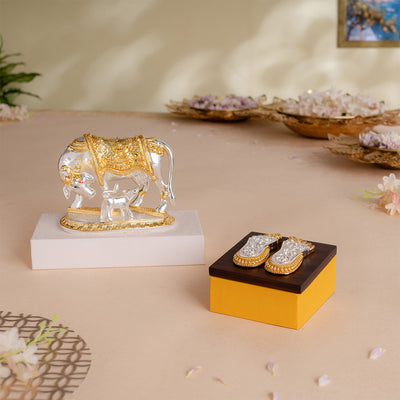
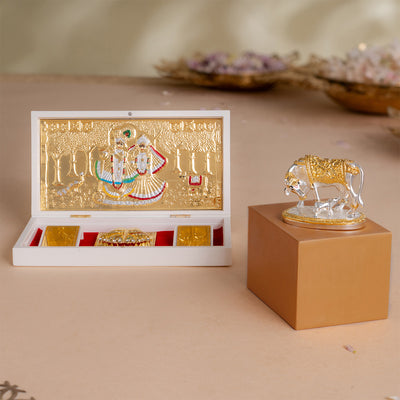
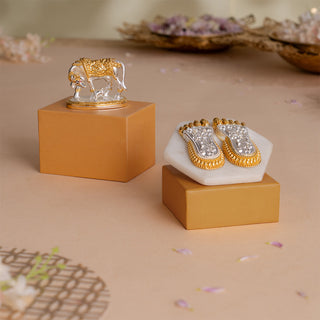
And the association with Lakshmi is easy to trace from there. Where there is a fed, healthy herd, there is a household that is doing well. Which is why Lakshmi and the cow so often share a shelf, and why the Kamdhenu is frequently paired with her charan paduka in a single set.
The calf is not decoration
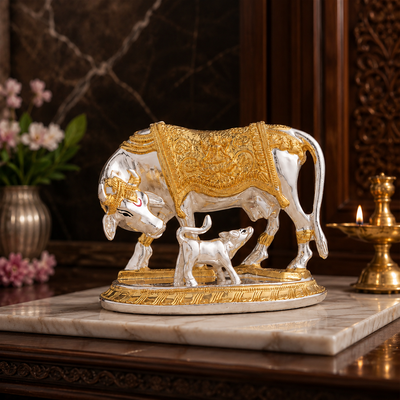
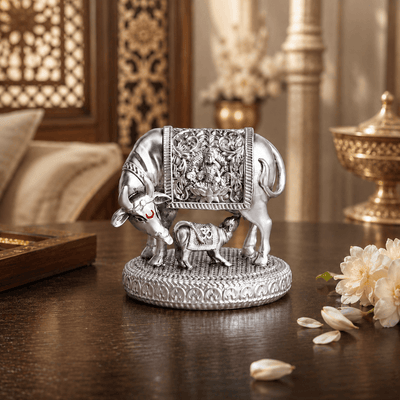
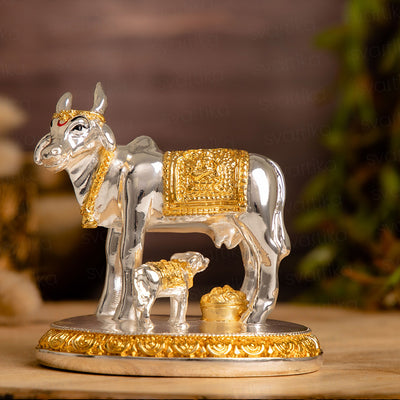
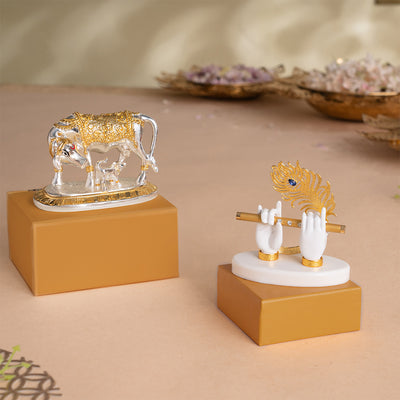
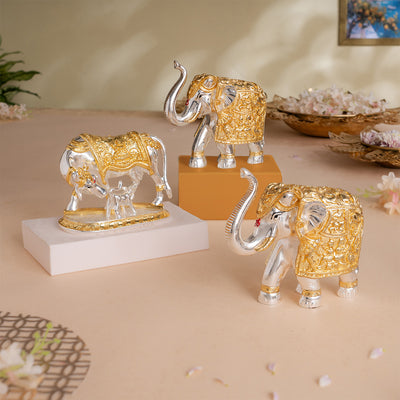
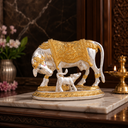
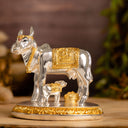
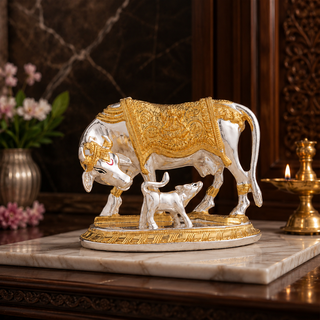
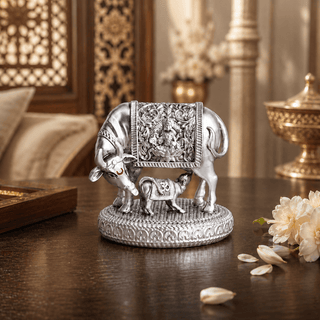
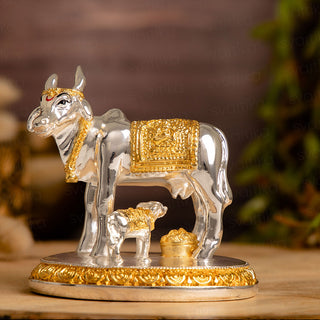
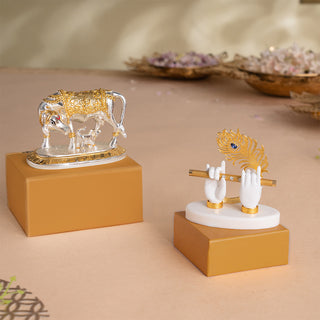
Almost every Kamdhenu murti shows a cow with a calf at her side, and the calf is doing real work. A cow with a calf is a cow in milk. The figure is about the flow, not the animal.
The wish-cows of the texts are mothers, and their gift is maternal rather than magical. Milk for whoever arrives. Less a wish machine, more a house where nobody is turned away hungry.
 0% off
 13% off
What scripture does and does not say about keeping one
There is no verse prescribing a Kamdhenu image in a home, and this is where most articles start inventing. There is no scriptural direction it must face. There is no rule about which room, which corner, or which day to bring it in. Anyone who gives you a chapter number for those things is making it up.
What the texts give you is permission, and it is broader than you would expect. The Bhagavata's deity-worship chapter lists eight legitimate materials for a sacred image: stone, wood, metal, a smearable substance like clay, painted, sand, jewels, and an image held purely in the mind.6 Sand and a mental picture sit in the same sentence as gold. The tradition never priced devotion.
The same chapter draws a distinction that clears up a lot of household anxiety: images are either installed or not installed, and only the formally installed one is bound to stay in its place. A murti on your shelf is almost certainly the second kind. It can be moved, cleaned, carried, or taken along in a car without anything being violated.
It also, interestingly, tells the worshipper which way to sit: east or north, or simply facing the deity. The direction rule in the text governs the person, not the statue. Most of what circulates as idol-facing law is later domestic custom, which we look at across Vastu-friendly home decor ideas and what to keep in a pooja room.
Worth adding: classical Vastu itself is architecture. The Brihat Samhita, the oldest surviving authority people cite, gives chapters to house-building, to finding water, to temples, to the making of idols and to their installation. It has no chapter on ornaments in a living room.7 Nearly every "Vastu decor rule" online is twentieth-century interior advice wearing a very old name, the same problem you meet with the seven running horses.
 5% off
Living with a Kamdhenu at home
None of the above is an argument against keeping one. It is an argument for keeping one honestly.
Put it somewhere you will actually look at it: a pooja shelf, an entrance console, a study desk. Somewhere clean, not underfoot. Keep it dusted; a neglected idol says more about a house than a well-placed one does, and regular cleaning is the least ritualistic and most respectful thing you can do.
Material is your call. Plated pieces hold detail beautifully; brass ages into something warmer; a small one travels well. All of them are valid, on the tradition's own terms, whatever the vastu shelf you are building.
And if you want the object to do what the texts actually ask, let it remind you of the thing it stands for. Feed a stray. Contribute to a gaushala. Keep a house where people get fed. The Bhagavata's instruction was grass for the cows, not gold for the shelf, the murti is a good memory aid for that, which is a real function and not a small one.
A Kamdhenu also makes an unusually thoughtful gift, which is why it shows up so often among vastu shanti return gifts and housewarming presents. You are handing someone the idea of a house with enough to share. That is a better wish than money.
So, what is the Kamdhenu cow?
She is the tradition's oldest image of abundance that does not run out, and she is more than one being, described by more than one text, in accounts that were never reconciled.
Surabhi rises from the ocean. Nandini feeds an army. Shabala does the same in the Ramayana. Kamadhenu is what all of them do, and the personal name of none of them.
The tradition was never troubled by this. Different communities carried different versions for centuries without anyone forcing a merge. Only the internet needed one tidy answer, and got it by flattening the rest.
The real story is better. A cow who, when you say "give," gives, and a body of manuscripts patient enough to keep every version of her.
Also read: Can We Keep Kamdhenu Cow at Home | The 10 Avatars of Vishnu | The Mohini Avatar and the Nectar | Where to Place Laxmi Charan Paduka at Home | Ganesh Laxmi Murti Position Guide