Almost every Diwali article starts with Rama coming home to Ayodhya. So we went looking for the oldest set of Diwali instructions we could actually open and read.
The Padma Purana has a whole chapter on it. Uttara Khanda 122 is titled "The Celebration of Dipavali" in the volume's own contents. It is vivid, strange, and a little unsettling. It talks about oil baths, dead ancestors and gambling. It never mentions Ayodhya.
When is Diwali Lakshmi Puja, and why does the date move?
In 2026 that day is Sunday, 8 November (New Delhi). Lakshmi Puja falls on the amavasya, the new moon, in the month of Kartika. The puja is done in the evening, after sunset.
That sounds simple until you learn what a tithi is. A tithi is not a day. It is the time the moon takes to gain 12 degrees on the sun. The moon does not move at a steady speed, so a tithi stretches and shrinks. Robert Sewell and Sankara Balkrishna Dikshit tabulated the range in The Indian Calendar (1896). The shortest tithi runs about 21 hours 34 minutes, the longest about 26 hours 6 minutes. The average is roughly 23 hours 37 minutes.2
So the amavasya tithi almost never matches one calendar date neatly. It can begin in the afternoon of one day and end in the afternoon of the next. Lakshmi Puja is kept on the day that tithi is running at sunset, because sunset is when the puja happens. That is why two panchangas sometimes give two different Diwali dates. The same elasticity moves Navratri's nine nights and Karwa Chauth's moonrise fast.
Sewell also names the exception that causes most muhurat confusion. The usual rule is that the tithi running at sunrise gives the day its name. But when a rite is fixed to a set part of the day, the tithi running at that moment governs instead. An evening puja follows the evening, not the sunrise. The same principle sets the midday window for Ganesh Chaturthi and the midnight one for Janmashtami.
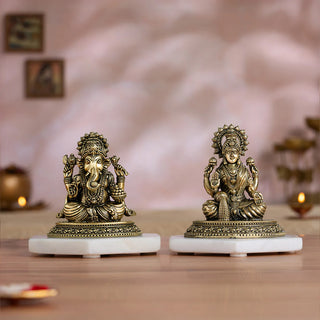
What the Padma Purana says about Dipavali
The chapter reads nothing like a modern Diwali guide. It is a list of things to do across three days, and about half of them are about getting rid of bad luck rather than inviting good.

It opens with a bath. Not an evening puja, a bath. "Laksmi (resides) in oil and Ganga in water," it says, and "He who would bathe in the morning on Caturdasi in Dipavali does not see Yama's world." That is the root of the abhyanga snan, the pre-dawn oil bath many families still keep on Naraka Chaturdashi.
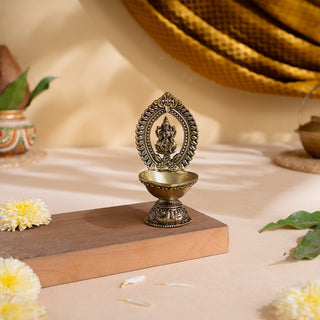
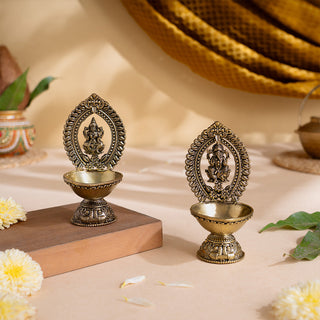
Then come the lamps, and the list of places to put them rewards slow reading. Not just the doorway. The text names temples of Brahma, Vishnu and Shiva, then "especially at apartments on the tops of the houses, sanctuaries, assembly halls, rivers, ramparts, gardens, wells, streets, pleasure-groves near houses, stables and abodes of elephants also."
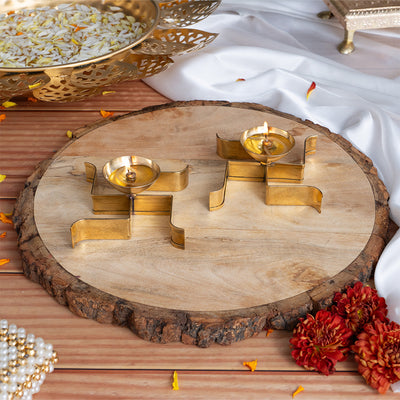
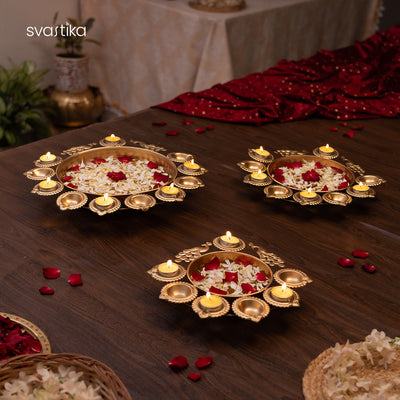
That is a whole settlement being lit, not a house. Diwali here is civic. Some of those places kept their own customs long after. William Crooke, surveying north Indian popular religion in 1896, recorded that water from seven wells was collected on the night of Diwali and used by women hoping for a child.5 The modern version, where lamps stay on our own thresholds, is a smaller idea than the one this text had. Our guide to diya decoration and our list of Diwali decoration items both begin where this chapter ends.
Why Yama keeps showing up in the oldest Diwali
The Puranic Diwali is full of death.
The chapter prescribes water libations while reciting Yama's names, a long roll-call that includes Dharmaraja, Mrtyu, Antaka, Vaivasvata, Kala and Citragupta. It says plainly that the king "should offer a light to Naraka." On the new moon day it calls for a parvana shraddha, the formal offering to dead ancestors, made with curd, ghee and milk.
So the festival of lights was also, once, a festival of the dead. Lamps for the ancestors, water for Yama, a light offered to hell itself. It lasted in folk memory too. Crooke, writing in the same decade, noted that all Hindus then believed the ghosts of the dead returned on the night of the Diwali.6 Almost none of that survives in how most families keep Diwali now, though Chhath Puja, a few days later in the same month, still carries something of that older, sterner mood.
Nobody dropped this deliberately. Festivals shed layers over centuries. But it is worth knowing that the Diwali we inherited is an edited one.
Waking Lakshmi, and driving Alakshmi out
The puja itself is one line: "Before Visnu has got up, he should awaken Laksmi through the women." The women of the house wake the goddess first, before Vishnu himself is up. The text adds that if she is woken this way, "for one year Laksmi does not leave him."1

That is Lakshmi Puja in its oldest recorded form. Not a long vidhi with sixteen steps. A household waking a guest.
Then the other half. "Alaksmi is driven out of the courtyard of the house by the joyful city-women by means of sounding the musical instruments and drums." Alakshmi is Lakshmi's elder sister, misfortune in person. She gets her own episode in the same volume, where she is finally settled at the root of the ashvattha tree.
Read that way, the whole festival makes better sense. The scrubbing of the house, the noise, the crackers, the sweeping before dark. It is not only welcome. It is eviction. You clear the house of one sister so the other will stay.
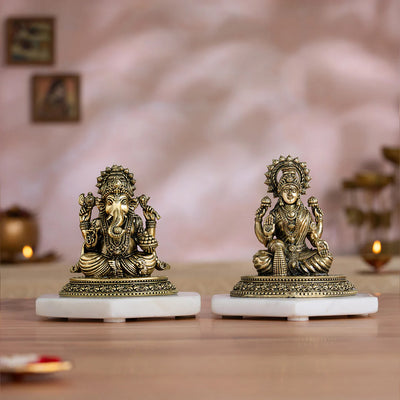
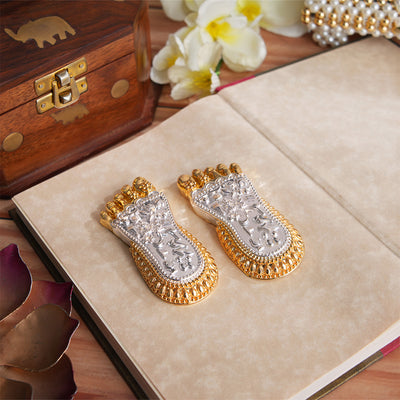
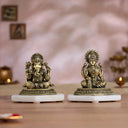
The footprint custom sits in the same logic. A Lakshmi charan paduka at the threshold marks an arrival you are hoping for, and our note on where to place charan paduka at home covers the practical side. Where the murtis themselves should sit is a separate question, answered in our Ganesh Lakshmi murti position guide.

Three things people get wrong about Diwali
1. That Diwali is only about Rama's return
The Padma Purana gives an entire chapter to Dipavali and Rama is not in it.1 Neither is Ayodhya, nor the return from exile. We searched the chapter directly.
The Rama association is real, old in practice and dearly held, and nobody needs to drop it. But Diwali is honestly a stack of several festivals that fused: a Yama and ancestor rite, a Lakshmi rite, the Bali and Vamana story, Govardhana puja, and the Rama homecoming. Picking one and calling it the meaning flattens something far more interesting. For the Rama thread properly, our piece on how Rama's story ends follows him well past the crowning.
2. That gambling at Diwali is a modern corruption
It is in the text, with a reason attached. The chapter tells how "Formerly Parvati vanquished Siva in the game of dice, and sent him away naked," and then sets an omen rule: "He who gets victory first (passes) the year happily." It directs that one "should play the game of dice at night." The Motilal Banarsidass editors flag this in the volume's preface as giving a sort of religious sanction to gambling during the festival.1
We are reporting it, not recommending it. But the idea that card night is a lapse in an otherwise pious festival does not survive contact with the source.
3. That the panchang gives one correct muhurat
There is no such thing as the panchang. Opening the Calendar Reform Committee's proceedings, Nehru said India then had "at present thirty different calendars, differing from each other in various ways, including the methods of time reckoning." The Committee's 1955 report lists more than fifty printed panchangas across seven languages.4
They disagree on real things. Whether the month ends at new moon or full moon. Which ayanamsa to use. Even the basic rule for naming a day after a tithi. Sewell gives the sunrise rule. Ebenezer Burgess, translating the Surya-Siddhanta in 1860, gives a different one: "The civil day receives the name of the lunar day which ends in it." Two authorities, two conventions.
The five days, and what each one is for
Dhanteras opens the sequence, and is when most households buy metal for the year. Naraka Chaturdashi is the oil bath day, the one the Padma Purana describes first. Lakshmi Puja falls on the Kartika amavasya, in the evening.
The morning after, the text moves straight to Govardhana puja and the honouring of cows, which are decorated and neither milked nor made to carry loads. Elsewhere that day is kept as Annakut or Bali Pratipada. Bhai Dooj closes the run, and in feeling it sits close to Raksha Bandhan, another sibling day whose oldest records look nothing like the modern version.
Regions weight these five days differently, and none of that is a mistake. It is what happens when a sequence is assembled from several older observances. One idea does run through all of them: the house is prepared before the goddess is invited. That is also the logic behind what belongs in a pooja room and which Shree Yantra suits a home.
How to fix your own puja time without a fake muhurat
Lakshmi Puja is done in pradosh kaal, the stretch of evening just after sunset, on the day the Kartika amavasya tithi is running at that hour. The one window we print, in the box above, is for New Delhi only: a minute published with no place attached is not a fact.
Pradosh is a fraction of the evening, not a fixed slot on a clock. It starts later in Ahmedabad than in Kolkata, and it shifts as sunset shifts.
So take your own city's sunset, use a panchanga published for your region, and check whether amavasya is current after that sunset. If it is, that is your day. If your family follows a particular tradition, follow that. Sewell noted that whole treatises exist for settling exactly these conflicts, and named the Nirnayasindhu as the one in general use across most of India in his time. These arguments are old, and they were never settled by a single book.
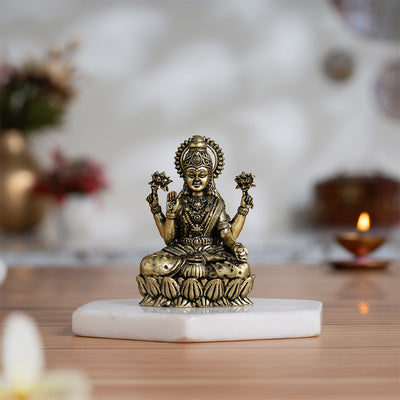
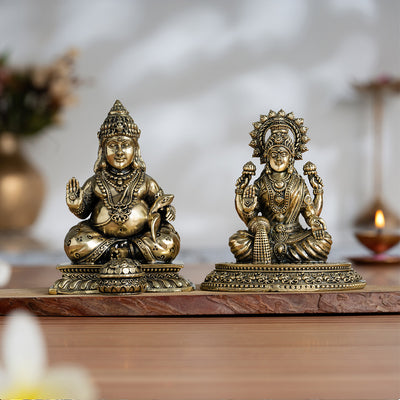
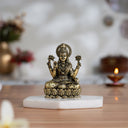
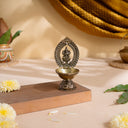
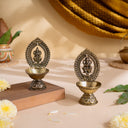
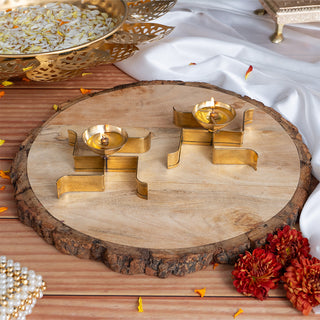
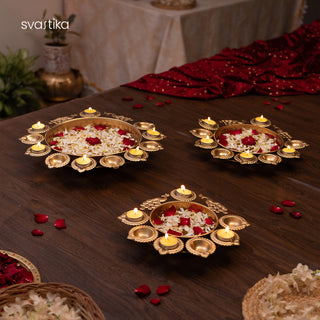
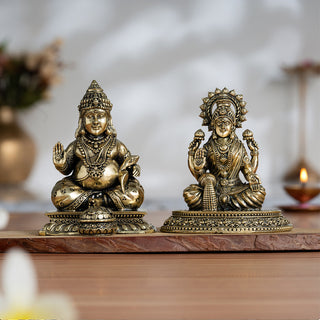
Choosing what to light, place or gift is the easier half. If the murti on your shelf needs replacing, buy a Lakshmi murti for Diwali before Dhanteras rather than on the evening, so it is unwrapped and in place by the puja. The lamps are in brass diyas, and Diwali gifts and what people buy on Dhanteras are grouped for exactly this week. If you are shopping for other people, our notes on choosing a Diwali gift and why hampers took over festive gifting may help.
The Padma Purana's Diwali is bigger and odder than the one we kept. Lamps at the wells and the elephant sheds. Water for the dead. A goddess woken by the women of the house before anyone else is up. Knowing that does not make the modern festival wrong. It just makes it visible as something people built, slowly, out of parts.
Also read: Navratri: date, tithi and fasting rules | Karwa Chauth: traditions and puja timing | Ganesh Chaturthi: muhurat, tithi and visarjan | Chhath Puja: rituals and vrat vidhi | Best Diwali home decoration items