| Day | Date | Tithi | Form of Durga | Colour |
|---|---|---|---|---|
| 1 | Sun, 11 Oct | Pratipada | Shailaputri | Orange |
| 2 | Mon, 12 Oct | Dwitiya | Brahmacharini | White |
| 3 | Tue, 13 Oct | Tritiya | Chandraghanta | Red |
| 4 | Wed, 14 Oct | Chaturthi | Kushmanda | Royal blue |
| 5 | Thu, 15 Oct | Panchami | Skandamata | Yellow |
| 6 | Fri, 16 Oct | Shashthi | Katyayani | Green |
| 7 | Sat, 17 Oct | Saptami | Kalaratri | Grey |
| 8 | Sun, 18 Oct | Saptami again | Kalaratri, second day | Purple |
| 9 | Mon, 19 Oct | Ashtami, Navami from 10:51 am | Mahagauri | Peacock green |
| 10 | Tue, 20 Oct | Navami to 12:50 pm, then Dashami | Siddhidatri, then Vijayadashami | Dashami, no colour |
The colour chart takes its first colour from the weekday Navratri begins on, orange for a Sunday, and the other eight follow a fixed order. Lists that disagree this year disagree on days eight and nine, where the repeated Saptami moves Mahagauri to Monday. Dates and tithis follow Drik Panchang for New Delhi.
Navratri 2026 day by day: what falls on which date
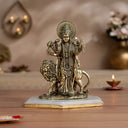
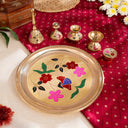
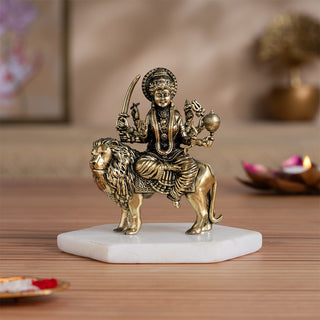
Ghatasthapana is on Sunday, 11 October. Pratipada runs from 9:19 pm on Saturday, 10 October to 9:30 pm on Sunday, and Drik Panchang gives the ghatasthapana window as 6:19 am to 10:12 am in New Delhi, with Abhijit muhurat from 11:44 am to 12:31 pm printed beside it. The second window is there for a reason. This year the morning slot falls in Chitra nakshatra and Vaidhriti yoga, both of which ghatasthapana rules traditionally avoid, so some families will wait for midday. Your family's panchang decides that, not this page. The kalash comes first and the murti sits beside it, so if the shelf is still waiting for its brass Durga idol, it needs to be home by Saturday.
The tenth day is the unusual part. Saptami is current at sunrise on Saturday, 17 October and again on Sunday, 18 October, so it names two days in a row and pushes Ashtami to Monday, 19 October. Ashtami ends at 10:51 am that morning and Navami takes over, which is why Sandhi Puja, the 48 minutes where the two meet, runs from 10:27 am to 11:15 am on the 19th. Drik Panchang lists Maha Navami on the 19th for that reason. Navami is still current at sunrise on Tuesday, 20 October and ends at 12:50 pm, so families who go by the sunrise tithi keep Navami, Siddhidatri and the parana that morning. Dashami begins at 12:50 pm, and Vijayadashami falls the same afternoon, with the Vijay muhurat from 1:59 pm to 2:45 pm.
If you keep kanya pujan on Ashtami, it is Monday, 19 October. On Navami, either the 19th after 10:51 am or the morning of the 20th can be defended, and households split on it. Kanya pujan and the mata ki chowki evenings are where Navratri gifting actually happens, and Navratri gifts for guests and hosts are worth ordering before the first morning rather than during the nine days.
In Bengal the same tithis make Durga Puja: Bodhon and Maha Shashthi on Friday, 16 October, Maha Saptami on Saturday, 17 October, Maha Ashtami and Kumari Puja on Monday, 19 October, Maha Navami on Tuesday, 20 October, and Bijoya Dashami, with sindoor khela and the visarjan, on Wednesday, 21 October, a day after the north by the Bengali reckoning. Bijoya visits start that evening, and what people carry to a Bijoya visit is its own small tradition.
Why the Navratri date changes every year
Navratri is counted in tithis, not calendar dates. The table above is only what the rule produces for 2026.
A tithi is not a day. Robert Sewell and Sankara Balkrishna Dikshit, in The Indian Calendar (1896), define it as the time the moon takes to gain 12 degrees on the sun. The moon does not travel at a steady speed, so that stretch of time keeps changing. Their measured range runs from 21 hours 34 minutes at the shortest to 26 hours 6 minutes at the longest. The average is about 23 hours 37 minutes.1
So nine tithis are not nine days. They are nine uneven slices of moon movement laid over a calendar of even 24 hour days. The two grids never line up. That is the whole reason the festival drifts, and it is the same machinery behind the Ganesh Chaturthi tithi and the Raksha Bandhan full moon.
Why Navratri is sometimes eight days and sometimes ten
Navratri lands on eight dates when one of its nine tithis is skipped, and on ten when one of them repeats. 2026 is a ten-day year: Saptami repeats on 17 and 18 October.
Because a tithi can be shorter or longer than a civil day, some tithis get skipped and some get counted twice. A tithi during which the sun never rises is expunged. Sanskrit calls this kshaya. A tithi on which the sun rises twice is repeated, called adhika or vriddhi. Sewell states that in twelve lunar months there are "generally... thirteen expunctions (kshayas) and seven repetitions (vriddhis) of tithis."
Nothing has gone wrong when that happens. The moon simply did not cooperate with the calendar that year. Sewell adds a line worth knowing: "The day on which no tithi ends, or on which two tithis end, is regarded as inauspicious."
There is a second layer. The two great authorities do not even agree on how to name a day after a tithi. Sewell gives the sunrise rule, where "the tithi current at sunrise of the solar day gives its name and numeral to that day." Ebenezer Burgess, translating the Surya Siddhanta in 1860, gives a different rule: "The civil day receives the name of the lunar day which ends in it."
Two respected sources, two conventions. Different panchanga traditions follow different ones. That is the honest mechanical answer to why your almanac and your neighbour's almanac give two dates.
There is no single Indian panchang
People say "the panchang says" as if there is one book. There is not, and there never has been.
Opening the Calendar Reform Committee in the 1950s, Jawaharlal Nehru said: "I am told that we have at present thirty different calendars, differing from each other in various ways, including the methods of time reckoning." The Committee's own report lists more than fifty printed panchangas then in circulation across seven languages.5 They disagree on the ayanamsa, on where the lunar month begins, and on the naming rule above.
Monier-Williams noticed the same thing in 1891 and named the cause plainly: "The variation in time in this and other festivals is caused by the circumstance that the months of the Northern and Southern Brahmans differ in the dark fortnight." The northern month ends at full moon, the southern at new moon. The same nights carry two different month names. It is the reason a dark fortnight fast like Karwa Chauth is called Kartika in Delhi and Ashvina further south.
What the Devi Mahatmya actually prescribes
The Devi Mahatmya is the text at the heart of Navratri. It sits inside the Markandeya Purana, cantos 81 to 93, and it tells the Mahishasura story that Durga's many arms belong to.2
In canto 92 the goddess herself gives instructions. F. E. Pargiter's 1904 translation has her promise protection to those who listen to the poem "on the eighth day of the lunar fortnight, on the fourteenth and on the ninth, with intent mind." A few verses later she names the occasion: "the great annual worship that is performed in autumn time."
So Ashtami and Navami are textual. An autumn Devi festival is textual. What the text asks for is that the poem be heard. It does not lay down nine numbered nights, a menu, or a wardrobe.
Monier-Williams, writing in Brahmanism and Hinduism (1891), describes the nine nights as practice rather than scripture: "Durga-puja, or Nava-ratra, 'nine nights,' beginning on the 1st and ending on the 10th day of the light half of Asvina." He adds that the tenth day "is called Vijaya-dasami, or Dasa-hara," which is the Dussehra everyone knows.
One more honest note. Pargiter's own introduction calls the Devi Mahatmya "a pure interpolation" into the Markandeya Purana. The scriptural core of Navratri is a text inside another text. That is not a scandal. It is just how these books were assembled.
Where the nine Navratri colours came from
The nine colour calendar is modern, and it is not scripture. Every year a chart goes around. It takes its first colour from the weekday Navratri begins on, orange for a Sunday, white for a Monday, red for a Tuesday, and the other eight follow a fixed order: orange, white, red, royal blue, yellow, green, grey, purple, peacock green.

It is not in the Devi Mahatmya. It is not in Monier-Williams' long survey of Hindu fasts and festivals. It is not in William Crooke's two volume study of north Indian popular religion from 1896, which records tiny village observances in detail.4 The scheme spread through regional newspapers in western India, and it is perhaps two or three decades old in its current form.
That does not make it worthless. A household needs some way to make nine days feel like nine distinct days rather than one long stretch, and colour does that job well. Wear the colours if you enjoy them. Just do not let anyone tell you a Purana asked for it.
The nine forms, and which book they come from
The Navadurga names are Shailaputri, Brahmacharini, Chandraghanta, Kushmanda, Skandamata, Katyayani, Kalaratri, Mahagauri and Siddhidatri.
Searching Pargiter's full translation of the Markandeya Purana for those names returns nothing usable. Only Katyayani appears at all, and not as part of any list of nine. The one hit for Kushmanda is a class of demons in a completely different canto.2
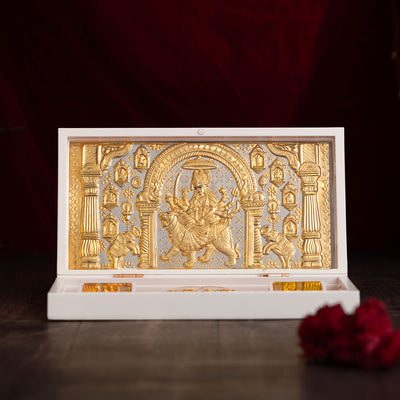
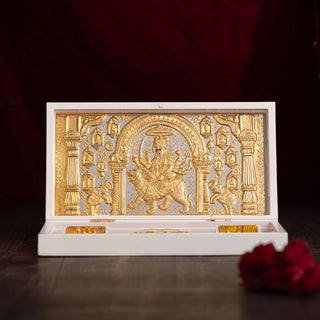
The nine name scheme belongs to the Kavacha, a protective hymn attached to the Durga Saptashati recitation manuals rather than to the Purana text itself. That is a living, widely used tradition, and a Nav Durga pocket temple that carries all nine forms in one frame follows it faithfully. It is simply a different layer of the tradition from the Purana, and it is worth knowing which is which.
Three things people get wrong about Navratri
1. That Rama worshipped Durga for nine nights before killing Ravana. This is the akalabodhana, the untimely awakening of the goddess. It is a beautiful story and it is genuinely old, but it is not in the Devi Mahatmya. The word Rama does not occur once across cantos 81 to 93 of Pargiter's translation. The episode belongs to the later regional Ramayana tradition, most famously Krittivasa's Bengali version.
2. That the colours are scriptural. Covered above. Modern, regional, newspaper driven, and fine.
3. That there is one correct muhurat. A muhurat is usually a fraction of the daylight period, not a clock reading, so it moves with your city's sunrise. Add fifty competing panchangas and two rival naming rules, and a printed time with no place attached is not a fact. Use a local almanac.
Ghatasthapana and the fasting rules
Ghatasthapana is the pot installation that opens the festival. A copper or clay kalasha is filled with water, barley is sown around it, and the goddess is invited to stay for nine days.

It is done in the first tithi of Ashvina shukla paksha. Sewell's rule matters here. His sunrise convention is for ordinary purposes, but he notes that "some religious ceremonies are ordered to be performed on stated tithis and at fixed times of the day," and then the tithi current at that moment governs instead. This is why panchangas print a ghatasthapana window rather than a whole day, and why the window differs between cities. The New Delhi window above is one city's answer; take the rule to your local almanac.
On fasting, the texts are quieter than the internet. The Devi Mahatmya asks you to hear the poem. It prescribes no menu. What people actually keep varies a lot: one meal a day, satvik food, no grain or common salt, or a phalahar diet of fruit, milk, sabudana and kuttu flour. Some fast all nine days, many keep only the first and last. Ashtami or Navami usually brings kanya pujan, where young girls are fed and honoured, a custom with its own regional gifting traditions.
Pick what your body and your family can carry. None of it is a scriptural mandate.
There are four Navratris, not two
Most people know two: Ashvina in autumn and Chaitra in spring, the one that closes on Ram Navami.
Monier-Williams recorded four in 1891: "nine nights in each of the months Asvina, Chaitra, Pausha, and Ashadha are also observed as holy nights." The Pausha and Ashadha sets are the ones now called gupta or hidden Navratri, kept quietly by tantric practitioners rather than publicly. The autumn Ashvina one is the festival the Devi Mahatmya points at, and it lands about twenty days before Diwali and Lakshmi Puja.
Same nine tithis, very different festivals
Navratri is not one festival. It is several, sharing a set of tithis.
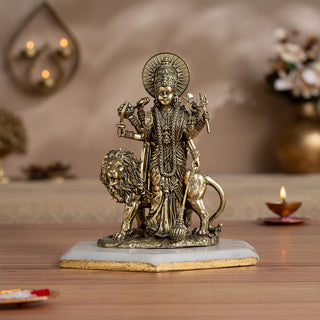
In Bengal the last four days are Durga Puja, with the ten armed image cast into the water on the tenth. In Gujarat the nights are garba and dandiya around a lamp. In Tamil Nadu it is Golu, tiered steps of dolls. Across the south the ninth day is Ayudha Puja, when tools are worshipped, and it feeds straight into Vidyarambham, when children are started on their letters.
Crooke saw that tool worship in the 1890s and wrote it down. The Nepalese, he noted, "worship their weapons and regimental colours at the Dasahra festival," and grain sellers worshipped their weights. He also recorded farmers in the Ashvina month burning a fire sacrifice in the field on one of the days of the Nauratri. Soldiers, shopkeepers and cultivators, all on the same nine tithis.
That is the real shape of Navratri. Nine elastic slices of moon movement, one very old instruction to hear a poem in the autumn, and a thousand local ways of filling the gap. The dates move because the moon moves. Everything else, including the colours, is us.
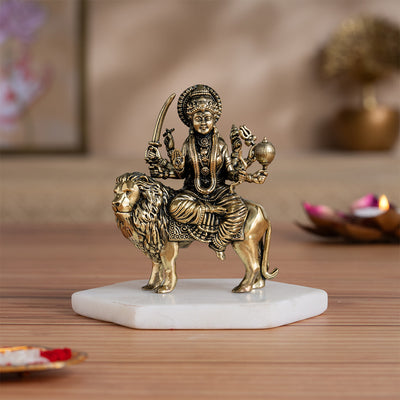
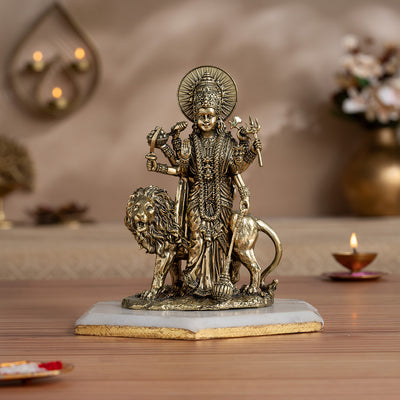
If you are setting up at home this year, our notes on home temple decoration, budget decoration ideas and what to keep in a pooja room may help, and there is a separate one for office setups. For the goddess herself, the Durga idols and brass diyas collections cover most of what an Ashvina altar needs, the Navratri gifting range handles the rest, and Durga Puja gift ideas cover the Bengali side of the same nine tithis.
Also read: Why We Celebrate Chaitra Navratri | How Many Hands Does Goddess Durga Have | Durga Puja Decoration at Home | Best Navratri Return Gifts | Krishna Janmashtami Vrat and Muhurat