Search "things to keep in pooja room for good luck" and you get a shopping list. Twelve items, fourteen items, seventeen items. Each one comes with a rule attached, and each rule comes with a warning about what happens if you break it.
So I went looking for the original list. The one in the texts.
It is about three things long. And one of them is an image you hold in your mind, which nobody can sell you.
The short answer, and why it catches people off guard
Scripture gives you a valid image, a clean seat, a direction for the person sitting down, and a list of articles offered during the ritual. It does not tell you how many idols to keep, which corner they belong in, or what colour the walls should be.
Those instructions sit in the eleventh canto of the Srimad Bhagavatam, chapter 27: Krishna explaining kriya-yoga to Uddhava. It is the closest thing the tradition has to a manual for worshipping at home rather than at a temple. Read it expecting a checklist and you will be disappointed.
That sparseness is not an accident, and it is not a gap you are supposed to fill with rules from elsewhere. It is a kindness. A short list is one an ordinary household can actually keep.
What the Bhagavata Purana actually names
An image: in any of eight materials. Verse 11.27.12 lists them: stone, wood, metal, a smearable substance such as clay, painted, sand, jewels, and an image held purely in the mind.1 Read that again slowly. Sand sits in the same sentence as jewels. A painted image sits beside a metal one. A murti that exists only in your attention counts as a valid murti.
This single verse dissolves most of the anxiety people carry into a shrine. If you have been told your resin idol is "less pure" than marble, or that only brass is fit for a home temple, the text does not agree. Material hierarchy is a market idea. The tradition is broader than the shop.
A distinction between two kinds of image. Verse 11.27.13 divides images into the moved and the not-moved. The installed deity, the text says, is not taken away or brought forward again. It stays. A non-installed image carries no such obligation. This matters enormously for home practice, because a household shrine almost always holds non-installed images. That is precisely why home worship is legitimately more relaxed than temple worship, and it is also the honest answer to whether you can keep a small murti in a car dashboard or move an idol during cleaning. You can. Portability is a recognised category, not a compromise.
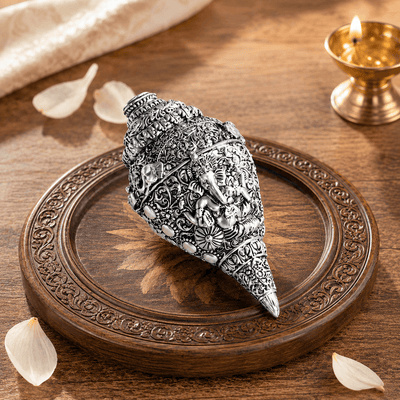
The conch. Verse 11.27.27 places the shankh among the honoured articles of worship, alongside the Sudarshana chakra. So a conch in your pooja room has real textual footing, which is more than can be said for most items on the usual lists. We have written separately on how to keep a shankh in the pooja room, including the startling detail that the Panchajanya was originally a sea-demon's body.2 If you want the chakra's story too, that one has its own history.
The one direction rule that exists, and it isn't about the idol
This is the correction I would most like people to take away.
Verse 11.27.19 does give a direction. It says to lay the seat with kusha grass pointing east, and then to sit facing east or north, or simply to sit facing the deity, whichever way the deity happens to be.1
The rule governs you. Not the statue.
Nearly every "pooja room Vastu" article inverts this. The idol must face east. The idol must never face south. Ganesha's trunk, Lakshmi's gaze, the door, the wall. Those conventions are real in the sense that families genuinely follow them, and there is nothing wrong with following them. But if you want to know what the deity-worship chapter itself instructs, it is about where the devotee's body goes when they sit down. We have covered the popular conventions in their own pieces (which direction a Ganesh idol should face and where Ganesh and Lakshmi sit relative to each other) and they are worth reading as practice, not as law.
Notice also what the rule quietly implies. "Or facing the deity, whichever way it is" is a text making room for real rooms. Small flats. Odd corners. A shelf that only fits one way.
So what is actually worth keeping? An honest list
Here is the list with labels attached, so you know what you are holding.
A murti or image you can look at properly. Textual. Any of the eight materials. Choose by what draws your attention, not by price. If you are picking a first idol, our guides on which Ganesha idol suits a home, keeping a Shiva statue at home, a standing Vishnu idol and which Hanuman idol works best go into the iconography properly.
A clean, defined seat for the worshipper. Textual, and the most overlooked item on any list. The Bhagavata specifies the seat before it specifies anything decorative. A mat you keep only for this is enough.
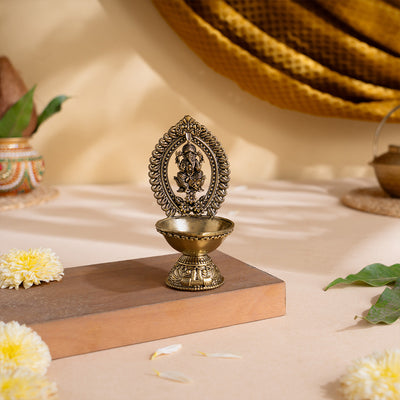
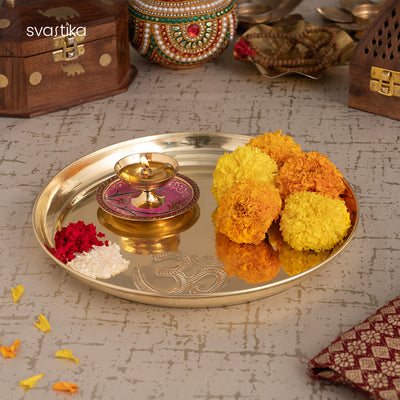
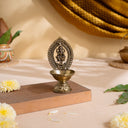
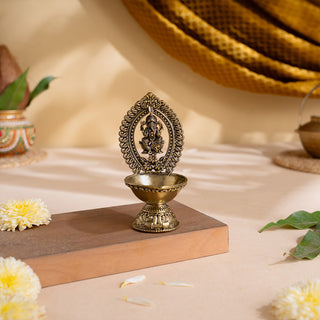
A lamp. Custom, and very old custom, woven through temple and household practice everywhere in India. The Bhagavata's worship sequence involves offerings of light among other articles, but the elaborate rules about lamp counts and wick numbers are living tradition. Keep a diya because a flame changes a room, not because a rule says five wicks.
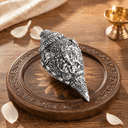
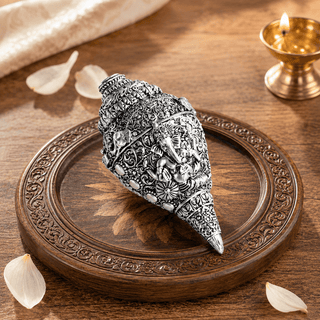
A conch. Textual, per 11.27.27. If you keep one, keep it clean and keep it where it is not knocked about. This silver-plated Ganesh shankh is the piece we would put on a shelf where it will actually be seen rather than stored.
Flowers, water, incense, food offerings. Textual as categories, in the sense that the worship chapter describes offering articles to the deity. The specific rules (this flower for this god, never that leaf) are regional and sometimes very local, though some have long lineages worth knowing. See Ganesha's favourite flower and why tulsi is kept away from Ganesha.
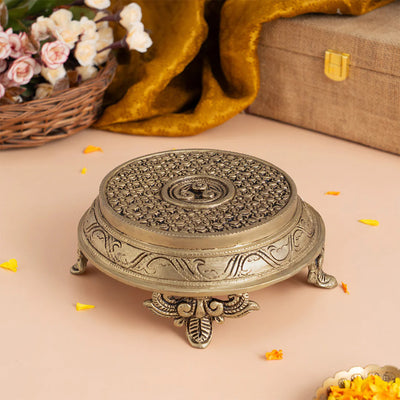
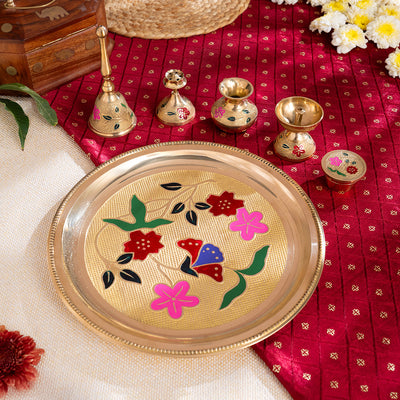
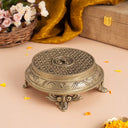
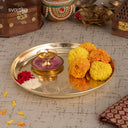
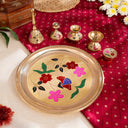
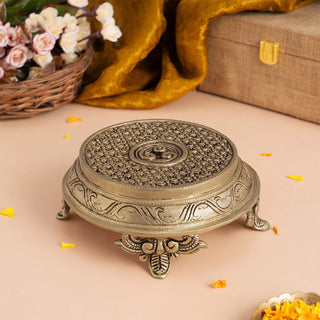
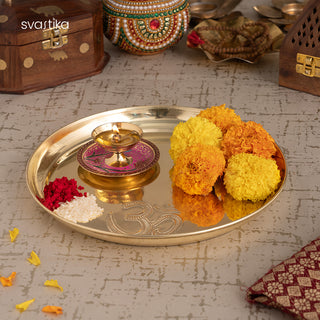
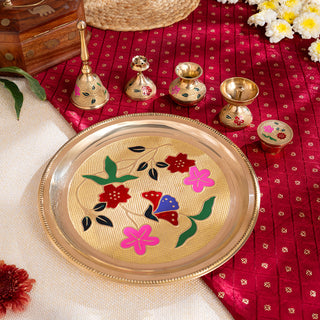
A chowki or raised platform, a thali, a bell, kumkum, a yantra. All custom, all useful, none prescribed by the texts we read. That is not a reason to skip them. A raised seat keeps a murti off a dusty shelf, which is a dignity argument, and dignity is something the tradition does care about. On the yantra question specifically, our piece on which Shree Yantra is best for a home found that the Saundarya Lahari, the classic source, describes the geometry at verse 11 and never once names a material.
Where Vastu Shastra actually applies
Most "pooja room Vastu" advice is not Vastu Shastra. It is twentieth-century interior advice wearing a very old name.
You can check this yourself. Varahamihira's Brihat Samhita is the classical proto-Vastu authority. Open the table of contents in V. Subrahmanya Sastri's 1946 translation and the shape of the subject is obvious: Chapter 58 is House-Building. Chapter 59 is the Exploration of Water Springs. Chapter 62 is the Description of Temples. Chapter 64 describes idols, and Chapter 66 covers their installation, and both sit after the temple chapter, because they are about temple images and consecration.3
There is no chapter on ornaments in a living room. There is no chart of where to put a mirror. Chapter numbers even vary between editions, which tells you something about how settled this "rulebook" really is.
Scholarship backs the same point from another direction. Apte and Supekar's 1983 comparative study of the Vastu-Purusha-Mandala in the Paushkara Samhita against the Brihat Samhita, published in the Bulletin of the Deccan College Research Institute, found meaningful divergence between the texts on the core construction grid itself. Classical Vastu is a comparative, argued tradition. Not one book with one answer.
What survives that scrutiny is still worth keeping: light, air, orientation of the building, uncluttered thresholds, and a clean space set aside for worship rather than borrowed from another use. Those are real principles from a real building tradition. We have written more about what holds up in Vastu-friendly home decor.
Five things people get wrong about pooja rooms
1. "The idol must face east or it brings misfortune." The deity-worship chapter's direction rule is for the worshipper: sit facing east or north, or facing the deity (Bhagavata 11.27.19). Idol-facing rules are later domestic convention.
2. "Only marble or brass is a proper material." Eight materials are listed as valid, including clay, sand, paint and a purely mental image (11.27.12). The hierarchy is commercial, not scriptural.
3. "Never move an idol once placed." Close to the opposite of what the text says. Only the formally installed deity is bound to stay put; a non-installed image is portable by design (11.27.13).1 Cleaning, shifting shelves, carrying a murti while moving house: none of that is a violation. Our guide to cleaning a marble idol assumes exactly this.
4. "Vastu Shastra prescribes where to put statues and decor." The classical texts are about construction and temples. Whether that is a horse statue, a Kamdhenu cow or Lakshmi's charan paduka, we could not locate a classical prescription for any of them.
5. "There are fixed rules about two shankhs, or shankh water for Shiva." We could not find these in Bhagavata 11.27, in 10.45, or anywhere in the Brihat Samhita's chapter structure. They are living customs, sometimes held very strongly, and they deserve to be described as customs rather than dressed up with an invented verse number.
A pooja room the texts would recognise
Strip it back and it looks like this. One image you can see clearly, in whatever material you have. A clean place to sit, facing east or north, or simply facing the murti. Water, a flame, something growing, something offered. A shelf that is not also where the keys go.
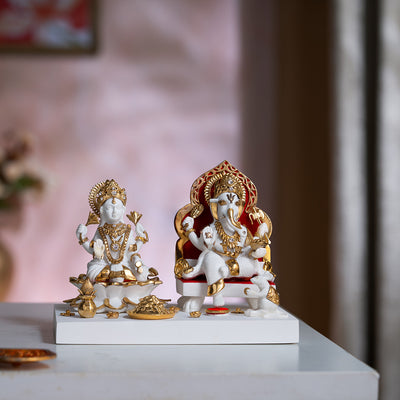
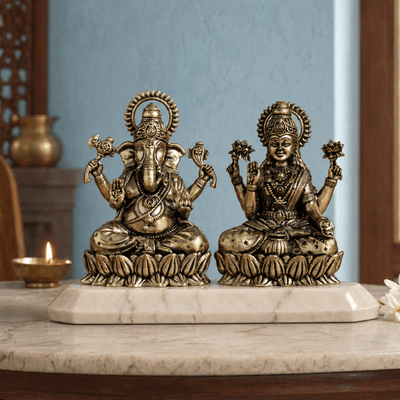
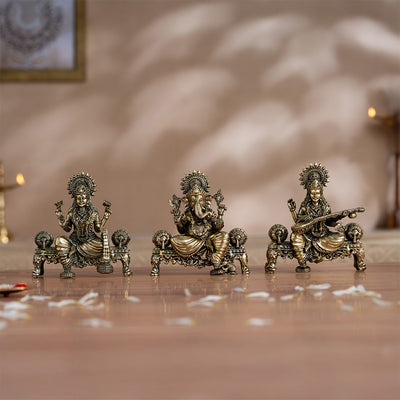
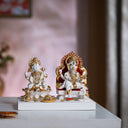
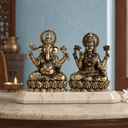
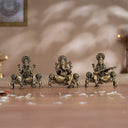
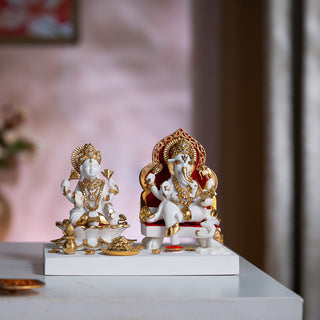
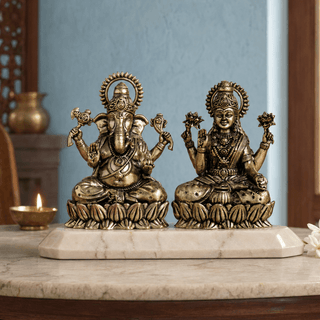
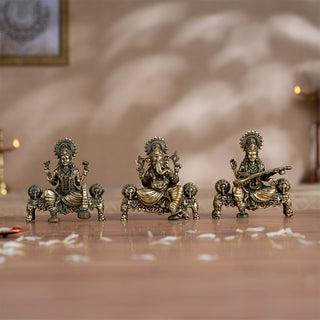
Everything past that is yours to choose. The Ganesh-Lakshmi pairing most Indian homes keep is custom, and a lovely one, especially around Diwali Lakshmi Puja, and a household that already keeps Ganesha elsewhere often keeps a Lakshmi murti on her own. A thali, bell and chowki are custom too, and they make the daily ritual easier to actually do, which counts for a great deal. If you are setting up for a festival, our notes on Diwali home decoration and on decorating a Krishna idol are practical rather than prescriptive, on purpose.
The texts are relaxed about objects and serious about attention. There is a reason the eight-material list ends with an image held in the mind. Whatever you keep on that shelf, the shelf is not the point. Turning up at it is.
Also read: How to Keep Shankh in Pooja Room | Ganesh Laxmi Murti Position Guide | Which Shree Yantra is Best for Home | Vastu-Friendly Home Decor Ideas | How to Worship Lord Krishna