Somebody, at some point, told you not to bring a standing Vishnu murti into the house. Maybe a relative. Maybe a vastu consultant. Maybe a blog with a lot of confidence and no citations.
The usual reason given is that a standing deity is "about to leave", or that the pose brings restlessness into the home. It sounds plausible. It has the shape of an old rule.
So we went looking for the rule. We read what the iconographic texts actually classify, and what the Puranas say about how Vishnu is meant to be seen. The rule isn't there. What is there is far more interesting, and much more useful when you are actually standing in a shop deciding which murti to take home.
Why nobody can show you the verse
There is no verse that says "a standing Vishnu image may be kept at home." There is also no verse that says it may not. That is the honest part, and this article is built on it: proving that something is absent is different from proving something is present.
The reason is simple. This was never a controversy in the texts. The Shilpa Shastra tradition is the body of technical literature on how images are made and installed. It spends enormous care on proportion, on material, on the direction an image faces, on which weapon goes in which hand. If a whole posture had been banned from domestic worship, that is exactly the kind of instruction those texts would have recorded, and recorded loudly.
Instead, standing is treated as one of the standard poses. The Shilpa texts call it sthanaka, and they subdivide it: samapada-sthanaka, where the feet are level and together, and kayotsarga-sthanaka, the free-hanging-arms stance. There are even names based on how far apart the feet are set: vaitastika and ardhavaitastika.1 That level of technical detail is not how a tradition talks about a pose it disapproves of.
Vishnu is specifically named among the deities regularly shown in sthanaka. That is the whole answer to the title question. The rest of this article is about what the texts do care about, because that turns out to be worth knowing.
What the Shastras actually sort images by
The Shilpa tradition divides images by mood and function, not by posture. A yoga-murti is the deity shown in meditation, absorbed, turned inward. These are prescribed for riverbanks, forests and mountain tops, deliberately away from human habitation.3 A bhoga-murti is the deity shown in a domestic situation, gracious and available, and these are prescribed for temples built in towns and inhabited places.2
Read that again, because it quietly settles the question. The tradition does have a category for "the image that belongs where people live." It is defined by the deity's mood and relationship to the devotee. Posture never enters the definition.
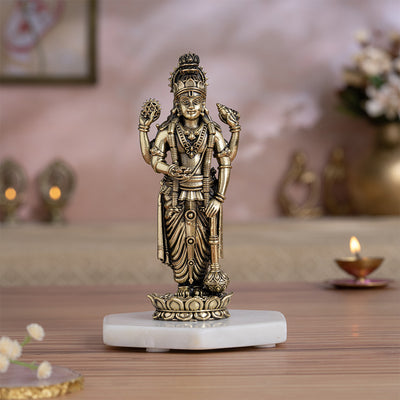
A standing Vishnu with the conch and discus raised in blessing is a textbook bhoga mood. He is dressed, crowned, attended, turned toward you. That is an image made for a household. The same logic covers a Shiva statue at home, which people worry about for the same reasons and with the same lack of textual basis.
There is a third category too, the vira-murti, the deity in a fierce or warlike aspect. That one is handled with more caution in practice, and it is why people keep an ugra Narasimha differently from a peaceful one. If you want to see how ferocious that form gets, the Narasimha avatar is the sharpest example in the whole Vaishnava canon. But a standing Vishnu is not a vira image. He is the calm one.
Standing, seated, reclining: what each posture is saying
Posture is not a permission question, it is a choosing question. Vishnu is shown in three broad attitudes, and each carries a different feeling.
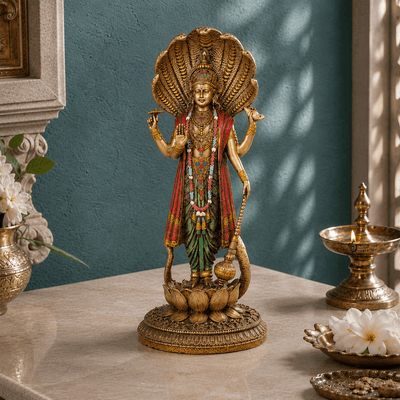
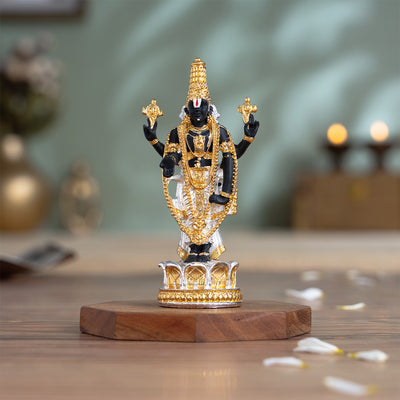
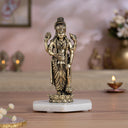
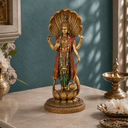
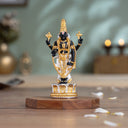
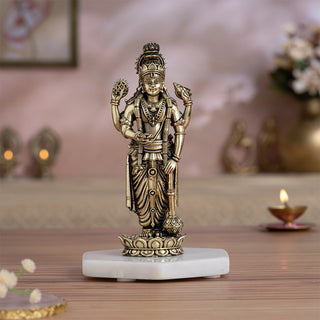
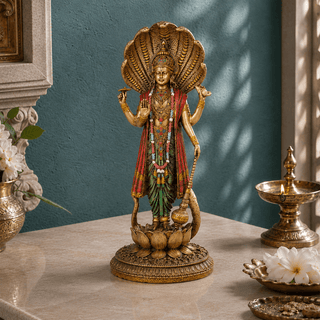
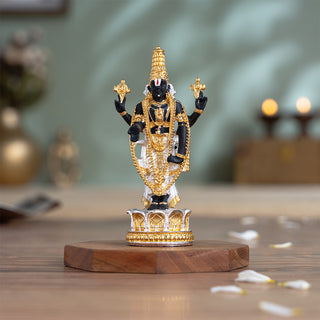
Sthanaka (standing). Upright, usually four-armed, holding the conch, the discus, the mace and the lotus. This is Vishnu as the one who acts. The avatars are all descents, all arrivals, and the standing form is the posture of a god who arrives. In a home shrine it reads as readiness and blessing. A standing brass Vishnu murti is the most direct version of this: no throne, no serpent, just the god upright with his attributes, which is exactly how the Puranas describe him when they describe him at all.
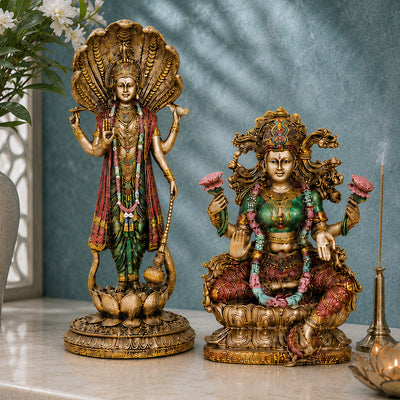
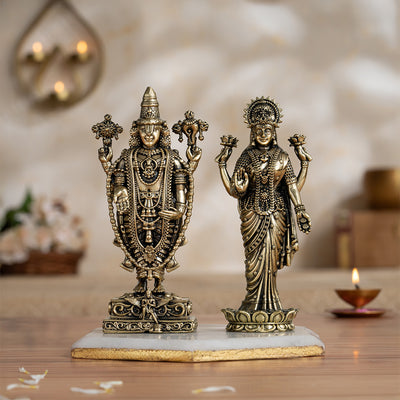
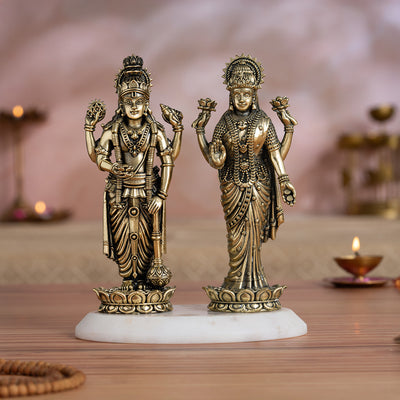
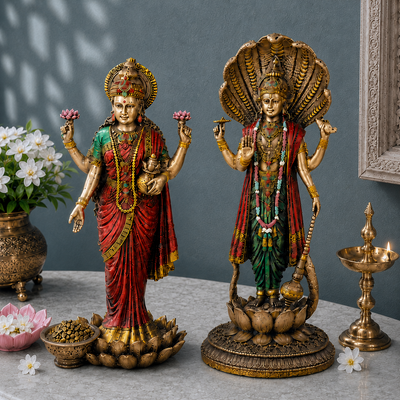
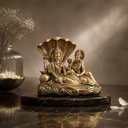
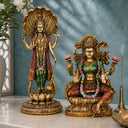
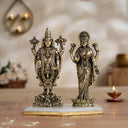
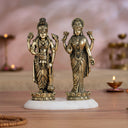
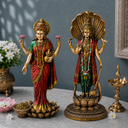
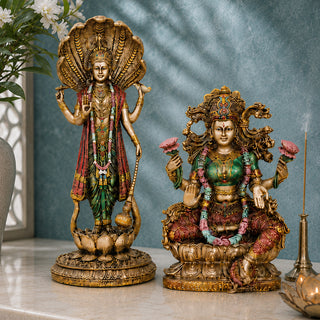
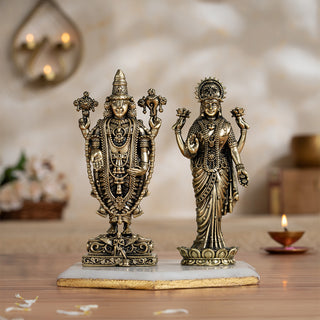
Asana (seated). Vishnu enthroned, often with Lakshmi. This is the audience posture: the deity settled, receiving, giving. Households that want a shrine centred on stability and household prosperity often lean here, which is also why Vishnu Lakshmi pairs are so common in Indian homes.
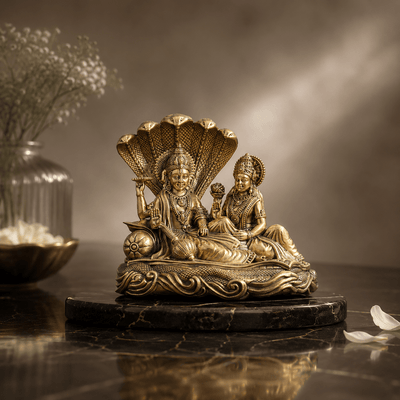
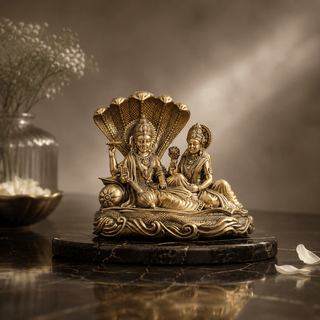
Shayana (reclining). Vishnu asleep on the serpent Ananta on the cosmic ocean, with Lakshmi at his feet. This is the Anantashayana form, and it is the strangest and most beautiful of the three. It is the god at rest between cycles of creation, dreaming the next world into being. The Vishnu Purana's Varaha account has the earth set down on the water "where it floats like a mighty vessel".4 The same ocean, the same stillness underneath everything.
None of these is holier than the others. They are three answers to the question "what is God doing right now", and the tradition kept all three.
Three things people get wrong about this
1. "A standing idol means the deity won't settle, or will leave." This is modern consultancy advice. It has no textual basis we could locate in the Agamas, the Shilpa Shastra literature or the Puranas. The idea seems to borrow a bit of human body language: a standing guest is leaving. It then applies that to a form the texts describe as permanent and self-established. It is worth saying plainly: if someone tells you this, ask them for the source. There isn't one.
2. "Standing images are only for temples, seated ones for homes." The temple-versus-home distinction in the Shastras exists, but it runs along the yoga-murti and bhoga-murti line described above: meditational images away from habitation, domestic-mood images in inhabited places. Some of the most famous standing Vishnu forms in India, including the one at Tirumala, are worshipped daily in the most crowded, most inhabited places imaginable. If you want the story behind that particular standing form, we've covered who Balaji is separately.
3. "The four arms and weapons make it a fierce image, so it's risky at home." The conch, discus, mace and lotus are not a battle kit. They are identifiers. In Valmiki's Ramayana, when Brahma finally tells Rama who he really is, the description used is "the Lord Narayana himself, the glorious god, who wields the discus".5 The discus is how you know it's him. The weapons even have their own tangled backstories. The Mahabharata says Agni gave Krishna the discus after the burning of the Khandava forest, which is not the version most people have heard.8 We went through that in who gave the Sudarshan Chakra to Krishna.
What the tradition does ask of you
Once you stop worrying about posture, the actual instructions come into focus. They are less exotic and much more demanding.
Keep it consistently. The strongest theme across the ritual literature is not placement but regularity. A murti that is offered water, light and attention every morning is being worshipped. One that is dusted twice a year is decor. This is the same principle behind what goes into a pooja room in the first place.
Keep it clean. Physical cleanliness is treated as a real requirement, not a nicety. Brass tarnishes, marble stains, and both are easily handled if you keep a routine: our guide on cleaning a marble idol covers the basics without damaging the surface.
Give it a settled place. Not a shelf that gets rearranged, not a console table that doubles as a key drop. A fixed spot, raised off the floor, ideally in the northeast of the home. The same reasoning shapes where Ganesh and Lakshmi go and where charan padukas are placed.
Don't let the shrine become styling. This is the one thing the texts are genuinely firm about. A bhoga-murti belongs in an inhabited place because the deity is being hosted there. Hosting has obligations. It is the difference between a shrine and a display, and it applies just as much to a decorated Krishna idol or a Kamdhenu cow at home.
Choosing a standing Vishnu murti for your home
A few practical things, learned from people who actually keep these shrines.
Scale it to the shrine, not to the room. A 12-inch standing Vishnu needs vertical clearance and a stable base. A 6-inch one sits comfortably in a mandir cabinet. Measure before you buy; the standing Vishnu idols for the home that we make are six, eleven and twelve inches tall.
Check the base. Standing figures carry their weight high. A wide, heavy base is not a design detail, it is what stops the murti tipping when someone shuts a door. Good brass idols are cast with this in mind.
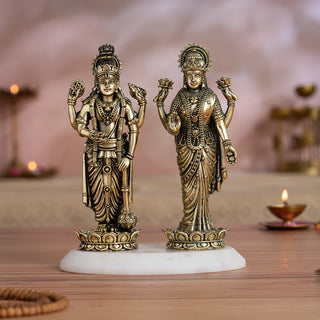
Decide alone or paired. Vishnu alone reads as protection and order. Vishnu with Lakshmi reads as household abundance. Both are traditional; it is a question of what your shrine is for. The same choice comes up with Hanuman idols and Ganesha idols.
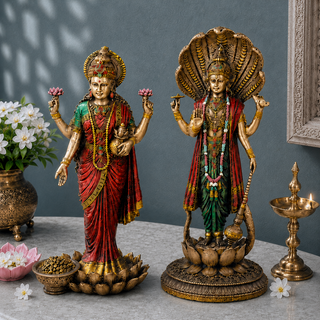
Material matters less than you think. Brass, panchdhatu, marble dust, gold-plated resin: the texts care about the image being whole and undamaged far more than about which sanctioned material it is made from. A chipped or cracked murti is the one real disqualifier in traditional practice.
So, the answer
Yes. Keep the standing Vishnu at home.
The tradition that produced these images was not squeamish about posture. It gave standing a technical name, subdivided it, and used it for its most beloved deities. What it asked for instead was steadiness from the person keeping the image: daily attention, a clean and fixed place, and the understanding that you are hosting someone rather than arranging an object.
That is a harder rule than "don't buy the standing one." It is also the real one. And if you want to know who the deity in your shrine actually is, past the four arms and the crown, the Puranas are unexpectedly generous with detail: from the fish who towed a boat through the flood to the tortoise who felt a mountain grinding on his back as a pleasant scratch.7 Explore the full range of Vishnu idols when you're ready to choose.
Also read: The 10 Avatars of Vishnu | Who Is Lord Vishnu's First Devotee? | The Vamana Avatar and King Bali | Can We Keep Horse Statues at Home? | How to Keep a Shankh in Your Pooja Room