It starts with a man doing something ordinary. King Satyavrata is standing in the river Kritamala, offering water, the way people still do at dawn. He lifts a palmful, and there is a tiny fish in it.
He tries to put it back. The fish asks him not to.
That is the whole beginning of the first of the ten avatars of Vishnu. No thunder, no army. A small fish in a cupped hand, asking for protection.
What actually happens in the Matsya story
The Bhagavata Purana gives the fullest version, in Canto 8, Chapter 24.1 Satyavrata is described there as a great devotee who was living on water alone. The fish appears in his palms while he is making his morning offering (8.24.12).
He puts it in his water pot. By morning it has outgrown the pot. He moves it to a well, then a lake, then a larger body of water, and every time it fills whatever it is given. Eventually he carries it to the ocean, and the fish protests even that.
By then Satyavrata has understood. This is not a fish. He asks who it is, and the Lord tells him plainly: in seven days the three worlds will go under. A boat will come. Take the seven sages, take herbs and seeds, take every kind of living creature, and get in.
The flood arrives on schedule. And here is the detail people forget: the boat has no sail and no oars. It is tied to the fish. "Following the instructions formerly given by the Supreme Personality of Godhead, the King anchored the boat to the fish's horn, using the serpent Vasuki as a rope" (8.24.45).
So the picture is a golden fish with a single horn, a rope made of a living serpent, one boat, seven sages, and the seed of everything that will ever grow again. That is the image every painter and sculptor has been trying to get right for a thousand years, and it is why the forms of Vishnu are so often shown with water somewhere in them.
The part almost every retelling drops: the stolen Vedas
Matsya came to recover the stolen Vedas, not only to save life. Most retellings drop this half of the story.
The chapter opens before the flood, with a theft. "At the end of Brahma's day, when Brahma felt sleepy and desired to lie down, the Vedas were emanating from his mouth, and the great demon named Hayagriva stole the Vedic knowledge" (8.24.8).
Read that again. The end of a cosmic day. The creator getting drowsy. Scripture slipping out of his mouth as he nods off, and a demon quietly taking it. It is one of the strangest and most human images in the Puranas, and it gives the whole story its stakes. The flood is not only about drowning. It is about the world losing its instruction manual.

Brahma, whose mind-born sons carry so much of the tradition's transmission, is not the villain here. He is simply tired, at the end of his day, the way anyone is. Matsya's job is to get back what was lost while he slept.
The quietest detail in the whole story
While the world is underwater, Matsya teaches.
The flood lasts a very long time. The boat stays tied to his horn. And through all of it he is talking to the king and the sages on board.
The Bhagavata says the Lord, appearing as a fish, explained the Absolute Truth to Satyavrata and the sages in that boat, giving them self-realisation through sankhya-yoga and eternal Vedic knowledge (8.24.54-56). The whole crossing is a classroom. Everything that can be destroyed is being destroyed outside, and inside the boat someone is patiently explaining the difference between matter and spirit.
Satyavrata comes out of it changed. "King Satyavrata was illuminated with all Vedic knowledge by the mercy of Lord Vishnu, and in this period he has now taken birth as Vaivasvata Manu, the son of the sun-god" (8.24.58). He is not Manu when the story starts. He becomes Manu because of what happened on that boat.
Get the name right and the story reads differently. Satyavrata is a king who is rescued and then educated, and the education is the actual reward.
Is Matsya really the first avatar of Vishnu?
Yes in the standard list, no in the oldest texts.
In the Dashavatara sequence, Matsya is first. That list runs on cosmic time, so it begins in water and moves outward: fish, then Kurma the tortoise, then Varaha the boar, then Narasimha the man-lion, then Vamana the dwarf, and on through Rama and Krishna to Kalki. Matsya opens it because water comes first.
But the Bhagavata Purana, which is the text most people are quoting when they talk about avatars at all, keeps its own list in Canto 1, Chapter 3.2 That list names twenty-two descents, starting with the four Kumaras. In it, Matsya is tenth (1.3.15). Kurma is eleventh. Mohini is thirteenth. Rama is eighteenth, Krishna twentieth.
And then, having counted to twenty-two, the same chapter shrugs and says the incarnations of the Lord are innumerable, like rivulets from inexhaustible sources (1.3.26).
So "first avatar" is true of one list and not of another, and the tradition itself says the counting was never the point. If you want a sense of how large that idea gets, the avatars of Shiva run into similar arithmetic, and the number is never really the answer there either.
The fish was not always Vishnu's
The fish in the oldest version of this story is not Vishnu at all.
The oldest surviving version of the flood-and-fish account is in the Shatapatha Brahmana, at 1.8.1, and there is no Vishnu in it. A fish warns Manu, Manu keeps it, the fish grows, the flood comes, the fish tows the boat. The fish is simply a fish who speaks, and later Vedic-era reading tends to identify it with Prajapati, the lord of creatures.9
Then the Mahabharata retells it in the Vana Parva, and the fish reveals himself at the end. He says he is Brahma.7
Only in the Puranas does the fish become Vishnu. The Matsya Purana names him as Vishnu and, in a small variation worth noticing, uses the serpent Shesha as the rope instead of Vasuki.6
Three texts, three answers about who the saviour actually was. That is not a flaw in the tradition. It is what a story looks like when it is genuinely old and has been carried by many hands. Anyone who tells you there is one fixed version of any of this, including where the Sudarshana Chakra came from, has not opened enough of the texts.
Three things people get wrong about Matsya
1. "The king Matsya saved was Manu."
In the Bhagavata he is Satyavrata, a king of the Chakshusha manvantara, and he becomes Vaivasvata Manu afterwards, by the Lord's mercy (8.24.10-11, 8.24.58). Calling him Manu at the start of the story quietly deletes the transformation that the story is about. The Shatapatha Brahmana version does call him Manu from the beginning, which is probably where the confusion started.9
2. "Matsya is the first avatar, full stop."
He is first in the Dashavatara because that list is ordered by cosmic time. In the Bhagavata's own enumeration he is tenth of twenty-two (1.3.15), and the same chapter then says the descents cannot be counted (1.3.26). Both statements are in the same text, a few verses apart. Neither is being hidden.
3. "Matsya just pulled a boat."
He recovered the Vedas from Hayagriva (8.24.8), and he spent the entire flood teaching sankhya-yoga to the people on board (8.24.54-56). A rescue is the smaller half of what happens. This is the same pattern you find in the other descents: power in these stories is almost never the interesting part, and the texts know it.
Is this the same story as Noah's flood?
Nobody knows, and "we do not know" is the accurate position.
Flood accounts turn up across the ancient world. Mesopotamia has Utnapishtim in the Gilgamesh epic. The Hebrew Bible has Noah. India has this. Scholars have argued about borrowing, shared memory of real floods, and independent invention for two centuries, and no one has settled it.
What is worth noticing is what is different rather than what is similar. Noah's cargo is animals. Satyavrata's cargo is animals, herbs, seeds, seven sages, and scripture. The Indian version is at least as worried about knowledge surviving as about bodies surviving. And the voyage itself is a lesson, not just an escape.
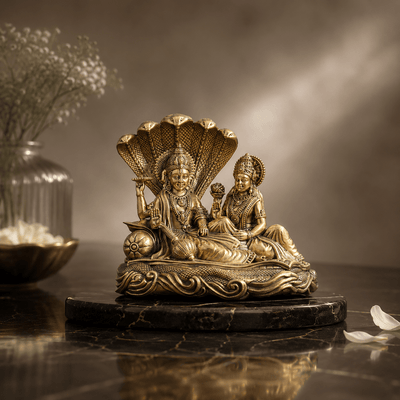
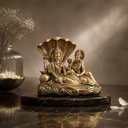
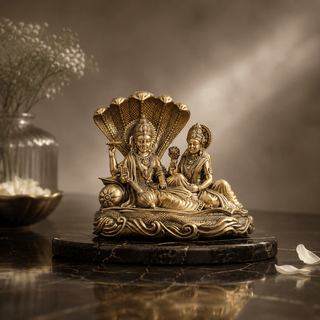
There is also the matter of time. In this cosmology the flood is not a one-off punishment. It is a pralaya, a dissolution at the end of a cosmic day, and it will happen again. Between one cycle and the next, Vishnu is described as resting on the serpent Ananta on the cosmic waters. That image, which you can see in murtis like the Narayana on Ananta-Sajya, is really the same scene as Matsya's flood, seen from the other side: the world dissolved, the waters everywhere, and the one who is not going anywhere.
Why a fish, and what he looks like
The choice of form is not random in any of the descents. The boar in the Varaha story is read in the Vishnu Purana as the Vedic sacrifice itself in bodily shape.8 The wish-fulfilling cow Surabhi rises from the churned ocean because the ocean is being asked to give everything it holds.
The fish is the one form that can move through a world that is entirely water. When there is no ground left, the only thing that can carry you is something at home in the flood. That is the logic, and it is why Matsya has to come first in the cosmic-time list. Nothing else could function yet.
In sculpture and painting he appears two ways. Sometimes he is a full fish, gold-scaled, with the horn the boat is tied to. More often he is shown from the waist up as a four-armed Vishnu, conch and discus in the upper hands, with the lower body of a fish. Both are traditional. Neither is more correct.

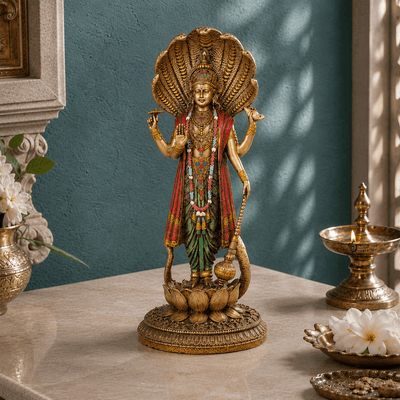
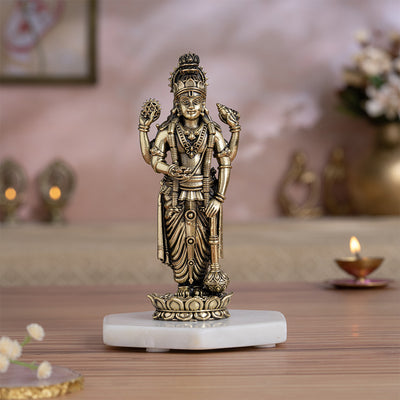
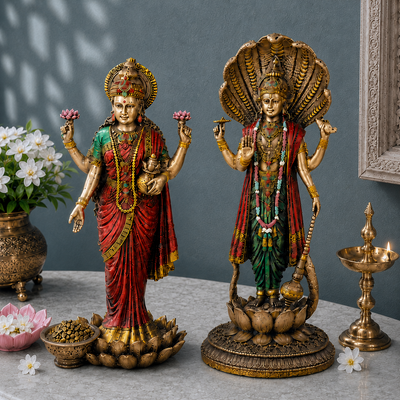
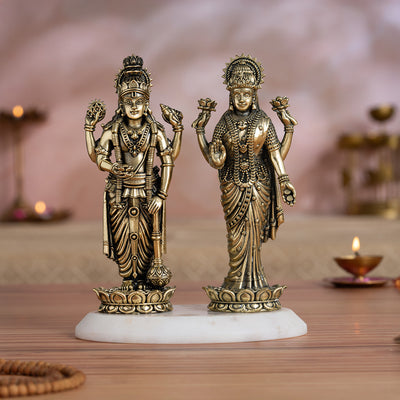
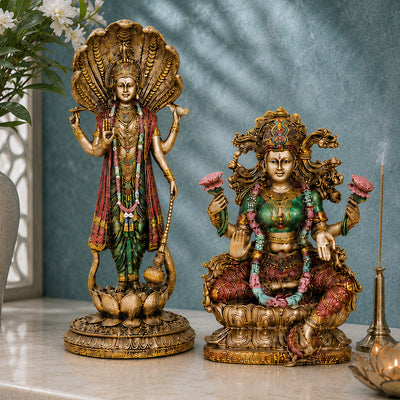
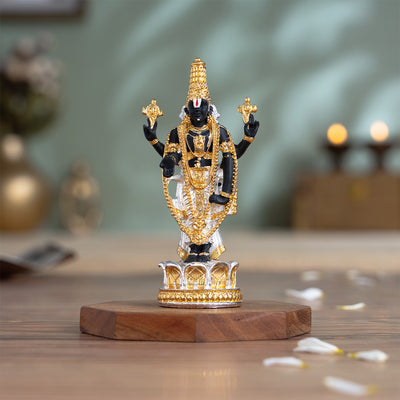
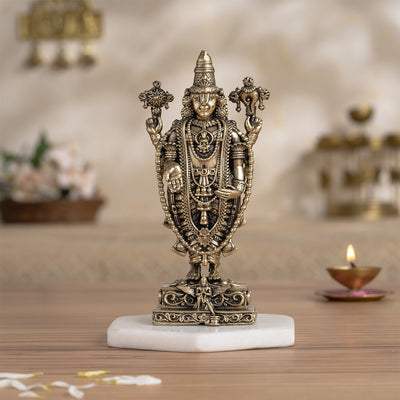
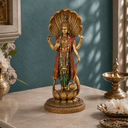
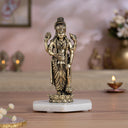
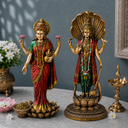
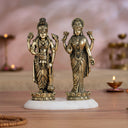
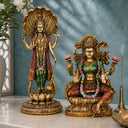
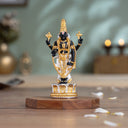
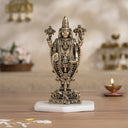
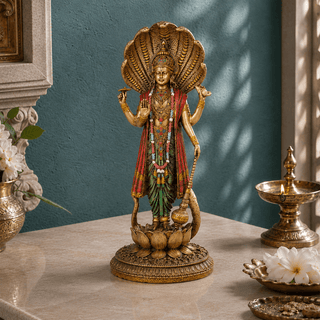
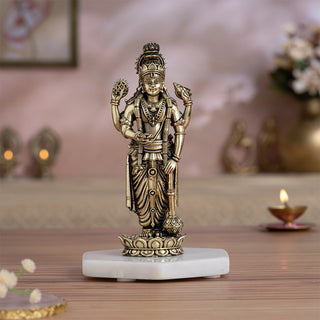
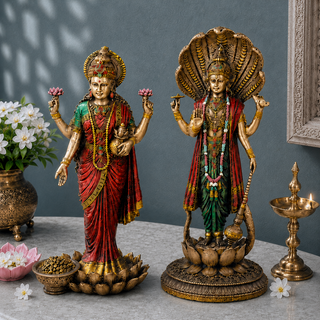
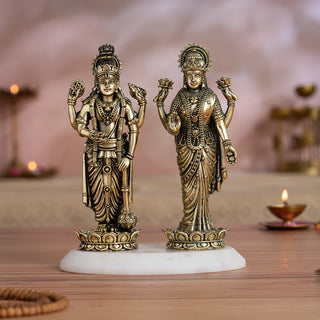
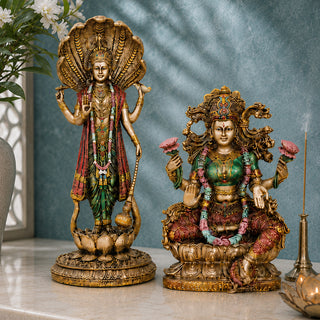
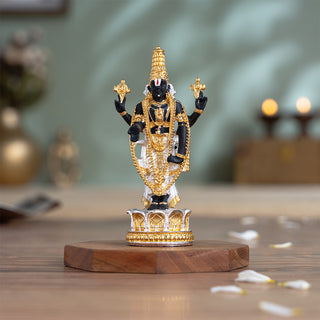
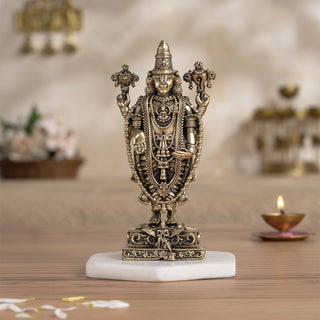
If you keep Vishnu at home, you are usually keeping him in one of his more familiar forms rather than as Matsya: standing, or seated, or reclining, in brass or antique finish, often beside Lakshmi. The Vishnu and Lakshmi pairs are the most common household choice in India, and the Venkateswara or Balaji form is probably the most worshipped Vishnu murti in the country. If you have wondered whether a standing image is allowed in a home shrine, we went through what the Shilpa Shastra actually says about that in a separate article, and the short version is that the rule you have heard is not in the texts.
Where Matsya sits in the larger arc
Read on its own, the Matsya story is a rescue. Read alongside the rest, it is the opening move of something longer.
The Vedas are stolen and recovered. Then the ocean is churned and the world's treasures come up. Then the earth is lifted out of the water. Then a child's faith is defended against his own father. Then a king who keeps his promise is honoured for it. The descents are not ten separate emergencies. They are one long argument that the world is being held.
That is also why questions like who Vishnu's first devotee was or who among the immortals is still walking the earth keep circling back to the same place. And it is why the tradition could later absorb a figure like the Buddha into the list at all, though that inclusion is contested and the texts genuinely disagree about it.
Satyavrata's boat is where it opens. A man who tried to put a small fish back in the river, and was asked not to.
Also read: The 10 Avatars of Vishnu | Varaha Avatar Story | Who Is Lord Vishnu's First Devotee | Can We Keep a Standing Vishnu Idol at Home | Kalki Avatar: What the Texts Actually Say | Balarama Avatar of Vishnu: Eighth, Not Ninth