He picked up a handful of leaves
There's a short passage in the Pali canon that I think about far more than the famous ones. The Buddha is staying in a simsapa grove. He picks up a few fallen leaves, holds them out, and asks the monks which is more: the leaves in his hand, or the leaves in the forest around them.
The forest, obviously.
Then he tells them that's the difference between what he knows and what he teaches. And he explains the cut. The things he left out were left out because "they are not connected with the goal, do not relate to the rudiments of the holy life, and do not lead to disenchantment, to dispassion, to cessation, to calm, to direct knowledge, to self-awakening, to Unbinding" (Simsapa Sutta, SN 56.31).
That's the frame for everything below. Most articles on the Buddha hand you a list of teachings. Almost none of them mention that the teacher himself said the list was short on purpose.
So what did the Buddha preach?
Four truths, and a path. That's it.
He gave them for the first time at Isipatana, the deer park at Sarnath near Varanasi, to the five ascetics who had walked out on him earlier. The text is the Dhammacakkappavattana Sutta, SN 56.11, and it's the closest thing Buddhism has to a founding document.
The first truth is the one everyone thinks they know. It is almost never quoted correctly. It isn't "life is suffering". It's a list:
"Birth is stressful, aging is stressful, death is stressful; sorrow, lamentation, pain, distress, & despair are stressful... In short, the five clinging-aggregates are stressful."
Read that last line again. Not the aggregates. The clinging-aggregates. Dukkha, in the first sermon, is a diagnosis of a mechanism, not a verdict on existence.
The second truth names the mechanism: craving. Three kinds of it, in his wording, craving for sensual pleasure, craving for becoming, and craving for non-becoming. That third one is the interesting one, the craving to not be, which is why the tradition never treated despair as a shortcut.1
The third truth is that this craving can end, described as its "remainderless fading & cessation, renunciation, relinquishment, release, & letting go."
The fourth truth is the path. And notice the shape of the whole thing. Symptom, cause, prognosis, treatment. It reads like a physician's note, and the tradition has always said so.
The Eightfold Path, and why he called it the Middle Way
Before he gives the four truths, he does something else first. He rules out two ways of living.
"That which is devoted to sensual pleasure... base, vulgar, common, ignoble, unprofitable; and that which is devoted to self-affliction: painful, ignoble, unprofitable."
He was qualified to say it. He had lived in a palace, and then he had starved himself half to death with those same five ascetics. He wasn't theorising about either extreme. He had failed at both.
What's left in the middle is eight factors, always given in this order in SN 56.11: right view, right resolve, right speech, right action, right livelihood, right effort, right mindfulness, right concentration.
Notice how ordinary that list is. Three of the eight are about how you talk, what you do and how you earn. You could keep the entire middle section of the path without believing anything metaphysical at all. That's not an accident.
The second sermon: "this is not mine, this I am not"
The second sermon, the Anatta-lakkhana Sutta (SN 22.59), argues that none of the five aggregates is a self. He gave it to the same five men.
He takes the five aggregates that make up a person, form, feeling, perception, mental formations, consciousness, and examines each one. Is it permanent? No. Is what's impermanent comfortable? No. Then is it fit to be regarded as "mine, I am this, this is my self"?
The formula he gives is blunt: "This is not mine, this I am not, this is not my self."
At the end of it the text says the five monks were freed, which made, in the sutta's own count, "six arahants in the world."2 Six people. That's the whole movement at that moment.
Anatta, not-self, is the piece most popular summaries quietly skip, because it doesn't soften into a wellness message. It is also what makes the Buddha's teaching genuinely different from the Vedantic and Puranic frameworks it grew up beside. In those, the enduring self is the point. If you've read about the seven chiranjeevis or asked whether Hanuman is still alive, you're working inside a very different set of assumptions about what persists.
What the Buddha refused to preach
He flatly refused to answer 10 questions, and he explained why.
A monk named Malunkyaputta gets fed up. He tells the Buddha he'll leave the order unless he gets answers to ten questions. Is the cosmos eternal or not? Is it finite or infinite? Are the soul and the body the same thing or different? Does a Tathagata exist after death, or not, or both, or neither?
The Buddha does not answer. He tells a story instead (Cula-Malunkyovada Sutta, MN 63). A man is shot with a poisoned arrow. The surgeon arrives. The man says: don't pull it out yet. First tell me the archer's caste, his name, his clan, whether he was tall or short, what kind of bow it was, what the bowstring was made of.
He dies before anyone finds out.
Then the Buddha says the thing that reframes his whole career. Those questions are undeclared, he says, because knowing the answers wouldn't remove the arrow. What he declares is only the four truths, "because they are connected with the goal."4
Take that seriously and a lot of the noise around Buddhism goes quiet. He wasn't being evasive about the soul and the afterlife. He was refusing on principle, and he explained the principle.
"Don't go by reports": the sutta everyone half-quotes
The Kalama Sutta (AN 3.65) is the most shared and most mangled thing the Buddha said. The Kalamas of Kesaputta tell him that teachers keep passing through, each one praising his own doctrine and trashing the rest, and they can't tell who's right.
His answer, in full:
"Don't go by reports, by legends, by traditions, by scripture, by logical conjecture, by inference, by analogies, by agreement through pondering views, by probability, or by the thought, 'This contemplative is our teacher.'"
Ten grounds rejected, including scripture and including himself. That's where the internet version stops, and it turns into "believe nothing, trust yourself."
But he keeps going. The test he actually gives is whether qualities "are criticized by the wise", and whether, when adopted and carried out, they "lead to harm & to suffering." Then he teaches the four brahmaviharas: goodwill, compassion, sympathetic joy, equanimity.5
So it's a test by consequence, with the wise as a check on your own judgement. Not radical individualism. Considerably harder than the poster version.

Four things people get wrong about what he preached
1. "The Buddha taught that life is suffering"
The first sermon says no such thing. It enumerates birth, aging, death, sorrow, lamentation, pain, distress and despair, and lands on the five clinging-aggregates (SN 56.11). Clinging is the target. Pessimism about existence was never on the syllabus.
2. "The Flower Sermon is in the sutras"
The famous scene where the Buddha silently holds up a flower on Vulture Peak and only Mahakasyapa smiles is Zen's founding story, and it's beautiful. It is also not in the Pali canon. Its well-known form is Case 6 of the Wumenguan, the Gateless Gate, compiled by the Chinese Chan master Wumen Huikai in 1228 CE, roughly seventeen centuries after the Buddha.10 It's Song-dynasty Chinese literature about the Buddha, which is a different thing from a record of him. We go deeper into that lineage in our piece on what Zen meditation actually means.
3. "The mustard seed story is one of his discourses"
The Kisa Gotami episode, the grieving mother sent to find mustard seeds from a house untouched by death, is real and old. But it sits in the Dhammapada Commentary attached to verse 114, which is commentarial literature written centuries after the discourses. Her own verses in the Therigatha don't mention mustard seeds at all, and they describe a far larger catastrophe.9 That tangle is worth its own article, and we've written it: how the Buddha taught Kisa Gotami.
4. "The bumps on his head are 108 snails"
Not scripture. The canon lists the physical marks of a great man twice over, in the Lakkhana Sutta (DN 30) and the Mahapadana Sutta (DN 14), and neither mentions snails, shells, or anything sheltering his head.78 The curl-mark in those lists is about body hair, not head hair. We checked both lists item by item in the 108 snails story.
One more, since it comes up constantly in Indian homes: the identification of the Buddha as an avatar of Vishnu belongs to Puranic Hinduism, not to any Buddhist text. It's a later cross-tradition claim, and it's genuinely interesting as one, but it isn't something the Buddha or his own tradition taught. Our guide to the ten avatars of Vishnu covers where that listing comes from. Something similar happens at Puri, where the temple's own layered history keeps drawing Buddhist connections, as our piece on the Jagannath temple notes.

What he said at the end
The Maha-parinibbana Sutta (DN 16) records his last months, and there are no revelations in it. Ananda asks what the community should do without him. The Buddha's answer:
"Be islands unto yourselves, refuges unto yourselves, seeking no external refuge; with the Dhamma as your island, the Dhamma as your refuge."
You'll often see this as "be a lamp unto yourselves". The Pali word is dipa, which can mean both island and lamp, and translators genuinely split on it. Island reads better in context, because the passage is about a flood, not a dark room. Worth knowing that the pretty version is a translator's choice.
He also tells Ananda there's no hidden teaching being saved for the end: "there is nothing, Ananda, with regard to the teachings that the Tathagata holds to the last with the closed fist of a teacher who keeps some things back."
And the last words themselves are an instruction, not a secret: "All compounded things are subject to vanish. Strive with earnestness."6
He spent forty-five years teaching, and ended by pointing away from himself. Compare that with how differently the great teachers of the Indian epics exit, whether it's what happened to Krishna's body or how Ram left the world. Those endings are events. This one is a handover.
Keeping a Buddha figure at home, honestly
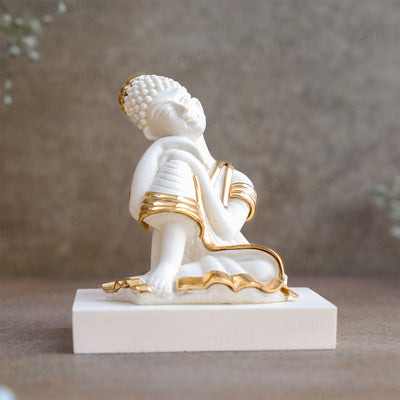
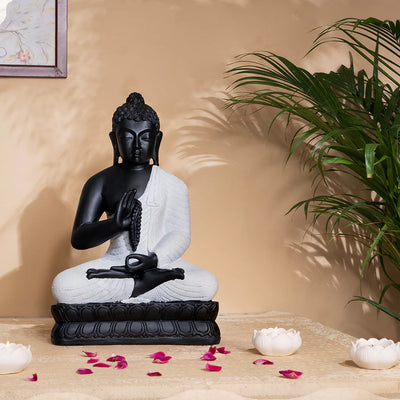
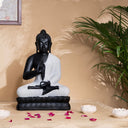
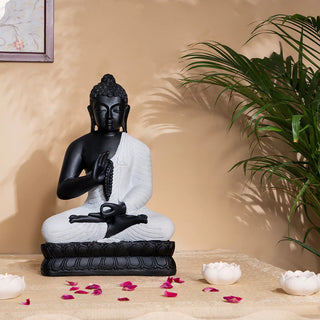
Plenty of people keep a Buddha statue at home without being Buddhist, and there's nothing dishonest in that as long as you know what you're keeping. A seated Buddha isn't an object of petition. Nothing in the four truths asks you to request anything from him. The figure is a reminder of a posture, and of that final instruction to strive.
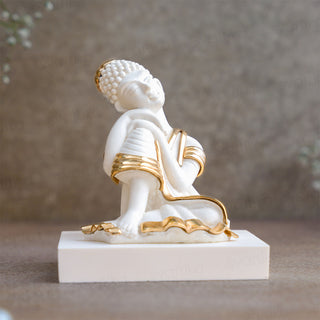
Practically: give it a settled, uncluttered place at or above eye level rather than on the floor, don't tuck it into a bathroom or a shoe corner, and keep it clean. If it's marble or marble-dust, our guide on cleaning a marble idol saves a lot of damage. A small meditating Buddha in white and gold works better on a quiet shelf than a large one in a busy room, for the same reason the teaching is short: less to look at, more to notice.
If you're setting up a corner from scratch, the general principles in what to keep in a pooja room and vastu-friendly home decor apply, and the same placement logic used for a Shiva statue at home carries over. Our Premium Edits pieces and the compact pocket temples are both built for small, undramatic spaces, which suits this particular teacher.
Full-moon day in Vaishakha is when much of Asia marks his birth, awakening and death together, which we cover in why Buddha Purnima is celebrated. And if you're curious about the wider renunciant world he belonged to, Mahavira was teaching in the same region in the same era, as our piece on Mahaveer Jayanti explains. Compare all of it with the recitation-centred devotion of something like the Krishna mantras and you can feel how different two Indian paths can be.
One honest caveat
These discourses were carried orally for roughly four centuries before being written down. The Pali canon is one school's recension among several that once existed. The wording is remarkably stable across the parallel collections, but "the Buddha said" always means "the tradition preserved him as saying." Anyone who tells you otherwise is selling certainty that the texts themselves don't claim.
Also read: How the Buddha Taught Kisa Gotami | What Zen Meditation Really Means | Why Buddha Purnima Is Celebrated | Mahaveer Jayanti and Mahavira's Teachings