Most festivals remember one thing. A birth, a victory, a homecoming. Buddha Purnima remembers three, and it puts all three on the same full moon.
That is what the title question is really asking. If he was born on this day, how can he also have died on it? The answer is that the tradition chose to keep the whole arc of one life on a single lunar date. Once you see it that way, the puzzle turns into the point.
What Buddha Purnima actually marks
Tradition says Siddhartha Gautama was born on a Vaishakha full moon at Lumbini, in what is now Nepal. Years later, on the same full moon, he sat under a tree at Bodh Gaya and woke up. That is what the word Buddha means: one who is awake. And in his eightieth year, again on that full moon, he died at Kusinara.
Outside India the day is called Vesak. The United Nations recognised it in 1999 by resolution 54/115, and its own page states the tradition plainly: "It was on the Day of Vesak two and a half millennia ago, in the year 623 B.C., that the Buddha was born. It was also on the Day of Vesak that the Buddha attained enlightenment, and it was on the Day of Vesak that the Buddha in his eightieth year passed away."3
Note the wording. Even a United Nations page is repeating a tradition here, not a dated record. Hold on to that, because it matters later.
Does Buddhist scripture give the date?
No. No Buddhist text gives a date for his death.
The Maha-parinibbana Sutta is the canon's long account of the Buddha's last months and his death. T. W. Rhys Davids translated it in 1881 for the Sacred Books of the East series. Search the whole text and you will not find a month, a tithi or a calendar date for his passing. The one month named anywhere in that volume, Kattika, belongs to a separate note about the deaths of two of his disciples.1
So the day itself is remembered custom. The events are canonical. The date on which all three are placed together is not. Saying that out loud does not weaken the festival. It just tells you what kind of thing it is, the same way honest reading changes what you assume about Ram Navami or Hanuman Jayanti.
What the sutta does record about his death
Quite a lot, and it is very specific. He died at Kusinara, in the Upavattana Sala Grove of the Mallas, lying between two sal trees. His last meal was served by Chunda the smith and included dried boar's flesh. He fell ill after it, and he took care to tell his followers that Chunda was not to be blamed.

His last words were not a farewell. They were an instruction.
"Decay is inherent in all component things! Work out your salvation with diligence!"
The text then adds one flat line: "This was the last word of the Tathagata." No miracle, no final revelation. A teacher finishing a sentence. That plainness is the same voice you meet when he teaches Kisa Gotami about grief, and it runs through everything he preached.
His age comes from inside the text too. Speaking to the wanderer Subhadda near the end, he says he was twenty-nine when he left home, and that he had been a wandering seeker for fifty-one years since. Twenty-nine plus fifty-one is eighty. That is his own arithmetic, not a later chronicle's.
Was he really born at Lumbini?
Yes, and the proof is carved in stone.

Around 249 BCE the emperor Ashoka went to Lumbini and put up a stone pillar. It is still there, and it is inscribed. In D. C. Sircar's translation the pillar says that Ashoka came in person "because the Buddha, the Sage of the Sakyas, was born here," that he built a stone wall around the spot, and that he freed the village of Lumbini from tax, leaving it to pay only one eighth of its produce.2
That is a tax order carved in stone by a named ruler, roughly two centuries after the Buddha died. It is not a devotional story. It is administration. Very few sacred sites anywhere carry that kind of proof.
Then why do people argue about the year?
Because the years everyone quotes, 623 BCE for the birth and 543 BCE for the death, come from the old chronicles of Ceylon. Those same king lists put Ashoka's coronation about sixty years off. We can fix Ashoka's date independently from Greek records, because he names Greek kings in his own inscriptions.
Rhys Davids said so in print in 1881. The date 543 BCE, he wrote, "is now acknowledged to be too early by all scholars who have seriously considered the subject."1 He would not sign off on the corrected figure of about 485 BCE either. A chronicle gets less reliable the further back it reaches.
So the plain answer is that we do not know the year. We know the place, from Ashoka. We know the age, from the sutta. The year is open. And a United Nations page still carries 623 BCE, which shows how long a traditional number can travel once it is written down.
Why the date moves every year
In 2027 it falls on Thursday, 20 May. Buddha Purnima falls on the full moon of Vaishakha, so in the Gregorian calendar it lands somewhere in April or May and shifts each year. People often call this vagueness. It is the opposite.
Robert Sewell and Sankara Balkrishna Dikshit set out the mechanism in The Indian Calendar in 1896. A tithi, the lunar day Indian festivals are fixed to, is not a block of twenty-four hours. It is the time the moon takes to gain twelve degrees on the sun. One lunation is thirty tithis, covering the full 360 degrees. Since the sun and the moon both change speed, a tithi keeps changing length.
Two things follow. A tithi in which the sun never rises is dropped from the calendar, which is called kshaya. A tithi in which the sun rises twice is repeated, which is called adhika.6 That is why a festival can seem to skip a day, or be kept on two days in a row.
The calendar also inserts an extra month to keep the lunar year tied to the solar one. So a fixed tithi has to drift across weeks of Gregorian dates. The same machinery moves Navratri, Raksha Bandhan and Karwa Chauth.
One more wrinkle. North India ends its lunar months at the full moon and the south ends them at the new moon. So the very same full moon can sit in differently named months in different states. If your family calendar and a friend's disagree, this is usually why.

Three things people get wrong about Buddha Purnima
1. That scripture says the three events fell on one day. It does not. The Maha-parinibbana Sutta gives no date for the death at all. The convergence is a later Theravada tradition, and the United Nations describes it as tradition too. It is a beautiful shape given to a life, not a record copied from an archive.
2. That the Buddha was born in 623 BCE. That figure comes from the Ceylon chronicles, and scholars have rejected it since the 1880s. Rhys Davids called it too early well over a century ago. The honest answer is that the year is unknown.
3. That Hindus keep the day because the Buddha is Vishnu's ninth avatar. This is the one that surprises people most, so it needs its own section.
Is the Puranic Buddha the same person?
Barely. In the Sanskrit he is not even called Buddha.
In the Vishnu Purana, translated by H. H. Wilson and edited by Fitzedward Hall, Vishnu sends out a figure of illusion to the demons on the banks of the Narmada. He arrives "in the semblance of a naked mendicant, with his head shaven, and carrying a bunch of peacock's feathers," and he talks them out of the Vedas so that the gods can defeat them.
Here is the striking part. Hall's editorial notes record that the Sanskrit does not call him Buddha. It calls him mayamoha, the great delusion. Hall notes that "the translation adds the words Jaina and Bauddha to the original," and that Burnouf "boldly substitutes Buddha" for mayamoha.4 A translator publicly flagging his predecessor's insertion is rare, and it tells you the identification was partly made in English.
The calendar backs this up. M. M. Underhill's The Hindu Religious Year (1921) lists the Hindu Buddha-avatara day as Ashvina shukla dashami, a completely different date from Vaishakha Purnima. She adds that "this incarnation day is wholly disregarded, and only noted in calendars."5 Underhill lists Buddha's birthday separately, in the Vaishakha table.
So Indians of every background keeping Vesak is real and warm and old. It just is not the avatar list doing the work. Compare it with a story like the Mohini avatar, which the Puranas tell as a full episode, and the difference is obvious.

How the day is kept
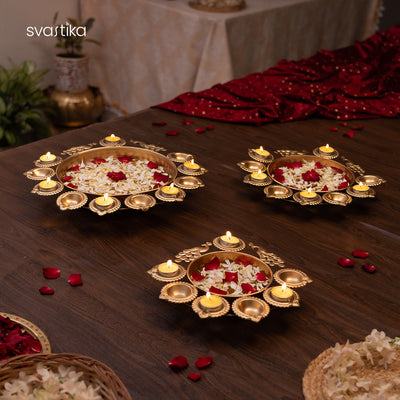
Quietly, mostly. People visit a vihara or a temple, offer flowers and light, and sit. Many take the five precepts for the day. Many eat only vegetarian food. Lamps are lit at dusk, which is why the day looks a little like Diwali from a distance, though the meaning is its own.
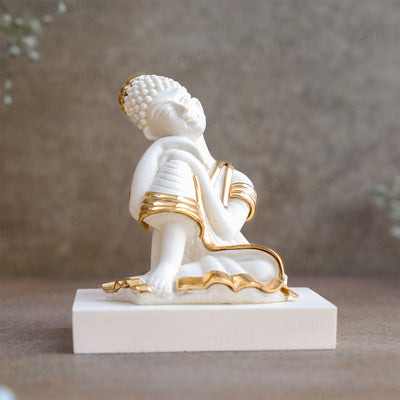
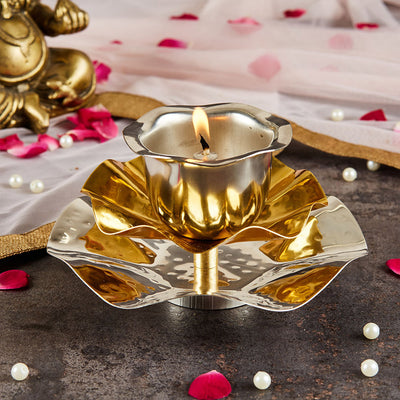
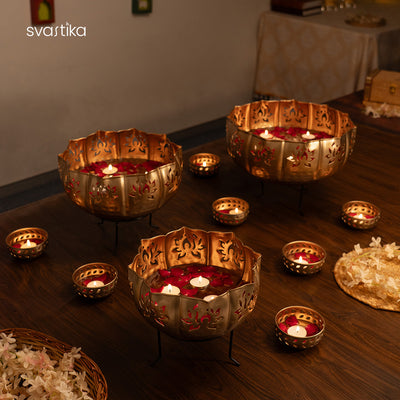
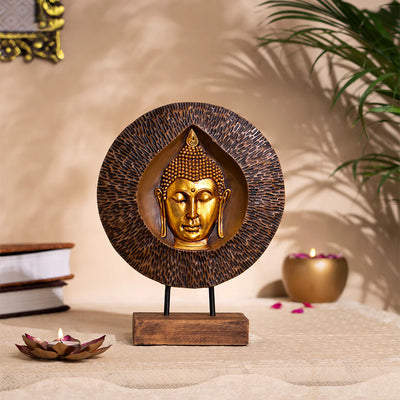
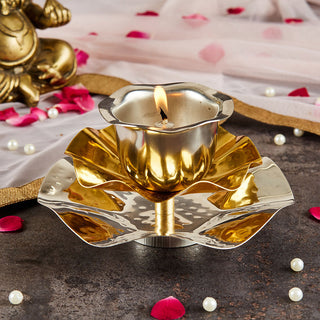
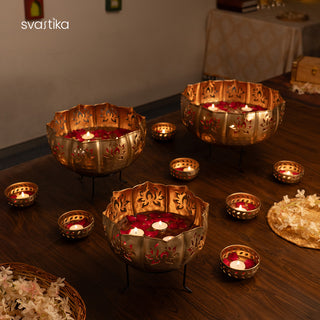
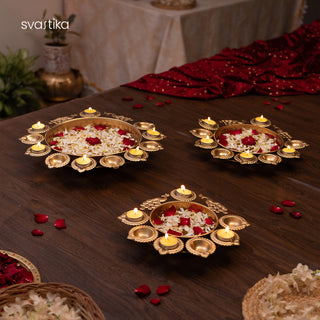
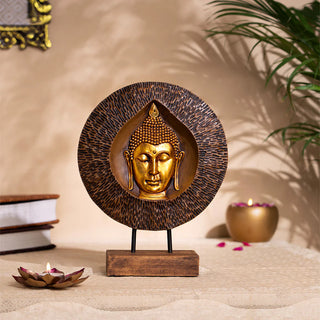
At home a small setup is enough. One seated meditating Buddha at eye level, a lamp, water, and flowers. The lotus is the natural flower for it, since it grows out of mud and opens clean, and lotus shapes turn up across our brass diyas and urlis for the same reason.
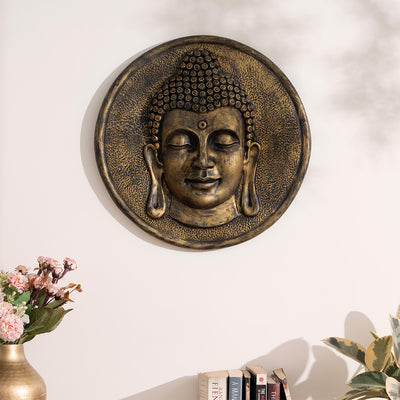
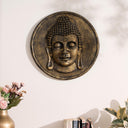
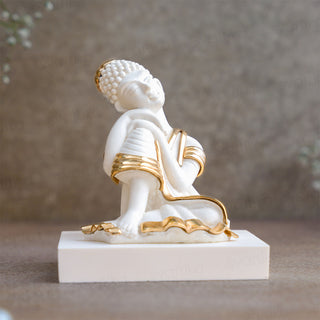
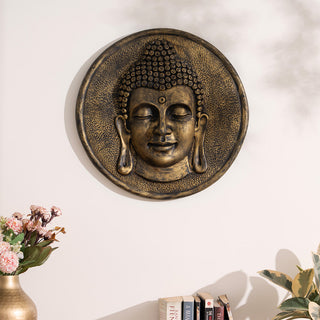
The posture itself carries the teaching. The half-closed eyes are not sleep. They are attention turned inward, which is the whole of Zen practice in one line. Even the curled hair on the head has a story of its own. If you are choosing a piece for a room, our Buddha idols range from small desk figures to wall panels. The calmest spot is usually a low, uncluttered shelf with light falling on it.
Vesak also sits in a busy stretch of the Indian calendar. Mahavira Jayanti and Chaitra Navratri come just before it. In many homes the same shelf and the same pooja essentials serve all of them through the season.
So why celebrate a day he both arrived and left?
Because the teaching he left is exactly about that. Decay is built into everything made of parts, he said, so get on with the work. A festival that puts a birth and a death on one moon is not being careless with the calendar. It is repeating his last sentence in the shape of a date.
Also read: What Did Buddha Preach to the People | Buddha and Kisa Gotami | 108 Snails on Buddha's Head | Mahaveer Jayanti | The 10 Avatars of Vishnu
Cover photo: Rohit Sharma, CC BY-SA 4.0, via Wikimedia Commons.