He was called Vardhamana first. It means "the increasing".
The Acaranga Sutra explains why. While he was still in the womb, the family's wealth grew. "Since the prince was placed in the womb of the Kshatriyani Trishala, this family's treasure of gold, silver, riches, corn, jewels, pearls, shells, precious stones, and corals increased; therefore the prince shall be called Vardhamana."1
That is a very ordinary reason for a name. Grain in the store, coins in the box. And the boy named for a household getting richer grew up to teach that owning things is the problem. Mahaveer Jayanti is the birthday of that man, and the gap between his first name and his life's work is the most interesting thing about him.
What the Jain canon says about Mahavira's birth
The details come from two very old Jain texts, both translated into English by Hermann Jacobi in 1884 for the Sacred Books of the East series.
The Kalpa Sutra places the birth "in the first month of summer, in the second fortnight of Chaitra, on its fourteenth day, in the middle of the night while the moon was in conjunction with the asterism Uttaraphalguni". A nakshatra is a lunar mansion, one of twenty-seven star groups the moon passes through each month.
His mother was Trishala, of the Vasishtha gotra. His father was Siddhartha, of the Kashyapa gotra. The place was Kundagrama, near Vaishali in what is now Bihar.
Jacobi makes a small, honest point about that town. The canon calls it a sannivesa, which the old commentator explains as a halting place for caravans. "It must therefore have been an insignificant place," Jacobi writes, and he notes that Jain and Buddhist writers both made their founders' hometowns sound grander than they were.
Living practice went with the thirteenth, not the fourteenth. Sinclair Stevenson, writing in 1915 after years among Jain families in Gujarat, records the birth "on the thirteenth day of the bright half of the moon in the month Caitra, the time came when Trisala, herself perfectly healthy, gave birth to a perfectly healthy child".3
The gods gave him his famous name later. The Acaranga says plainly, "the name Venerable Ascetic Mahavira has been given to him by the gods." Vardhamana was the household name. Mahavira, great hero, came after.
Why the date moves every year
In 2027 that day is Monday, 19 April. Mahaveer Jayanti lands on a different English date each year. That is not sloppiness. It is how a lunar calendar works.
Sewell and Dikshit explained the machinery in The Indian Calendar back in 1896. A tithi is not a day at all. It is "the time occupied by the moon in increasing her distance from the sun by 12 degrees". Since the sun and the moon both change speed as they move, "the length of a tithi constantly alters".
So a tithi can be shorter or longer than a sunrise-to-sunrise day. Sometimes a tithi has no sunrise inside it and gets deleted from the calendar. Sometimes it holds two sunrises and gets repeated. That is why a festival can look like it skipped a day, or turn up on two days in different towns. The same mechanism shifts Ram Navami, which falls four days before Mahaveer Jayanti in the same bright fortnight, and Hanuman Jayanti at the end of it.
There is a second thing worth knowing. Jacobi's Kalpa Sutra says "second fortnight" for the birth month, which sounds like the dark half to a modern reader. It is not. The same text dates the first Tirthankara, Rishabha, to "the first fortnight, the dark fortnight of Chaitra". So in this system the dark half comes first and the bright half is second.
Sewell and Dikshit describe exactly this habit in northern India, where the month ends at the full moon and "the dark fortnight is the first fortnight of the month". So Mahavira's "second fortnight" is shukla paksha, the bright half. Chaitra is also the month that opens the year for much of India, which is why Gudi Padwa, Ugadi and Chaitra Navratri all sit in the same few weeks.
What Mahavira actually taught
Non-violence, and he reasoned it out rather than commanding it. Most festival writing turns his teaching into a list; the canon argues instead.
Here is the ahimsa passage from the Acaranga Sutra: "All sorts of living beings should not be slain, nor treated with violence, nor abused, nor tormented, nor driven away." Then comes the reason. "For all sorts of living beings pain is unpleasant, disagreeable."
Read that twice. It does not say do no harm because a scripture says so. It asks you what pain feels like to you, takes your answer, and extends it to every living thing. Ahimsa in Jain hands is a conclusion, not a command.
The rest of his teaching sits on top of that. Truth, not stealing, celibacy and non-possession are the other four great vows. Non-possession, aparigraha, is the one that reaches back and touches his birth name. The child of a growing treasury spent his life saying that holding on is the injury.
Did Mahavira start Jainism?
No, and the canon itself shows why not.

Jains count twenty-four Tirthankaras, teachers who build a ford across the river of rebirth. Mahavira is the last of them. The twenty-third, Parshva, came before him, and Jacobi points out something you can actually check: the vows changed in number.
"The Jainas previous to Mahavira's time had only four great vows, since the fourth was included in the fifth," Jacobi writes in his introduction. "But Mahavira brought the number of the vows again up to five."
That is a reformer's fingerprint. You cannot raise a count from four to five unless four already existed. He inherited an order, tightened it, and led it. Both major Jain groups, Digambara and Svetambara, agree on that much.
How do we know Mahavira was a real person?
Because his rivals wrote about him.
The Buddhist canon knows him as Nataputta, head of the Niganthas, and treats him as a competitor of the Buddha. Jacobi calls this out as independent testimony. "For some particulars we have the testimony of the Buddhists also, in whose writings Mahavira is mentioned under his well-known name Nataputta, as the head of the Niganthas or Jaina monks and a rival of Buddha."2 The Buddhists also name Papa as the place where he died, which is where the Jain canon puts it.
Two traditions that disagreed about almost everything agree on the man and on the town where he died. That is strong evidence. It also means Mahavira and the Buddha were near contemporaries in the same part of India, teaching to overlapping crowds. If you have read what the Buddha preached or the story of Kisa Gotami, you already know the world Mahavira walked through. Both men taught a discipline of stilling the mind, and the later Zen tradition traces back to that same century of argument. Even the legends rhyme, like the odd tale of the 108 snails on the Buddha's head, and shrines to both still stand a few hours apart in Bihar. A Buddha idol and a Tirthankara image share a posture for a reason.
Four things people get wrong about Mahaveer Jayanti
1. "The Kalpa Sutra says Chaitra Shukla Trayodashi." Jacobi's Kalpa Sutra reads fourteenth. The parallel account in the Acaranga Sutra reads thirteenth.1 Both agree on Chaitra, the bright fortnight, midnight and Uttaraphalguni. Tradition settled on the thirteenth. The one day gap inside the canon is real, and almost nobody mentions it.
2. "Mahavira founded Jainism." He was the twenty-fourth Tirthankara of an existing order. The four-to-five vow change is the clearest surviving proof that he inherited rather than invented.
3. "The womb transfer story is standard Jain belief." It is not. The Svetambara texts say Mahavira was first conceived by the brahmani Devananda and moved by Indra into the womb of the kshatriyani Trishala. The Digambaras reject the whole episode. Jacobi's own footnote states it flatly: "This legend is rejected as absurd by the Digambaras, but the Svetambaras staunchly uphold its truth. As it is found in the Acaranga, the Kalpa Sutra, and many other books, it cannot be doubted that it is very old."1 Old, yes. Agreed on, no.
4. "Jains light Diwali lamps because everyone in India does." They light them for a reason recorded in their own scripture, and it is about Mahavira. More on that below.
How Mahaveer Jayanti is observed
The day is quiet by Indian festival standards. There is no feasting and no fireworks.
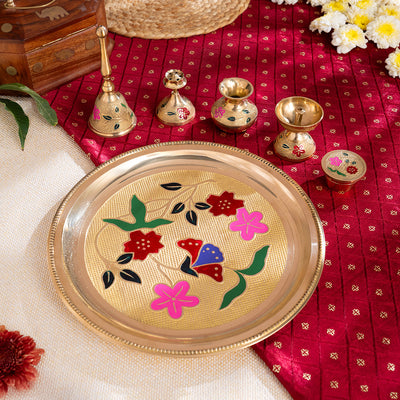
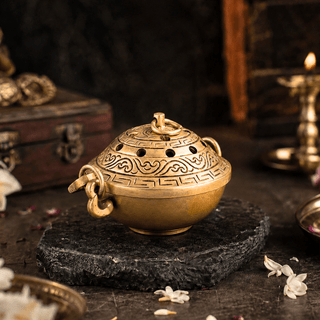
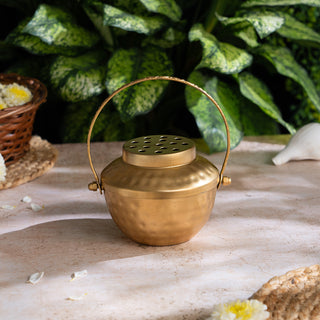
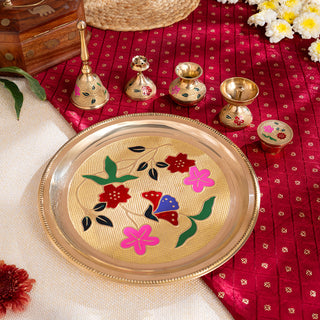
Temples hold an abhisheka, a ceremonial bathing of the Tirthankara image, and communities carry the image in a procession called a rath yatra. Many Jains fast, give to charity, and take a vow for the day, often a stricter one about food.5 The fasting is closer in spirit to the disciplined nine days of Navratri than to a celebration meal. Readings from the Kalpa Sutra are common, and the pooja essentials used are deliberately plain.
Not every Jain sect keeps the day the same way. Stevenson noted in 1915 that Sthanakavasi Jains "are not permitted to celebrate the day, lest it should lead to idolatry", while image-worshipping sects decorated their temples with flags. She was a Christian missionary and her judgements on Jain belief are worth reading with care, but her notes on what people actually did are first hand.
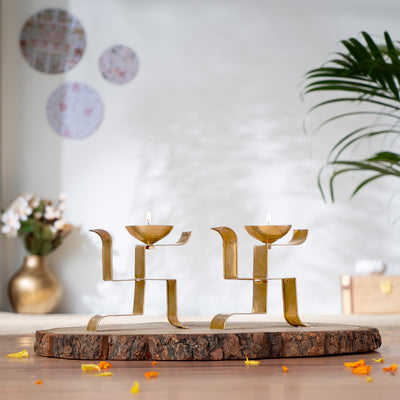
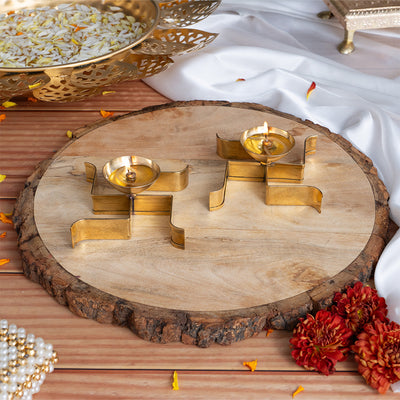
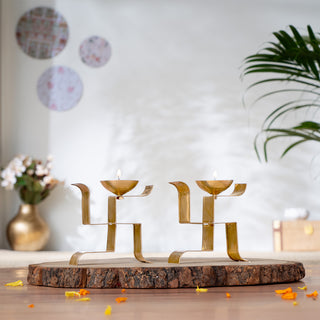
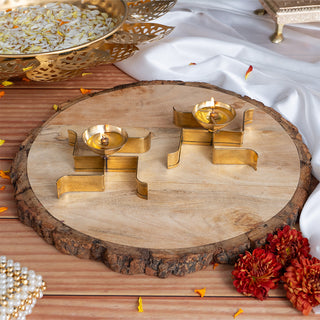
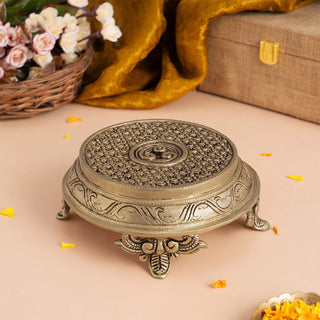
Lamps belong in a Jain home shrine as much as any other, and the brass diya in front of a Tirthankara image is doing the same work it does anywhere: marking that a space is set apart. Jains draw the swastika in rice before the image as one of the eight auspicious signs, which is why a swastika-shaped brass diya sits comfortably in a Jain pooja room. Brass and marble both need care over the years, and cleaning a marble idol follows the same rules across traditions.
The other end of the life: Diwali at Papa
Mahavira died at Papa. The Kalpa Sutra gives the moment: "in the dark fortnight of Karttika, on its fifteenth day, in the last night, in the town of Papa, in king Hastipala's office of the writers, the Venerable Ascetic Mahavira died."

The fifteenth of the dark fortnight of Karttika is the new moon night. It is Diwali.
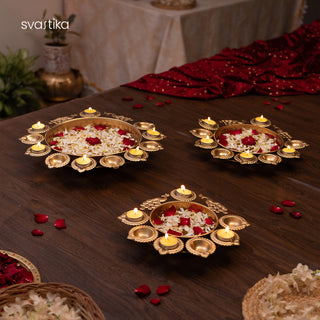
Jacobi noted the practice in his 1884 footnote: "The Jainas celebrate the Nirvana of Mahavira with an illumination on the night of new moon in the month Karttika." Stevenson records the line the tradition gives for it, spoken by the eighteen kings who were there: "Since the light of intelligence is gone, let us make an illumination of material matter." So on the night your neighbours are lighting lamps for Lakshmi Puja, or for Rama's return to Ayodhya, a Jain family next door is lighting them because a teacher left the world. Same night, same flames, three different memories. The lamps and decorations often look identical from the street. Nobody is confused. India simply lets a date carry more than one story, the way the ten avatars of Vishnu absorbed figures from outside the tradition.
The same happened to the Buddha. Hindu texts made him an avatar, but the Puranic figure barely resembles the teacher of Sarnath. In the Vishnu Purana he is an illusion sent to lead demons away from the Vedas, and Fitzedward Hall's editorial notes point out that the Sanskrit calls him mayamoha, the great delusion, with the name Buddha supplied by translators.6 That is why Buddha Purnima has its own honest complications. Mahavira never got absorbed that way. He stayed himself.
Which brings the year back around. Born on a bright Chaitra night, gone on a dark Karttika one. Spring and the start of winter, a birthday and a set of lamps. Jains keep both.
Also read: Ram Navami: Date, Tithi and Rituals | Why We Celebrate Buddha Purnima | What Did Buddha Preach to the People | Why We Celebrate Chaitra Navratri | Diwali Lakshmi Puja: Rituals and Timings