Search for Krishna mantras and you will get a hundred lists of seven. They almost never tell you where the mantra came from. That is the one thing worth knowing, because a mantra with a text behind it and a mantra somebody wrote in 1960 are different objects, even if both are beautiful.
So this list is ranked by how well-sourced each mantra is, not by how often it appears on the internet. Where the source is a verse, you get the verse. Where it is tradition, it says tradition. Nothing here is dismissed. A bhajan is not a lesser thing than an Upanishad. It is just a different thing.
1. Om Namo Bhagavate Vasudevaya: the best-documented Krishna mantra there is
ओं नमो भगवते वासुदेवाय
Twelve syllables, which is why it is called the dvadashakshara mantra. If you only ever learn one Krishna mantra, the case for this one is simple: the Bhagavata Purana does not just mention it, it shows you the scene where it is given.
A five-year-old boy named Dhruva is insulted by his stepmother and walks into the forest. The sage Narada finds him and gives him this mantra. The instructions around it are startlingly practical. Go to Madhuvana on the bank of the Yamuna, Narada says. Bathe. Prepare a seat (4.8.42-43). Chant om namo bhagavate vasudevaya (4.8.53-54). Offer pure water, garlands of forest flowers, roots, fruit, fresh grass, buds, bark and tulsi leaves (4.8.55-56).
That is a home puja, described inside scripture, with a mantra at the centre of it. There is almost nothing else like it in the Krishna material. If you have read our piece on Vishnu's first devotee, this is the same boy and the same forest.
One word of care about the famous promise attached to it. Narada tells Dhruva the result comes in seven days.1 Quote it, but keep the context visible: a child doing severe austerity alone in a forest, not fifteen minutes at a home altar before work.
The name itself is worth unpacking. Vasudeva means "son of Vasudeva", and Krishna's biological father was Vasudeva of the Yadava line. So the mantra names him by his human parentage, which is a quietly lovely thing for a mantra addressed to the Supreme to do.
2. The Hare Krishna maha-mantra
हरे कृष्ण हरे कृष्ण कृष्ण कृष्ण हरे हरे
हरे राम हरे राम राम राम हरे हरे
Sixteen names, thirty-two syllables, three names repeated in a pattern that becomes hypnotic quickly. This is the mantra most people outside India have actually heard.
Its traditional source is the Kalisantarana Upanishad, a Mantra-Upanishad of the Krishna-Yajurveda. That placement is confirmed in K. Narayanasvami Aiyar's 1914 collection Thirty Minor Upanishads, which lists it exactly there. It is a minor and late Upanishad rather than one of the principal ten, and saying so does not weaken it in the slightest: it simply tells you honestly what kind of text you are standing on.
The mantra was carried into the modern world by the Gaudiya Vaishnava tradition, and the practice built around it (kirtan, sung aloud, in company) has its own scriptural warrant. Prahlada lists the nine limbs of devotion in Bhagavata Purana 7.5.23, and kirtanam, singing, is the second of them, sitting right after hearing.
3. Sarva-dharman parityajya: Bhagavad Gita 18.66
सर्वधर्मान्परित्यज्य मामेकं शरणं व्रज
"Give up all varieties of dharma and come to me alone for shelter."
This is the Gita's charama shloka, its final instruction, and it is recited as a mantra of surrender across almost every Vaishnava school. It is a verse rather than a mantra formula, and that distinction is real, but a verse chanted with that intention has functioned as a mantra for a very long time.
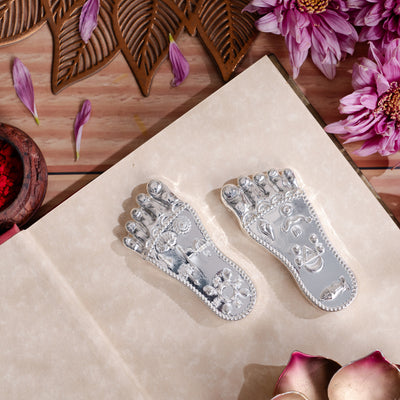
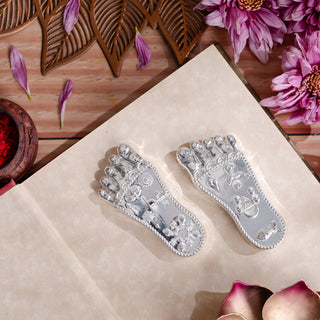
Here is a small point of precision that separates a citable article from a decorative one. People constantly quote 18.66 as "surrender at Krishna's lotus feet." The verse contains no word for feet. It says mam ekam saranam vraja: come to me alone.7 The lotus feet vocabulary is entirely real, but it lives in the Bhagavata Purana, above all in the Gopi-gita at 10.31.7 and 10.31.19 and in the footprint verse 10.30.25, where the gopis identify Krishna's tracks by marks on his soles: a flag, a lotus, a thunderbolt, a barleycorn and an elephant goad, followed in the Sanskrit by "and so on", so the verse names five without fixing the number at five.3
4. Patram pushpam phalam toyam: Bhagavad Gita 9.26
पत्रं पुष्पं फलं तोयं यो मे भक्त्या प्रयच्छति
"A leaf, a flower, a fruit, water: whoever offers that to me with devotion, I accept it."
This one is usually filed under worship rather than mantra, and it belongs in both places. Recited before an offering, it is the shortest complete theology of puja anyone has written. Four things a person with no money can find. The whole weight of the verse sits on one word, bhaktya, with devotion.
If you want the fuller practice around it, our guide to worshipping Krishna at home walks through Prahlada's nine limbs and the Dhruva instructions together. It pairs naturally with any mantra practice: 9.26 is what you offer, the mantra is what you say.
5. The Gopala mantra: eighteen syllables
क्लीं कृष्णाय गोविन्दाय गोपीजनवल्लभाय स्वाहा
The ashtadashakshara or Gopala mantra addresses Krishna as Govinda and as the beloved of the gopis. It is genuinely old and it is central to Gaudiya initiation, but its home is the Gopala-tapani Upanishad and the Pancharatra ritual literature, not the Puranas. It carries a bija or seed syllable at the front, which is the signature of Tantric and Agamic mantra construction rather than Puranic recitation.
Traditionally it is given by a guru at initiation rather than picked up from a page. That is worth respecting, and worth saying plainly rather than printing it as a self-service item.
6. The Krishna Gayatri
ओं देवकीनन्दनाय विद्महे वासुदेवाय धीमहि
तन्नो कृष्णः प्रचोदयात्
"We meditate on the son of Devaki, we contemplate Vasudeva; may Krishna impel us."
The original Gayatri is Rig Veda 3.62.10, addressed to Savitr. The deity-specific Gayatris (Krishna Gayatri, Ganesha Gayatri and dozens more) are later constructions that keep the metre and swap the deity. They come from Tantric and Pancharatra compilations. The metre is Vedic; this particular verse is not.
The line does contain a nice piece of scripture-accurate naming, though. Devakinandana, son of Devaki: the Bhagavata is careful that Devaki bore him and Yashoda raised him, and both women are called his mother without the text ever ranking them.
7. Achyutam Keshavam, and the honest note about bhajans
अच्युतं केशवं कृष्ण दामोदरं
राम नारायणं जानकी वल्लभम्
This appears on every "ancient Krishna mantras" list online. It is a devotional song (a string of Krishna's names set to a metre) not a mantra prescribed by any Upanishad or Purana.
None of that is a criticism. Chanting the names of God is the practice Prahlada himself lists at 7.5.23, and a name-string sung with attention is doing exactly what kirtanam means. Only the label needs correcting. Calling a bhajan an ancient Vedic mantra does not make it more powerful; it makes the person telling you so less reliable about everything else. The same goes for "Krishna Govinda Govinda Gopala" and most of the melodies you will hear in a Vrindavan lane at dusk. Living devotion, yes. Verses, no.
Three things people get wrong about Krishna mantras
"There is a fixed number of repetitions that guarantees a result"
The 108, the 1008, the mala counts: these come from Tantric and later ritual manuals, and different manuals give different numbers for the same mantra. The Bhagavata's own instruction to Dhruva gives no count at all. It gives a place, a bath, a seat, offerings and a mantra.1 If a page tells you a specific japa count is scriptural, ask which verse. There usually isn't one.
"18.66 tells you to surrender at his lotus feet"
Covered above, and worth repeating because it is so common. No word for feet in that verse. The feet language is Bhagavata language, and it runs deeper than decoration: Prahlada lists pada-sevanam, serving the feet, as a limb of devotion in its own right (7.5.23), and Krishna's own death in the Bhagavata comes from an arrow through the foot, mistaken by the hunter Jara for a deer's face (11.30.33). If that arc interests you, we followed it in what happened to Krishna's body.
"Mantras are how Krishna's story says people reached him"
The Bhagavata's own examples are stranger and warmer than that. The poor brahmin friend (the man everyone calls Sudama, though 10.80.6 only calls him "a certain friend of Krishna") arrives in Dwarka with four fists of begged flat rice and asks for nothing. The gopis are told at 10.47.29 that they were never separated from him to begin with. Uddhava, sent to console them, ends up wishing he could be reborn as a bush in Vrindavan (10.47.61). None of that is japa. Mantra is one of nine limbs, not the whole body.

How to actually chant, according to the only text that spells it out
The Dhruva passage is the closest thing scripture gives to a beginner's procedure. Here it is, as steps.
- A clean, quiet place. Narada names Madhuvana on the Yamuna. The principle behind it is what most people take away, a spot set apart, not the corner of a busy room (4.8.42).
- Bathe first, then sit. The text mentions the bath and the prepared seat before it mentions the mantra (4.8.43).
- The mantra itself. Om namo bhagavate vasudevaya (4.8.54).
- Something offered. Pure water, forest flowers, roots, fruit, fresh grass, buds, bark, and tulsi leaves (4.8.55-56). Tulsi is named outright, which is worth noting because it is the element people treat as optional.
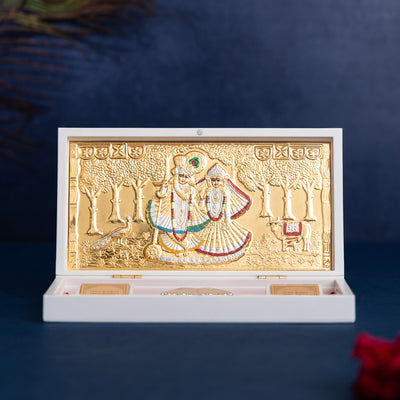
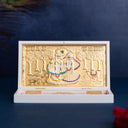
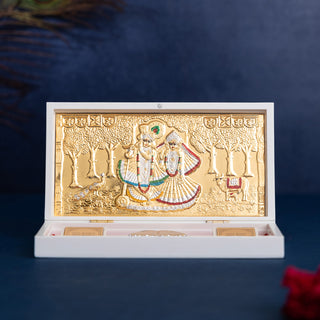
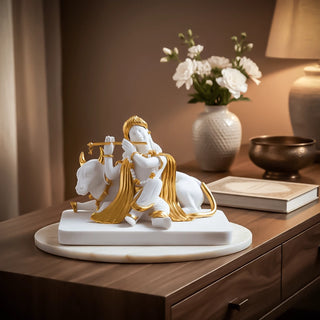
- Something to face. The texts assume an image or a form held in mind. A small Radha Krishna pocket temple does this job well for anyone chanting away from home, and it folds shut to travel.
If you are setting up a proper corner for it, the Puranas have more to say about that than people expect: the Padma Purana treats sweeping the floor and lighting a lamp as acts of worship rather than chores before it. We collected that material in how to decorate a Krishna idol at home and in what to keep in a pooja room. Our Krishna idols and pocket temples are made for exactly this kind of daily, unspectacular use.
What the texts actually promise
The Gita's promises are about fear and bondage, not about outcomes. That is narrower than the internet's version, and better. 18.66 ends with "do not fear." 9.26 promises acceptance of the offering, nothing else.8 The Bhagavata's promises are larger and are stated as devotional rhetoric: the Padma Purana, for instance, says the merit of observing Radha Ashtami is a hundred times that of a thousand Ekadashi fasts, which is a way of speaking, not arithmetic.10 We wrote about that claim and its source in why Radha Ashtami is celebrated.
What no primary text does is promise money, a job, or a specific marriage in exchange for a specific number of repetitions. Pages that do are selling certainty, and certainty is the one thing this literature is careful never to sell.
Where these mantras sit in the larger story
Read the Krishna material end to end and you notice how little of it is instruction. It is mostly narrative, and the narrative is full of unfinished business nobody tidied up.
Krishna leaves Vrindavan on Akrura's chariot and promises nothing: at 10.39.35 he says only "I will do my best," and 10.39.37 records that the gopis were left without hope of seeing him again. He never returns. We traced that in what happened to Radha after Krishna left Vrindavan. The flute vanishes from the story at the same moment, and no text says where it went, the subject of where Krishna's flute is now. Radha's death, the scene everyone knows, appears in no Purana at all. Even why he never married her has no verse behind the popular reasons.
Against all that silence, the mantras are the part of the tradition that survived intact because people kept saying them out loud. Dhruva's twelve syllables are still said the way Narada gave them. That is a strange kind of continuity, and a better reason to chant than any promised result.
For the calendar side, see Janmashtami vrat vidhi, Janmashtami decoration ideas and the Janmashtami gifts households give that week; for Krishna's place in the wider Vaishnava frame, the ten avatars of Vishnu and who gave him the Sudarshan Chakra. Households that chant to the pair keep Radha Krishna idols; those who chant to the child form keep a Laddu Gopal. The same source-checking is worth doing outside this cluster too: our note on the Sai Baba mantra for health runs the same test.
Also read: How to Worship Lord Krishna | The Sacred Lotus Feet of Krishna | Where is Krishna's Flute Now | Krishna and Sudama | Who is Vishnu's First Devotee