Ask this online and you get an answer within seconds. Someone says the flute is in Goloka. Someone else says it is buried under the Yamuna. A very popular version has Krishna playing it one last time as Radha dies in his arms, then breaking it and never touching a flute again.
All of it is confident. None of it is in a text.
I went looking for the verse. I read the flute chapters of the Bhagavata Purana, the Vrindavan sections of the Vishnu Purana in Wilson's translation, and Jayadeva's Gita Govinda, the poem that made Radha a household name. Here is what I actually found, including the strange thing nobody points out: the flute does not get destroyed in the story. It gets quietly dropped.
What the flute actually was
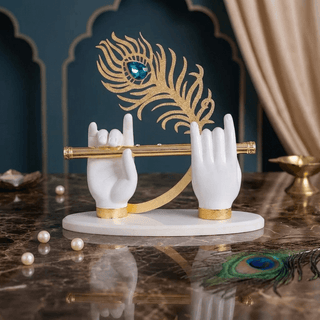
The murali is a length of bamboo with finger holes bored at measured points. That is it. It is easy to over-imagine, and traditional descriptions keep it plain: a cowherd's tool, the kind of thing a boy in a cattle village would cut for himself.
This matters. Krishna is by birth a Yadava prince, son of Vasudeva of the line of Shurasena, though who Krishna's father is has more than one honest answer. He ends up ruling a city. He carries the Sudarshana chakra, a weapon with its own origin story. And yet the object the whole tradition remembers him by is a stick of bamboo he used while following cows around.
Nobody made the flute a relic. It was never royal, never gold, never called a treasure. Which is probably why no text bothers to say where it ended up.
The one chapter that describes the flute fully
The Bhagavata Purana's tenth canto has a chapter called the Venu-gita: the song of the flute. It is the gopis, standing on rooftops, describing what happens when Krishna plays. It is the fullest scriptural account of the flute we have, and it is not subtle.
Cattle stop chewing. The Bhagavata says they hold the half-chewed grass in their mouths, ears raised, absolutely still (10.35.4-5). Rivers slow their current (10.35.6-7). Birds on the lakes come forward to listen the way one approaches a teacher (10.35.10-11). And Indra, Shiva and Brahma (the three the tradition never puts below anyone) bow their heads because they cannot work out what they are hearing (10.35.14-15).1
Read that list again and notice who is in it. Animals, water, birds, gods. Not one human devotee. The flute in the Bhagavata is not background music for a love story. It is a sound that stops the natural order in its tracks.
The cattle detail is worth sitting with. He is Govinda, the one who tends cows, and the cow's place in Indian devotion is old and deep. The first beings the flute affects are the ones he actually worked with.
The exact point where the flute disappears
The flute disappears the moment Krishna leaves Vrindavan. In chapter 39 of the same canto, Akrura arrives with a chariot and a summons from Mathura. Krishna gets on it. The gopis run after it. And what he says to them is almost unbearably thin: the Bhagavata gives him one line of comfort, that he will do his best (10.39.35), and then states flatly that they were left without the hope of ever seeing him back (10.39.37).2
He does not promise to return. He never does return. The one later meeting the Bhagavata records is at Samanta-panchaka, near Kurukshetra, during a solar eclipse many years later (10.82.39-46), and even there, the text names no gopi.4 If you have ever wondered what happened to Radha after Krishna left Vrindavan, this silence is where the trail actually goes cold.
Now track the flute across that same boundary. Before the chariot: an entire chapter of the Bhagavata is about the sound of it. After the chariot: the Krishna of the text is a diplomat, a warrior, a king with a very complicated household, and finally the teacher of the Bhagavad Gita on a battlefield. The flute is simply not part of that vocabulary any more.
This needs care, because it is easy to overclaim. Scripture does not state he never played again. It stops describing it. That is an observation about what the text chooses to narrate: the flute is loud in Vrindavan and absent in Dwarka.
Three things people get wrong about Krishna's flute
1. "He broke it when Radha died."
This one fails twice over. First, no Purana, no epic and no classical Sanskrit poem narrates Radha's death at all. Not the Bhagavata, which never even uses her name. Not Wilson's Vishnu Purana. Not the Gita Govinda, which is the single work most responsible for her fame and which has no death scene in it.8 We looked at this in detail in the piece on how Radha died, and the finding was the same: there is no verse.
Second, even if such a scene existed, no text attaches a broken flute to it. The image of Krishna snapping the murali is modern devotional retelling. It is genuinely moving, and it is not scripture. Citing it as scripture is how good stories get turned into bad history.
2. "The flute is kept somewhere: a temple, a vault, Goloka."
Nothing in the consulted texts records a location. There is no Puranic inventory of Krishna's possessions after Dwarka. The Bhagavata does narrate the end of his life in unsparing detail: the hunter Jara mistaking his lotus-red foot for a deer and piercing it, and Krishna forgiving him outright with the words that what he did was Krishna's own desire (11.30.33, 11.30.39).5 If you want to know what happened to Krishna's body after his death, the tradition has plenty to say. About the flute, it says nothing.
3. "Radha kept it, so the story ends neatly."
Many people in Braj do believe Krishna left the flute behind with the gopis, or with Radha specifically. This is living devotional tradition and I would not argue with anyone who holds it. But it should be named for what it is: belief, not verse. The same care applies to the popular claim that Radha was older than Krishna, which also turns out to have no scriptural basis once you go looking.
So why does the flute vanish exactly when Vrindavan does?
Because in the logic of the story they are the same thing.
The flute is a Vrindavan instrument. It calls cows in from grazing and calls gopis out of their houses. It works on a forest, a river, a herd. There is nothing for it to do in Mathura, where Krishna arrives to kill a king, and nothing for it to do in Dwarka, where he runs a state. The murali does not get destroyed. It becomes irrelevant, which in a story is a much colder fate.
You can see the same shift in the man. In Vrindavan he is a boy who steals butter and gets caught. In Dwarka he is the friend who receives a broke brahmin classmate carrying a bundle of flattened rice (the Sudama story) and rebuilds his life without being asked. Same person, completely different register. The flute belongs to the first one.
That is probably why the tradition never asked where it went. Nobody looks for the flute because everyone already knows. It is in the place he left.
What Krishna himself said about being far away
After he leaves, Krishna sends Uddhava back to Vrindavan to console the gopis. His message: they were never separated from him in the first place, since he is present as the Soul of all (10.47.29). Then something startling. The distance is deliberate. He is far from their eyes so their minds stay on him (10.47.34).3
Absence, in his own words, is a method.
Uddhava does not leave that village the same man. By the end of the chapter he is wishing he could be reborn as any bush or creeper in Vrindavan, just to have the dust of the gopis' feet fall on him (10.47.61, 10.47.63). The comforter ends up envying the people he came to comfort. It is one of the great reversals in the text, and it tells you where the Bhagavata thinks the highest devotion actually lived.
Apply that to the flute and the question dissolves a little. It was never a relic to be located. It was a sound made in one place, for particular people, and then not needed. That is also why Krishna never married Radha reads less like a tragedy and more like a design decision once you sit with the sources.
Then why is the flute in every single idol?
Because iconography records what a deity is worth remembering by, not the last thing he did.
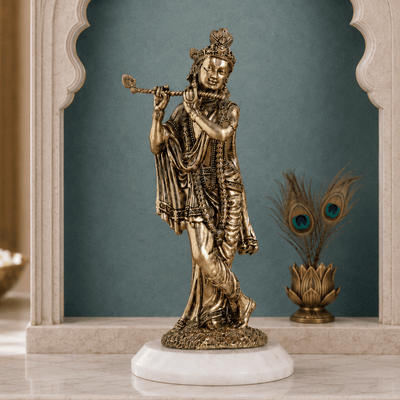
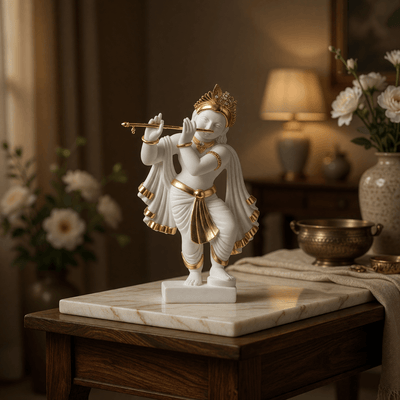
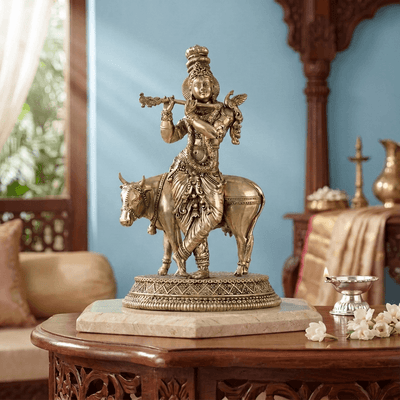
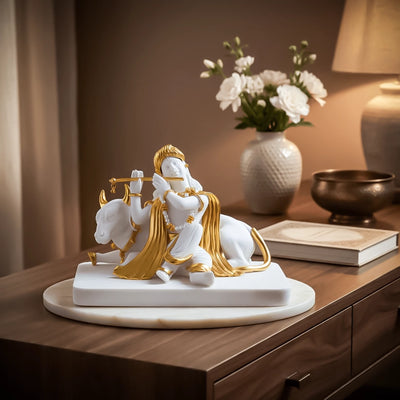
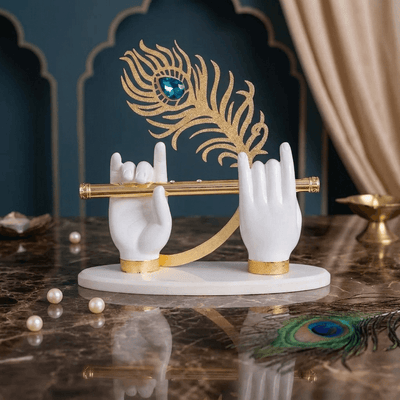
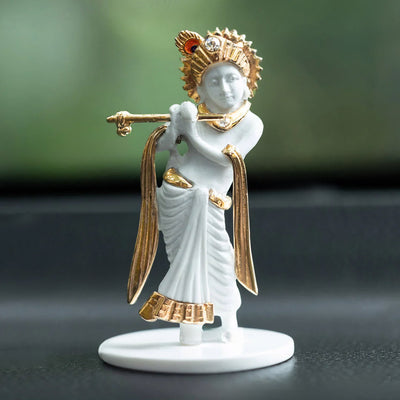
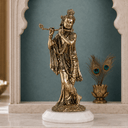
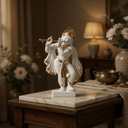
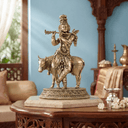
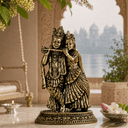
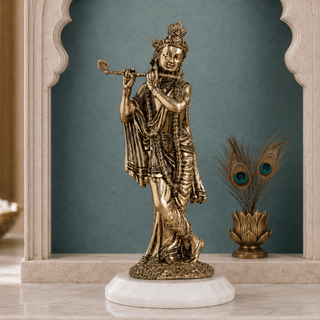
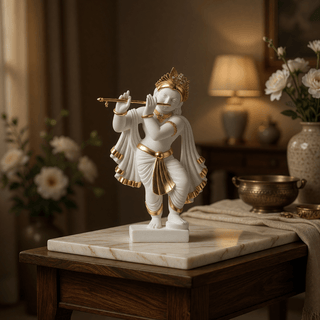
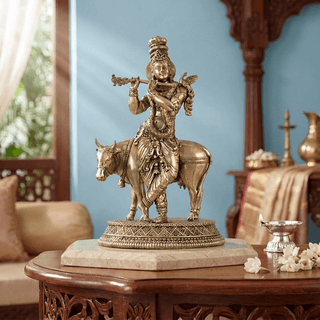
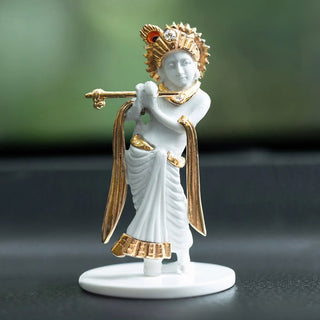
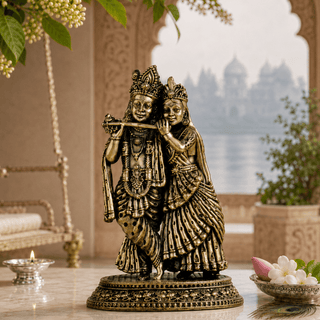
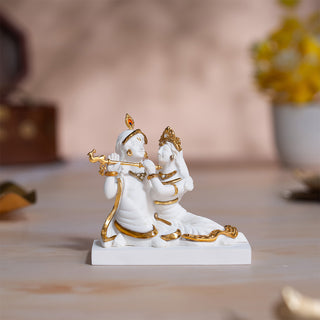
Walk into any home shrine in India and the Krishna there is almost certainly holding a flute: often in tribhanga, the three-bend stance, one leg crossed over the other, murali at the lips. Go through any collection of Krishna idols and you will see how total the association is.
That is not a mistake. Sculptors chose the boy with the bamboo over the king with the chakra, and have kept choosing him for over a thousand years. When you keep a murti of Krishna playing the flute in your pooja room, you are not marking a place he stood. You are keeping the Vrindavan version of him: the one who was easy to reach, before the chariot came.
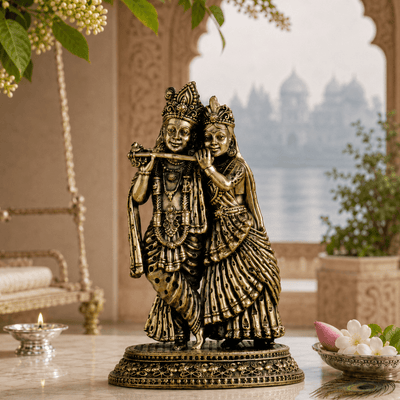
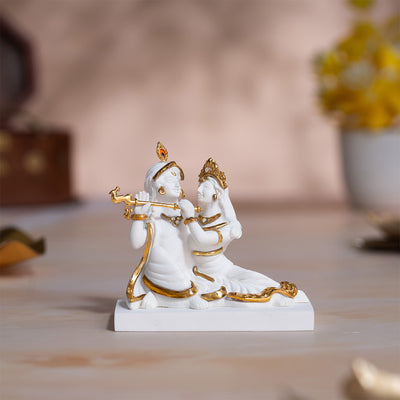
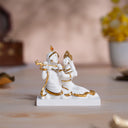
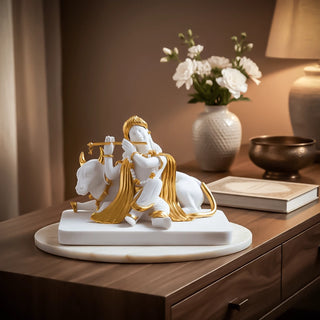
The same instinct shows up in the Radha Krishna idols people bring home for a marriage. Radha is not named in the Bhagavata at all. She becomes central much later, in the Brahma Vaivarta and Padma Puranas and above all in the Gita Govinda. Yet she is in the murti, next to him, permanently. Devotion keeps what it loves and is not embarrassed about the dates.
If you are setting up a shrine, the practical side is worth doing well: decorating a Krishna idol at home has more Puranic backing than most people expect, right down to the cloth and the lamp. And around Janmashtami, the flute usually gets a garland of its own.
What you can do with the answer
An unresolved question is not a dead end. The tradition gives you plenty to do with it.
You can chant. The best-documented Krishna mantra in the corpus is the twelve-syllable om namo bhagavate vasudevaya, which Narada gives the child Dhruva in the Bhagavata's fourth canto (4.8.53-54) with real instructions attached: a clean place by the river, a bath, a seat, offerings of water, forest flowers, fruit and tulsi (4.8.42-43, 4.8.55-56).6 There are other Krishna mantras worth knowing, but that one has a chapter behind it.
You can keep it small. The Bhagavad Gita sets the bar at a leaf, a flower, fruit and water offered with devotion (9.26), which is the whole basis of how to worship Krishna at home without turning it into a shopping list. Prahlada's nine limbs of bhakti in the seventh canto (7.5.23-24) include serving the lotus feet as a practice in its own right, which is a nice thing to know if you have ever wondered why padukas are kept at all.
And you can mark the days. Radha Ashtami, a fortnight after Janmashtami, has a genuine Puranic charter in the Padma Purana: including the detail that Radha did not have an ordinary birth, but appeared on Vrishabhanu's sacrificial ground.
The short version
Nobody knows where Krishna's flute is, and no scripture claims to. The Bhagavata gives it a whole chapter and then lets it go, at exactly the moment Krishna gets on Akrura's chariot and leaves the only place he was ever simply happy.
Every popular answer (the breaking, the burial, the vault in Goloka) is filling a silence the texts left on purpose. And the silence says something the invented endings cannot. The flute was never a thing to be kept. It was a sound, made in one village, for a few years, and then he grew up and went to work.
If you want to hold on to it, hold on to it the way the sculptors did: in brass, in marble, at the lips of a boy who has not left yet.
Also read: How Did Radha Die | What Happened to Radha After Krishna Left Vrindavan | What Happened to Krishna's Body After His Death | Why Krishna Didn't Marry Radha | Krishna and Sudama