Ask this question on the internet and you get a confident answer within seconds. Radha was five years older. Or eleven. Some pages give it to the month.
So we went looking for the verse. We read the chapters where Radha actually appears, in the translations that print the Sanskrit alongside. And the honest result is stranger and better than a yes or no. The texts that mention her age are not talking about age the way we mean it. They disagree with each other. And not one of them ever compares her years to Krishna's.
That sounds like a let-down. It isn't. Once you see why the question doesn't have an answer, you understand something real about who Radha is in the tradition, and why she is the one figure in Krishna's life that scripture keeps refusing to pin down.
First, the part nobody mentions: Radha isn't in the oldest Krishna texts
Radha does not appear in the oldest Krishna texts at all.
The Bhagavata Purana is the great Krishna scripture. Canto 10 is his whole life: Gokula, the butter, the flute, the rasa dance, Mathura, Dwarka. Radha is not named in it. Not once.
There are two famous places where English editions insert her. At 10.30.26 the gopis find a second set of footprints beside Krishna's and realise he took one girl aside. At 10.47.11 a gopi pours her heart out to a honeybee. In both, the Sanskrit says only gopi: "a certain cowherd girl." Honest translations print "[Radha]" in square brackets, because it is the translator's identification, not the verse's. The name only surfaces at 10.30.28 as a footnote on the word aradhitah, "she who worshipped him."5
The Vishnu Purana, older and more sober, is the same story. H. H. Wilson's translation covers the rasa dance in Book V without naming a single gopi. Radha is simply absent.8
So when someone tells you Radha was five years older than Krishna and cites "the Puranas," the first question is: which one? Because the two that most people think of do not contain her.
The only two ages in scripture, and they don't agree
Radha becomes a named, central figure in two later Puranas. Both give her a number. The numbers are different, and neither is a birthday.
The Brahma Vaivarta Purana (Brahma-khanda, chapter 5) places her in Goloka, Krishna's eternal realm. She emerges from the left side of Krishna's own body, is described as sixteen years old, and is called "the lady of the life of Krishna." The text explains her name from that moment: she was born mid-dance and ran toward him.
The Padma Purana (Patala-khanda, chapter 71) tells a completely different scene. Narada goes looking for Radha and finds her dull, blind and deaf. Then she takes on "a divine, very fascinating form resembling that of a young girl fourteen years old."
Sixteen in one, fourteen in the other. Notice the wording in both cases. She is described as. She assumes a form resembling. These are descriptions of an appearance, not entries in a register. The idea behind them is nitya-shodashi: eternally sixteen, forever at the age where youth is complete and does not move. It is the same instinct that makes every murti of Krishna a young man, whether the story is from Vrindavan or Kurukshetra.
Read those two lines as birthdays and you have a contradiction to solve. Read them as what they say (the form she appeared in) and there is nothing to solve.
So where did "older Radha" come from?
From devotional tradition, not from a text. The belief is old, widely held, and especially strong in Braj and in Bengal, where the Radha-Krishna devotional world is deepest. It did not come from nowhere, and nobody was being dishonest.
It usually travels with two other ideas. One is that Radha was already married to another cowherd, which several regional retellings and later poetic traditions carry. The other is the theology of viraha, love as longing, the sense that Radha understands the separation before Krishna does, that she is the older soul in the relationship even where nobody counts years.
Somewhere in the retelling, "older in understanding" hardened into "older by five years." That is how folk memory works, and it is not a scandal. It is only a problem when a blog prints it as a verse.
The single work most responsible for Radha's fame is not a Purana at all. It is Jayadeva's Gita Govinda, a twelfth-century Sanskrit poem that made her a household name across India. Read Edwin Arnold's 1875 translation end to end and you will find she is Krishna's supreme beloved, she is never called his wife, and there is no account of her death, and no age for her anywhere. The poem that made Radha famous never told us how old she was.9
The texts can't even agree on how she arrived
Scripture gives Radha at least three incompatible origins, which makes an age gap impossible to measure even in principle.
- Born to Vrishabhanu and Kalavati. The Brahma Vaivarta and Narada Puranas give her ordinary cowherd parents. The Shiva Purana adds a backstory, and it is worth reading, because it is the one place a text says plainly where Radha's mother came from. In the Rudra Samhita's Parvati Khanda (chapter 2), three mind-born daughters of the Pitrs (Mena, Dhanya and Kalavati) fail to rise when the Kumaras enter, and are cursed to be born as human women. Softening the curse, the sage tells them what each life will hold: "The youngest Kalavati shall be the wife of the Vaishya — Vrishabhana. At the end of Dvapara, Radha shall be her daughter." A few lines later: "Kalavati's daughter Radha, resident of Goloka, shall become the wife of Krishna united with him in secret love." Notice what that makes Radha's birth: the back half of somebody else's punishment.
- Found, not born. The Padma Purana's Brahma-khanda, chapter 7 (the very chapter that establishes her festival) says Radha "appeared with a divine form on the sacrificial ground of Vrishabhanu." A related reference tradition puts it flatly: he was clearing ground for a sacrifice, found a girl there, and raised her as his own.10
- Emerged from Krishna's body. The Brahma Vaivarta's Goloka account, where she comes out of his left side.
If she was found on a sacrificial ground with no birth event, there is no date to subtract from. If she came out of Krishna's own body, the arithmetic is worse than difficult: it is meaningless.
Three origins is not a flaw in the record. It is the record. This is the same tradition that comfortably gives Krishna two fathers and one cosmic one and never picks. Indian scripture is much more relaxed about holding several true things at once than we are.
In the oldest theology, "older" isn't even a category
Radha does not arrive from outside and fall in love with Krishna. She emerges from his left side. She is his own energy (his shakti) taking a form he can be in relationship with. In that framework, asking whether she is older than him is like asking whether your reflection is older than you.
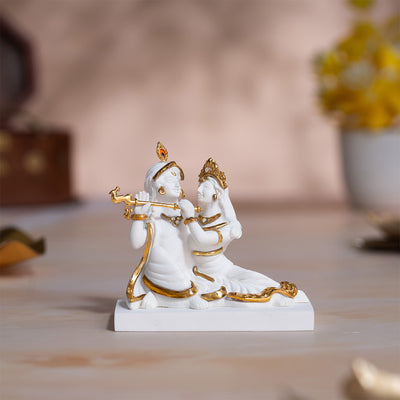
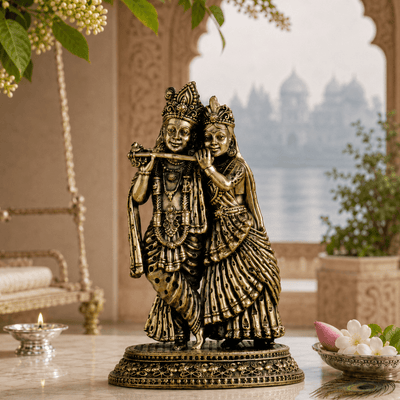
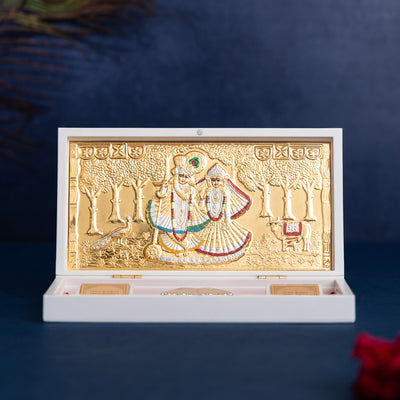
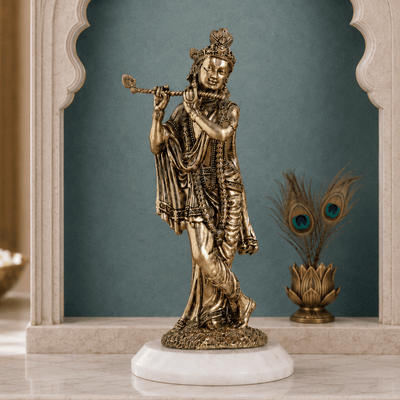
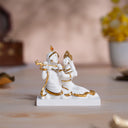
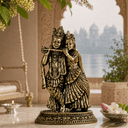
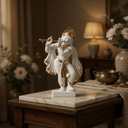
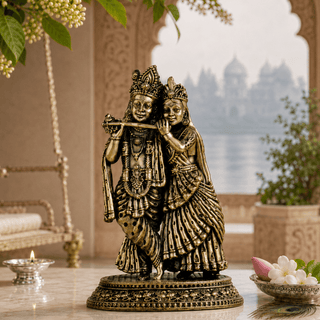
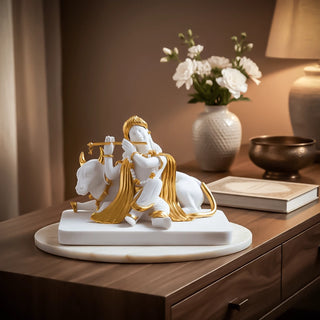
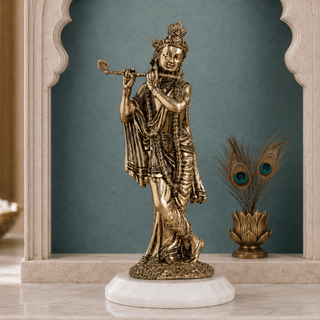
This is also why the artistic tradition almost never shows them separately. Look at any classical Radha Krishna murti and you'll notice they are composed as one shape: one lean, one curve, one line running through both figures. The brass Radha Krishna murti in the tribhanga pose is the clearest example of it: Krishna's three-bend stance and Radha's answering tilt only read correctly as a pair. Sculptors were working from the theology, not from a love story.
It also explains something that puzzles a lot of people, which is why Krishna never married Radha while the Bhagavata carefully records how many wives he did have. Marriage is a contract between two parties. The texts were never treating her as a second party.
Four things people get wrong about this
1. "The Puranas say Radha was five years older." No consulted text states any age difference between them. Not the Bhagavata, not the Vishnu Purana, not the Brahma Vaivarta, not the Padma Purana, not the Gita Govinda. The number is folk tradition wearing a citation.
2. "Radha is the heroine of the Bhagavata Purana." She is not in it. Every "Radha" in an English Bhagavata is a translator's or commentator's identification of an unnamed gopi, and honest editions bracket it. She becomes central in the Brahma Vaivarta, the Padma Purana and above all the Gita Govinda.
3. "She was fourteen when she met Krishna" (or sixteen). Both numbers exist in scripture, but they describe the divine form she assumed: one in Goloka, one when revealing herself to Narada. They are not chronological ages, and using either as a birthday means ignoring what the sentence around it says.
4. "She was born in Barsana in the normal way." One tradition says so. Another says Vrishabhanu found her on his sacrificial ground. A third says she emerged from Krishna's body. The texts disagree, and smoothing that over to make a tidy paragraph is exactly how a myth gets manufactured. If her arrival is unsettled, an age counted from it cannot be firm.
What scripture does say about her, clearly
The texts are generous about Radha in other directions.
The Padma Purana's Brahma-khanda chapter 7 gives her a real festival with a real charter: Radha Ashtami, on the eighth day of the bright fortnight of Bhadrapada, about a fortnight after Janmashtami. The chapter prescribes worshipping her image with sandal, flowers, incense, lamps, cloth and fruit, with song and dance, and attaches a merit claim so large it is clearly meant as praise rather than accounting.
The Bhagavata, even without naming her, is remarkably clear about the gopis' standing. Uddhava (a Yadava prince, sent from Mathura to console them) ends his mission wishing to be reborn as any bush or creeper in Vrindavan, just to receive the dust of their feet.6 The man sent to comfort them goes home envying them.
And the answer to what happened after Krishna's chariot left is not a romance either. He promised nothing. At 10.39.35 his whole parting message is "I will do My best," and the text says the gopis were left without hope of seeing him again.7 What he sends later, through Uddhava, is a line worth more than any reunion: you were never separated from me. If you want the full arc, we traced it in what happened to Radha after Krishna left Vrindavan, including the one time they meet again, at Kurukshetra, during an eclipse.
So what do you tell someone who asks?
Say this, and you'll be more accurate than almost anything else they'll read: nobody knows, because no text ever said. Two Puranas describe her divine form as sixteen and as fourteen. Neither is a birthday, neither matches the other, and neither is measured against Krishna.
The belief that she was older is genuine, old and loved. It just isn't a verse, and there's a difference between the two that's worth keeping.
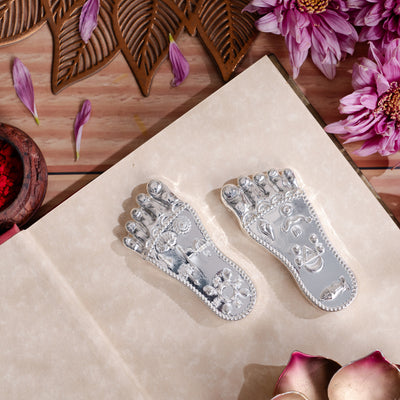
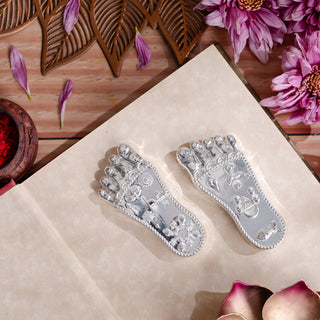
That distinction runs through the whole Krishna cluster once you start noticing it. The Bhagavata never gives his poor brahmin friend a name: the story we all call Krishna and Sudama gets the name from later tradition. No text records what happened to his flute. Even what happened to his body has a scriptural answer and a temple answer, and they're not the same. The five marks on his soles, though, are right there in verse 10.30.25 (flag, lotus, thunderbolt, barleycorn, elephant goad) which is how the gopis knew the footprints were his in the first place.
Knowing which is which doesn't cost you the devotion. It's what makes the devotion worth having.
If you keep Radha and Krishna at home, the practice is simpler than the theology. Scripture's floor is famously small: a leaf, a flower, fruit, water, offered with love. The rest is in how to worship Lord Krishna, the well-sourced Krishna mantras, and a proper guide to setting up a Krishna idol at home. For the festival week, our Janmashtami decoration notes mark which customs are Puranic and which are simply beloved. Browse the full range of Krishna idols, handcrafted brass idols, or the Janmashtami gifts if you're choosing one for a home temple or for someone else's.
Also read: How Did Radha Die | What Happened to Radha After Krishna Left Vrindavan | Why Krishna Didn't Marry Radha | Why Radha Ashtami is Celebrated | Who is the Father of Lord Krishna