Every September, Barsana fills up. Kirtan runs through the night, the temple on the hill opens its doors, and lakhs of people come to celebrate the birthday of a woman whose name does not appear in the most famous Krishna scripture ever written.
That sentence is not a provocation. It is just true, and it is the most interesting thing about this festival.
Why is Radha Ashtami celebrated?
Because a Purana says to.
The Padma Purana's Brahma-khanda has a chapter (the seventh) whose title in N. A. Deshpande's translation is simply "The Greatness of Radhashtami." It sets the day: the eighth (ashtami) of the bright fortnight of the month of Bhadrapada. It describes what to do: worship an image of Radha with sandal paste, flowers, incense, lamps, cloth and fruit, accompanied by song, dance and instruments. And it makes a claim about the reward that is deliberately, almost comically, huge. The fruit of observing Radha-janmashtami is said to be a hundred times that of a thousand Ekadashi fasts. Even a casual observer is promised Vishnu's world along with a crore of his family.1

Read that as devotional rhetoric, not arithmetic. Puranas talk like this when they want you to understand that something matters more than the thing you already do. The point is that a text was willing to rank Radha's day above a thousand fasts.
The date puts the festival in a specific mood. Janmashtami falls in the dark fortnight of Bhadrapada (Shravana in the amanta reckoning), and about fifteen days later comes Radha's day. Krishna's appearance, then hers. In Braj they are treated as two halves of one season, with Ganesh Chaturthi and Kajari Teej landing in the same crowded weeks.
One honest wrinkle, since we're being careful. The Padma Purana's big vow section (the Uttara-khanda) has a full chapter on the Janmashtami vrata and no Radhashtami chapter at all.3 So even inside a single Purana, the festival is attested unevenly. There is also a lexicon tradition that places Radhashtami in the dark fortnight of Ashvina instead. That is almost certainly an artefact of purnimanta versus amanta calendars. It is also why regional dates for the same festival drift by a fortnight. I'd rather flag that than smooth it over.
Radha wasn't born. She appeared.
Almost every article you will read says Radha was born in Barsana to Vrishabhanu and Kirti. The Padma Purana chapter that establishes Radha Ashtami says she descended at Krishna's command to relieve the earth's burden, and appeared with a divine form on the sacrificial ground of Vrishabhanu. A cross-text reference tradition puts it even more flatly: Vrishabhanu was clearing ground to perform a sacrifice, and got a girl. He raised her as his own daughter.10
Found, not delivered. On a yajna ground, not in a birthing room.
If that reminds you of Sita (discovered in a furrow by Janaka while he ploughed a sacrificial field), you are noticing something real. The tradition has a recurring instinct that a goddess who enters the world does not arrive the ordinary way. It's the same instinct that shapes the question of who Sita's real father was, and it is worth sitting with rather than tidying up.
Three origins, and they don't agree
Radha's arrival is not settled scripture. It is three different accounts that cannot all be true at once.
She was born to Vrishabhanu and Kalavati. This is the Brahma Vaivarta and Narada Purana line, and it is the version behind Barsana as her birthplace and Kirti or Kalavati as her mother.
She was found on a sacrificial ground. The Padma Purana, as above. No mother named in that account at all.
She emerged from Krishna's own left side. The Brahma Vaivarta Purana's Brahma-khanda, chapter five, has Radha appear from the left half of Krishna's body in Goloka, described as sixteen years old and called "the lady of the life of Krishna." She is named Radha, the text says, because she was born mid-dance and ran toward him.4
That third version quietly changes everything. If Radha is Krishna's own energy taking a form, then she is not a woman who fell in love with God. She is the loving half of God, standing apart long enough to be loved back. Which is also why questions like why Krishna never married Radha land differently once you know it. You cannot marry your own shakti in the ordinary sense.
The strange fact under the festival: Radha isn't in the Bhagavata Purana
The Srimad Bhagavatam is the great Krishna text. Ten cantos of it, in places verse by verse, are about Vrindavan. And it never once uses the name Radha.
There are two places where translators insert her. At 10.30.26 the gopis find a second set of footprints beside Krishna's and realise he took one of them aside. She is called only "a certain gopi."7 At 10.47.11 a gopi addresses a honeybee in one of the most beautiful passages in the book, again, unnamed. Honest editions print "[Radha]" in square brackets, because that is what it is: a commentator's identification, not the verse.
The Vishnu Purana, older and drier, doesn't name her either. H. H. Wilson's translation covers the rasa dance in Book V without naming a single gopi.5
So where does Radha become Radha? In the Brahma Vaivarta and Padma Puranas, and above all in Jayadeva's Gita Govinda, a twelfth-century Sanskrit poem that put her at the centre of the story and never let her leave. Edwin Arnold translated it in 1875 as The Indian Song of Songs. Read it and you can watch a devotional world reorganise itself around one figure.
This does not make Radha late or lesser. It makes her a genuine development in Indian religious thought: the moment the tradition decided that the highest devotee deserved a name, and that the relationship mattered as much as the deity. Her festival grows exactly in step with her scriptural profile. That is not a scandal. It is history you can trace.
What people get wrong about Radha Ashtami
"Radha Ashtami is just custom, with no scripture behind it." The opposite, actually. Most myth-busts here go the other way, but this one is real: the Padma Purana names the tithi, the rite and the reward. If anything the festival is better attested than several observances nobody questions.
"She was born in Barsana on this day, to Vrishabhanu and Kirti." Widely believed, deeply loved, and not what the festival's own charter chapter says. Three texts give three arrivals. Say "we celebrate her appearance" and you are on solid ground with all of them.
"Radha was older than Krishna, five years or eleven." No primary text says this. The only two ages in scripture are descriptions of her divine form and they contradict each other: sixteen in the Brahma Vaivarta's Goloka account, and "resembling a young girl fourteen years old" when she reveals herself to Narada in the Padma Purana's Patala-khanda.2 Neither is a birthday, and neither is measured against Krishna. We looked at the age question in detail separately.
"Radha died in Krishna's arms in Dwarka, and he broke his flute." No Purana, no epic, no classical poem narrates Radha's death at all. Not the Bhagavatam, not the Vishnu Purana, not the Gita Govinda. The story is modern devotional retelling and a lot of people love it. But it is not scripture, and it should never be cited as such. We traced the search in full in how did Radha die, and the related question of where Krishna's flute went.
How Radha Ashtami is actually observed
The Puranic instruction is short. Worship her image with sandal, flowers, incense, lamps, cloth and fruit. Sing. Dance. Play something.

Notice what is not in that list: no complicated procedure, no shopping list, no rare ingredient. The detailed sixteen-step puja most of us learned comes from Agama and Pancharatra ritual literature, not from this chapter. Here it is essentially: dress her, light something, feed her something, and make a joyful noise.
In practice, across most homes and temples in Braj and beyond, the day tends to look like this:
- A fast, often till noon: Radha is said to have appeared at midday, unlike Krishna's midnight, so the fast breaks earlier than on Janmashtami.
- Abhishek of the Radha-Krishna image with milk, curd, honey and water, then fresh cloth. Yellow and pink are the usual colours of the day.
- Flowers, and a lot of them. Bhadrapada is a generous month for them, and the Padma Purana asks for flowers by name.
- Kirtan and the Radha-name, which in Braj practice matters more than any offering.
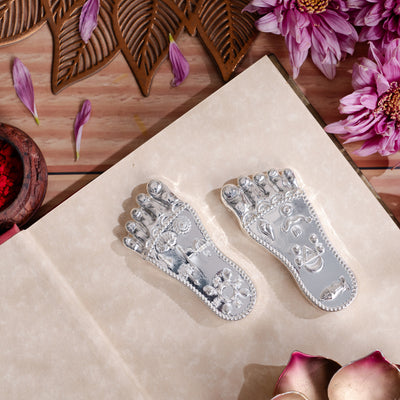
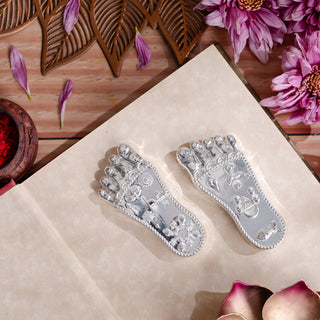
- Charan darshan at Barsana: the Shriji temple opens Radha's feet for viewing on this day alone, which is why the crowds are what they are.
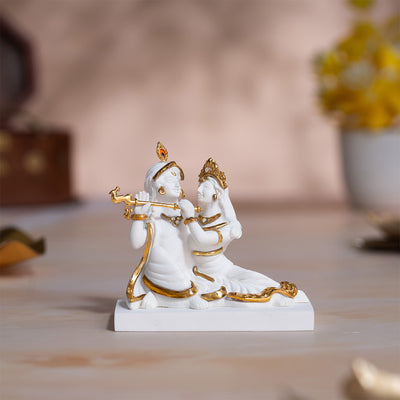
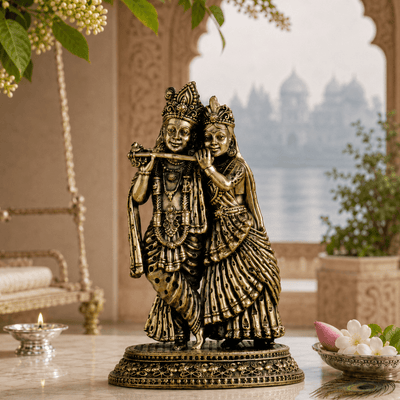
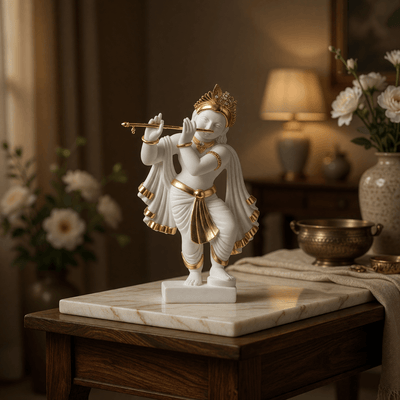
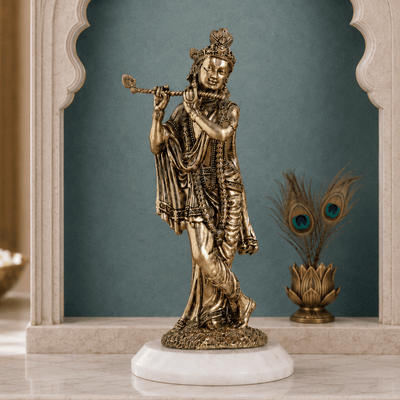
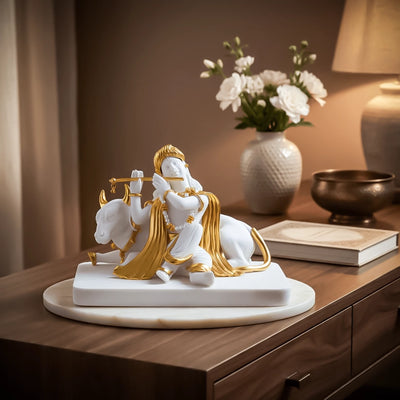
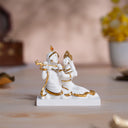
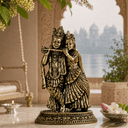
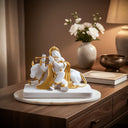
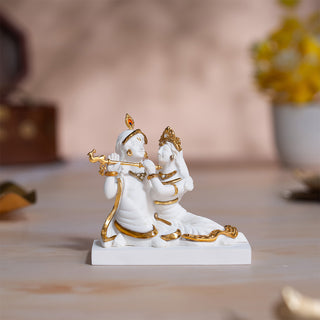
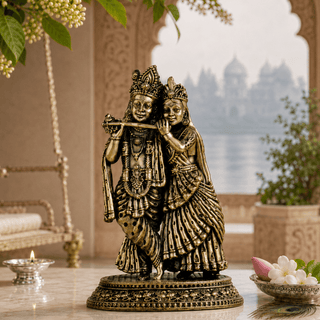
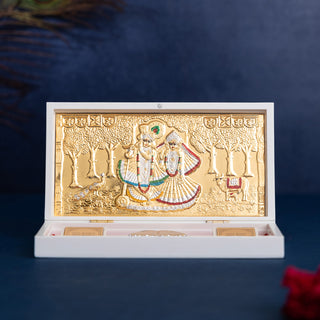
If you keep a home altar, the honest version of this festival is small. A clean puja setup, a lamp, whatever flowers your street sells, and an image you actually look at. The Padma Purana's own instruction is image worship, so a Radha Krishna murti is the one thing the chapter genuinely asks for. Everything after that is your affection, not a requirement. If you're setting up for the first time, we've written about decorating a Krishna idol at home and what belongs in a pooja room, and there's a plain guide to how to worship Krishna if you want the wider frame.
For chanting, the Radha-name paired with Krishna's is the tradition's own answer, and our note on Krishna mantras and where each one actually comes from is a good place to start.
Why the festival still makes sense
The Bhagavatam never names Radha, but it does something else. When Krishna leaves Vrindavan he makes no promise to return: the text says only "I will do My best," and then that the gopis were left without hope of seeing him again.9 Later he sends Uddhava with a message, and the message is not comfort. It is: you were never separated from me at all.
And Uddhava, a Yadava prince sent to console village women, ends the chapter wishing he could be reborn as any bush or creeper in Vrindavan, just for the dust of their feet.8 The messenger goes home envying the people he was sent to help. That is the Bhagavatam's own verdict on who ranked highest in this story, and it does not need a name to be devastating. We followed that thread in what happened to Radha after Krishna left Vrindavan.
Radha Ashtami is the day the tradition gives that unnamed devotion a name, a face and a birthday. Whether she was born in Barsana, found on a yajna ground, or emerged from Krishna's left side, every version is saying the same thing in different grammar: the love came first, and it came from his side.
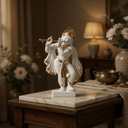
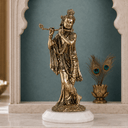
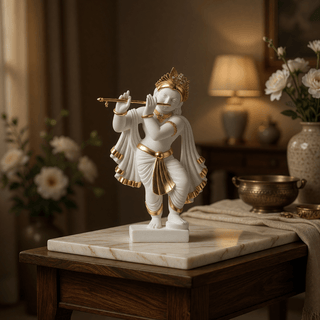
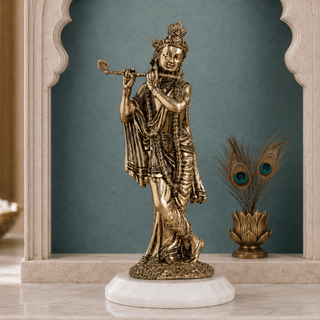
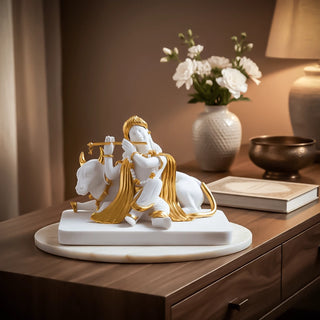
Which is also why images of the two are almost never made separately. The Radha Krishna murtis people keep at home are one composition, not two figures placed near each other, and even a solitary Krishna idol with a flute is understood to be playing for someone.
For more of the textual detective work in this cluster: who Krishna's father actually was (there are three answers, on purpose), the Krishna and Sudama story and the surprise that the Bhagavatam never names Sudama, the lotus feet of Krishna, and how many wives Krishna had.
Also read: Why Krishna Didn't Marry Radha | How Did Radha Die | What Happened to Radha After Krishna Left Vrindavan | Janmashtami Decoration Ideas | How to Worship Lord Krishna