A festival named after a song
Most Indian festivals are named for a god, a day or a deed. Kajari Teej is named for a kind of music.

Kajri is the monsoon song of eastern Uttar Pradesh, sung in Mirzapur, Banaras and the villages around them. The songs are almost always about absence. A woman sings that the rains have arrived and her husband has not. The clouds are low, the peacocks are calling, and she is alone with them.
William Crooke, who spent years writing down folk practice in these districts, refers to "the Kajali in autumn" as a separate seasonal festival of Upper India.6 The songs came first. The fast settled onto them.
That matters, because it explains the mood of the day. This is not a solemn temple observance. It is women singing together in the rain about longing, which is a very different thing from a liturgy.
Kajari Teej tithi: is it Shravana or Bhadrapada?
In 2027 Kajari Teej falls on Friday, 20 August. Both months are correct. They name the same day.
India runs two ways of ending a lunar month. Robert Sewell and S. B. Dikshit laid it out in The Indian Calendar (1896): "By one, called the amanta system, a month ends with the moment of amavasya or new moon; by the other it ends with the purnima... The purnimanta scheme is now in use in Northern India, and the amanta scheme in Southern India."2
So the tithi itself never moves. Only the label on the month changes. The same dark-fortnight third day is counted as Bhadrapada in Lucknow and as Shravana in Pune. One sunrise, two names.
Once you see that, a lot of festival confusion clears up. It is the same reason people argue about which month Krishna Janmashtami belongs to.
Why two almanacs still print different dates
Even after you settle the month, two panchangas will sometimes put Kajari Teej on different English dates. That is not carelessness. It is built into the system.
A tithi is not a day. It is the time the moon needs to move twelve degrees away from the sun, and it can run shorter or longer than one sunrise to the next. Sewell and Dikshit again: "A tithi on which the sun does not rise is expunged... a tithi on which the sun rises twice is repeated." They counted about thirteen expunctions and seven repetitions in twelve lunar months.
So the honest answer to "what is the date this year" is this: check a panchanga for your own town, and expect a neighbouring state to differ by a day. The same mechanism shifts Karwa Chauth and Navratri around. We do not print muhurat clock times here. People plan real worship around them, and a wrong minute does real harm.
The oldest written record of this fast
The earliest dated record is from 1885. George Grierson, a British administrator who catalogued village life in Bihar, published Bihar Peasant Life that year. At section 1443 he writes that in the north and east, "on the 3rd Bhadon (August-September) occurs the [Tij], on which women fast a day and night in honour of the goddess Parbati, and eat sattu (ground parched grain) next day."1
A fast for Parvati, kept a day and a night, broken with sattu. That is Kajari Teej, described 140 years ago.
How do we know he means the dark fortnight and not the bright one? Because of his own reckoning. At section 1445 he places the dark half of Saon in late July and the light half in early August, dark half first. His months run purnimanta. So an unqualified "3rd Bhadon" is Bhadrapada Krishna Tritiya, and the sattu clinches it, because sattu is the Kajari food and not the Haritalika one.
Grierson never uses the word Kajari. The identification rests on the tithi, the goddess and the food together. It is a strong inference rather than a certainty, and it is worth saying so.
What the katha actually says
Kajari Teej has no Puranic katha of its own. The stories told at the vrat, the poor brahmin's wife, the moneylender, the various village tales, are folk vrat-katha. They travel by mouth and by cheap printed pamphlet. I could not trace any of them to a Purana, and neither, as far as I can tell, has anyone else.
What does exist in scripture is the story underneath all three Teejs: Parvati's penance to win Shiva. The Shiva Purana tells it in the Rudra Samhita, in a chapter of the Parvati Khanda headed "Description of Parvati's penance". She stands on one leg, wears bark, keeps the five-syllabled mantra going. Verse 52 says plainly: "Parvati thus spent three thousand years in the penance-grove performing penance and meditating on lord Siva."4
The next verse adds a detail I love. Shiva had performed his own penance in that same grove for sixty thousand years. She went and stood exactly where he had stood.
If you want the fuller version of that story and what later retellings did to it, we have written about Parvati's supposed 108 lives separately. The short version: the Shiva Purana counts no births at all.
How Kajari Teej is kept
The rituals are local and they vary from district to district, but the shape is steady.

- The fast. Married women keep a nirjala vrat, without food or water, through the day and into the night. Unmarried girls keep it in many families too.
- The neem. A neem branch is set up and worshipped as Parvati, with water, roli, rice and flowers. In some homes a small clay or metal image of Shiva and Parvati is used instead.
- The moon, not the sunset. This is what sets Kajari apart from most fasts. Nobody eats until the moon has risen and been offered arghya, and on a dark-fortnight night the moon is late.
- Sattu. The fast breaks with sattu, roasted gram flour, mixed with ghee and jaggery. Grierson recorded exactly this in 1885. The food has not changed.
- The cow. In Bundelkhand many families do a gau puja and give the first roti of the meal to a cow before anyone touches theirs.
- Jhulas and mehndi. Swings go up on trees, mehndi goes on hands, and daughters go back to their parents' homes for the day.
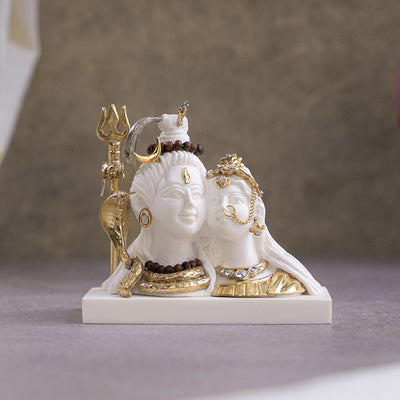
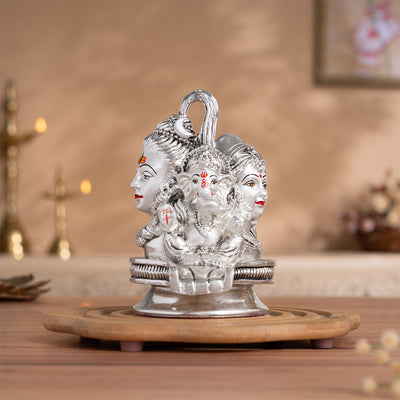
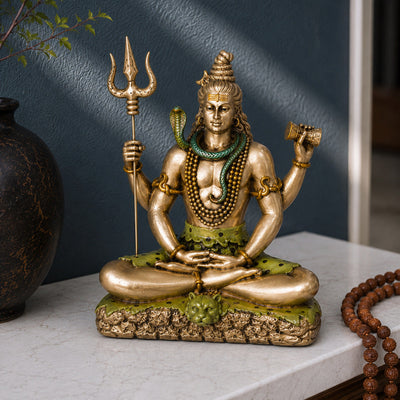
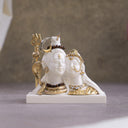
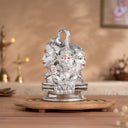
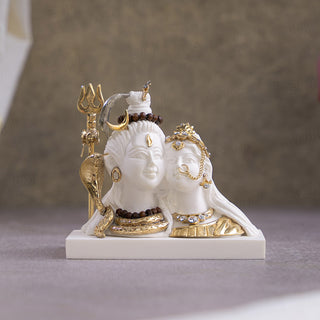
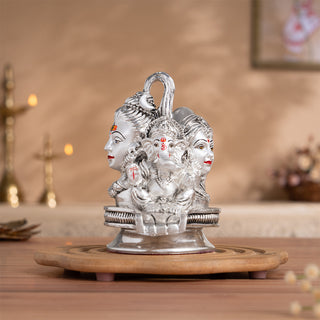
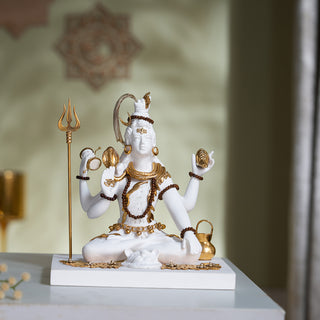
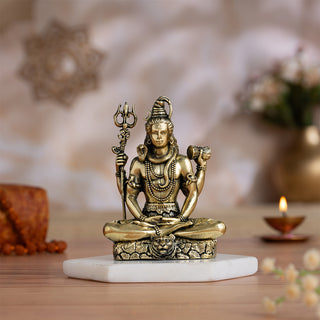
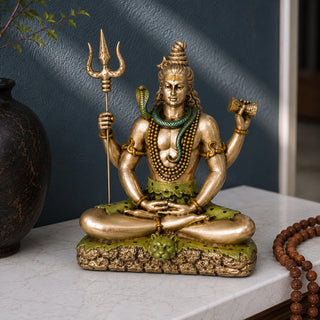
Households that keep an image rather than a branch usually use a joined Shiva and Parvati murti. The day is about the pair, not about either one alone. A piece like this Shiv Parvati murti is the sort of thing that stays in a family shrine long after the fast ends. If you keep a Shiva image at home year round, our note on keeping a Shiva statue at home covers placement.
Three things people get wrong about Kajari Teej
1. That the sand-linga story belongs to this festival
You will find the same katha copied onto every Teej page: Parvati runs into the forest with a friend, makes three lingas out of sand, keeps a night vigil, and her worried father finally relents. M. M. Underhill's survey The Hindu Religious Year (1921) records that story as the legend of Haritalika Teej, on Bhadrapada shukla tritiya, and attributes it to the Bhavishyottara Purana.3 It belongs to a different day, a fortnight later. Attaching it to Kajari is a copying error that spread.
2. That the three Teejs are one festival
They are three different days, spread across about a month. Hariyali Teej falls on Shravana shukla tritiya. Kajari Teej falls on Bhadrapada krishna tritiya. Haritalika Teej falls on Bhadrapada shukla tritiya. Underhill's 1921 survey documents only Haritalika by name, which tells you how locally the other two were kept.
3. That the sources disagree about the month
They agree completely. As Sewell and Dikshit show, purnimanta Bhadrapada Krishna Tritiya and amanta Shravana Krishna Tritiya are the same twenty-four hours. Nobody is wrong here, which is a nicer answer than the argument usually gets.
How Kajari sits beside Hariyali and Haritalika
Hariyali Teej is the green one, at the start of the rains, full of swings and new bangles. Haritalika is the strictest, a nirjala fast with a night-long vigil. Kajari sits between them and carries the music.
All three honour Parvati, and all three point back to the same marriage. If you want the family behind these stories, we have pieces on Shiva's own parentage, on the five daughters of Shiva, and on how Ganpati and Gauri are related. Parvati's fiercer forms are a separate thread, taken up in how many hands Durga has and in why Chaitra Navratri is kept.
Crooke also recorded how loose Teej practice could be on the ground. Near Saharanpur he watched girls in their best clothes walk to a tank and drop offerings into the water. Then they split into two parties, one playing bride and one playing bridegroom, and staged a mock wedding around a tulsi plant. No pandit, no fixed script, and a lot of teasing.5 That is a living festival, not a rulebook.
Why the honest answer is the better one
It would be easy to hand Kajari Teej a verse number and move on. Plenty of pages do. But the festival is more interesting without one.
What we can actually show is this. A women's fast for Parvati, on this exact tithi, broken with sattu, written down in Bihar in 1885. Monsoon songs of separation, old enough that Crooke logged them as their own seasonal event. A calendar system that explains the two month names completely. And behind all of it, a Purana chapter about a goddess who stood on one leg for three thousand years in the grove where Shiva had once stood.
None of that needs propping up. Compare it with a festival like Chhath Puja, which Grierson also recorded in the same book and which likewise has no scripture prescribing it. Or Onam, where the yearly homecoming everyone repeats turns out to be Kerala's own tradition rather than Puranic text. The pattern holds. The regional festivals that people actually keep are usually older than the texts that were supposed to authorise them.
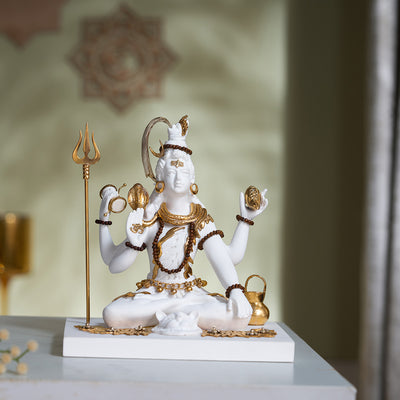
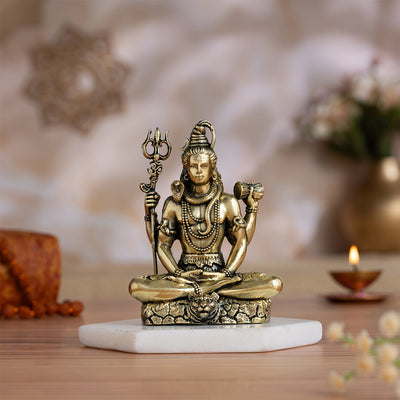
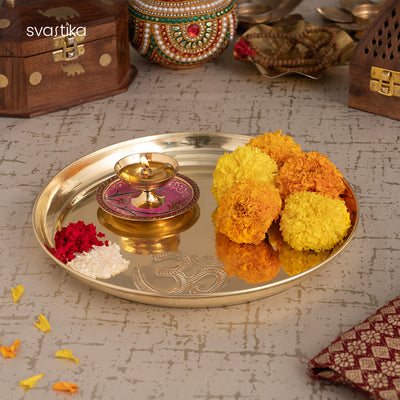
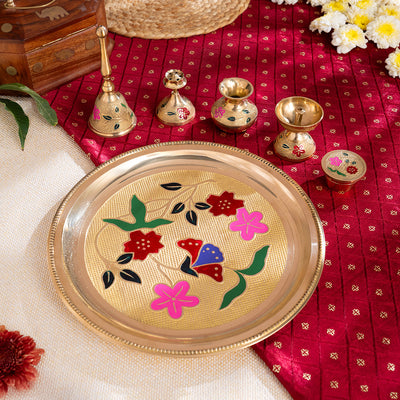
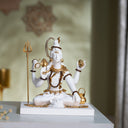
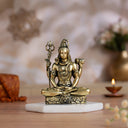
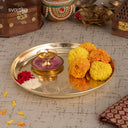
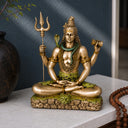
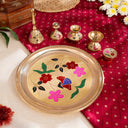
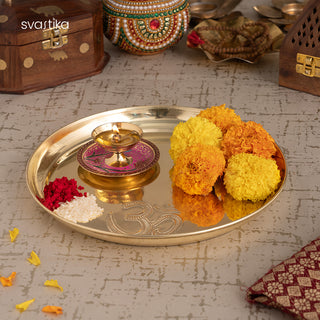
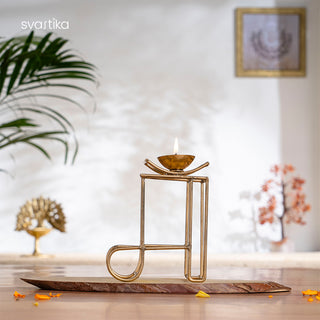
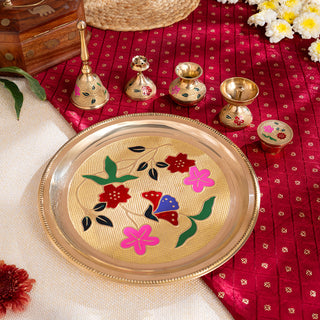
If you are setting up for the day, the practical needs are small: a clean space, a lamp, a thali, and something to hold the neem or the image. Our brass diyas and pooja thali range cover the basics, and the Shiva idols collection has joined Shiva-Parvati forms if you want one for the shrine. For the room itself, see what to keep in a pooja room.
Then put the phone down and learn a kajri. That is the part the festival is actually named after.
Also read: Hariyali Teej and Parvati's 108 Lives | Chhath Puja: Significance and Vrat Vidhi | Karwa Chauth: Traditions and Puja | Who Are Lord Shiva's Father and Mother | Things to Avoid on Maha Shivratri