Most festivals celebrate a winner. Onam does not.
Kerala's biggest festival belongs to a king who lost everything. He gave away his kingdom, was pushed below the earth, and Kerala has been waiting for him ever since. Ten days of flowers and feasting for the man on the losing side of the story.
When is Onam, and why the date barely moves
In 2027 Thiruvonam falls on Sunday, 12 September; the nakshatra runs from 2:58 am on 12 September to 6:04 am on 13 September (Thiruvananthapuram). Onam lands in late August or early September every year, and it barely moves. That is because it is not set by a tithi, the lunar day that fixes almost every other Hindu festival.
Onam falls on Thiruvonam, a nakshatra. A nakshatra is one of twenty seven star segments the moon passes through. The Cochin volumes of L. K. Anantha Krishna Iyer list Thiruvonam as the twenty second of these, and give Chingam as the month running roughly August to September.4
Chingam is the first month of the Kollam year used in Kerala. Robert Sewell and S. B. Dikshit, in The Indian Calendar (1896), describe that year as sidereal solar. It tracks the sun against the fixed stars rather than the moon.
So Onam sits still. Genuinely lunar festivals wander. Chhath Puja and the Puri Ratha Yatra can swing two or three weeks against English dates. Onam does not.
Malayalam almanacs can still differ by a day on which morning counts as Thiruvonam. That is normal, and it happens with tithi festivals too, as anyone who has compared panchangas for Raksha Bandhan or Kajari Teej knows. Check a Kerala panchanga rather than a printed calendar from another state.
The story Onam is built on
Bali was an asura king. Asura is usually translated as demon, which is misleading here, because the texts treat him as a good ruler. He was the grandson of Prahlada, the boy Vishnu saved as Narasimha, and the same Prahlada many call Vishnu's first devotee.
Bali grew so powerful that he took the three worlds. The Bhagavata tells what happened next across Canto 8, chapters 15 to 23. Bali held a great sacrifice and promised to give anything asked of him.
A short brahmin boy walked in. This was Vamana, the dwarf form of Vishnu, and one of the ten avatars. He asked for three paces of land.
Bali's teacher Shukracharya saw through it at once and told him to refuse. Bali would not break a promise. He poured the water and gave his word.
Vamana then grew. One step covered the earth, the second covered the sky, and there was nowhere left for the third. Bali offered his own head.
What the Bhagavata actually says happened to Bali
Vishnu does not condemn Bali. He praises him. English quotations here follow Tagare's translation.
गुरुणा भर्त्सितः शप्तो जहौ सत्यं न सुव्रतः ॥
तावत्सुतलम् अध्यास्तां विश्वकर्मविनिर्मितम् ॥
सदा सन्निहितं वीर तत्र मां द्रक्ष्यते भवान् ॥In plain English: Scolded and cursed by his own teacher, this man of firm vows still did not let go of the truth. Let him live in Sutala, the realm Vishvakarma built. And there, hero, you will always find me close by.
Bhagavata Purana 8.22.30, 8.22.32, 8.22.35
At 8.22.31 Vishnu also promises him Indra's own office in the age of the Manu Savarni. Chapter 23 is headed "Bali, free from bonds, enters Sutala."
There is no yearly visit to earth anywhere in the passage, and no mention of Kerala at all.1
One correction, because we got this wrong before. An earlier version of this article said the texts disagree about where Bali went: Patala in the Vishnu Purana, Sutala in the Bhagavata. Checked against the Sanskrit, they never disagreed. The Vishnu Purana's chapter on the lower worlds does not mention Bali at all. It lists seven regions, and Sutala is one of them.
महाख्यं सुतलं चाग्र्यं पातालं चापि सप्तमम् ॥
In plain English: Mahatala, Sutala, and Patala, which is the seventh.
Vishnu Purana 2.5.2
Patala is both the seventh region and the name of the whole set, so Sutala sits inside it. The contrast came from reading an English chapter heading as a placement. On the substance the two texts agree: the Vishnu Purana also says Bali will become Indra.2
Three things people get wrong about Onam
1. The boon to return every year is not in the Bhagavata. The motif is real and old, but it belongs to a different festival. M. M. Underhill's The Hindu Religious Year (1921) records it from the Bhavishyottara Purana, where Vishnu grants Bali three days a year to reign on earth wherever no lamps are lit.5 That is why lamps are lit at Diwali. Maharashtra still worships Bali at Balipratipada, singing that all troubles should depart and Bali's kingdom should come. Two regions, the same longing, two different days.
2. Onam is not a lunar festival. People assume it drifts because Hindu festivals drift. Onam is tied to a nakshatra inside a solar month, which is why it stays parked in the same fortnight of the English year while Gudi Padwa and Ugadi follow their own reckonings.
3. Mahabali was not defeated and punished. The Bhagavata is on his side. Sutala is described as a place worth wanting even for gods. Underhill wrote in 1921 that popular sentiment leans towards Bali, and that Vamana is not a favourite god. Kerala's affection for Maveli is not a modern rewrite. It was already there a century ago.
The ten days from Atham to Thiruvonam
Onam is not one day. It is a ten day run, each day named for the nakshatra it falls on.
- Atham starts it. The first pookalam is laid, small and usually just one flower.
- Chithira, Chodhi, Vishakam, Anizham build through the middle. The flower carpet grows a ring a day, markets fill, and Anizham is when the snake boats begin practising in earnest on the Pamba.
- Thriketa, Moolam bring the first small sadyas and the visiting of relatives.
- Pooradam is when the Onathappan clay figures are set up on the pookalam.
- Uthradam is the eve, the big shopping and cooking day. Kerala calls it first Onam.
- Thiruvonam is the day itself, when Maveli is believed to arrive.

Some families carry it two days further, to Avvittam and Chatayam, when the Onathappan images are taken to be immersed.
How Onam was kept a hundred years ago
The best older description I could open is V. Nagam Aiya's Travancore State Manual, Volume II (1906). It is an official government account, not a devotional one.
It calls Onam a very important Malabar festival celebrated in memory of the reign of Mahabali Chakravarti, and places it in the last week of August or first week of September. It says the people prayed to Vishnu, who allowed the king to visit his dear land once every year, "and this is popularly believed to be on the Tiru-onam day in the month of Chingam."3
Popularly believed. A colonial administrator in 1906 was already marking the yearly visit as belief, not text.
The same source describes clay images made the night before, and four days of feasting. The karanavan, head of the joint family, gave cloth to every member and dependent, farm labourers included. The Cochin volumes record the same custom across the border, two pieces of cloth given to Cheruman workers.
That is where Onam's reputation for equality actually comes from. Not a slogan. A recorded practice of giving cloth to the people who worked your land.
The rituals, and what each one is for
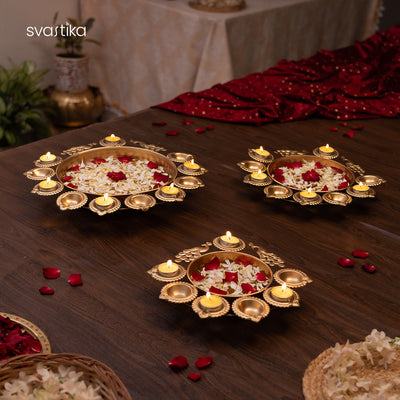
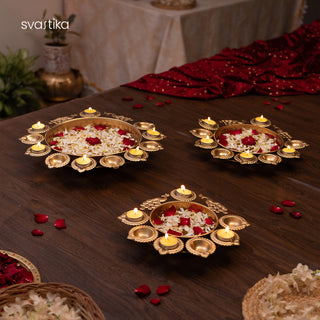
Pookalam. The flower carpet at the doorstep, laid fresh each morning and grown wider as the ten days pass. It is a welcome mat for a guest, which is exactly what Maveli is.
Onathappan. Small cones of clay or a pyramid shape set at the centre of the pookalam, standing for Mahabali and Vamana together. Simple, homemade, and older than any decoration you can buy.
Onasadya. The feast, served on a banana leaf, vegetarian, with the items in a fixed order and payasam at the end. The leaf points a particular way and you eat from the left. It is the single most recognisable thing about Onam.

Vallamkali. The snake boat races, most famously at Aranmula and on the Pamba, with crews of a hundred rowers and villages that have competed for generations.
Onakkodi. New clothes given to everyone in the house, the modern form of the cloth giving the 1906 manual described.
Pulikali and Thiruvathira kali. The tiger dance through the streets of Thrissur, and the circle dance women perform around a lamp.
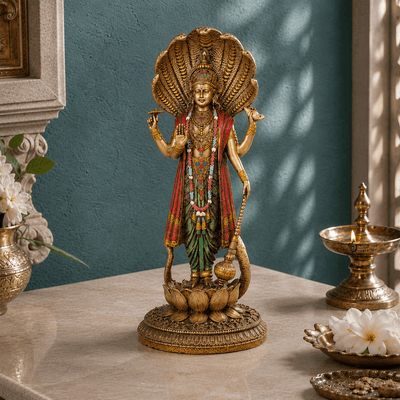
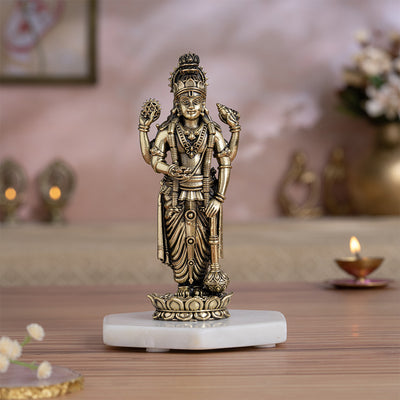
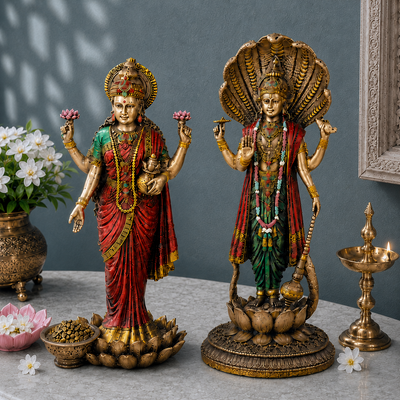
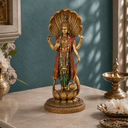
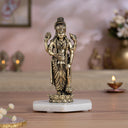
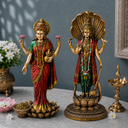
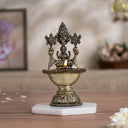
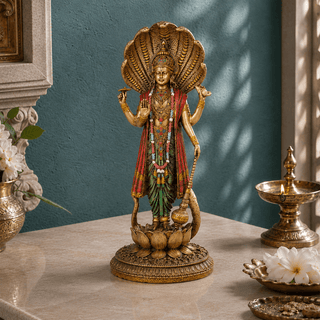
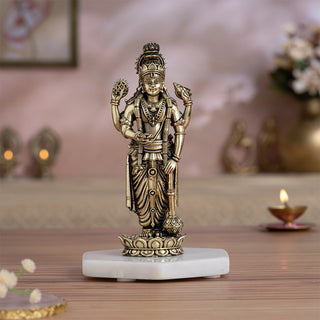
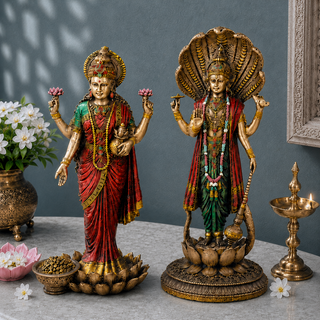
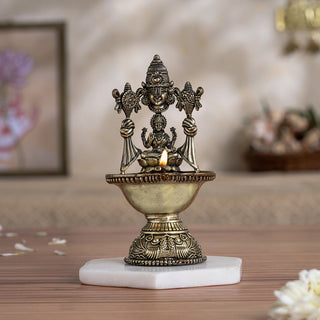
If you keep a home shrine, the natural focus for the day is Vishnu, since the festival hangs on the Vamana story. Many Kerala homes light a lamp before a standing Vishnu form, and a piece like the Lord Vishnu standing antique idol suits that quiet, upright treatment. Where and how to place it is worth reading up on first, and we have covered keeping a standing Vishnu idol at home in detail.
Keeping Onam at home, outside Kerala
You do not need a courtyard or a boat crew. The parts that travel well are the flowers, the lamp and the food.
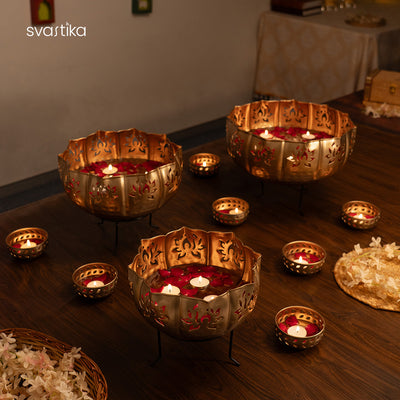
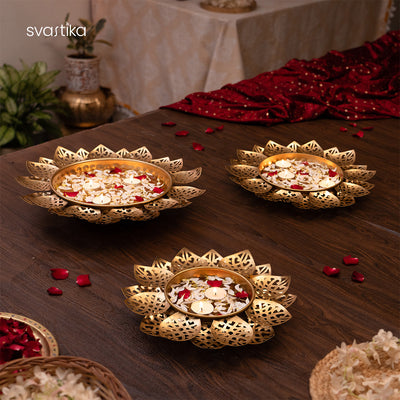
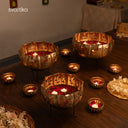
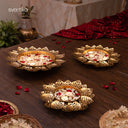
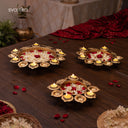
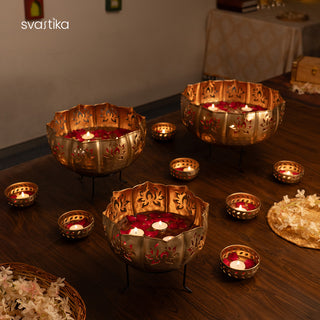
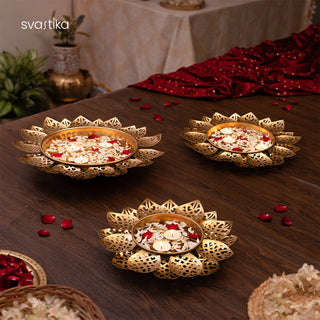
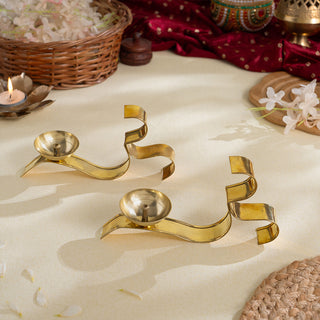
Lay a pookalam even if it is small. Loose petals in an urli of water hold the same idea when floor space is short, and a lamp beside it does the rest. Practical layouts are in our guide to Onam decoration ideas, and the Diwali diya decoration guide works here too.
Cook what you can of the sadya. Four dishes done properly beat twenty done badly. If you are sending something to family in Kerala, our Onam gift ideas and the Onam gifts selection are a starting point, and the Vishnu idols range covers the Vamana connection directly.
Why the sympathy for Maveli still holds
Onam is sometimes said to appear in Sangam poetry, in the Maturaikkanci. I could not open a readable translation of that passage, so I will not attach a line number to it. Treat it as a claim worth checking, not a fact this article verified.
What we can say from the sources is stranger and better. Scripture gives Bali a kingdom under the earth and Vishnu's own company. Kerala decided that was not enough, and gave him one day a year at home.
The Bhagavata already refused to call him a villain. Vishnu tricked him and then praised him for keeping his word anyway, much as the same avatar cycle turns strange in the Mohini story. Kerala simply took the text's sympathy one step further.
Ten days of flowers for a king the scripture would not condemn. That is not a misreading of the Purana. It is a very close reading of it.
Also read: Vamana Avatar of Vishnu | The 10 Avatars of Vishnu | Onam Decoration Ideas | Best Onam Gift Ideas | Diwali Lakshmi Puja