Onam decoration is really two shopping lists. One is flowers, bought fresh every morning for ten days and gone by evening. The other is metal: lamps, urlis and a thali that come out every year and look better each time. Get the second list right once and the first one becomes easy.
This guide covers what to buy, what to lay out on which day, and what it costs. For the dates and the ritual order, see Onam 2027: date, significance and rituals.
The ten-day pookalam: one design a day, not one design
The single most useful thing to know about the floral carpet is that it is not one pattern repeated. It grows.

It starts on Atham small and plain, traditionally just thumba, the tiny white flower, in a modest circle at the doorway. Each day it gains one more ring and one more colour, until Thiruvonam, when it is at its largest.
- Days 1 to 3 (Atham to Chithira): one or two rings. White thumba, a little yellow. Keep it under two feet across.
- Days 4 to 6: add thechi and chethi (the red and orange ixora) and mukkutti. Work in concentric bands, not a scattered pattern.
- Days 7 to 9: add geometry. A lotus centre, petal points radiating out, a defined outer ring.
- Thiruvonam: the full carpet. A clear centre and five or more rings.
Two things nobody tells you. Chalk your outline before you place a single petal, because a circle drawn freehand in flowers is never a circle. And work from the centre outward, darkest colour first, so your hands never cross a finished section.
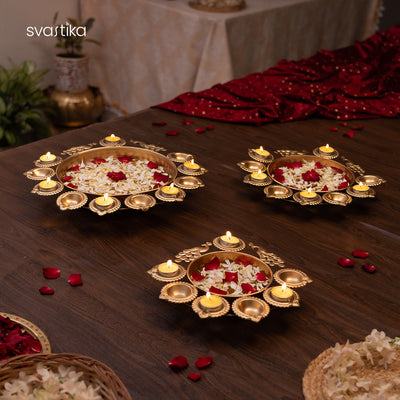
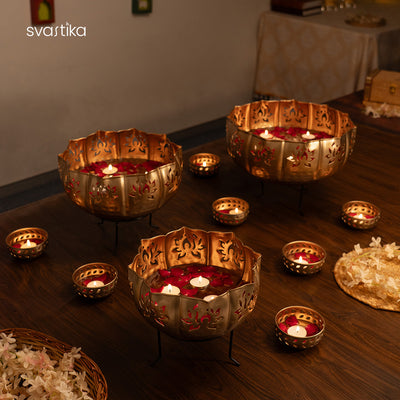
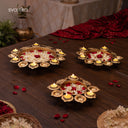
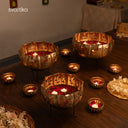
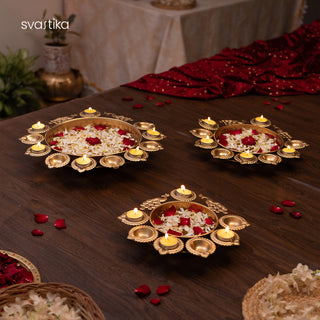
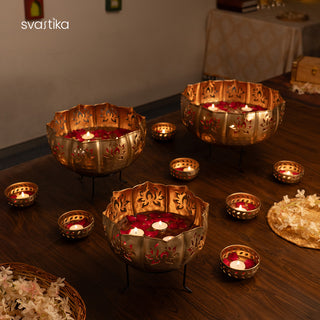
Keep the flowers sorted by colour in bowls before you start. A brass uruli is the right tool for this rather than a prop: wide, shallow, and heavy enough not to shift when you reach into it. The same peacock urli that holds petals in the morning holds floating flowers and diyas by evening. Sizes and shapes are in the urli collection, roughly ₹1,500 to ₹3,500.
The Onathappan, the part most decoration lists skip
At the centre of a traditional pookalam sit small conical figures of clay, called Onathappan or Thrikkakarayappan. They go up on Atham, stay through the ten days, and are taken for immersion at the end.
They are what makes the pookalam more than a rangoli. A rangoli is a pattern. A pookalam with an Onathappan at its centre is a seat, a place set for someone arriving. The whole floral arrangement radiates outward from them.
They are simply small pyramids of clay: unbaked, unpainted, sometimes smeared with rice paste. You make them, you do not buy them. Set them up on day one.
Lamps and brass: the layer you buy once
Flowers last a day. Lamps last a decade. This is where the money should go.

The nilavilakku, the tall standing lamp, is the anchor. It sits at the head of the pookalam or beside the doorway and is lit at dusk through all ten days. Around it, most homes keep:
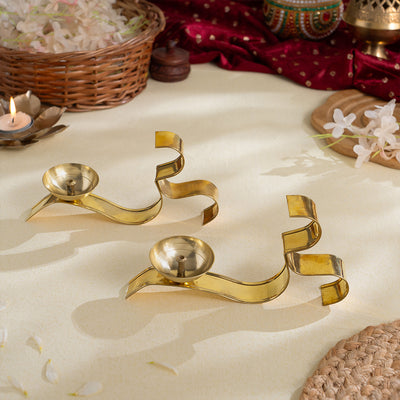
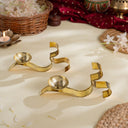
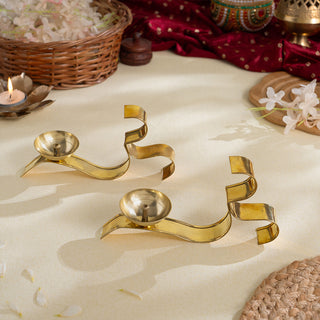
- Hand diyas (₹850 to ₹1,300) for the aarti and for carrying light room to room.
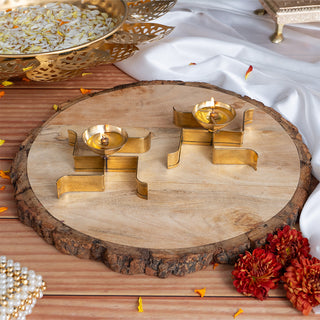
- Flat diyas (₹850 to ₹1,900) set at the four corners of the pookalam or along the outer ring. Four is the usual number.
- An uruli (₹1,500 to ₹3,500) at the entrance with water, flowers and floating wicks.
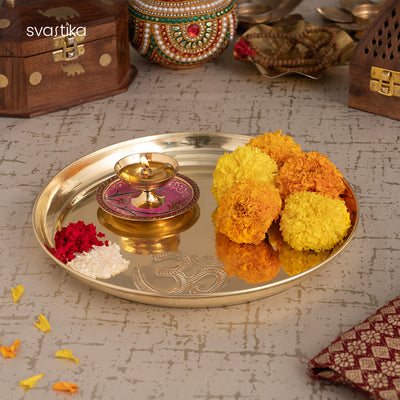
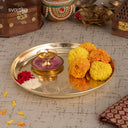
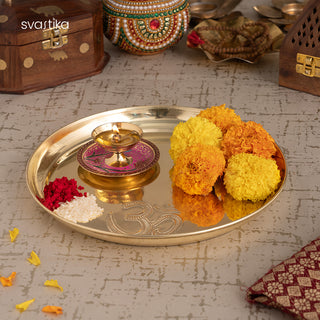
- A pooja thali (₹2,600 up) kept ready with kumkum, sandal, flowers and a lit wick.
Buy brass, and buy fewer heavier pieces rather than many light ones. Brass takes heat without warping and looks better after ten years than it did new, which is the honest reason it is traditional here. Thin pressed metal buckles the first time a wick burns down.
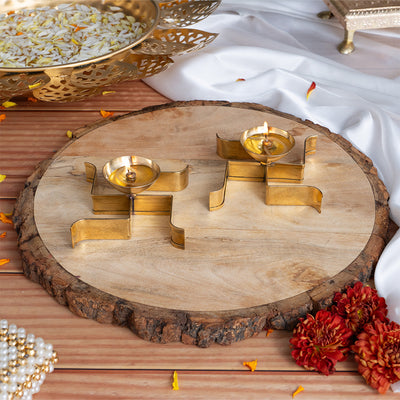
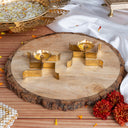
Shape matters more than you would think. A lamp with an Om, a swastika or a lotus form reads clearly from across a room, which is useful when it is sitting behind a floor full of colour. Most of these live in the brass diyas range, with the rest of the set in pooja essentials. The same logic applies at Diwali and Durga Puja: lamps are the permanent layer, flowers the seasonal one.
Should you keep a Vishnu or Vamana murti out during Onam?
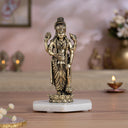
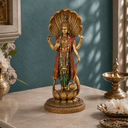
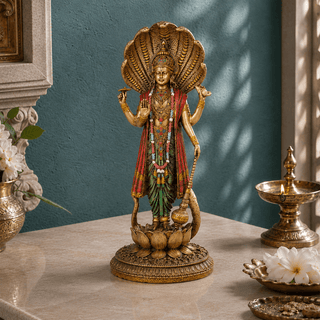
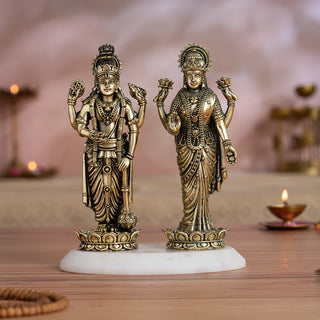
Many homes do, and it fits: Onam's story turns on Vamana, Vishnu's dwarf form, so a Vishnu murti at the pooja corner is the obvious companion piece to the pookalam.
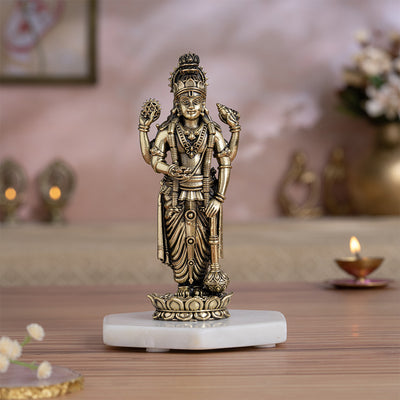
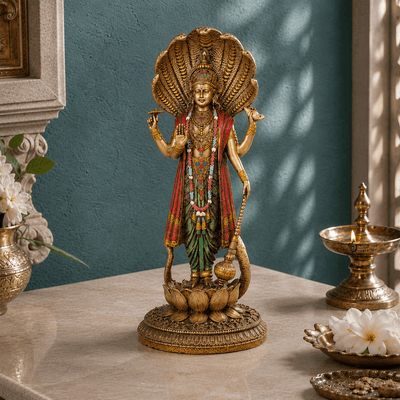
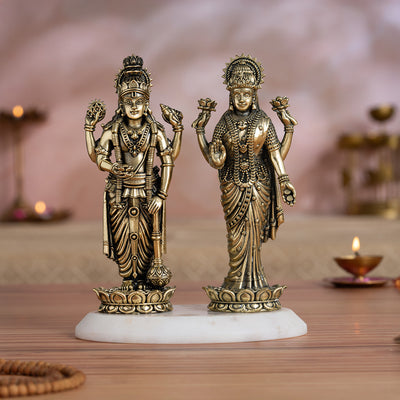
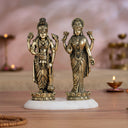
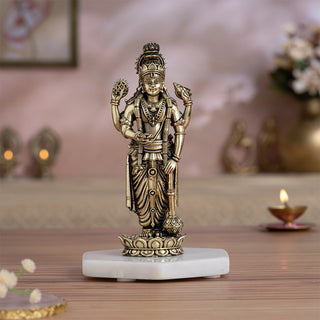
Two practical notes if you are buying one. Pick antique or matte finish over high polish. A floor of bright flowers is already loud, and a matte murti lets the pookalam stay the loudest thing in the room. And check the height against your shelf before you order, because standing Vishnu idols run tall. Good standing pieces sit around ₹5,000 to ₹6,000 in the Vishnu idols range; the antique finish range starts nearer ₹2,500 if that is over budget, and the wider brass idols range covers the sizes in between. If the murti sits low, a chowki lifts it clear of the flowers.
On placement and direction, we cover it in can we keep a standing Vishnu idol at home and things to keep in the pooja room. Worth two minutes before you fix a spot for ten days.
The doorway, the sadya and the rest of the house
The entrance. The pookalam usually sits in the courtyard or just inside the door, so the doorway is what people see first. A thoranam of mango leaves and marigold, a lamp on either side, a small uruli with floating flowers. That is enough. Do not crowd it; the flower carpet is the event.
The sadya setting. The feast is served on a banana leaf, tip pointing left, which is itself a design element. Keep the table quiet around it: plain runners, a low brass lamp, a few flowers, nothing tall that blocks the person opposite. If you are setting a long table for a crowd, the proportions in table decoration ideas for modern homes apply directly, and the table decor range has the low pieces.
The rest of the house. Vallam kali, the snake-boat race, is Onam's visual shorthand beyond the flowers: long boats, oars, a parasol at the prow. One boat motif on a wall or shelf beats a house full of generic festive bunting. Same principle as the restraint-first approach to home decor and the home temple decoration notes: one strong object over ten weak ones. Browse wall decor and home decor for the single-statement pieces.
What it costs, and what to buy first
If you are building the metal layer from nothing, do it over two or three years rather than in one August.
| Buy | What | Spend |
|---|---|---|
| Year one | Nilavilakku, 4 flat diyas, 1 uruli | ₹5,000 to ₹8,000 |
| Year two | Pooja thali set, 2 hand diyas | ₹3,500 to ₹6,000 |
| Year three | A Vishnu or Vamana murti | ₹2,500 to ₹6,000 |
| Every year | Flowers, banana leaves, mango leaves | ₹300 to ₹800 a day |
Order the metal two to three weeks ahead. Onam and the run-up to Diwali overlap with the busiest despatch weeks of the year, and a lamp that arrives on Thiruvonam is a lamp for next year.
For guests. Onam is a visiting festival, and something small at the door is part of it: a lamp, a brass piece, a pair of diyas. What travels well is listed in Onam gift ideas for family and friends, and the Onam gifts range is sorted for it, mostly ₹1,700 to ₹3,500. For a large family gathering, bulk gift items is the cheaper way to buy fifteen of the same thing.
What to avoid
Plastic or dyed flowers in the pookalam. They do not sit flat, the colour is wrong next to real petals, and the whole point is that it is remade each morning. Electric fairy lights strung over the flower carpet, which flatten it in photographs and fight the lamps. Tall centrepieces on the sadya table. And thin pressed-metal lamps sold as festival bargains, which warp on the first burn and never come out again.
One honest note worth having: the ten-day ritual calendar, the pookalam and the Onathappan are Kerala's own custom, not something the Bhagavata Purana lays down. The Purana leaves Mahabali in a comfortable realm with a promise attached, and Kerala built the homecoming around it. That is a better foundation for a festival than a footnote would have been, and it is why the decoration varies so much from house to house. Yours does not have to match anyone else's.
Also read: Onam 2027: Date, Significance and Rituals | Best Onam Gift Ideas for Family & Friends | Vamana Avatar of Vishnu | Diwali Diya Decoration | Things to Keep in the Pooja Room