Every year the same argument starts in some family WhatsApp group. One person's app says the fast is on Thursday. Someone's mother in Delhi says Wednesday. A cousin's panchang from Jaipur says something else again.
Nobody is being careless. The disagreement is built into how the Karwa Chauth date is calculated, and once you see the rule, the confusion stops being confusing.
Why the Karwa Chauth date moves every year
In 2026 the fast falls on Thursday, 29 October. Karwa Chauth sits on a tithi, not on a date. A tithi is a lunar day, and it is not the same length as a normal day.
Robert Sewell and Sankara Balkrishna Dikshit explain it plainly in The Indian Calendar (1896). A tithi is the time the moon takes to gain 12 degrees on the sun. Because the moon does not move at an even speed, that time keeps changing. Sewell's measured range runs from 21 hours 34 minutes at the shortest to 26 hours 6 minutes at the longest, with an average of about 23 hours 37 minutes.
So a tithi can start at 6 in the morning one month and at 11 at night the next. It drifts against the clock. That drift is why the festival lands on a different English date each year, and it is the same mechanism behind the shifting dates of Navratri, Diwali Lakshmi Puja and Krishna Janmashtami.
There is a second effect. Since tithis are longer or shorter than a day, some get skipped and some repeat. Sewell says that across twelve lunar months there are "generally thirteen expunctions (kshayas) and seven repetitions (vriddhis) of tithis." He also notes that a day on which no tithi ends, or on which two end, is treated as inauspicious.
None of this is astrology. It is arithmetic about the moon.
Why moonrise decides the day, not sunrise
Karwa Chauth is kept on the day the fourth tithi is still running at moonrise, not the day whose sunrise carries its name.1

Most festivals use a simple naming rule. Sewell states it in Article 31: "the tithi current at sunrise of the solar day gives its name and numeral to that day." Whichever tithi is running when the sun comes up, that is what the day is called. Karwa Chauth is the case where that rule gives the wrong answer.
Sewell says so himself. He writes that some ceremonies are ordered for stated tithis at fixed times of day, and then the tithi running at that moment governs. He gives a real example from the same ritual family. Describing a vow he calls Sankashta-nasana-chaturthi, he writes that a person fasts on every dark fortnight chaturthi "up to moonrise, which takes place about 9 p.m. on that tithi," and adds that this "has of course to be done on the day on which the chaturthi is current at moonrise."
On some years that is the day before the one your calendar prints as chaturthi.
This is the same monthly fast north Indians know as Sankashti Chaturthi, kept for Ganesha and broken at moonrise. If you have read about seeing the moon on Ganesh Chaturthi, you have already met the other half of this family, where the moon must be avoided rather than waited for.
Is Karwa Chauth in any Purana?
No Purana we could open prescribes Karwa Chauth. It is not in the Padma Purana's long Kartika chapters, which cover that month's vows in detail.6 It is also missing from a place where you would very much expect to find it.
William Crooke spent years documenting popular religion in exactly the region where Karwa Chauth is now strongest. His Popular Religion and Folk-lore of Northern India (1896) runs to two volumes. It records Salono, the barley sprout feast, snake worship, Dhela Chauth and dozens of smaller village observances. Karwa Chauth does not appear anywhere in it.34
That absence is checkable, and it matters. A festival this large leaving no trace in a careful 1896 survey of the same districts tells you the observance in its present form spread later, or spread quietly among women in ways a British administrator never wrote down.
So does that make it less real?
The story of Karwa Chauth may be folk narrative, but the shape of the ritual is old and documented. Sewell's Sankashta-nasana-chaturthi is the proof. A fast on a dark fortnight fourth tithi, held all day, released only when the moon appears, was already a known and technically described practice in the nineteenth century.1
Karwa Chauth belongs to that family. Women in north India took a form that already existed and gave it their own meaning, their own katha and their own objects. That is how living tradition usually works.
You can see the same layering in Raksha Bandhan, where the thread began as a protective charm before it became a brother and sister ritual, and in Hariyali Teej, another vow kept by married women for Shiva and Parvati.
Three things people get wrong about Karwa Chauth
1. That the katha comes from scripture. The story of Veeravati, whose seven brothers made a false moon with a mirror and a fire so she would break her fast early, is oral folk narrative. It has regional variants, which is normal for folk stories and not normal for Puranic text. Nobody has produced a chapter and verse for it, and you should be suspicious of any page that gives you one.
2. That Draupadi kept this fast. You will read that Draupadi observed Karwa Chauth on Krishna's advice while Arjuna was away. We could not locate this episode in the Mahabharata during this research, so we are not going to assert it. Treat it as a popular attribution until somebody shows you the passage.
3. That there is one correct muhurat. There is no single panchang to consult. Jawaharlal Nehru, opening the Calendar Reform Committee, said India had "at present thirty different calendars, differing from each other in various ways, including the methods of time reckoning." The Committee's own 1955 report lists more than fifty printed panchangas in seven languages, and records an unresolved dispute over ayanamsa in which one submission argued the Surya-Siddhanta method would give "27 kinds of ayanamsas and no two of them will agree."5
They also disagree on the basic naming rule. Sewell gives the sunrise rule. Ebenezer Burgess, translating the Surya-Siddhanta in 1860, gives a different one: "The civil day receives the name of the lunar day which ends in it." Two respected authorities, two conventions. That is the honest reason two panchangs print two dates.
The day, from sargi to the moon
What follows is living custom, not prescribed vidhi. It varies by family and by region, and none of it is wrong.
The fast starts before sunrise with sargi, a meal sent by the mother in law. Usually fruit, dry fruit, something sweet, and water taken before first light.
Then the fast runs all day. Many women keep it nirjala, without water. Others do not. Both are practised, and the rules differ from vrat to vrat, much as they do on Maha Shivratri.
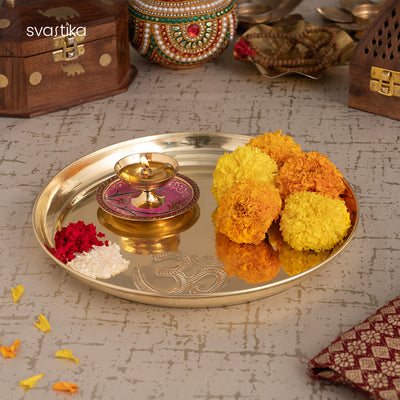
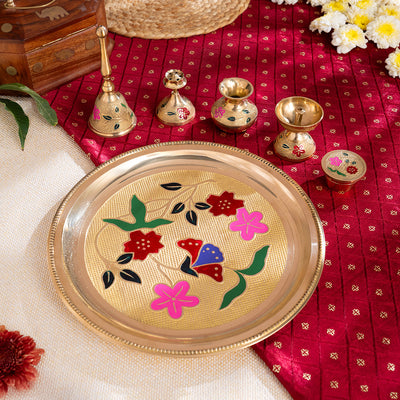
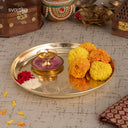
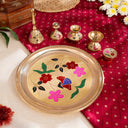
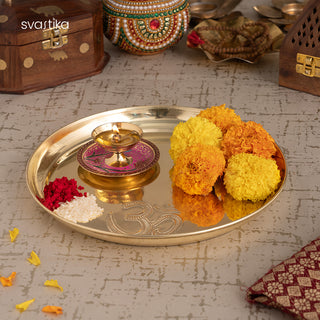
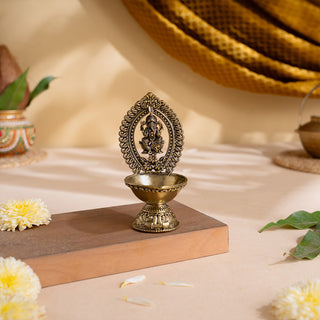
Through the day the puja space is cleaned and set. This is when the pooja thali is arranged and the diyas are readied, much as families do when setting up a pooja room for any major vrat.
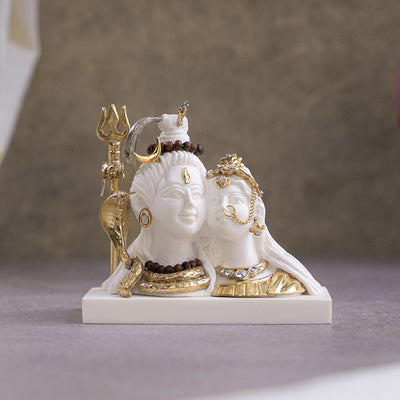
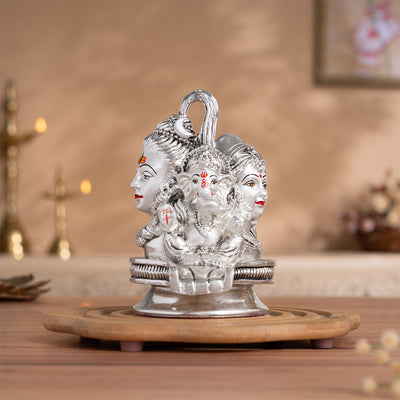
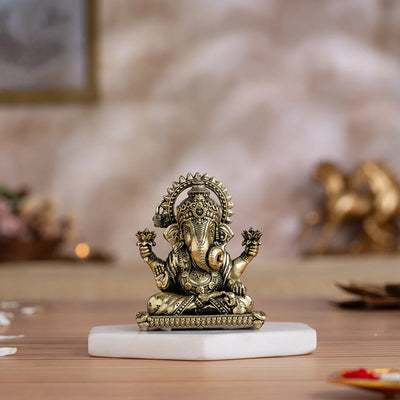
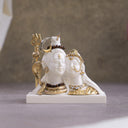
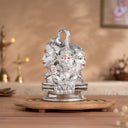
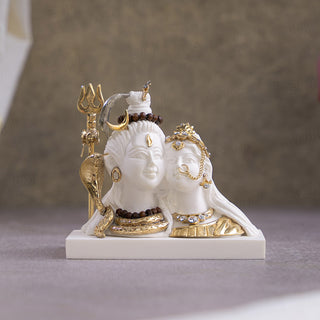
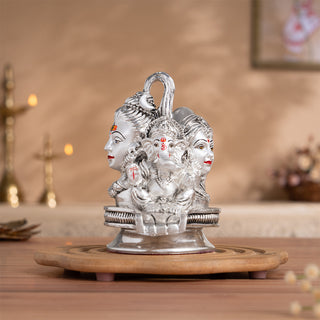
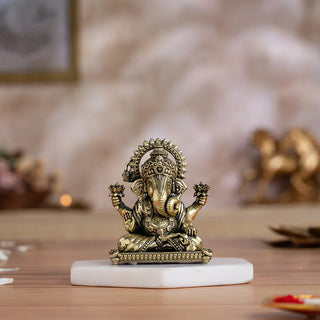
In the late afternoon or early evening the women gather in a circle for the katha. The thalis are passed from hand to hand as the story is told, each woman turning hers to the next. Gauri, meaning Parvati, is honoured, and Ganesha with her, which is why the rules about what may be offered to Ganesha apply here too. Many homes keep a Shiv Parvati murti at the centre of that circle, since the vow is addressed to a married couple, not to a single deity.
At night the moon is looked for. It is viewed through a sieve, then the husband is looked at through the same sieve, and he gives the first sip of water. Then the fast ends.
The karwa and the sieve
The festival is named after an object. A karwa is a small earthen pot with a spout, and water is poured from it during the ritual and offered to the moon.

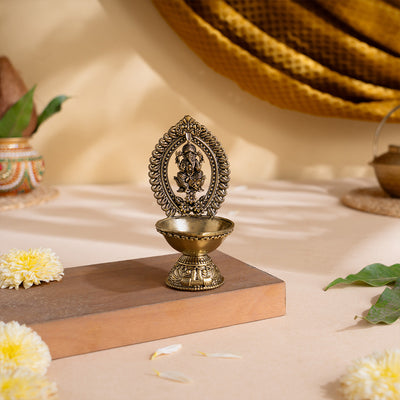
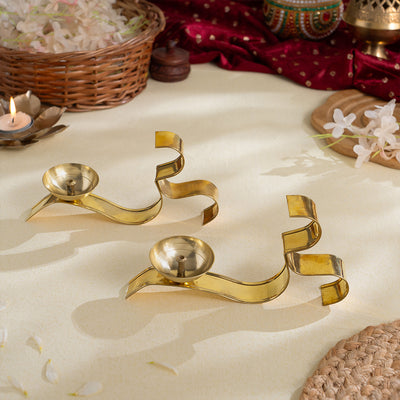
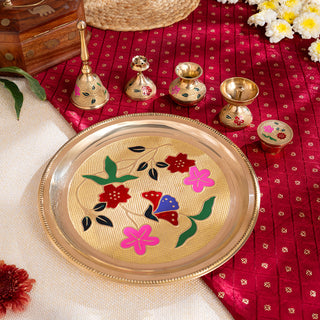
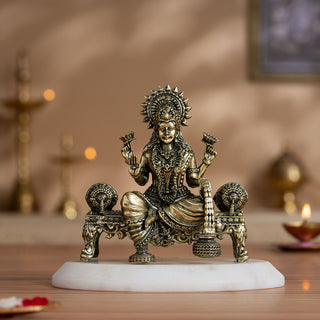
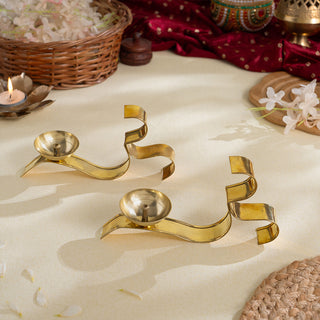
Clay matters here. The pot is cheap, breakable and made locally, which is what most village ritual objects were. Over time many families moved to metal, and today you will see brass and silver plated versions in the same role, alongside the brass diyas lit for the evening, arranged much the way they are for Diwali diya decoration.
The sieve is the stranger object and nobody has a settled explanation for it. What is clear is what it does. It puts a screen between the woman and both the moon and her husband, so that the first look at each is a framed, deliberate look. Whatever it once meant, that is what it does now.
Why Karwa Chauth is a north Indian festival
Part of the answer is calendrical, and Sewell explains it in Article 13. North and south India start their lunar months at different points. "The purnimanta scheme is now in use in Northern India, and the amanta scheme in Southern India."
In the north the month ends at the full moon. In the south it ends at the new moon. So the same dark fortnight sits in Kartika by northern reckoning and inside Ashvina by southern reckoning.
Karwa Chauth is named for a northern month, in a northern scheme. That is one reason it never became a pan Indian observance in the way Chaitra Navratri or Chhath Puja travelled along their own regional routes.
What to do about the timing
Do not plan your fast around a clock time you found on a website.
Moonrise is a local event. Across north India it can differ by half an hour to an hour on the same night, because your longitude and latitude are not your cousin's. A single national "Karwa Chauth moon time" is not a real number.
Three things are worth doing instead. Find the moonrise time for your own city, not for the country. Ask which day the chaturthi tithi is running at that moonrise, because that is the day the vrata belongs to. And if two panchangs in your house disagree, follow the one your family has always followed, since both are applying real rules and neither is a mistake.
Sewell already named the books that decide these cases. He notes that long treatises exist for exactly this purpose, and points to the Nirnayasindhu as one "in general use at the present time in most parts of India." Festival dates come from decision literature applied to a computed calendar. They were never printed in a single scripture, and no app can change that.
Which is a gentler thought than it sounds. The moon has to actually come up, you have to actually see it, and somebody has to hand you the water. For one night a year the whole thing runs on an event nobody can schedule.
Also read: Ganesh Chaturthi Puja Muhurat and Tithi | Kajari Teej Katha and Tithi | Relation Between Ganpati and Gauri | Who Are Lord Shiva's Father and Mother | How to Clean a Marble Idol
Cover photo: Soham1992Sanyal, CC BY-SA 4.0, via Wikimedia Commons.