Every year, somebody in the house says it at exactly the wrong moment. "Don't look up." And of course you look up. The moon is right there, thin and completely harmless-looking, and now you have supposedly earned yourself a season of false blame.
The belief is called mithya dosha (the blemish of false accusation). Look at the moon on Bhadrapada Shukla Chaturthi, the day of Ganesh Chaturthi, and people will say things about you that are not true.7
The remedy everybody gives is the same: hear the story of the Syamantaka jewel. Krishna was accused of stealing it. He cleared his name. Hear that story and your own false accusation dissolves.
It is a lovely piece of reasoning. It is also built on a join the text does not make. Here is what is actually there.
The remedy first, since that is what you came for
The traditional response has three parts, and none of them require a priest or an expense.

One: hear or read the Syamantaka katha: Bhagavata Purana, Canto 10, chapters 56 and 57. It takes about fifteen minutes. Reading it counts; the tradition is about attention, not performance.
Two: a widely repeated verse asks Ganesha's forgiveness and names the Syamantaka episode directly. Households recite it in front of the murti before the evening Ganpati decoration and lamps.
Three: some families say that if you have seen the moon, look at it deliberately on the following night, so the sighting is no longer an accident. That one is household practice and varies from street to street.
That is the honest practical answer. Now the interesting part.
I read both Syamantaka chapters. The moon is not in them.
The Syamantaka story is real and it is one of the better courtroom dramas in Sanskrit literature. Satrajit, a Yadava nobleman, receives a brilliant jewel from Surya. His brother Prasena wears it into the forest and does not come back. Satrajit concludes (publicly, loudly) that Krishna killed him for it.
Krishna tracks the jewel through a lion to the cave of Jambavan, the bear king, fights him for days, and returns with both the gem and Jambavan's daughter Jambavati as his wife. The accusation collapses. Satrajit, embarrassed, gives Krishna his daughter Satyabhama too: two of the marriages that get counted whenever people ask how many wives Krishna had.
Search the Sanskrit of chapters 56 and 57 and you will find no Chandra, no caturthi, no Bhadrapada and no Ganesha.1 The suspicion falls on Krishna for a completely ordinary reason: a man disappeared wearing an object Krishna had admired, his brother said so out loud, and Dvaraka repeated it. The scandal is social, not astronomical.
One correction: the curse word is in the Sanskrit
An earlier version of this article said these chapters held "no curse of any kind." That was wrong, and it was wrong in a way worth showing: it was written from an English translation.
In the Sanskrit at 10.56.31, Krishna tells Jambavan why he came into the cave:
मणिहेतोरिह प्राप्ता वयमृक्षपते बिलम्।
मिथ्याभिशापं प्रमृजन्नात्मनो मणिनामुना॥In plain English: Lord of the bears, we came into this cave for the jewel, to wipe the false charge off my name.
Bhagavata Purana 10.56.31
The word is mithyabhishapa. Monier-Williams glosses abhishapa as "curse" first, then "charge, accusation," then "false accusation, calumny," and cites this exact compound. The root shap, to curse, appears twice more in the chapter: Dvaraka reviles Satrajit (10.56.35), and Satrajit worries that people will revile him (10.56.41).
So there is plenty of cursing here. It is people cursing each other, not a god cursing the moon. The moon, the fourth day and Ganesha are still absent.
And the correction makes the join look less arbitrary than I first thought. What tradition guards against is mithya dosha, the blemish of false accusation. The Bhagavata's own word for Krishna's trouble is mithyabhishapa. Same mithya. Whoever attached this remedy to the moon belief was not picking a story at random. They were matching a word.
So where does the moon story actually live?
In a different text entirely, and a very appropriate one. The Ganesa Purana, in its Upasanakhanda, gives chapter 62 to exactly this subject. In Greg Bailey's academic translation, published by Harrassowitz in 1995, the chapter is listed as a description of the Moon's curse and favour.3
Read that title slowly. Curse and favour. Not curse alone. Whatever happens between Ganesha and Chandra there, it does not end with the moon in permanent disgrace.
That fits the shape of Ganesha stories. They run through a rupture and out the other side into restoration. His head is severed and replaced with a better one. His tusk breaks and becomes his name: Ekadanta, the one-tusked. Even the beheading that starts his life in the Siva Purana's account of Parvati and her son ends with him crowned as chief of the ganas.6 Nothing stays broken.
So the belief you grew up with joins two genuine stories from two different texts. The Syamantaka half is real. The moon half is real. Only the join is later.
Why the moon got cursed at all
The popular version, which you will hear at any pandal, goes like this. Ganesha, full of modaks, riding home on his mouse. The mouse startles. Ganesha topples. Chandra, watching from above, laughs at the round-bellied god sprawled on the road.

In most retellings he breaks off his tusk and hurls it at the moon, declaring that anyone who looks at Chandra on this day will be falsely blamed. The moon apologises. The curse is softened to a single day of the year.
I want to be careful here, because this is where blogs start inventing. I verified that the chapter exists and what it is titled. I could not read its narrative body. So take the modak-and-mouse details as the popular telling they are, and the chapter as the citation it is.
What is worth noticing is the thrown tusk. It links this story to a bigger question: who actually broke Ganesha's tusk. The moon is only one of several competing answers there, and the most famous one turns out to be the weakest.
Three things people get wrong about this
1. "The Bhagavata Purana says Krishna saw the moon on Chaturthi."
It does not. Bhagavata Purana 10.56 and 10.57 carry the Syamantaka narrative in full, and neither chapter mentions the moon, the fourth lunar day or Ganesha.2
The moon framing was added later, borrowed from the Ganesa Purana's separate material. The sentence "Krishna was accused because he saw the moon" is the part with no textual home.
2. "Seeing the moon guarantees you will be defamed."
Even inside the tradition, that is stronger than what the tradition says. The Ganesa Purana's own chapter heading pairs curse with favour. A curse that comes bundled with a boon, and that has a stated remedy attached to it, is not a sentence: it is a story about consequence and repair. Treating it as a fixed astrological penalty flattens it into something much smaller than it is.
3. "The tusk-throwing detail comes from the Mahabharata."
People often mix the moon story with the far more famous one about Ganesha snapping his tusk to keep writing the Mahabharata. That second story is not in the Mahabharata. I read Ganguli's translation of Adi Parva, Section I, the epic's own account of how it was written down. Brahma proposes Ganesha as scribe. Ganesha agrees on the condition that his pen never stop. Vyasa counters that Ganesha must not write anything he has not understood, and then deliberately knots his verses so the pauses buy him time to compose.4
It is a wonderful scene: two writers negotiating terms. There is a pen in it. There is no tusk. Scholars also hold that this scribe episode is a later addition, and it is not in the main text of the Bhandarkar Oriental Research Institute's critical edition.
What to do if you already saw it
This is what households actually do, split into what is old and what is just sensible.
- Hear the katha. This is the actual traditional remedy. Bhagavata Purana 10.56 to 57. Read it aloud if you can: the story is short and genuinely entertaining.
- Ask forgiveness at the murti. Ganesha is Vighnaharta, the remover of obstacles, and every ritual in the house begins with him anyway. Standing in front of your Ganpati murti and saying you did not mean it fits how the festival treats him: as a guest, not a magistrate. The same goes for everything else you keep in the pooja room: hospitality, not paperwork.
- Do not stop the puja. Nothing in the tradition says a moon sighting invalidates your worship. The festival carries on: aarti, modaks, durva grass, and eventually visarjan.
- Skip the paid remedies. If somebody offers to sell you a dosha-removal package for this, they are selling you something the texts never priced.
Why the remedy is beautiful even if the join is not scriptural
Strip away the question of which text says what, and look at the logic of the remedy on its own. The fear is being blamed for something you did not do. The prescribed cure is to sit and hear a story about a man who was blamed for something he did not do, and who was cleared.
That is not superstition. It is a very old idea about how people survive being wrongly accused: you keep company with the story of someone who came through it.
And it is worth remembering that the Syamantaka episode is not a footnote in Krishna's life. It is where two of his marriages come from, and it sits inside the same body of narrative as how he received the Sudarshana Chakra and what eventually happened to him at Prabhasa. Being sent to that story as a remedy means being sent to one of the richest stretches of the Bhagavata.
How a belief like this gets built
None of this makes the belief fake. It makes it layered, which is more interesting.
A great deal of what we practise around Ganesha works this way. Some of it is straightforwardly scriptural: why tulsi is never offered to him has an entire chapter of the Brahmavaivarta Purana behind it, and durva grass gets six chapters in the Ganesa Purana.5 Some of it is Vastu reasoning wearing scriptural clothes, like the rules about which direction a Ganesh idol should face or where Lakshmi sits relative to Ganesha. Some of it is regional custom that hardened into rule, like the belief about a right-facing trunk being dangerous at home. And some of it is pure folk interpretation, like the fixed meanings people assign to seeing Ganesha in a dream.
Knowing which is which does not make you less devout. The categories make the tradition easier to love, because you stop defending things it never claimed. The same is true of nearly every big story. The question of Shiva's own parents gets different answers depending on which Purana you open. The texts are comfortable with that even when we are not.
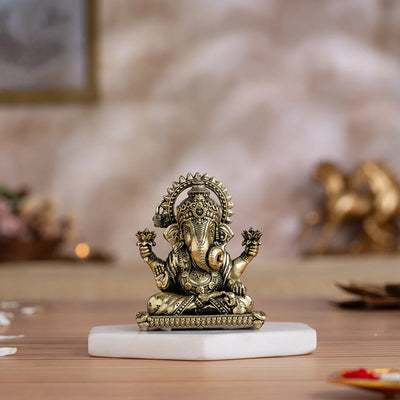
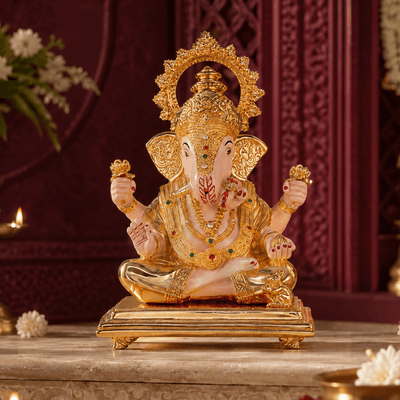
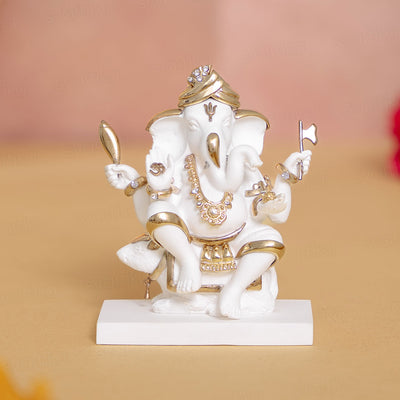
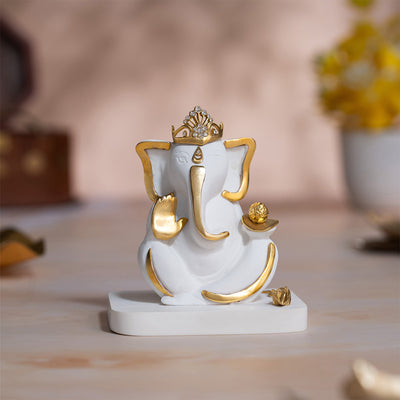
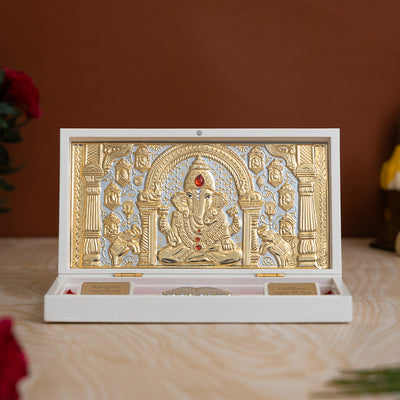
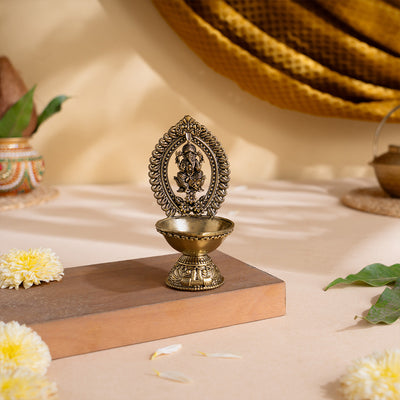
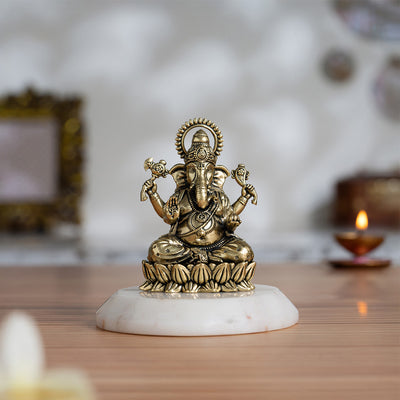
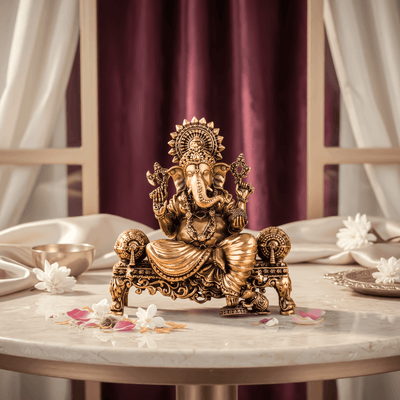
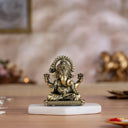
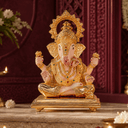
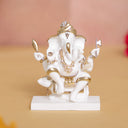
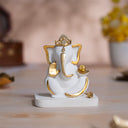
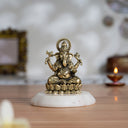
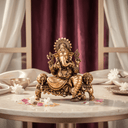
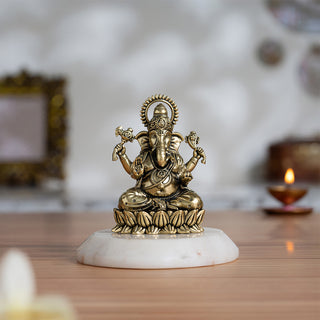
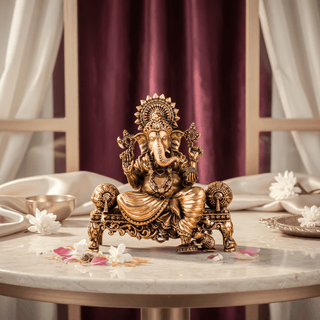
So: look at the moon or don't. Hear the Syamantaka story either way, because it is a good story. And if you are choosing a murti for the ten days, the Ganesha collection and the brass idols are the two most common starting points, with Ganesh Chaturthi gifting for the households you visit. What you bring home matters far more than what you happened to glance at in the sky.
Ganpati Bappa Morya.
Also read: Who Broke the Tooth of Lord Ganesha | How to Immerse a Ganesh Idol at Home | Relation Between Ganpati and Gauri | Why Tulsi is Not Offered to Ganesha | Which Ganesha Idol is Good for Home