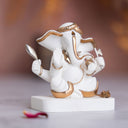
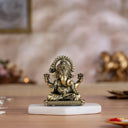
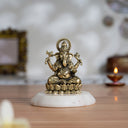
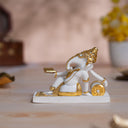
You woke up and he was there. Maybe sitting calmly. Maybe the idol from your grandmother's shelf. Maybe something odd: the murti cracked, or moving, or impossibly large. And within about four minutes of opening your eyes you were on your phone typing "Lord Ganesha in dream meaning", hoping somebody would tell you what it was about.
Here is what nobody searching that phrase gets told: the confident answers you are about to read are made up. Not maliciously. But the tidy tables (a smiling Ganesha means success within 40 days, a broken idol means a loss in the family) do not come from any Purana. They come from other blogs, which copied them from other blogs.
We went looking for a real source. This is an honest account of what we found, what we could not find, and what the tradition actually does with dreams.
The short answer: there is no scriptural dream dictionary for Ganesha
No passage in Puranic or shastric literature assigns a meaning to dreaming of Lord Ganesha. We could not find one in the texts that deal with him most closely, nor in the dream-omen material we could reach.
That is worth saying flatly, because every competing page implies otherwise. Some cite "the shastras" without naming one. Some cite a Purana without a chapter. If a page tells you a right-trunk Ganesha in a dream means a windfall and never says which text says so, it is because no text does.
The texts that do concentrate on Ganesha are remarkably detailed about other things. The Ganesa Purana's Upasanakhanda, in Greg Bailey's academic translation, runs to ninety-three chapters. It gives a whole chapter to the moon's curse and favour, another to the origin of durva grass, then five more as a full Durvamahatmya on that same grass. Chapter 46 is a thousand names.1 This is a text that cares enormously about how Ganesha is approached and worshipped.
It has nothing to say about what it means when he turns up in your sleep.
What we actually checked, and where we failed
Indian tradition does have a genre for this. It is called svapna-adhyaya (the chapter on dreams) and svapna material appears scattered through Puranic compilations and jyotisha literature. It is a real genre with real antiquity.
We opened an English translation of the Matsya Purana on archive.org specifically to reach a dream chapter. The scan's text layer was too degraded to read a chapter list reliably, let alone a chapter body. So we came away with nothing citable, and we are telling you that instead of quietly citing it anyway.
That failure limits what we can honestly say about the genre. We read what fragments we could, and we looked at how this material is generally described. The impression we came away with is that it reads omens from symbols (an animal, a body of water, a tooth falling out) rather than from a named deity arriving with a message meant for you. We could not verify how consistently that holds across the whole literature, so please treat it as a partial reading rather than a finding. The negative point is the one we can stand behind: nothing we opened assigns a meaning to dreaming of Ganesha.
We are not going to invent a verse number to fill the gap. A wrong citation would be worse than an empty one.
Three things people get wrong about Ganesha dreams
1. "The meanings come from the shastras"
They do not, as far as anyone has shown. This same pattern runs through a lot of popular Ganesha content. Take the most famous story of all: that Ganesha snapped off his own tusk to use as a pen while the Mahabharata was being dictated, because his pen broke and he had sworn not to stop writing.
Read the epic's own account of how it was written (Adi Parva, Section I, in Kisari Mohan Ganguli's translation) and the tusk is simply not there. Brahma proposes Ganesa as scribe. Ganesa's condition is that the pen must not stop. Vyasa's counter-condition is that Ganesa write nothing he has not first understood, and then Vyasa knots his verses deliberately so the pauses buy him time to compose. It is a contest of wits between poet and scribe. There is a pen in it. There is no broken tusk.2 (The best-attested answer to who actually broke Ganesha's tooth is a different story entirely.)
If the most repeated Ganesha story in India is not in the text everyone attributes it to, a dream-meaning table with no citation at all deserves the same scepticism.
2. "A broken or damaged idol in a dream is a bad omen"
This one causes real distress, so it is worth dismantling properly. No text we could find says it. And the assumption underneath it (that damage to an image of Ganesha signals misfortune) sits oddly with the tradition's own stories, where breakage is the point.
His head is severed and replaced. That is the founding episode of his form: the Siva Purana's Kumarakhanda gives one chapter to his birth, one to his head being chopped off, one to his resuscitation, one to his crowning as chief of the ganas.4 He is permanently missing a tusk (Ekadanta, the one-tusked, is among his oldest names) and the Brahmavaivarta Purana gives that breaking its own chapter, where Parashurama strikes with Shiva's axe.3
He is, iconographically, a figure defined by what was broken off him and restored. Reading a cracked murti in a dream as doom runs against the grain of his own mythology.
3. "The trunk direction in the dream tells you what it means"
The right-trunk/left-trunk scheme is temple and Vastu lore, not scripture, even for a physical idol, let alone a dreamed one. The classical iconographic literature sorts Ganapati by named form: Uchchhishta, Unmatta-uchchhishta, Kavala, Lakshmi, Heramba, Prasanna, Nritta Ganapati. T. A. Gopinatha Rao's 1914 survey covers Ganapati across thirty-odd pages and organises him by arms, posture, vahana and consort. Trunk-curve direction is not a category in that scheme at all.5
That does not make the belief worthless. It carries real meaning for the people who hold it. It is just not something a Purana says, as we go through in what a right or left trunk actually means.
Then why does a dream of Ganesha feel like something?
Because it probably is something: just not a coded message about your finances.
Two honest observations. First, the elephant has been an image of auspiciousness, rain and abundance in Indian symbolic thought for a very long time, quite apart from any dream manual. Nobody dreams of an elephant-headed god and feels neutral about it.
Second, and more simply: you dreamt of him because he is in your life. He is above the door. He is on the dashboard. He is the first name in almost every puja you have sat through, because Ganesha is invoked before any other deity is approached. That precedence has little to do with rank, though it does feed the old argument about who the most powerful god in Hinduism is. He is half the pair on most Diwali shelves, which is its own placement question. Dreams pull from what is already there.
Neither explanation reduces the experience. A dream that leaves you steadier for a morning has done something real. The mistake is only in treating it as a message that needs decoding by a stranger on the internet.
What tradition actually does with a dream
Across most of Hindu devotional life, dreams of a deity are treated as a prompt rather than a prediction. The traditional response to a vivid dream of Ganesha is not to look up what it foretells. It is to turn towards the practice: to sit down properly at the shrine you have been walking past for a month, to do the puja you kept postponing, to actually clean the murti.
Read that way, the dream is not information about the future. It is a nudge about the present. And that has one large advantage over the dream dictionaries: it cannot go wrong. A prediction can fail and leave you disillusioned. An invitation to pay attention pays off either way.
If you want to do something the morning after
None of this is prescribed by any text. It is sensible household practice, labelled as such.
- Sit at the shrine for five minutes. Not a full vidhi. Just presence. If the shelf has been half-empty for a while, what belongs in a pooja room is a gentler starting point than a rulebook.
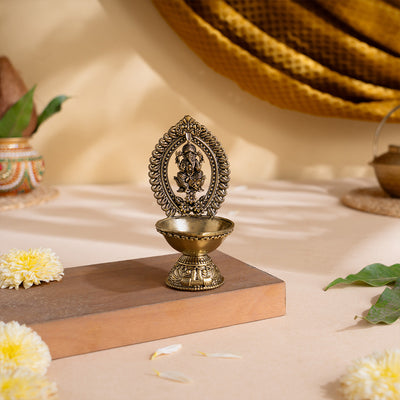
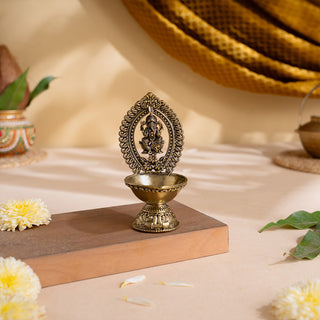
- Light a lamp. The simplest gesture of acknowledgement. A dedicated brass Ganesha diya lives on the shelf permanently and turns a passing impulse into a habit that outlasts the dream, which is exactly why brass has always been the household metal.
- Offer durva. If you want one offering with genuine textual weight behind it: six chapters of the Ganesa Purana's Upasanakhanda are devoted to durva grass, which is more attention than any flower receives anywhere in that text. We unpack this in the favourite flower question, where the honest answer turns out to be a grass. Everything else on the tray (the thali, the lamp, the bell) is custom, and good custom, but custom.
- Clean the murti. Especially if the dream involved a damaged or neglected idol, which, frankly, is often just your mind noticing something your eyes already registered. Here is how to clean a marble idol without damaging the finish.
- Leave it there. Do not build a decision around it. No text authorises that, and no tradition asks it of you.
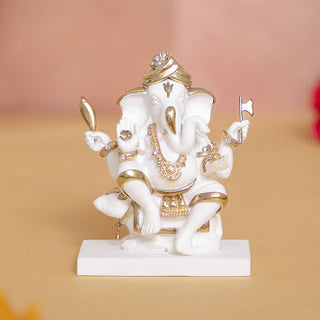
One thing to steer away from: buying a new murti because a dream seemed to ask for one. If you were already planning to, fine: which type of Ganesha idol suits a home and which direction it should face are worth reading first, mostly because they are honest about how much of that advice is Vastu rather than scripture. But a dream is not a shopping instruction, and anyone who says otherwise has something to sell.
The pattern behind all of this
Once you start checking Ganesha beliefs against the actual texts, a pattern shows up, and it runs both ways.
Some very confident claims dissolve. The moon-curse story attached to Ganesh Chaturthi is the cleanest example: the Bhagavata Purana's Syamantaka narrative, read in full across Canto 10 chapters 56 and 57, contains no moon, no fourth lunar day, no Ganesha and no curse.67 Krishna falls under suspicion because Prasena vanishes wearing the jewel and Satrajit accuses him publicly. The moon material is real, but it lives in the Ganesa Purana instead. Two genuine stories, welded together later: we traced the join in what to do if you see the moon on Ganesh Chaturthi. Much of the festival works this way: the Chaturthi tithi and timings are astronomical reckoning, while immersing the idol at home rests on genuinely old ritual logic: the presence is invited in, then respectfully seen off.
But some beliefs hold up completely. The reason tulsi is not offered to Ganesha is properly scriptural: the Brahmavaivarta Purana's Ganesa Khanda gives the reciprocal curses of Tulsi and Ganesa their own chapter. Your grandmother was right about that one.
Even his family is stranger than most people assume. Gauri and Parvati are the same goddess, and in the Siva Purana she makes Ganesha entirely by herself, which is precisely why Shiva, arriving home, does not recognise the boy at his own door. That thread runs through the relation between Ganpati and Gauri, and further back into who Shiva's own parents are.
The goal is not scepticism for its own sake. It is knowing which is which, and being willing to find that the belief you were about to correct is the one with a chapter number behind it.
A last, kinder point
Most people who search this phrase are not doing research. They are slightly unsettled and want reassurance, and the pages that meet them invent certainty because certainty is comforting.
Something sturdier: there is no verdict hanging over you from a dream, because no text assigns one. Whatever you felt on waking (steadiness, warmth, a little unease) is yours to interpret. If the dream makes you light a lamp more often, it did its work.
Also read: Who Broke the Tooth of Lord Ganesha | Ganesha Trunk Right or Left: What It Means | Relation Between Ganpati and Gauri | The Favourite Flower of Lord Ganesha | If You See the Moon on Ganesh Chaturthi