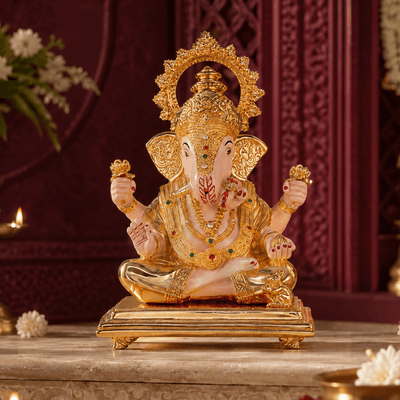
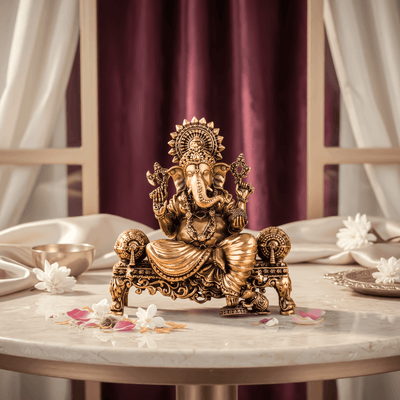
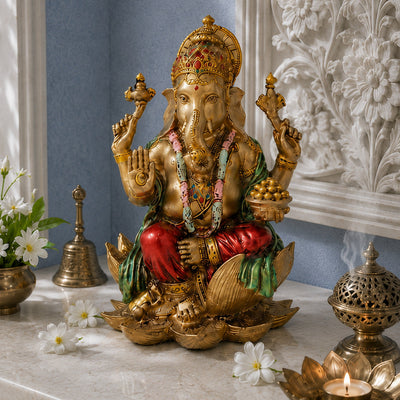
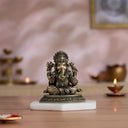
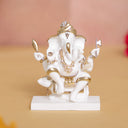
Almost everyone asks this question in the same situation. You are standing in a shop, or you have twelve tabs open, and there are forty Ganeshas in front of you. Sitting, standing, dancing, brass, marble, gold-plated, trunk left, trunk right. Somebody has told you that one of them is wrong for a home. Nobody has told you which, or why.
So let's do this properly. There is a real classical literature on how Ganesha is depicted. It is much older and much stranger than anything in a buying guide. Once you know what is in it, choosing gets easier, not harder.
The honest answer first: the texts classify forms, not "home suitability"
No classical text ranks Ganesha forms by suitability for a house. The standard reference is T. A. Gopinatha Rao's Elements of Hindu Iconography, published in Madras in 1914. It remains the work that iconographers reach for, because Rao worked directly from the Agamas and Shilpa texts rather than from popular practice. Ganapati gets pages 35 to 67 of the first volume.
The tradition sorts Ganesha by named form: each one defined by the number of arms, what those arms hold, the posture, the vehicle, and whether a consort is present. Rao treats Uchchhishta Ganapati, Unmatta-uchchhishta, Kavala, Lakshmi Ganapati, Heramba, Prasanna and Nritta Ganapati among others.
What you do not find, anywhere in that scheme, is a category for "good for home".1 The Agamas are describing how an image should be made and installed, mostly in a temple context. They are not shopping guides, and they never claimed to be. Any ranking of forms by domestic suitability (including the one in this article) is somebody in the present tense giving advice.
That should be freeing rather than frustrating. It means you are not at risk of breaking a rule you have never read.
Names worth knowing before you choose
Most people buying a Ganesha idol have never heard the actual form names, which is a shame, because they are more interesting than "small brass one".
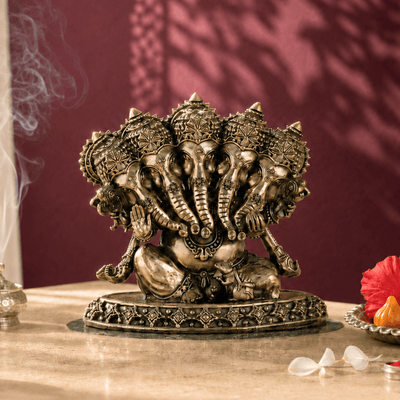
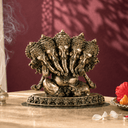
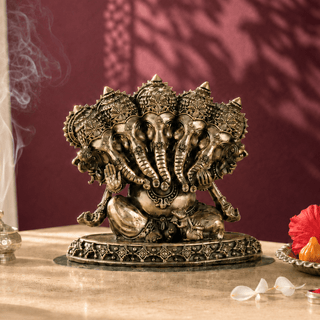
- Heramba Ganapati: five-faced, usually riding a lion rather than the mouse. This is the protective, formidable form. If you have seen a Panchamukhi Ganesha and wondered what it was, this is it.
- Nritta Ganapati: the dancing form, one leg lifted, weight shifted. Pure movement and celebration.
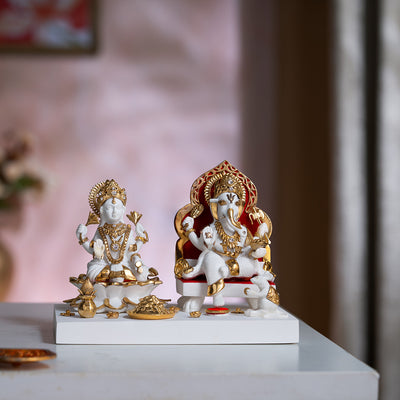
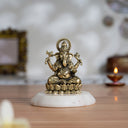
- Lakshmi Ganapati: Ganesha shown with Lakshmi. Note this carefully, because it matters later: a Ganesha-Lakshmi association genuinely exists in the classical iconography, long before anyone thought about Diwali shelf arrangements.
- Prasanna Ganapati: the gracious, pleased form. Calm, seated, approachable.
- Uchchhishta Ganapati: a tantric form with a very specific ritual context, and one you will essentially never encounter in a domestic shrine.
Notice what has happened. The moment you have these words, "which type is good for home" stops being a superstition question and becomes a design question. You are choosing a mood, and the tradition has already named the moods.
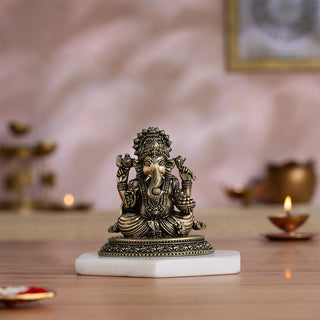
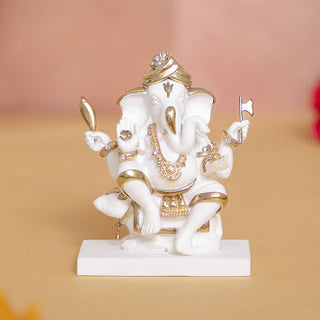
Sitting, standing or dancing: what the posture is doing
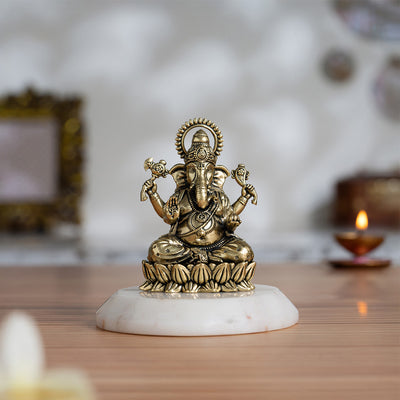
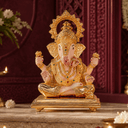
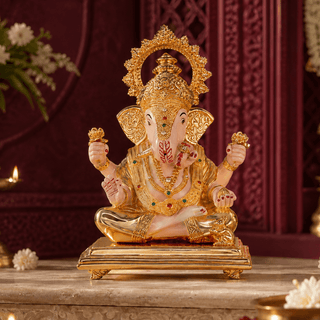
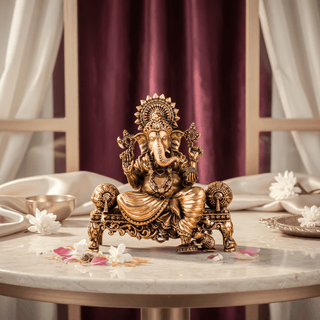
A seated Ganesha suits a daily shrine best. This is the one place where the common advice and the iconography agree.
A seated Ganesha, particularly in lalitasana (one leg folded in, the other hanging down easy), is an image of settled presence. Somebody who has arrived and is staying. That is the emotional register a household shrine runs on, and it is the honest basis for the standard "seated is best at home" recommendation. Not a rule from a Purana. Just a good match between what the image says and what the room is for.
A dancing Nritta Ganapati is doing something different. It is festive, kinetic, celebratory. It is wonderful in a living room, on a console table, in a space that is about energy and guests. Some people keep one in a shrine too, and nothing bad happens to them.
A standing Ganesha reads as active and outward-facing, which is why standing forms are more common in temple and processional contexts. Again, a tendency, not a prohibition.
Reclining Ganeshas, which have become popular in recent years, have no classical basis I could find at all. They are a modern decorative idea. That is fine, as long as you know that is what they are, and place them accordingly: a shelf, not a shrine.
The trunk question, answered plainly
Both trunk directions are fine in a home. Here is where the belief comes from. A right-curving trunk, dakshinabhimukhi, is said to be powerful but demanding, requiring strict ritual discipline, and unsuitable for homes. A left-curving trunk, vamamukhi, is said to be gentle and safe for householders.
Here is the honest position. That scheme is temple lore and Vastu tradition. It is not in the classical iconographic literature. Rao's thirty-three pages on Ganapati organise the deity by arms, posture, vehicle and consort, and trunk-curve direction is simply not one of the categories.1
Which does not make it meaningless. The reasoning behind it is coherent on its own terms: the right side is associated with the sun, with discipline, with the pitru direction; the left with the moon, with coolness, with the settled householder. Siddhivinayak in Mumbai, the most famous right-turned trunk in India, does maintain a demanding ritual regime. That is real. It is temple practice.
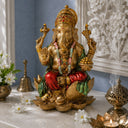
So: if you already own a right-trunk murti, you have not made a mistake, and nothing is going to go wrong. If you want the version that carries the household association, a seated, left-trunk Ganesh murti is exactly that, and it is the form most people picture when they think of a home Ganpati anyway. We have written about where the left and right trunk belief comes from in more detail, including why it persists so strongly.
Material: this is the part that actually has rules
Material is where practical tradition is genuinely clear, and it splits along one line: is this image permanent, or is it temporary?
Clay is for festival worship. Unpainted natural clay is used for Ganesh Chaturthi precisely because it dissolves. The whole ritual logic (avahana, inviting the presence in, and visarjana, taking leave of it at the end) depends on the image being impermanent. That is why home immersion in a bucket is theologically complete rather than a compromise. A clay Ganesha is not a cheaper murti. It is a different kind of object.6
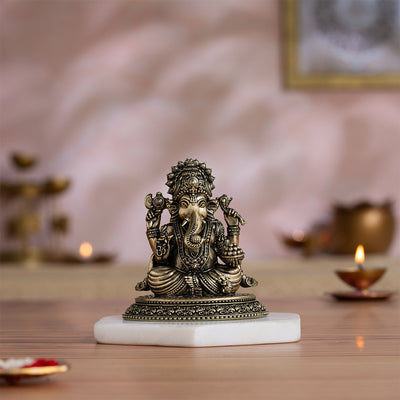
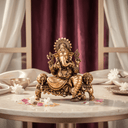
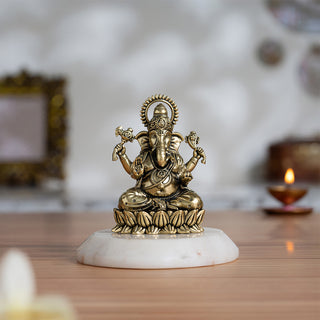
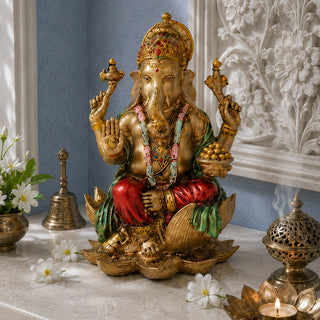
Brass is the classic permanent household material in most of India. It survives daily handling, oil lamps and decades of abhishekam, and it develops a patina people become attached to. Most of what sits in a working pooja room is brass, and there is a reason for that.
Marble is beautiful and heavy and better suited to a fixed installation than a shelf that gets rearranged. It also stains, so it wants a little care: we have a guide on cleaning marble idols that will save you from the vinegar mistake.
Panchaloha, the five-metal alloy, is the traditional material for consecrated temple bronzes in the South. It is a serious choice, and a lovely one for a permanent home shrine.
The one thing worth saying plainly: metal and stone murtis are never immersed. They are permanent images with their own ritual logic. Confusing the two is the single most common mix-up we get asked about.
Three things people get wrong about choosing a Ganesha
1. "Scripture says a right-trunk idol should not be kept at home."
No Purana says this. The belief comes from temple practice and Vastu reasoning, and it deserves respect as living tradition, but the classical iconography, as surveyed by Gopinatha Rao, classifies Ganapati by named form and never by trunk direction. Believe it if it means something to you. Do not believe you have violated a text.
2. "There is a scripturally correct direction for the idol to face."
There isn't. No Purana legislates the orientation of a household image. The north-east preference comes from Vastu Shastra. Its reasoning is that the ishana corner belongs to the devatas. That is an internally coherent traditional system, and a genuinely useful one. The classical texts that do discuss orientation, the Mayamatam and the Manasara, are manuals of temple architecture addressing consecrated buildings, not shelves in a flat.2 We go through this properly in our piece on which direction a Ganesh idol should face.
3. "Red hibiscus is Ganesha's scriptural favourite, so buy a form suited to flower offerings."
The texts are far more emphatic about a grass. The Ganesa Purana's Upasanakhanda gives durva grass chapter 63 for its origin story and then five more chapters, 64 to 68, as a full Durvamahatmya.3 No flower receives anything close to that attention. Hibiscus is real and widespread regional practice, especially in Maharashtra and Bengal, but it is practice, not prescription, which we unpack in the favourite flower question. The same worship logic explains why tulsi is kept off his tray, and that one, unusually, is straightforwardly scriptural.
So how do you actually choose?
Start with the room, not the rule.
If this is for a daily pooja space, go seated, go brass or panchaloha, and go modest in size. A murti you can comfortably do abhishekam on is worth more than a large one you are slightly afraid of. For most shelf mandirs that means five to eight inches, or a small Ganesh idol of two to four inches if the shelf is already full. Everything else in the space follows the same logic: we have a longer list of what belongs in a pooja room if you are setting one up from scratch.
If it is for a living room or an entrance, you have much more freedom. Dancing forms, antique finishes, wall pieces and larger sculptural murtis all work, and the only real considerations are height, light and not putting the image somewhere undignified: bathroom walls, under a staircase, on the floor.
If it is for a festival, buy clay, buy unpainted, and plan the immersion before you plan the decoration. Our Ganesh Chaturthi decoration ideas and the tithi and visarjan dates both assume this.
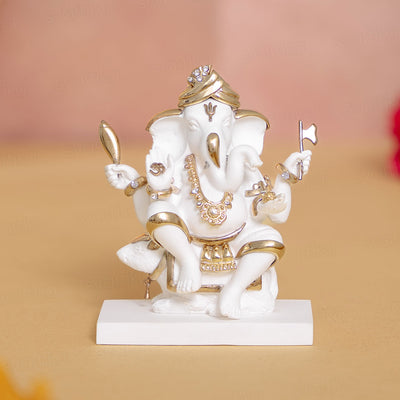
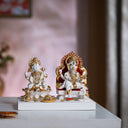
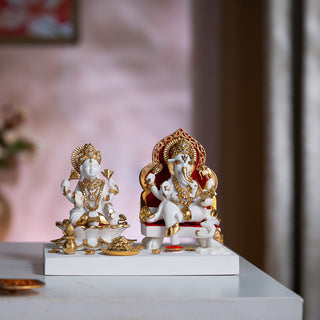
If it is a gift, the Ganesh-Lakshmi pairing is the safest and most loved choice in India and the mainstay of our Ganesh Chaturthi gifts, and it turns out to have older iconographic company than most people realise, given that Lakshmi Ganapati is a named Agamic form.
And if it is for a car, that is genuinely a different problem: weight, adhesion and the fact that a dashboard is not a shrine. We covered it separately in keeping a murti in the car, and the car dashboard idols range is sized for exactly that.
One last thing, about worrying
A lot of Ganesha anxiety comes from a mismatch. People assume the tradition is a rulebook, and then panic when the rules seem to contradict each other. But the tradition around Ganesha is unusually relaxed, and its own texts are relaxed with each other too.
The Puranas do not even agree on how he was born: the Siva Purana has Parvati making him herself, the Brahmavaivarta has a boon from Krishna and Shani's gaze.45 They disagree about whether the mother-son story runs one way or another. They disagree about his tusk, and the most famous version of how it broke turns out not to be in the Mahabharata at all. Much of North India shows him married to Riddhi and Siddhi; much of Tamil Nadu holds firmly that he is a brahmachari. Both are old. Both are held sincerely.
A tradition that comfortable with disagreement is not going to be undone by your shelf. Choose the image you actually want to look at every morning. That has always been the real criterion, and it is the one the texts leave open on purpose.
Also read: Ganesha Trunk Right or Left: What It Means | Which Direction Should a Ganesh Idol Face | How to Immerse a Ganesh Idol at Home | Who Broke the Tooth of Lord Ganesha | Which Hanuman Idol is Good for Home