The short answer, and why most guides cannot back theirs up
None of the famous rules about which Hanuman idol is good for home come from scripture. South-facing only. Never keep a flying Hanuman. The mace must point away from the bedroom. Panchmukhi belongs in temples, not houses.
I went looking for where those rules come from, and I could not find a single one of them in the Valmiki Ramayana, the Mahabharata, or the major Puranas. Not one. They are real customs, followed sincerely by millions of families, and they vary quite a lot from Tamil Nadu to Uttar Pradesh. But they are practice, not scripture, and the pages that state them with total confidence never give you a source.
The scripture almost nobody quotes about Hanuman at your door
Long after the Ramayana, in the Mahabharata, Bhima walks into a forest at Gandhamadana and finds an old monkey lying across his path, tail blocking the way. He tells it to move. It says it is too old, and invites him to lift the tail himself.
Bhima (the strongest of the Pandavas, and himself a son of Vayu) cannot move it with one hand. Then, in Ganguli's translation, "with both arms he pulled it, resembling the pole reared in honour of Indra."1 Still nothing. That is when he realises who he is talking to. It is the epic's way of ranking two brothers without making them fight, and if you want the fuller version of that question, we covered it in who can defeat Lord Hanuman.
What matters here is what Hanuman promises before Bhima leaves:
"Remaining on the flagstaff of Arjuna's car will I emit fierce shouts that will damp the energy of thy foes."
Mahabharata, Vana Parva, Section CL (Ganguli translation)
That promise is why Arjuna's banner is called Kapidhvaja, the monkey banner. And it is the honest scriptural basis for the whole idea of Hanuman as a guardian at an entrance. He volunteered for the position. He asked to sit at the front of somebody else's vehicle and frighten off what was coming.
If you are bringing him home for protection, that is your reason, and it is a much better one than a direction rule nobody can trace.
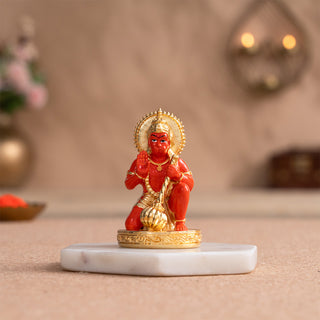
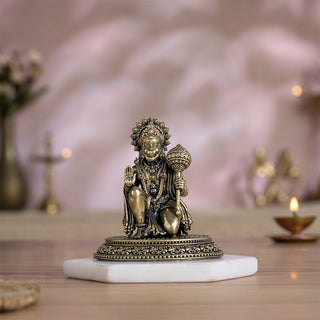
The recognised forms of Hanuman, and what each one is for
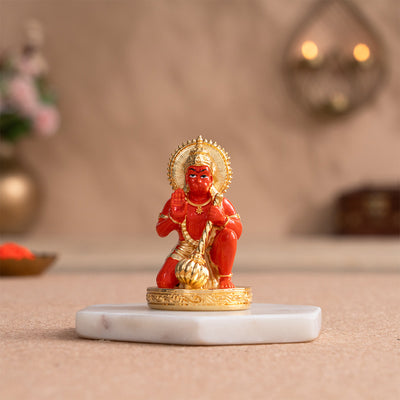
Unlike the placement rules, the sculptural forms are well documented across South Asian temple sculpture. There are five you will actually encounter when shopping.
Dasa or Bhakta Hanuman: the servant
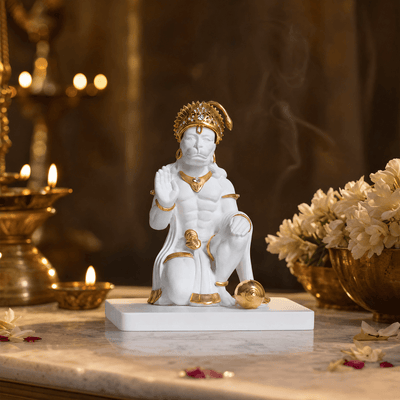
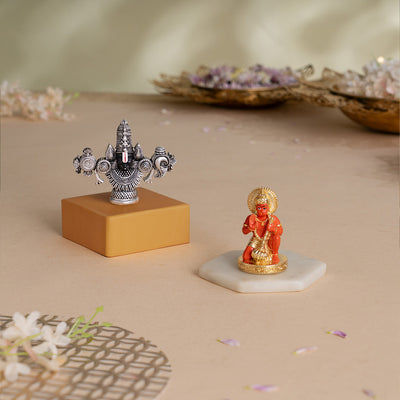
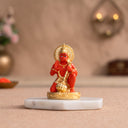
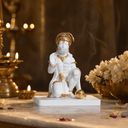
Hands folded at the chest, head slightly bowed, often seated or standing near Rama. This is Hanuman as devotee rather than warrior, and it is the form most temple traditions consider suited to a household shrine. The energy of the image is quiet. It sits well beside other murtis in a pooja room without dominating them.
If you want one form for a family shrine and you do not want to think about it further, this is the one.
Vira or Veera Anjaneya: the warrior
Mace raised, one foot forward, sometimes trampling a demon underfoot. This is the temple and gateway form. It is not wrong at home, but it is loud, and it belongs at an entrance or in a room where you want that charge rather than in a small prayer corner.
The Sanjivani-bearer: Hanuman carrying the mountain
Flying, mountain balanced on one palm. This is the moment from the war when he could not identify the healing herb and carried the whole peak instead.6 Families often choose this one when somebody in the house is unwell, and there is a real logic to that. The story behind the image is a rescue.
It also connects to something practical. The Hanuman Bahuk is a 44-verse poem Tulsidas wrote around 1607 CE while in severe pain in his arms, and it is still recited specifically for physical ailment. Not a posture, despite what half the internet says. A poem an old man wrote because his arms hurt.
Abhaya mudra: the open palm
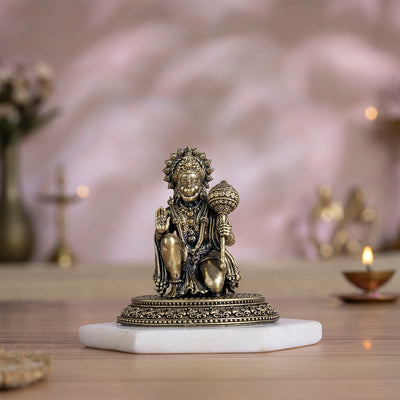
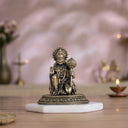
The raised right hand, palm out, is the gesture of fearlessness. It appears across Hindu iconography and it is the most direct thing an idol can say to the person looking at it. A small brass Hanuman seated in abhaya mudra is about as uncomplicated as a home murti gets, and brass is forgiving over decades in a way plated resin is not.
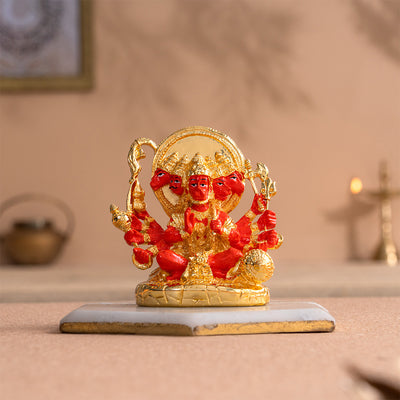
Panchamukhi: the five-faced form
Five faces: Hanuman facing east, Narasimha south, Garuda west, Varaha north, Hayagriva looking upward. Fierce, protective, and the form people most often get told not to keep at home.
More on that below, because the reasoning behind that warning is worth examining.
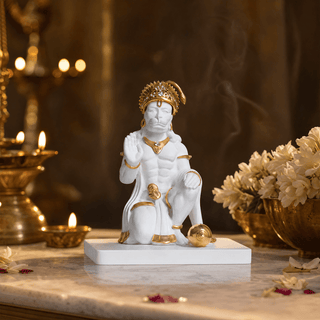
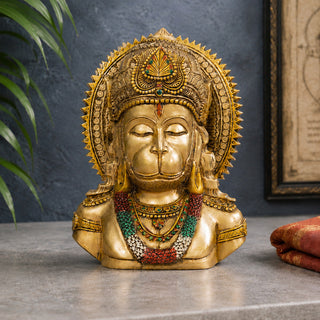
Five things people get wrong about Hanuman idols
1. "Panchmukhi Hanuman is from the Ramayana." It is not in Valmiki at all. The episode where Ahiravana drags Rama and Lakshmana to Patala, and Hanuman grows five faces to blow out five lamps burning in five directions at the same instant, comes from later regional retellings: chiefly the Bengali Krittivasi Ramayana of roughly the 15th century, and a 16th-century Telugu Mairavana charitra. That is around two thousand years after Valmiki.
This does not make it less meaningful. Regional Ramayanas are how the epic stayed alive in each language, and the five faces are a genuinely brilliant piece of storytelling: the form exists to solve a puzzle no ordinary body could solve. We told it properly in the Panchmukhi Hanuman story. Just know it is younger than people assume, and that the faces borrow from Narasimha and Varaha because his devotion is meant to contain Rama's own arsenal.
2. "Never keep Panchmukhi at home." There is no textual rule saying this. What there is, is a widespread temple convention that fierce, weapon-bearing forms are handled with more ritual discipline than gentle ones: daily worship, no neglect. That is a real and sensible instinct. It is not a prohibition anyone can cite. If you will keep the lamp lit and the shelf clean, the objection largely disappears.
3. "Hanuman must face south." Dakshinamukhi Hanuman shrines are a genuine and beautiful South Indian temple tradition. They are also a temple tradition, not a Puranic instruction for private homes, and other regions do not follow it. If you are already arranging a shrine, the same honesty applies elsewhere: we made the same point about which direction a Ganesh idol should face and about keeping a Shiva statue at home.
4. "Hanuman was blessed with immortality by Sita at Rama's coronation." Yuddha Kanda 128 is the passage everyone cites for this, and it does not say it. Sita takes off her pearl necklace and gives it to him. Rama gives Sugriva a chaplet and Angada a bracelet. No boon of deathlessness is granted to anyone in that scene.4
The real anchor is better anyway. In the Mahabharata, Hanuman tells Bhima what he actually asked Rama for: "may I live as long as the history of thy deeds remaineth extant on earth."1 His life is tied to the survival of the story, not to a blessing at a ceremony. That is the thread we followed in is Lord Hanuman still alive and in our piece on the chiranjeevis.
5. "Nothing ever touched him, so his idol is pure invincibility." Valmiki is more interesting than that. Ravana strikes Hanuman on the chest with an open palm and Hanuman "reeled repeatedly", then hits back so hard that Ravana "shook like a mountain when the earth trembles," and Ravana actually praises him mid-fight (Yuddha Kanda 59.60-65). Indrajit's Brahmastra does bind him, though Hanuman reasons first that being captured will get him an audience with Ravana.5
Blows land on him. He is never stopped. Those are different things, and the second one is the better thing to keep on a shelf.
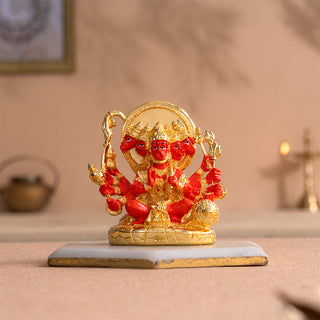
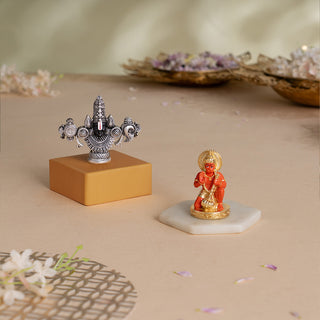
Tuesday, Saturday and sindoor: lovely, and also custom
Tuesday and Saturday worship, and the offering of sindoor mixed with oil, are among the most widespread Hanuman practices in India. They are also devotional practice and regional convention rather than anything prescribed in the epics or the Puranas.
The sindoor tradition in particular does not need a fake citation to be moving. The popular story is that Hanuman found Sita applying vermilion for Rama's long life, and reasoned that if a little brings Rama some benefit, covering himself entirely would bring more. That is folk narrative. It is also a perfect description of how he thinks, which is probably why it stuck.
Two of his birthdays are observed across India for similar regional reasons, which we explained in why Hanuman Jayanti is celebrated twice a year. Different calendars, same devotion, no contradiction.
If you follow Tuesday worship, follow it. Just do not let anyone tell you a text commands it.
So how do you actually choose one?
Start with why he is coming into the house, because the forms genuinely differ in what they carry.
- For a daily shrine and a family that prays together: Dasa or Bhakta Hanuman, folded hands. Quiet, devotional, sits beside other deities without competing.
- For an entrance, a shop, or a room you want guarded: Vira Anjaneya, or Panchamukhi if you will keep the worship regular. This is the form the Mahabharata's banner promise actually supports.
- For a household where someone is ill or recovering: the Sanjivani-bearer, with the mountain.
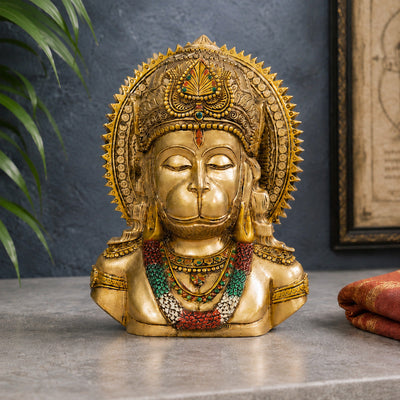
- For a car, a desk, or a small ledge: a compact murti or a face figure. Our note on keeping a murti in the car covers the sizing and mounting side of that, and the pieces sized for a dashboard are grouped together if you are buying for the car.
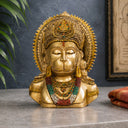
Then think about material, which matters more over time than most people expect. Brass ages rather than degrades and can be polished for generations. Plated murtis hold fine detail beautifully and suit a shrine where they are not handled daily. Marble-dust and resin pieces take the finest carving of all, and want dusting rather than washing: we wrote up the method in how to clean a marble idol.
And then place him where you will actually see him. That sounds like a soft answer, but it is the defensible one. A murti in a corner you walk past without looking is doing less than a murti at eye level in a room you use. The same reasoning applies to choosing a Ganesha idol for home, and it holds here too.
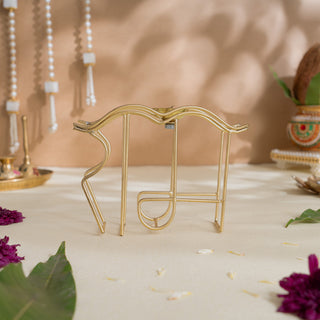
One more thing worth knowing before you buy
Hanuman is almost never worshipped alone in the older imagination. He is worshipped as somebody's. Son of Kesari and of Vayu at once, which Valmiki states deliberately using two separate categories of sonship: we unpacked that in who was Lord Hanuman's father.2 Servant of Rama. Brother in arms to Lakshmana.
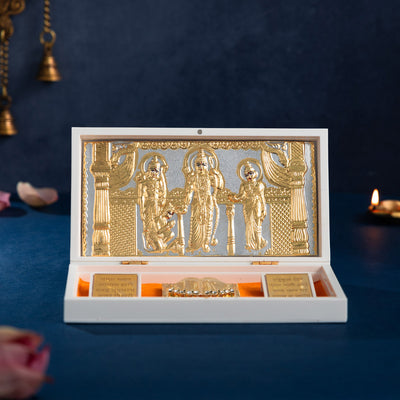
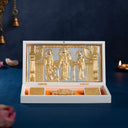
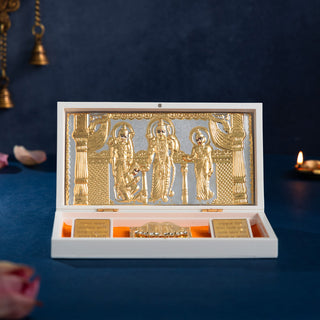
This is why so many homes keep a Ram Darbar rather than a standalone Hanuman: the whole relationship is in the frame, with Hanuman at the feet where he chose to be. If you are drawn to the folded-hands form, a Ram Darbar is often what you actually wanted.
And if you are curious about the stranger corners of his story (the sweat-born son in Makardhwaja, or the single temple tradition that gives him a wife named Suvarchala), those are worth reading, as long as somebody tells you honestly which parts are epic and which are folk. Most pages will not. We try to. Browse the full Hanuman idol collection when you know which form you are looking for.
Also read: Is Lord Hanuman Still Alive | The Panchmukhi Hanuman Story | What is Hanuman Bahuk | Who Can Defeat Lord Hanuman | Things to Keep in Your Pooja Room | The 10 Biggest Hanuman Statues in India, by Verified Height