Ask this in a room full of people and you get three confident answers. Vayu, the wind god. Kesari, with Vayu supplying only the power. Or Shiva himself.
All three are quoting real texts. So instead of picking a winner, open the oldest source.
What the oldest source actually says
The birth account is not in the part of the Ramayana most people know. It comes in Kishkindha Kanda 66, at a very specific moment. The vanara army has reached the southern shore, nobody can cross, and Hanuman is sitting there having apparently forgotten that he can.
So Jambavan, the old bear king, tells him his own story back to him. Hanuman's parentage is narrated to Hanuman, because he needs reminding.
Jambavan says that Anjana was once an apsara named Punjikasthala, cursed to take the form of a vanara. In that form she became the wife of Kesari. One day the wind embraced her, and Vayu promised her a son who would be brave, clever, and his own equal at leaping and flight (Kishkindha Kanda 66.18-19). Sanskrit quoted below is Valmiki's and the Mahabharata's; the English is ours.
Notice what Valmiki does not do. He does not apologise. He does not call Kesari a stepfather or explain the situation away. He simply gives the child two fathers and moves on to the next verse.
Kshetraja and aurasa: two words worth knowing
The reason Valmiki can do this without embarrassment is that classical Indian law had precise vocabulary for it, and both terms describe a legitimate son.
Valmiki puts both words in one breath:
स त्वं केसरिणः पुत्रः क्षेत्रजो भीमविक्रमः मारुतस्यौरसः पुत्रस्तेजसा चापि तत्समः।
In plain English: So you are Kesari's son, his kshetraja son, of terrible valour, and the aurasa son of the Wind, his equal in fiery strength.
Valmiki Ramayana, Kishkindha Kanda 66.29-30
An aurasa-putra is the begotten son, born of one's own body. That is Vayu.
A kshetraja-putra is literally "the son of the field", the field being the marriage. A child born to a man's wife is that man's son in law and society, whoever begot him. That is Kesari, and it is not a consolation prize: in the older Dharmashastra lists, the kshetraja sits near the top.
So the argument about whether Kesari "counts" is one the text already settled. He counts. So does Vayu.
The epic does the same elsewhere. Sita has a father who found her and a father nobody can name, covered in the real father of Sita. The Ramayana is comfortable with layered parentage in a way modern retellings are not.
How a broken jaw gave him his name
Hanuman's name comes from a broken jaw, and the verses that describe it quietly explain the whole father question.
As a baby, Hanuman saw the rising sun, thought it was fruit and leapt for it. Indra struck him with the vajra, and the boy fell and broke his left jaw on a mountain peak.
The Sanskrit word for jaw or cheek is hanu, and Valmiki spells the connection out himself:
तदा शैलाग्रशिखरे वामो हनुरभज्यत। ततो हि नामधेयं ते हनुमानिति कीर्तितम्
In plain English: On the mountain peak his left jaw was broken. From that, your name is famous as Hanuman.
Valmiki Ramayana, Kishkindha Kanda 66.24
His most famous name is a scar.
Then comes the part that matters here. Vayu did not take it well. The wind god withdrew air from all the worlds until the gods came to make peace. And the peace offering was a set of boons:
प्रसादिते च पवने ब्रह्मा तुभ्यं वरं ददौ। अशस्त्रवध्यतां तात समरे सत्यविक्रम स्वच्छन्दतश्च मरणं तव स्यादिति वै प्रभो।
In plain English: Brahma gave you this boon: that you cannot be killed by weapons in battle. And Indra gave you this: that your death will come only when you yourself choose it.
Valmiki Ramayana, Kishkindha Kanda 66.27-29
Notice what happened. Hanuman's power was not something he was born holding. It was compensation paid to an angry father. Vayu's rage over an injured child is why Hanuman is nearly impossible to kill.
Those two boons are the honest basis of his deathlessness, and they are narrower than people assume: not killable by weapons, and dying only when he chooses. That is not the same as being unkillable, which is why he can be staggered by Ravana and bound by Indrajit without contradiction.34 We went through those episodes in who can defeat Lord Hanuman, the question of whether he is still around in is Lord Hanuman still alive, and the company he keeps in the seven chiranjeevis.
The third answer: is Hanuman an avatar of Shiva?
The Shiva Purana identifies Hanuman as an avatar of Shiva: a Rudra born into the world in vanara form to serve Rama. Not a fringe view. It is why you hear him called Rudravatar, and why in much of North India his worship sits inside a Shaiva frame.
Other Puranas take a different line and call him a marud-amsha: a portion of Vayu, a fragment of the wind rather than a separate person. That is a subtler claim than "son of Vayu," and closer to Valmiki without being identical to him.
And Valmiki, the oldest of the three, does neither. He gives the Kesari and Vayu account and never mentions Shiva at all.
Three frameworks that do not reconcile. Vaishnava traditions generally reject the Shiva-avatar reading; Shaiva traditions hold it firmly. Nobody has resolved it, and nobody has tried very hard, because it causes no problem in practice.
It helps to remember that Shiva's own parentage is a knot of the same kind, which we untangled in who are Lord Shiva's father and mother, and that the number of forms attributed to him is its own long argument: see how many avatars of Shiva. Layered identity is normal in this literature, not an error in it. The same tolerance is why the "most powerful god" question has never had one settled answer either.
Every name he has is a claim about his father
Every name Hanuman carries preserves a different answer about his father. You do not need to read a single Purana to know that Hindus have held all three at once. You can hear it in the names people chant every Tuesday.
- Kesari-nandan: son of Kesari. The social father, named first in the Chalisa's own world.
- Anjaneya: son of Anjana. His mother, and by far his most common South Indian name.
- Pavanputra and Vayuputra: son of the wind.
- Maruti: of the Maruts, the storm gods. This is the marud-amsha reading, hiding in plain sight in a name half of Maharashtra uses.
- Rudravatar: the Shaiva answer.
Nobody pruned this list. Every competing theology kept its name, and devotees use them interchangeably without noticing. Tulsidas does the same in the Hanuman Bahuk, which is a poem and not, as the internet insists, a posture. That is a tradition deciding the question was not worth a fight.
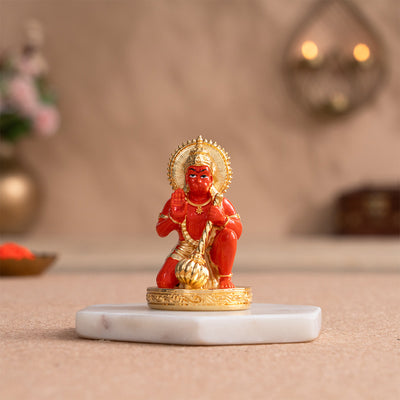
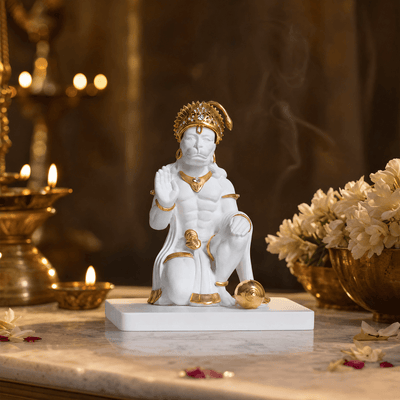
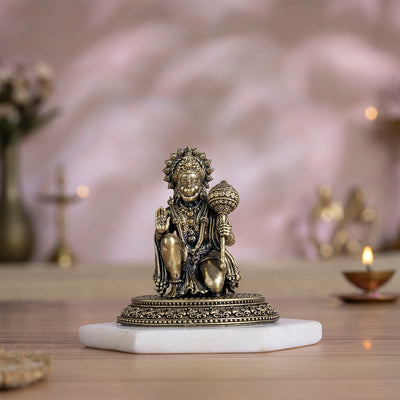
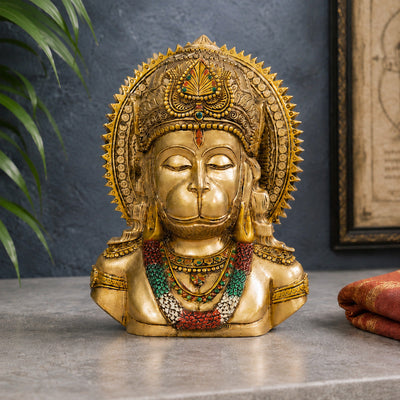
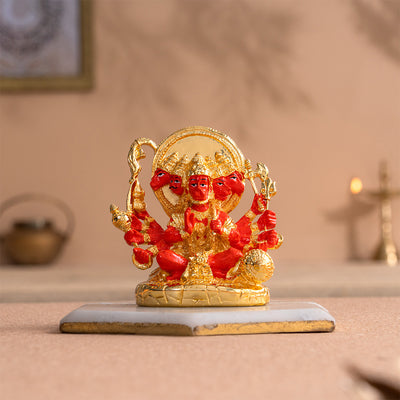
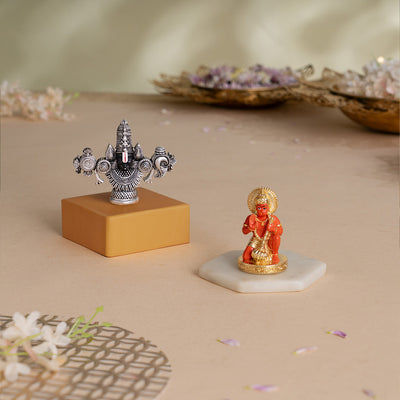
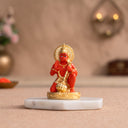
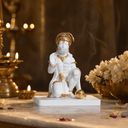
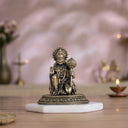
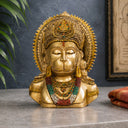
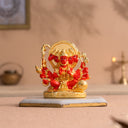
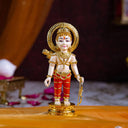
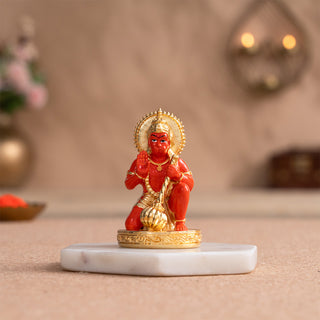
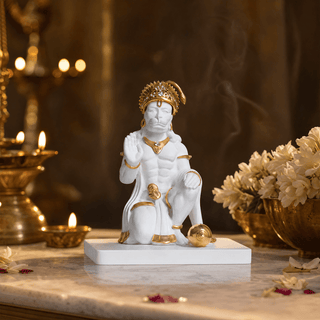
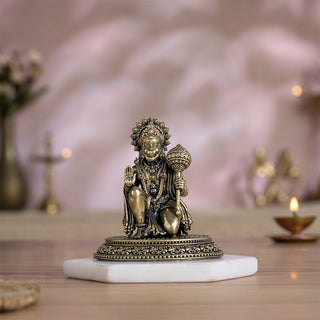
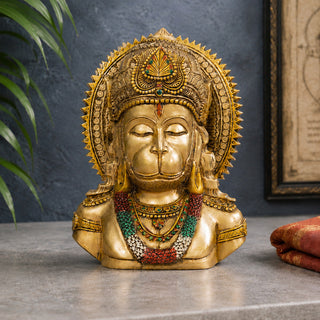
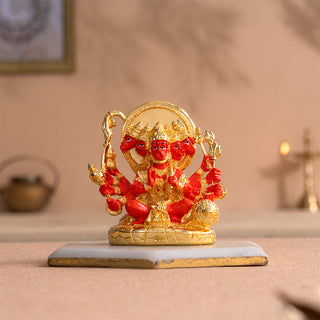
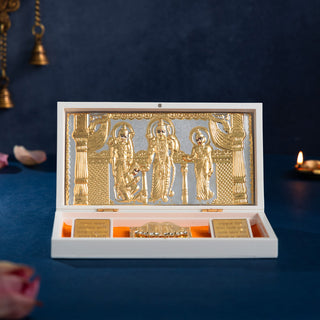
You will see the same layering in how he is depicted. The warrior form, the folded-hands servant form, the five-faced Panchmukhi form, the mountain-bearer, all current, all in temples, none cancelling the others. If you are choosing one for a shrine at home, the differences matter, and we walked through them in which Hanuman idol is good for home. The Bajrangbali murtis we make cover the folded-hands and five-faced forms, and the cast brass idols are there for those who want the older material.
Four things people get wrong about this
1. "Kesari was only a stepfather." Valmiki never says this and the vocabulary argues against it. Kshetraja sonship was a recognised legal category, not a polite fiction. Hanuman is Kesari's son in the fullest sense the text has available, which is exactly why Kesari-nandan survives as a name.
2. "Hanuman forgot his powers because a rishi cursed him." What Valmiki shows is only the forgetting itself: Jambavan has to recite Hanuman's birth and boons back to him before he will attempt the ocean (Kishkindha Kanda 66.25-37). The explicit curse-by-sages explanation belongs to the Uttara Kanda and to later tradition. The distinction is worth keeping, because in Valmiki the forgetting reads as humility rather than as a handicap someone placed on him.
3. "He got his strength because he is Shiva." In the oldest account he got it as a settlement after his father throttled the world's air supply. Two different explanations, two different texts, two different theologies. Merging them into one smooth story loses the more interesting fact that they are separate.
4. "The Ramayana calls him a lifelong brahmachari, so Vayu's role must be metaphorical." Valmiki never uses the vow at all. In the one place the question arises (searching Ravana's sleeping quarters in Sundara Kanda 11), Hanuman worries that looking at other men's wives harms dharma, then settles it by saying that nothing in his mind moved, and that the mind drives every sense, and his is well settled (11.41-42). The virtue Valmiki praises is composure, not abstinence. That later anxiety about his chastity is also why tradition later gave him a son born of sweat and a wife he never touched: two puzzles we took apart in the story of Makardhwaja and who is the wife of Lord Hanuman.
The brother nobody mentions
Bhima is also a son of Vayu, which makes Hanuman and Bhima brothers. That consequence of Vayu's fatherhood gets skipped almost everywhere, and it pays off in a completely different epic.
They meet, once, in the Mahabharata's Vana Parva. Bhima is walking through the forest at Gandhamadana and finds an old monkey lying across the path with its tail in the way. He tells it to move. It says it is too old, and suggests he lift the tail himself.
Bhima, the strongest of the Pandavas, cannot lift it with one hand. Then he cannot lift it with both arms either (Vana Parva 146). The epic ranks the two brothers without staging a single blow.
What follows is even better. Hanuman first refuses to show Bhima the form he had in the Ramayana, saying this is an age of decline and he no longer has that shape, then gives in and shows it anyway when Bhima will not leave without seeing it (Vana Parva 148.6, 149.1-9). Before he goes, he makes a promise that explains a piece of iconography most people never think about:
विजयस्य ध्वजस्थश् च नादान् मोक्ष्यामि दारुणान् शत्रूणां ते प्राणहरान् इत्य् उक्त्वान्तरधीयत
In plain English: “And standing on Arjuna's flagstaff I will let out terrible roars that take the life out of your enemies.” Having said this, he vanished.
Mahabharata, Vana Parva 150.15
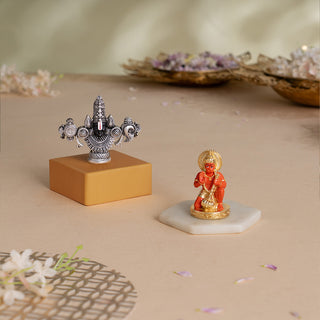
That is why Arjuna's banner in the Kurukshetra war is the Kapidhvaja, the monkey standard.6 And it is the one genuinely scriptural reason Hanuman belongs at a doorway or an entrance, not a Vastu rule, but a promise he made to his brother.
Why three answers are better than one
It would be easy to declare Vayu the "real" father and Kesari the technicality. Most articles do. It is the least interesting thing you can do with this material.
The sources show a tradition that never felt the need to choose. A man raised him. A god begot him. A third theology says he was never only a son at all. Nobody deleted anyone.
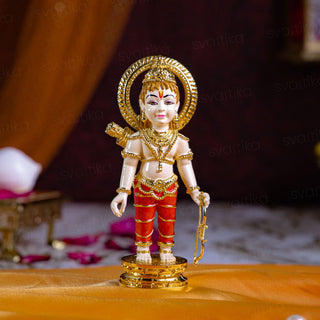
And then there is the fourth relationship, the one he chose rather than inherited. Almost every image of Hanuman you will ever see shows him kneeling, or carrying something, or standing at a doorway waiting to be useful: a servant of Rama, whose story runs from the Ram avatar through the brothers of Ayodhya, covered in Lord Rama's brothers, all the way to how Ram died. That posture, hands folded and head slightly bowed (the Dasa or Bhakta form) is the one most households keep. Three men and gods decided who fathered him. This one bond he picked himself.
Three fathers by birth and theology. One by choice. The tradition kept every single one, and if you have ever wondered why his birth is celebrated on two different dates in two different regions, Hanuman Jayanti turns out to work the same way, no one ever felt the need to settle it.
Also read: Is Lord Hanuman Still Alive | Who Can Defeat Lord Hanuman | The Panchmukhi Hanuman Story | What is Hanuman Bahuk | The 7 Chiranjeevis