Somebody has probably told you this one. The Buddha sits down under a tree to meditate. The sun turns brutal. His head is shaved and bare. So 108 snails climb up his body, settle on his scalp, and hold their cool damp bodies there to shade him. He reaches awakening. They dry out and die. That is why, the story says, every Buddha statue has those little round bumps on the head.
It is a genuinely lovely story, and I wanted it to be true. So I went looking for it in the texts. It is not there. Not in a sutta, not in the commentaries, not in the Jataka birth-tales. What I found instead was a list of thirty-two things the canon actually does say about the Buddha's body, and honestly, it beats the snails.
First, the story as people tell it
Let's not be snobby about it. The popular version goes roughly like this. Siddhartha Gautama has left his palace and cut off his hair at the Great Renunciation, an episode told in Ashvaghosha's Buddhacarita, the earliest full poetic life of the Buddha.9 He sits in deep meditation. The midday sun beats down on his exposed head and threatens to break his concentration.
Snails, being cool and moist, crawl up and arrange themselves over his scalp like a living cap. Some versions say they sacrificed themselves knowingly, some that the Buddha blessed them on waking. The bumps on statues are their shells, frozen in stone forever.
You can see why it spreads. It has a martyr, a sacred-sounding number, and it explains a visual detail everybody has noticed but nobody could account for. That is the perfect shape for a story that travels. It is also, as far as the Buddhist canon goes, folklore, and saying so is not an insult. Traditions carry real truth in stories that were never scripture, the same way the enormous eyes of Lord Jagannath carry meaning no single text fully accounts for.
So what do the texts actually say about the Buddha's body?
Quite a lot, as it happens. The Pali canon has a list called the thirty-two marks of a great man, the mahapurisa lakkhana. It appears in full in two separate discourses, which is unusual and useful: the Lakkhana Sutta (Digha Nikaya 30) and the Mahapadana Sutta (Digha Nikaya 14). Two independent enumerations of the same list. If snails were part of the tradition's picture of the Buddha's body, this is exactly where they would be.
They are not. Here is a sample of what is actually on the list:
- Feet that plant flat and even on the ground, with wheel-marks on the soles
- Long fingers and toes, and a body proportioned like a banyan tree, as tall as his arm-span
- Skin so smooth that dust does not stick to it, with a golden complexion
- Forty teeth, even and gapless, and a very long tongue
- Eyes described as deep blue, "like that of a newly born calf"
- A tuft of soft white hair between the eyebrows, "like cotton wool"
Read it as a whole and you notice something. This is not a physical description in the way a passport is. It is a list of auspicious signs used to identify a mahapurisa, a great man destined for one of two paths: a world-ruling king or a fully awakened teacher. Whole traditions in India ran on this kind of body-reading. Counting divine features and reading meaning into them is an old habit across the subcontinent, which is why questions like how many hands Goddess Durga has have real answers rather than decorative ones.
There is a second useful piece of negative evidence. The Brahmayu Sutta (Majjhima Nikaya 91) describes the Buddha at length as a brahmin observes him, and it dwells on how he walks, how he eats, how he holds himself. No snails there either.
The curls on Buddha statues are sculpture, not scripture
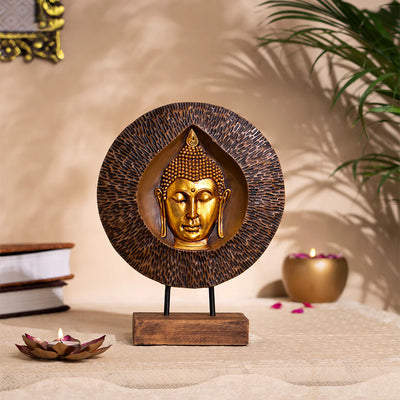
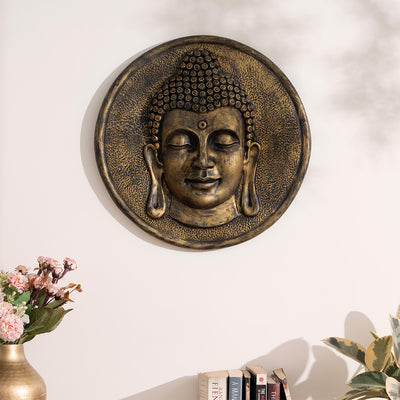
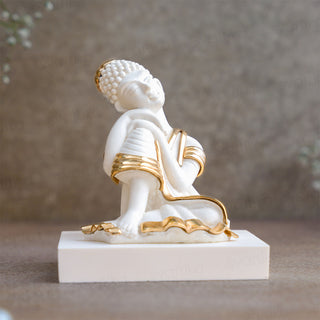
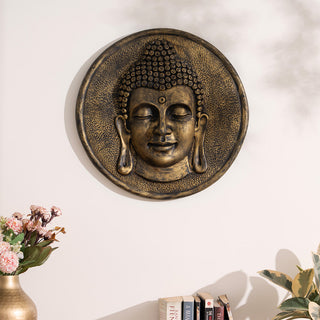
Look at almost any Buddha figure and you will see the head covered in small, uniform, spiral curls. That is where the snail story attaches itself. But the canonical mark about curling hair is not about head hair at all. It is about body hair. The Lakkhana Sutta puts it plainly: his body-hairs grow upwards, they are blue-black, and they curl clockwise. That is the mark. Body hair, one hair per pore, curling in a particular direction.
Head hair barely comes into it. And it makes sense that it wouldn't. The Buddha was a shaven renunciant. He cut his hair off when he left home. The tight snail-shell curls you see on a statue are a sculptural convention that developed in Buddhist art over centuries, a way of showing "hair" on a figure who by definition kept none.
Once you know that, a Buddha figure reads differently. You are not looking at a portrait. You are looking at a visual grammar, the same way an idol's posture, hand gesture and seat all carry fixed meanings in Indian image-making. If you want that visual grammar applied to a form you already know well, the armless form of Jagannath is the closest parallel: a shape people constantly try to explain with a legend, when the honest answer is older and stranger.
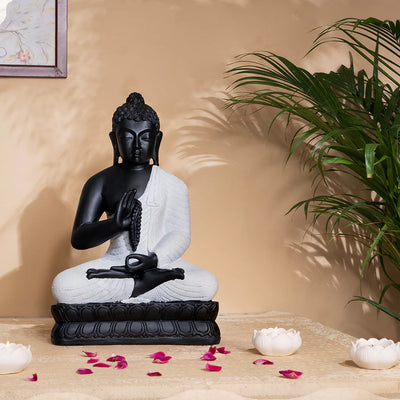
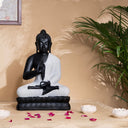
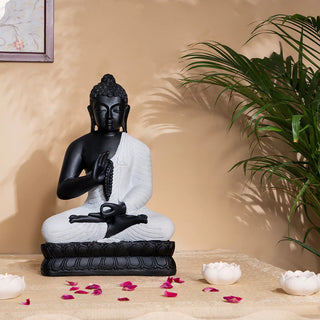
You can see the convention clearly on a well-modelled piece. On a seated meditating Buddha, the curls are evenly spaced, identical, and clockwise, which no real head of hair has ever been. That uniformity is the tell. It is a code, not a copy.
The bump has a name, and translators still argue about it
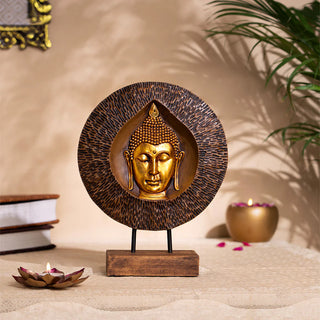
The raised mound at the crown is called the ushnisha. Its textual seed is the very last of the thirty-two marks, Pali unhisasisa.
Here is the honest part. Nobody can tell you cleanly what that Pali word describes, because translators disagree. The Sutta Friends edition of DN 30 renders it as a forehead that is flat and tall. Older translators, including Rhys Davids and Maurice Walshe, give something quite different: a head shaped like a royal turban. Same word, two very different pictures.
What both readings share is that it is a mark of an auspicious person, sitting in a list alongside thirty-one others. It is not a topknot. It is not a swelling. It is certainly not a pile of shells. And when a later sculptor had to render an ambiguous word in stone, he did what sculptors do: he made a decision, and everyone copied it.
The dot people sometimes read as a third eye is the other one, the urna, the tuft of white hair between the eyebrows. That one is unambiguously canonical.
Three things people get wrong about the 108 snails
1. That it is scripture
It is not. Two independent canonical lists of the Buddha's marks were read item by item for this article, and neither contains snails, shells, or any creature on the head.12 The claim being made here is a negative one, and a negative can never be absolute across the whole of Buddhist literature in every language. But "this is not in the Pali canon's description of the Buddha's body" is a solid statement, and the burden now sits with anyone who says otherwise to name the text.
2. That 108 comes from a Buddhist source
108 is real and it is everywhere in Indian traditions. Mala beads. Defilements in Buddhist lists. Temple counts. The number carries weight, which is exactly why it gets borrowed. In Hindu tradition it shows up in places like the story of Parvati's 108 lives. But it does not appear in the canonical mark-lists in connection with the Buddha's head or hair. It was almost certainly attached to the snail story later to give it a scriptural ring it never had.
3. That the bump and the curls are the same thing
They are two separate features with two separate stories. The curls are a sculptural convention. The ushnisha is a contested word in a canonical list. Merging them into one origin story, snails, does neither of them justice.
Why the story survives anyway
The snail story survives because it says something the tradition genuinely believes, in a form a child can hold. Awakening is worth a life. Even the smallest creature has a share in it. That sits comfortably beside the teaching of not-self, where the line between one creature and another gets thinner the harder you look.8 Jataka birth-tales are full of animals who give something up, so the snail story fits the tradition's grammar perfectly. It just was not written by the tradition. It is a folk story that learned the local accent, and that is a real category, not a failure.
Compare it with the mustard seed story of Kisa Gotami. That one is also not a sutta; it lives in the Dhammapada commentary attached to verse 114.7 But it is old, it is inside the tradition, and it is taught. There are shelves, and knowing which shelf a story came off is part of respecting it.
What the Buddha did say, since we are here
He was unusually blunt about his own syllabus. In the Simsapa Sutta he picks up a handful of leaves, points at the forest, and says what he has taught is the handful; the rest he left out on purpose because it leads nowhere useful.5 His teaching, set out in his first sermon at Sarnath, was the four noble truths and the eightfold path, framed as a middle way between indulgence and self-torture. His last recorded words were an instruction, not a revelation: all compounded things are subject to vanish, strive with earnestness.6
A teacher that plain about the limits of what he taught is exactly the sort whose tradition eventually grows a snail legend. People want more than a handful of leaves. That is a human problem, not a Buddhist one, and it is the same impulse behind the later claim, found in Puranic Hinduism rather than any Buddhist text, that the Buddha was one of the avatars of Vishnu. Worth knowing as a cross-tradition claim, not as something Buddhists ever said about themselves.
If the practice side is what you are after, the sitting itself has its own long literature, and what zen meditation actually means turns out to be far less mystical and far more physical than most people expect. His birth and death are marked together on a single day, which is why Buddha Purnima is celebrated the way it is. And the other great renunciant teacher of roughly the same era gets his own day too, which is what Mahavir Jayanti commemorates.
Keeping a Buddha figure at home, knowing all this
Nothing here makes a Buddha statue less worth having. If anything it makes it more interesting to look at, because you now know that the curls, the bump, the long earlobes and the half-closed eyes are each a decision somebody made, carrying meaning, repeated for centuries.
Placement is the usual question. The advice for any devotional figure applies: a calm, clean, slightly raised spot, not on the floor, not crowded by clutter. The principles behind what to keep in a pooja room hold here, and if the piece is going into a living room rather than a shrine, vastu-friendly home decor ideas cover the layout side. A large figure works as a still point in a room, the same logic behind table decoration that carries some weight.
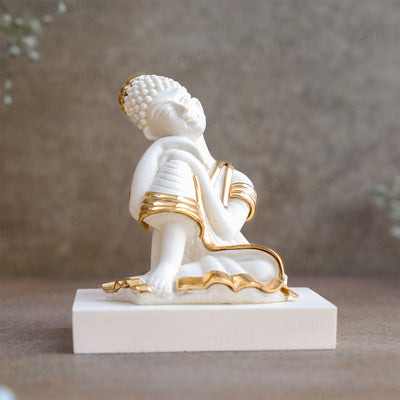
Marble-dust and resin figures collect dust in exactly those curls, so a soft dry brush is your friend; the method in how to clean a marble idol works for most cast pieces. If you are choosing between forms, our Buddha idols range covers seated, reclining and wall pieces, the premium edits line holds the finer gold-detailed work, and wall decor carries the same iconography at scale.
How this was checked
Both canonical lists of the thirty-two marks were read in full, item by item, in the Sutta Friends translations of DN 30 and DN 14, plus the Brahmayu Sutta as an independent description of the Buddha's person. No snail, shell, or head-covering creature appears in any of them. Where translators disagree, as on the ushnisha, both readings are given above rather than the tidier one. And nothing here dates the sculptural development of the ushnisha to a century, because that is an art-historical question deserving an art-historical source, not a guess.
Also read: What Did Buddha Preach to the People | How Buddha Taught Kisa Gotami | The Meaning of Zen Meditation | Why We Celebrate Buddha Purnima | The 10 Avatars of Vishnu
Cover photo: Heads of the Buddha, Thailand, late 18th to 19th century, The Metropolitan Museum of Art, CC0, via Wikimedia Commons.