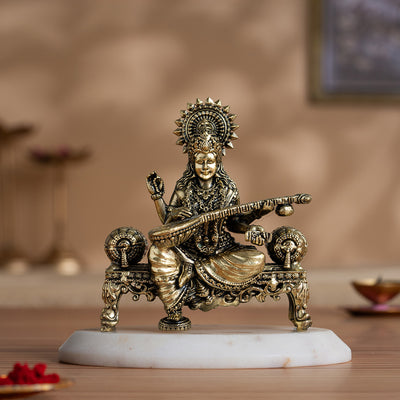
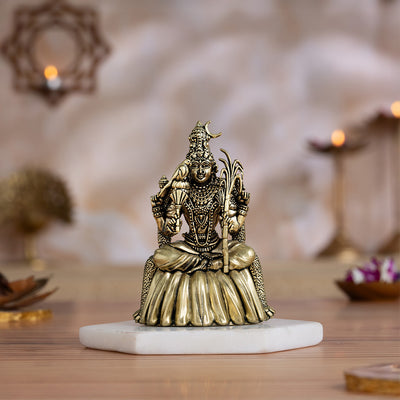
Ask ten people how many hands Durga has and ten of them will say ten. Ask why, and you get a story so tidy it sounds true: each god gave her one weapon, so she needed one hand each, so ten gods, ten hands.
Then you open the text everyone is quoting, and the tidy story falls apart in about two pages.
The short answer: the number moves
The Devi Mahatmya is the single most important source for the goddess who kills Mahishasura. It is a seven-hundred-verse hymn sitting inside the Markandeya Purana as Cantos 81 to 93, also known as the Durga Saptashati or Chandi Path. It is where the story lives. And it does not give her ten arms.
In the second chapter, as she rides into the demon armies, the text describes her "standing there pervading all the quarters around with her thousand arms."1 Not ten. A thousand, which in Sanskrit poetry is a way of saying countless.
Elsewhere in the same book, three separate meditation verses describe three aspects of the Devi with three different hand counts: ten, eighteen and eight. So the honest answer to the title question is that the count changes depending on which text you open, which aspect is being praised, and which part of India carved the image.
That variety is the interesting part. It is not a problem to paper over. It is also why a Durga murti for the home can have eight arms or ten and still be right.
What actually happens: she is assembled, then armed
The gods have lost. Mahishasura, the buffalo demon, has taken Indra's throne and the devas are wandering the earth. So Shiva and Vishnu grow furious, and light pours out of their faces. Light pours out of every other god too. It gathers, pools, and becomes a woman: a mountain of light, blazing in every direction.
Then the gods arm her. Not one weapon each. They hand over their own signature weapons, the ones they are known by, and several of them give more than one thing:
- Shiva gives his trident, drawn from his own
- Vishnu gives a discus, produced from his, the same Sudarshana chakra that later travels with Krishna
- Varuna gives a conch, and a noose
- Agni gives a spear
- Vayu gives a bow, and two quivers full of arrows
- Indra gives his thunderbolt, and a bell taken from his elephant Airavata
- Yama gives a staff
- Brahma gives a rosary, and a water pot
- Surya puts his rays into the pores of her skin
- Kala gives a sword, and a shining shield
- Vishvakarma gives an axe, and armour
- Kubera gives a drinking cup that never empties
- Shesha, the serpent of the deep, gives a necklace of snakes
- Himavat, the mountain, gives her jewels, and a lion to ride
Count the donors. That is roughly fifteen gods. Count the objects. It is well past twenty.2 The "one god, one hand" arithmetic does not survive contact with the passage.
What the passage does say, very clearly, is that she is carrying the combined armoury of the entire pantheon at once. Every god's defining power is in her hands simultaneously. That is the symbolism the text actually supports, and it is a bigger idea than a headcount. It is also why the question who is the most powerful god in Hinduism gets complicated fast once the Devi enters the room.
So where does "ten" come from?
From ritual art, mostly. And from Bengal.
Pratap Chandra Ghosha's Durga Puja, published in Calcutta in 1871, is an eyewitness description of how the Bengali image was actually made and worshipped. It is unusually precise, and it settles the question of where the popular picture comes from.
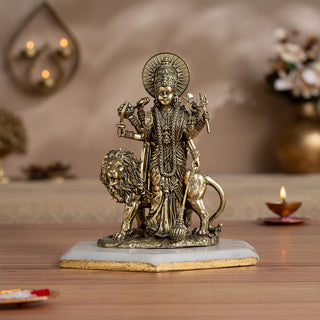
Ghosha describes the pratima as ten-armed. On the right hands: trident, sword, discus, dart and lance. On the left: shield, bent bow, noose, goad, and a bell (some workshops used an axe). Her right foot rests on the lion. Her left foot rests on the buffalo demon, who is shown as a headless trunk with the asura springing out of it, sword still in hand.3
That is the image on every pandal poster, every calendar, every Navratri hoarding. It is a documented ritual convention, several centuries old, and it is genuinely lovely. It is simply not the Devi Mahatmya describing that fight.
Ghosha also notes something worth remembering when you next look at a pandal: the ritual authorities he names for Durga Puja are the Kalika Purana, the Devi Purana and the Vrhannandikesvara Purana, not only the Markandeya. Different texts, different rules, different images.
UNESCO inscribed Durga Puja in Kolkata on its Intangible Cultural Heritage list in 2021, and records the other half of the logic. The images are sculpted from unfired clay pulled out of the Ganga. The eyes are painted on at Mahalaya to bring the goddess to life. On the tenth day the whole thing goes back into the river it came from.6 The ten-armed form is meant to be made, worshipped and dissolved. If you want the same festival at home in a form that stays, that is exactly the tension a brass Durga Puja setup is trying to hold.
Ten, eighteen, eight: three aspects, three counts
The Durga Saptashati is divided into three sections, called charitas, and each one has a dhyana (a meditation verse) printed before it, telling the reciter what to picture. Each dhyana describes a different aspect of the Devi. And each gives a different number of hands.
- Mahakali, of the first charita, where the demons Madhu and Kaitabha are killed: ten faces, ten legs and ten arms.
- Mahalakshmi, of the middle charita: eighteen hands, with all eighteen objects listed out.
- Mahasaraswati, of the third charita, who faces Shumbha and Nishumbha: eight hands.
Now read that again with the stories attached. The middle charita is the Mahishasura episode. So the goddess the text itself asks you to visualise while reciting the buffalo-demon fight (the one explicitly called the destroyer of Mahishasura) is eighteen-handed, not ten. The ten-count in this book belongs to Mahakali and a completely different demon.1
One honest caveat, because it matters. The Sri Ramakrishna Math edition's own publisher's note says the dhyana verses, along with the Kavacha, Argala and Kilaka, were added at the beginning of the Saptashati. They are liturgical tradition layered onto the Purana rather than the Purana's narrative voice. So even the eighteen is a devotional instruction, not the story's own description. The narrative itself keeps saying thousand.
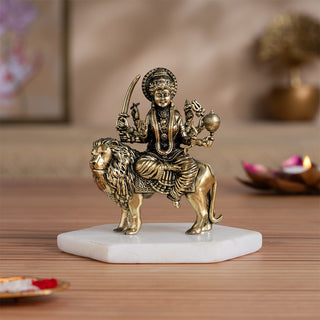
The eight-handed count is not obscure either: plenty of South Indian and brass-workshop images follow it, which is why an eight-armed Durga seated on her lion is every bit as traditional as a ten-armed one, and not a shortcut by the sculptor.
Five things people get wrong about Durga's arms
1. "Ten gods, one weapon each, ten arms." Both halves are wrong. Roughly fifteen donors give well over ten objects. Vayu alone gives a bow and two quivers; Brahma gives a rosary and a water pot; Vishvakarma gives an axe and armour.
2. "The ten hands stand for the ten directions." No text I could reach says this. The Devi Mahatmya attaches no symbolic scheme to a number of arms at all: it names donors and weapons and moves on. The directions gloss is a modern devotional reading. It is a nice one. It is not scripture, and it should not be sold as scripture.
3. "She killed Mahishasura with the trident." She did not. In the third chapter she leaps onto him, pins his neck under her foot, and strikes him with her spear. He begins to emerge in his true form from the buffalo's mouth, half out, and she takes his head off with her great sword.2 The trident is in her hands. It is not the killing weapon in this account.
4. "Durga rides a tiger." The Devi Mahatmya is explicit: Himavat the mountain gives her a lion. Ghosha's 1871 Bengali image has her right foot on a lion too. The tiger belongs to later regional forms, especially the Sherawali imagery of the north-west, which is why you will see both in shops, and why neither is a mistake, but only one is in this text.
5. "Durga has always been the one who kills Mahisha." Not across the board. John Dowson's Classical Dictionary records that in the Mahabharata, the asura Mahisha is killed by Skanda (Kartikeya) with Durga's version noted as the other, Puranic tradition.4 The texts disagree, and the Devi Mahatmya is where the Durga version becomes definitive.
Then what do all those hands actually mean?
Read the arming scene as a single gesture and it makes sense immediately.
The gods could not beat Mahishasura individually. Their power only worked when it was pooled into one body and one will. The arms are how a sculptor shows "all of it, at once": creation and destruction, war and stillness, a sword in one hand and a rosary in another, held without contradiction.
That is also why the number was never standardised. Two arms, eight, ten, eighteen, a thousand: each is a way of saying the same thing at a different volume. A pandal artist choosing ten and a brass caster in the south choosing eight are not disagreeing about a fact. They are both describing limitlessness in a medium that has to stop somewhere.
Worth adding: the great annual worship of the goddess is anchored to autumn in the Devi Mahatmya's own closing section, which speaks of "the great annual worship that is performed in autumn time." The spring nine nights are prescribed separately: the Devi Bhagavata Purana actually names four Navratris across the year and singles out the autumn and spring pair as the two to keep, which is the real reason Chaitra Navratri exists alongside Sharad Navratri.5
How to read a Durga idol at home
Once you know the counts, choosing an image gets easier rather than harder.
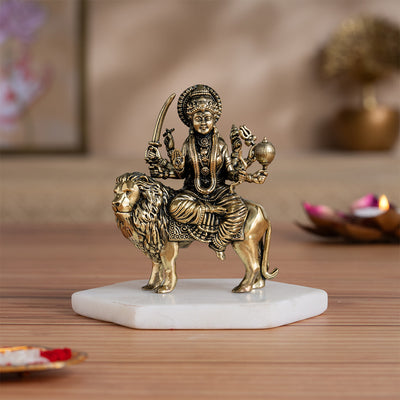
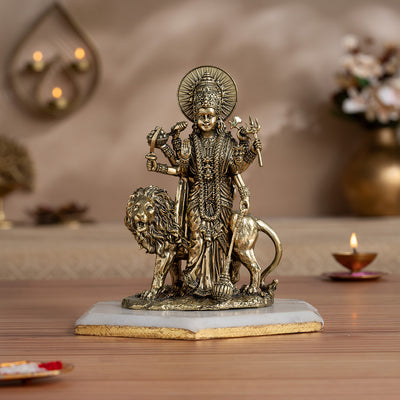
Look at the vahana first. A lion puts the piece squarely in the Devi Mahatmya's own description; a tiger points to the Sherawali tradition. Then look at the feet: a demon underfoot means the piece is specifically Mahishasuramardini, the buffalo-slayer, not a general Durga form. Then count the arms, and know that eight, ten and eighteen are all defensible.
If you are setting up for the nine nights, the two things the sources actually prescribe are simpler than the shopping lists suggest: an installed pot, and lamps. That is worth remembering whether you are planning a home temple setup, a low-budget one, or something for a shared office space. A single lit diya in front of a well-chosen murti does more than a crowded shelf.
For material, brass behaves differently from clay by design. It is meant to stay, be polished and be handed down. That is the opposite of the immersion logic, and it is a perfectly old household practice. Marble and marble-dust pieces need a gentler routine; there is a separate method for cleaning marble idols that is worth following before Navratri rather than after.
And if you are giving one away, the tradition of giving during these nine nights is real and textual. It just points somewhere specific: at the girls honoured in kanya pujan. That is covered properly in our piece on Navratri return gifts and across the Navratri gifting range, or the Bengal side of the same nine nights in Durga Puja gift ideas.
The number of hands was never the point. The texts were never trying to agree on it. What they agree on is stranger and better: that when the gods ran out of options, what they built was a woman carrying everything they had.
Also read: The 5 Daughters of Lord Shiva | Parvati's 108 Lives | Who Can Defeat Lord Shiva | Best Gift for Dasara | Things to Keep in Your Pooja Room