Ask this question on the internet and you get the same answer everywhere: nobody. No one has ever defeated Mahadev. Then follows a list of the fights he won.
The problem is that the Puranas do not agree with that answer. One of the most widely read texts in the Vaishnava tradition says plainly that Krishna beat him, and gives the name of the weapon. Another text, equally old and equally revered, says Shiva knocked down Vishnu's fiercest avatar and wore his hide afterwards.
So the honest answer to "who can defeat Lord Shiva" is not a name. It is a fact about how these books were written. Let's go through what each one actually says.
The strongest "yes": Krishna, at Banasura's city
The Bhagavata Purana, Canto 10, Chapter 63, is where this gets settled for Vaishnavas. Banasura is a demon king and a devotee of Shiva. Krishna's grandson Aniruddha has been captured in his city, and Krishna comes to get him back. Shiva fights on Bana's side, because he had promised to.
The text does not soften what happens next. Krishna uses the jrimbhana-astra, the yawning weapon, and Shiva is made to yawn and is bewildered by it (10.63.14). With Shiva out of the fight, Krishna turns to Bana's army.
Then comes the stranger part. Shiva releases his Jvara, his fever weapon, described as having three heads and three feet. Narayana answers with his own fever, a cold one. Shiva's burning fever is caught between the two, tormented, and finally goes and takes shelter with Krishna himself (10.63.22 to 29).1 Shiva's own weapon changes sides.
That is about as direct a defeat as Sanskrit narrative ever gives you, and it is not hidden in a footnote. It sits in the Krishna chapters people actually read. If you have read our piece on the ten avatars of Vishnu, this is the same theological engine at work: whichever form of Vishnu is on stage is the one who cannot be beaten.
Now read the Shiva Purana and the whole thing inverts
Open the Shiva Purana's Shatarudra-samhita, chapter 12, and you get the answer from the other side.
After Narasimha kills Hiranyakashipu, his rage does not stop. So Shiva takes the form of Sharabha: thousand-armed, winged, beaked, part bird and part beast. Sharabha binds the man-lion's legs with his tail and brings him down (12.13 to 16). Virabhadra then peels off Narasimha's hide, and Shiva wears it afterwards (12.35 to 36).3
Same book, chapter 23, and Shiva appears as a bull. He kills Vishnu's sons and then lectures Vishnu himself (23.3 to 6, 23.19 to 20).4
Notice the shape. It is not a different kind of story. It is the same story with the winner swapped. Krishna defeats Shiva in a Vaishnava text; Shiva defeats Vishnu's avatar in a Shaiva text, and both use the detail of taking something from the loser's body. This is one argument, told twice, from two sides.
Ravana: the clearest "no" in any scripture
If you want the passage where Shiva is genuinely untouchable, it is not a battle at all. It is in Valmiki's Ramayana, Uttara-kanda 16.
Ravana lands near Kailasa. Nandi stops him and Ravana mocks him, and Nandi curses him that monkeys will one day destroy his line. Ravana's answer is to get under the mountain and try to lift it. He does move it, enough that Parvati is frightened.
Shiva does not stand up. He does not pick up a weapon. He presses the mountain down with his great toe, and Ravana's arms are crushed under it. Ravana screams so loudly that the three worlds shake, and that scream is where his name comes from. Shiva names him Ravana, the one who makes the worlds cry out, and then gives him the sword Chandrahasa.
One toe. That is the point of the scene. The strongest king in the world, who would later carry off Sita, could not shift a mountain that Shiva was sitting on without noticing. If you want the wider family story here, we cover Ravana's brothers separately, and the war that followed in how Rama's life ended.
Arjuna fought him, and lost, and won
People often list Arjuna as someone who "fought Shiva to a draw." That is a misreading of the Kirata episode.
Arjuna is doing penance in the forest for a divine weapon. A boar charges. Arjuna shoots it and so does a hunter, a Kirata, and they argue about whose kill it is. The fight that follows is real and Arjuna does not win it. But the whole thing was a test. The hunter is Shiva, and at the end he is pleased with Arjuna and gives him the Pashupata, the weapon he came for. The Shiva Purana gives this episode several chapters of its own.
Being fought well is not being beaten. In these texts a good fight against Shiva is usually a form of worship, and it usually ends with a gift rather than a corpse. That pattern shows up again in the question of who can defeat Hanuman, where the answer turns out to be almost the same.
Three things people get wrong about this question
1. "No text ever shows Shiva losing"
It does, and we quoted it above. Bhagavata Purana 10.63.14 has Krishna bewildering him with the yawning weapon, and 10.63.22 to 29 has his own fever weapon surrendering to Krishna. You can argue about how to interpret it, and Shaiva commentators do. What you cannot say is that no such passage exists.
2. "Ravana composed the Shiva Tandava Stotra under the mountain, and that's why Shiva forgave him"
Valmiki's Uttara-kanda 16 has no hymn in it. It has the curse, the lifting, the toe, the crushed arms, the scream, the naming and the sword. That is the whole scene.8
The Shiva Tandava Stotra is attributed to Ravana by later devotional tradition, not by the Ramayana. That tradition is genuinely beautiful, because of what it does with the scene: it takes the loudest scream of pain in the epic and hears a hymn inside it. Worth loving. Just not worth citing as Valmiki. Ravana's devotion also comes up in our piece on Shiva's biggest devotee, and it is more complicated there than most retellings admit.
3. "Shiva has 19 avatars, so there's a fixed list of forms he fights in"
The Shiva Purana has a chapter literally titled "The nineteen incarnations of Siva" (Shatarudra-samhita 5). It lists Tridhama, Kali, Bali, Gautama, Vedashiras, Gokarna, Shikhandin, Sveta, Somasharman and others. None of the famous names are in it.5 The popular list of nineteen was assembled later from the chapter headings that follow, and the same book separately gives five forms, eight forms, a different set of ten and twelve jyotirlingas. We go through all of that in how many avatars Shiva actually has.
This matters for the battle question because Sharabha and Virabhadra get called "avatars" in these arguments as if they were fixed characters. In the text they are situations. Shiva takes a form when a situation needs one.
The enemy Shiva made himself: Jalandhara
Jalandhara is the one opponent Shiva made out of his own anger, which makes the fight uncomfortable to read.
Jalandhara is born from the brilliance of the eye in Shiva's forehead, thrown off into the salt ocean, where it becomes a boy crying at the meeting point of the Ganga and the sea. The Ocean takes him home and raises him. Brahma, not Shiva, gives him his name, saying that since the child made his eyes water he should be famous as Jalandhara (Yuddha-khanda 14.24).7
He grows up unbeatable, and the reason is his wife Vrinda, daughter of the asura Kalanemi. Her faithfulness is his armour. So the gods do not win the war by force. Vishnu takes Jalandhara's form and deceives her, the armour breaks, and only then can Shiva kill him. He does it with a discus he shapes out of the ocean water with his own toe (Yuddha-khanda 24.45 to 47).6
The text lets Vrinda say the uncomfortable part out loud. She asks how a devotee could be killed for another man's sake, without any offence, and she curses Vishnu to become a stone. When Jalandhara dies, his splendour goes back into Shiva, because it was Shiva's to begin with (24.52). We wrote about him at length in the story of Jalandhara, including why calling him Shiva's son is a translation shortcut.
So why do the texts disagree?
Because they were not written to be read side by side.
The Puranas grew inside communities. A Shaiva community in one region compiled the stories that made sense of its own worship. A Vaishnava community did the same. Each one needed its deity to be the ground of everything, not one god among many, and the simplest narrative way to say "this one is supreme" is to show him winning against the other one.
That is why these victories always come in pairs. Krishna beats Shiva; Sharabha beats Narasimha. Shiva as the bull kills Vishnu's sons; Vishnu's fever beats Shiva's fever. If you read only one book you will think the question is settled. Read two and you can see the argument.
The texts themselves sometimes signal that they know this. The Bhagavata Purana, in its final canto, says that among all Vaishnavas, Shiva is what the Ganges is among rivers (12.13.16).2 That is not the sentence of a book that thinks Shiva is a rival. It is a book that thinks he is the model devotee. That single verse turns the whole "who is stronger" question sideways, and it is the reason our article on the most powerful god in Hinduism refuses to give a clean ranking either.
What "unbeatable" actually means in these books
In almost every Shiva story, the moment of victory is a moment of not moving.
He presses a mountain with a toe. He shapes a discus with a toe. He sits in meditation while Kama shoots him, and burns him without standing up. The Kirata fight ends with a gift. Even the fever weapon at Banasura's city is something he releases rather than something he swings.
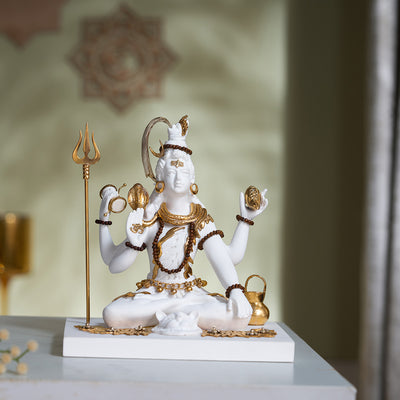
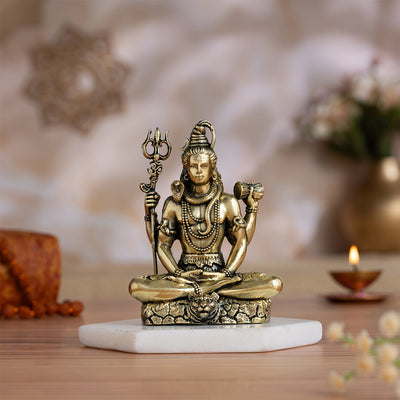
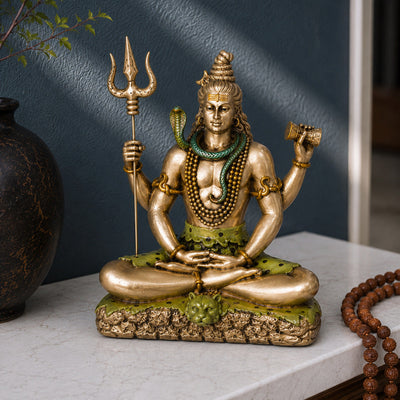
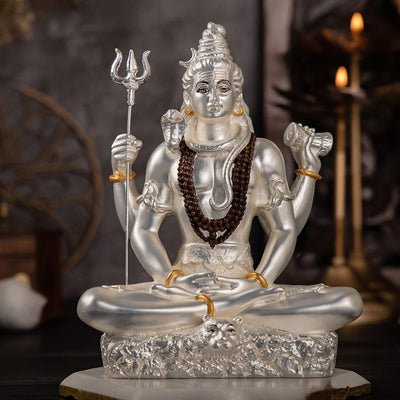
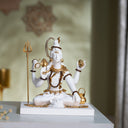
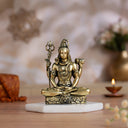
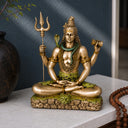
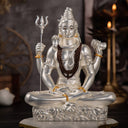
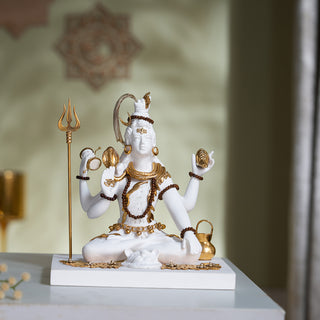
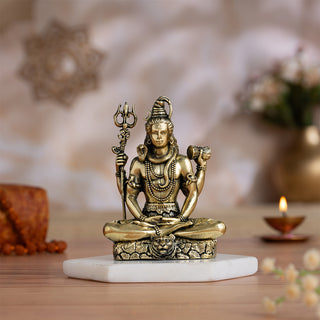
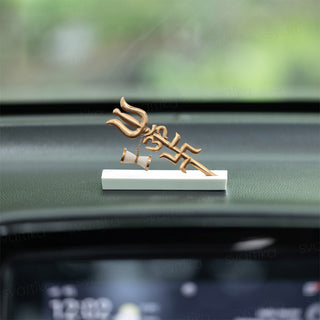
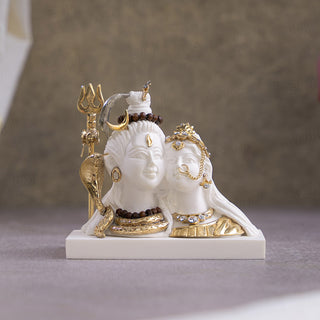
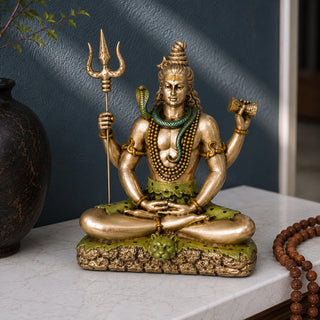
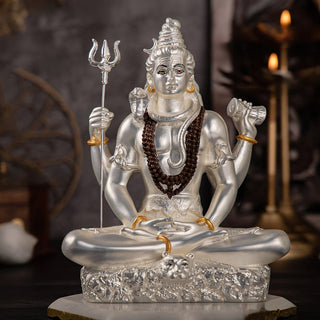
The iconography follows this exactly. The most common way Shiva is shown in Indian homes is not mid-battle. He is seated, eyes lowered, trident resting beside him rather than raised. A meditating Mahadev murti is the visual form of the same idea the Puranas keep circling: the power in this figure is not the power to win fights. It is the stillness that makes fights beside the point. That is also why the Shiva idols people keep at home are almost always in dhyana, and rarely in a fighting pose.
Which is the real answer to the title. Every text in this corpus that shows Shiva losing is a text with something to prove. Every text that shows him unbeatable is doing the same job for the other side. The one thing they all agree on, across the argument, is what he is like when he is not fighting at all.
A short honest summary
- Krishna, in the Bhagavata Purana: the strongest scriptural yes. Bewilders Shiva with the yawning weapon and beats his fever weapon (10.63.14, 22 to 29).
- Narasimha, in the Shiva Purana: the strongest scriptural no. Sharabha binds and fells him and Shiva wears his skin (Shatarudra-samhita 12).
- Ravana: never came close. Shiva pressed Kailasa down with one toe (Ramayana, Uttara-kanda 16).
- Arjuna: fought him as the Kirata, lost, and was rewarded with the Pashupata. Not a defeat of Shiva and not really a defeat of Arjuna.
- Jalandhara: born of Shiva's own discarded brilliance, killed by Shiva, and absorbed back into him.
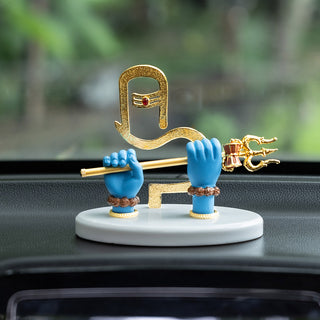
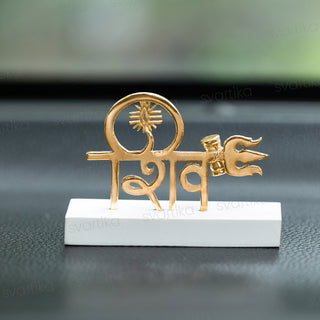
If you are reading these stories at home rather than for an exam, the practical questions matter more than the scorecard. We have written about what Maha Shivratri actually asks of you, which is far less restrictive than the internet claims, and whether you can keep a Shiva statue at home, where the Shiva Purana turns out to be unusually generous. For the family around him, there is the question of Shiva's parents, the five daughters people keep listing, and the bond between Ganpati and Gauri. Around Mahashivratri, our Mahashivratri collection and the hand-finished brass idols are where most of these forms live.
Also read: How Many Avatars of Shiva Are There | Jalandhara: The Demon Born of Shiva's Eye | Who Is the Biggest Devotee of Lord Shiva | Who Gave the Sudarshan Chakra to Krishna | The 7 Chiranjeevis of India