Search for Ravana's brothers and you get a tidy list of six names, the same six repeated across a dozen sites. It is a satisfying number. It is also not what the text says.
Nobody added them maliciously. They got added the way family stories get crowded: a cousin who fought like a brother, a villain from a beloved regional telling, a sister quietly counted as a sibling. Stacked up, they produce a number the Ramayana never gives.
How many brothers did Ravana actually have?
Three. Kumbhakarna and Vibhishana share both his parents. Kubera, the eldest, is a half-brother.
The genealogy sits in the Uttara Kanda, the seventh and final book of the Ramayana. Ravana's father is the sage Vishrava, son of the Brahmarishi Pulastya, who is himself one of the mind-born sons of Brahma. Ravana is not a demon in the sense of a separate species born opposed to the gods. He is a brahmin's grandson. His learning, his mastery of the Vedas, his capacity for austerity: all of it runs in the family line, on his father's side.
Vishrava had two wives. By the daughter of the sage Trinabindu he had Vaishravana, better known as Kubera. By Kaikasi, daughter of the rakshasa Sumali, he had four children. The Uttara Kanda names them in order, and the wording is worth reading as it stands: after Ravana, "the mighty Kumbhakarna was born... and a daughter of hideous aspect, named Shurpanakha, while Kaikasi's last child was named Bibishana."1
So the household is: Kubera (half-brother, elder), then Ravana, Kumbhakarna, Surpanakha and Vibhishana. Two mothers, five children, one father.
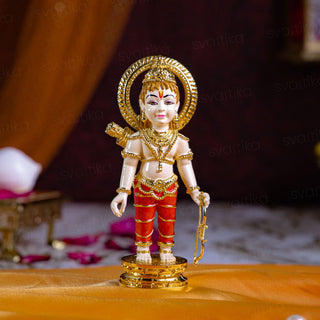
Kubera: the half-brother Ravana robbed

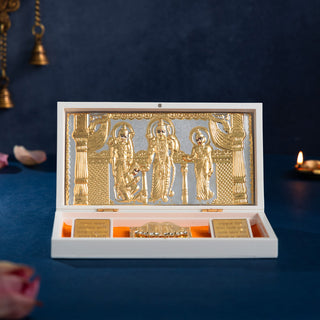
Kubera is the elder son. He is also the god of wealth, the keeper of the treasures of the earth, and (this is the part that matters) the original lord of Lanka. The golden city was his. So was the Pushpaka Vimana, the flying chariot that goes wherever its owner wishes.
The six-name lists skip him entirely, which is odd. He is the most interesting one.
Ravana took both from him. Not in a battle between good and evil, but in a family dispute over inheritance and standing. The younger brother, having earned terrifying boons through penance, drove out the elder and moved into his house.
Everything that follows in the Ramayana happens in a stolen city, using a stolen vehicle. Sita is carried away in Kubera's chariot. When people describe Ravana as a great king, it is worth remembering that his capital was not built by him.
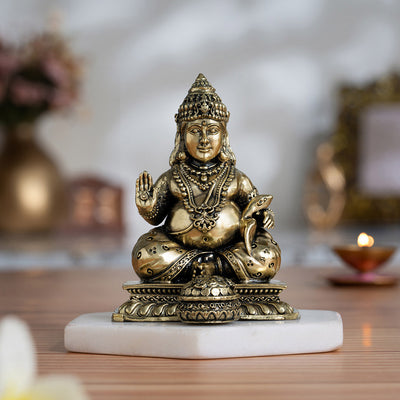
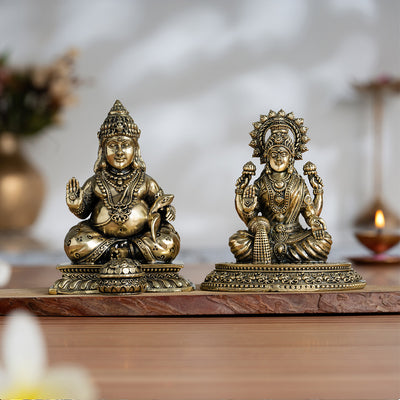
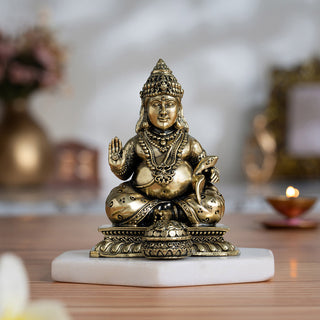
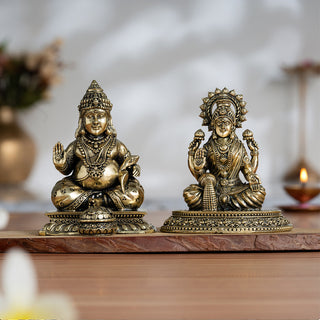
Kubera did not disappear. He is still worshipped, still invoked at Dhanteras and Diwali, still the deity people turn to for stability rather than sudden luck. A quiet brass Kubera with his mongoose is a lovely thing to keep once you know the god sitting there was thrown out of his own palace by his brother, and outlasted him anyway. If you want the wider set, the Kubera idols and Lakshmi murtis are usually placed together for that reason.
Kumbhakarna: the brother who knew Ravana was wrong

Kumbhakarna is woken because Lanka is losing. When he hears what happened, he tells his brother plainly that abducting another man's wife was wrong and that this is the consequence arriving. He does not defend the act, or pretend Rama is the aggressor.
Everyone knows the sleeping instead. Six months unconscious, one day awake, an appetite that empties villages. It is the detail children remember, and it buries the conversation before the war.
Then he puts on his armour and goes out to die for him anyway.
That is not the behaviour of a monster. It is the behaviour of a man who has decided that loyalty to his brother outweighs his own judgement, which is a recognisable, uncomfortable, entirely human choice.
One caution here. Kumbhakarna's famous curse belongs to this same Uttara Kanda material. The boon he asked Brahma for came out wrong: he asked for indra-asana and received nidra-asana, a seat of sleep instead of a seat of power. Many scholars treat the Uttara Kanda as a later addition.5 The widely used online Valmiki edition at valmikiramayan.net carries only six books and leaves it out. That does not make the stories worthless. It does mean the rakshasa genealogy and the sleeping-boon both sit in the most disputed book of the Ramayana.
Vibhishana: the brother who left

Kaikasi's last child is the one who breaks the family.
Vibhishana tells Ravana to return Sita. He says it in open court, more than once, and he is insulted and thrown out for it. He walks across to Rama's camp and asks for refuge, and Rama accepts him, over the objections of advisors who point out, reasonably, that this is the enemy king's brother.
He is crowned king of Lanka after the war. In many traditions he is counted among the seven chiranjeevis, the immortals still living out their long assignments, which is company shared with Hanuman and Parashurama.
Whether Vibhishana is a hero or a traitor is a real argument, not a settled one. Tamil tradition has been chewing on it for centuries. He abandoned his blood for a principle, and the epic rewards him for it, but the reward is ruling the ruins of his own family's city.
Surpanakha is the sister, not a brother

Surpanakha is Ravana's sister. She turns up in six-brother lists surprisingly often, which is a small injustice on top of a large one.
She is the one who approaches Rama and Lakshmana in the forest, is refused, and is mutilated for it. Her humiliation brings her cousins' armies down on Panchavati, and eventually brings Ravana to the Godavari. The war begins with what happens to her.
Whatever you make of her conduct, she is the hinge of the plot, and she is not a brother. Our piece on the real father of Sita covers what Valmiki says about her origins, and it is not what most people have been told either.
Where the extra brothers come from
Three things people get wrong, and why each mistake is understandable.
1. "Khara and Dushana were Ravana's brothers"
Valmiki settles this once, and settles it precisely. In the Uttara Kanda, Ravana is consoling the newly widowed Surpanakha and sending her to live with Khara in the Dandaka forest. He describes Khara to her as matrsvasuh putro bhrata tava kharah: "Khara, your brother, the son of your mother's sister" (7.24.30). That compound is not vague. It is not the mother's brother, it is the mother's sister. Khara is a cousin on the maternal side. Hari Prasad Shastri's translation gives it as "that son of the sister of thy mother, thy cousin Khara." Manmatha Nath Dutt's keeps both words in the same breath: "thy rich brother Khara... He is thy cousin", because the Sanskrit does exactly that. The critical edition carries that line at 7.24.30 exactly as quoted; the vulgate numbers it 7.24.37 and uses another word for the same relationship, matrsvaseya, mother's-sister's-son. Two editions, one meaning.3
But that thread is thin. Everywhere else the epic just calls him a brother and moves on. Surpanakha lists Khara alongside Ravana and Vibhishana when she names her family to Rama.6 She is called Khara's sister. Jatayu, fighting Ravana in mid-air, taunts him that he will fall "just as your brother Khara" did.7 That is ordinary Indian usage, where a cousin is a brother and nobody stops to specify. So: Valmiki is exact about Khara once, and casual about him the rest of the time.
The standard reference books disagree with us. John Dowson's 1879 Classical Dictionary of Hindu Mythology (the most-quoted English handbook on this) states flatly: "Khara. A man-eating Rakshasa, the younger brother of Ravana." He is not being sloppy. He is following a different genealogy, and his dictionary says which one. Dowson's entry for Vishrava explains that in the Mahabharata's account, Kubera gives Vishrava three rakshasi handmaids, and one of them is "Raka, the mother of Khara and Surpa-nakha." Make Raka a wife of Vishrava, and Khara becomes Ravana's half-brother on the father's side.
In Valmiki, though, Raka is not married to Vishrava at all. She is listed in the Uttara Kanda's own genealogy (7.5.36) as a daughter of Sumali, alongside Puspotkata and Kaikasi, which makes her Kaikasi's sister and Ravana's maternal aunt. One woman, two family trees, and Khara slides a generation depending on which you read. Valmiki's list of Kaikasi's children has no room for him either: Ravana, Kumbhakarna, Surpanakha, Vibhishana, and that is all.
So we follow Valmiki and call Khara a cousin. Anyone who calls him a brother is following the Puranic line, and is not simply wrong: they are reading a different book.
Dushana is paired with Khara as a commander in the same campaign. I could not find a passage that states his parentage, so I am not going to invent one. What can be said is that the text gives him a rank, not a place in Kaikasi's household.
2. "Ahiravana was Ravana's brother"
Ahiravana, or Mahiravana, is the ruler of the underworld who drags Rama and Lakshmana below the earth by magic, and is defeated by Hanuman in his five-faced form. It is one of the best episodes in the tradition, and also where Makardhwaja, Hanuman's own son, appears as the guard of that underworld gate.
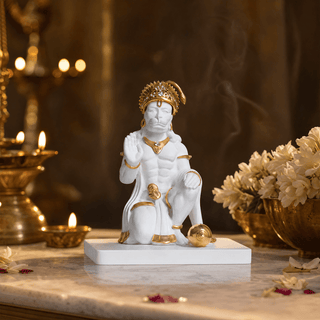
It is also not in Valmiki. A full-text search of the Uttara Kanda returns nothing for the name. He belongs to later regional retellings, most famously the Bengali Krittivasi Ramayan. The error is not enjoying the story: it is filing it under Valmiki. The Panchmukhi form most homes keep comes from that episode, worth knowing before you decide which Hanuman idol belongs in your home.
3. "Six is a fixed, agreed number"
It is not agreed anywhere. Different lists reach six by different routes: some count Khara and Dushana, some add Ahiravana, some add Surpanakha, some add Kubera's sons or Ravana's own sons by mistake. When five websites give you six brothers and no two lists match, that is the tell.
Valmiki's count is stable: two full brothers, one half-brother, one sister.
Heroes, villains, or something more?
Ravana is a Vedic scholar, a formidable musician, and one of the most single-minded devotees of Shiva in all of Hindu literature. The Shiva Tandava Stotram is attributed to him, and the story of him lifting Mount Kailash (and being pinned under it until he sang his way free) is one reason he is remembered as much for his devotion as for his arrogance. On the question of who counts as Shiva's greatest devotee, his name comes up seriously, as it does in the older argument about who could ever defeat Shiva at all.
Go outside Valmiki and it goes further. In the Jain Ramayana tradition, the Paumacariya, Ravana is not a demon at all. He is counted among the sixty-three salakapurusas, the illustrious figures of the age, a learned man whose powers were earned through austerity rather than granted to a monster. The scholar A.K. Ramanujan wrote about this in his essay "Three Hundred Ramayanas": the epic has always existed in many versions, and the versions disagree about who the villain is.
So "something more" is not a hedge. Ravana is a man with a brahmin grandfather, a stolen city, a brother who told him the truth and died for him anyway, a brother who told him the truth and left, and a sister whose pain he answered with a war that destroyed everyone he had. That is a tragedy with a family at the centre of it.
Why it matters that Dussehra burns three effigies
Look at the effigies that go up every Dussehra and there are usually three: Ravana in the middle, Kumbhakarna and Meghanada (Indrajit, Ravana's son) on either side. Not six brothers. Not Khara. The ritual has always known the shape of that household better than the internet does, worth remembering when you pick a Dussehra gift.
And the lamps, on the other end of the same story. Most of us were told Ayodhya lit rows of diyas to welcome Rama home. Valmiki spends two full chapters on the preparations (levelled roads, ground sprinkled with cold water, parched grain and flowers strewn, streets lined with flags) and nobody lights a lamp for Rama.910 We wrote a whole piece on where the diya tradition actually comes from.
That is the same lesson as the six brothers. The traditions we inherit are real and worth keeping. They are just not always where we think they came from.
The short version
- Kubera: half-brother, elder, god of wealth, original king of Lanka, robbed of both.
- Kumbhakarna: full brother, sleeps six months at a stretch, tells Ravana he is wrong and fights for him anyway.
- Vibhishana: full brother, defects to Rama, crowned king of Lanka, counted among the immortals.
- Surpanakha: sister, not a brother, and the reason the war starts at all.
- Khara: maternal cousin in Valmiki, commander at Janasthana; a half-brother in the Mahabharata's genealogy, which is why older reference books call him a brother.
- Ahiravana: a later regional character, absent from Valmiki entirely.
The pieces on Rama's own three brothers and how Rama's life ended take the same approach: what the verse says first, what tradition added second. The Ram idols and the Ram avatar of Vishnu cover the other half, and Ram Navami marks the birth Valmiki dates precisely to the ninth of Chaitra: a precision he never offers for the homecoming.8
Also read: Lord Rama's Brothers | The Real Father of Sita | How Did Ram Die | Is Hanuman Still Alive | Diwali Diya Decoration and the Ramayana