Search for the ten sons of Brahma and you will get the same ten names, copied from page to page, as if someone once took an official register down from a shelf.
Open the actual texts and that tidiness falls apart in about five minutes. Four major scriptures give four different counts. One is a list almost everybody misattributes. And the ten were not even Brahma's first attempt at children: they were his third, after two that went nowhere.
The ten sons of Brahma, and where each one was born from
The Bhagavata Purana gives the version people usually quote. In Canto 3, Chapter 12, the sage Maitreya lists them for Vidura and adds a detail almost no modern retelling includes: each son emerged from a different part of Brahma's body.
- Marichi: from the mind
- Atri: from the eyes
- Angiras: from the mouth
- Pulastya: from the ears
- Pulaha: from the navel
- Kratu: from the hand
- Bhrigu: from the skin
- Vasishtha: from the breath
- Daksha: from the thumb
- Narada: from the lap
The verse ends with the phrase that fixed the count ever since: Narada as the tenth (Bhagavata Purana 3.12.22–24).1
They are called manasaputras, mind-born sons. No mother, no womb, no childhood. Brahma thinks, and a fully-formed sage stands there. They are also called Prajapatis, lords of created beings, because populating the world is their job description. Brahma made them so creation could carry on without him thinking every creature into place.
The body-part detail is worth sitting with. Speech from the mouth, sight from the eyes, hearing from the ears, touch from the skin. It reads less like a family tree than a diagram of a mind sorting itself into faculties. The universe here is not built from outside. It is unpacked from inside a thinking being.
Brahma tried twice before this, and both times it failed
Both the Vishnu Purana and the Bhagavata record two earlier attempts that went nowhere.
Before the Prajapatis, Brahma created the Kumaras: Sanaka, Sananda, Sanatana and Sanat-kumara. Four boys, brilliant beyond measure, and completely uninterested in what he wanted them for. The Vishnu Purana calls them free of desire and passion, detached from the world, and unwilling to father anyone (Book I, Chapter VII).3 They chose lifelong celibacy. Creation stalled at generation one.
Brahma got angry. Genuinely, visibly angry, and out of that frustration came his next creation. The Vishnu Purana says Rudra sprang from his frowning forehead, half male and half female, then split into eleven.4 The Bhagavata has him born from between Brahma's eyebrows, in a colour mixed of red and blue, the shades of passion and ignorance (3.12.7). If you have ever wondered who Lord Shiva's father and mother are, this birth from Brahma's anger is one answer the texts give, and it sits uneasily beside the others. The eleven Rudras are part of why the tradition counts so many forms of Shiva.
Only after these two dead ends does Brahma produce the ten Prajapatis. So the famous list is not the beginning of creation. It is the third draft. His first children refused the job, and his second came out of losing his temper. For a god usually summed up in two words as "the creator", that is a surprisingly human portrait.
Six, nine, or ten? Why the count keeps changing
The Mahabharata says six. The Adi Parva is blunt about it:
ब्रह्मणो मानसाः पुत्रा विदिताः षण्महर्षयः।
मरीचिरत्र्यह्गिरसौ पुलस्त्यः पुलहः क्रतुः।।In plain English: Brahma's mind-born sons are known to be six great sages: Marichi, Atri, Angiras, Pulastya, Pulaha and Kratu.
Mahabharata, Adi Parva 66.10 (Ganguli's Section LXV)
No Bhrigu, no Vasishtha, no Daksha, no Narada. And six is not a translator's rounding: shan maharshayah, six great sages, is what the Sanskrit says.6
The Vishnu Purana says nine, and gives them a title as well as a count: "Bhrigu, Pulastya, Pulaha, Kratu, Angiras, Marichi, Daksha, Atri, and Vasishtha: these are the nine Brahmas (or Brahma rishis) celebrated in the Puranas" (Book I, Chapter VII). Narada is not in it.
The Bhagavata says ten: the nine above, plus Narada.
The Manusmriti also says ten, but swaps Daksha out for Prachetas.
Line them up and a stable core appears in all four: Marichi, Atri, Angiras, Pulastya, Pulaha, Kratu. Those six are never in dispute. Everything past them is a text making a choice. That includes whether to count Narada, who never had children and never founded a lineage, which is the very job the other nine were created for.
The Manusmriti catch: that famous list isn't Brahma's
This is the most repeated error on this subject, and it takes three verses to see it.
In Manusmriti 1.32–33, Brahma divides himself and produces Viraj, and Viraj in turn produces Manu. Then, at 1.34, the speaker changes. It is Manu talking:
अहं प्रजाः सिसृक्षुस्तु तपस्तप्त्वा सुदुश्चरम्। पतीन्प्रजानां असृजं महर्षीनादितो दश।।
In plain English: I wanted to bring living beings into the world. So I did very hard penance, and out of it I made ten great sages, the lords of all creatures.
Manusmriti 1.34
The "I" is not a translator's guess: the verse opens aham, and Manu is the one speaking.5
The ten that follow at 1.35 (Marichi, Atri, Angiras, Pulastya, Pulaha, Kratu, Prachetas, Vasishtha, Bhrigu and Narada) are Manu's creation, a full generation below Brahma. Every blog that quotes Manu 1.35 as "Brahma's ten sons" has skipped two verses.
To be fair, it is an easy slip. Manu is himself Brahma's descendant and the names overlap almost entirely with the Puranic set. But they are not the same claim, and a text that spells out a two-step descent deserves to be read the way it was written.
What became of them: where each lineage goes
Most of Hindu mythology's cast descends from these ten.
Marichi fathered Kashyapa, and Kashyapa is the ancestor of nearly everyone. Through his different wives come the devas, the asuras, the nagas, the birds. Narasimha tears open Hiranyakashipu. Vamana measures the worlds and sends Bali below. In both fights, Kashyapa's descendants stand on both sides, so both sides trace back to Marichi.
Pulastya is the grandfather of Ravana. Through his son Vishrava come Ravana, Kumbhakarna and Vibhishana, so Ravana's brothers and the whole Lanka line are Brahma's great-grandchildren. The demon king of the Rama avatar story is a brahmin sage's grandson, which is precisely why the epic keeps calling him learned.
Daksha fathers daughters who reshape the cosmos. Twenty-seven marry Chandra and become the lunar mansions. One is Sati, whose story of return and rebirth runs through Parvati's many lives. Daksha is also the Prajapati whose sacrifice ends in ruin when he insults Shiva: the relationship every listing of Shiva's family has to account for.
Bhrigu founds the Bhargava line, which gives us Shukra, guru of the asuras, and Parashurama: one of the sages named among the seven Chiranjivis. Angiras fathers Brihaspati, teacher of the gods. Atri is linked to Chandra and to Dattatreya. Vasishtha becomes the guru of the Ikshvaku kings and so the family priest of Rama and his brothers.
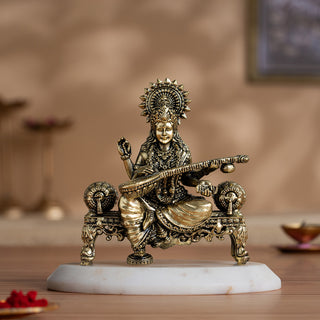
And Narada founds nothing at all. He walks: between worlds, veena in hand, carrying news and arguments and the occasional deliberate provocation. He is the one who instructs Prahlada, which makes him central to the question of Vishnu's first devotee. The instrument he carries is the same one Saraswati holds, and for the same reason: in this tradition, knowledge is not stored, it is played and passed on. Nine sons made families. The tenth made sure the stories moved.
Four things people get wrong about Brahma's sons
1. "There is a canonical list of ten." There isn't. Six, nine, ten and a different ten, from four texts of comparable authority. Presenting one as the list means quietly deleting three others.
2. "Manu 1.35 is Brahma's list." Read the speaker. Manu 1.34 has Manu say "I... called into existence ten great sages". They are his, not Brahma's.
3. "The Prajapatis came first." They came third. The Kumaras refused to reproduce, Brahma's anger at that produced Rudra, and only then did he make the Prajapatis (Vishnu Purana I.7; Bhagavata 3.12.4, 3.12.7).
4. "Brahma is simply one-third of an equal trinity." No major Purana says this. The Bhagavata openly ranks the three (Vishnu with sattva, Brahma with rajas, Shiva with tamas) and tells seekers to prefer the sattva form (1.2.23–26).2 Other texts argue just as hard the other way, which is why the question of who is most powerful has no single scriptural answer. The neat co-equal trinity is a modern teaching summary, not a Puranic position.
Why the disagreement is the most interesting part
It is tempting to read four different counts as sloppiness. It is closer to the opposite.
These names are gotras. Millions of Indian families still identify as Bhargava, Kashyapa, Vasishtha, Atri, Angirasa, reciting the sage they claim descent from at weddings, at thread ceremonies, at every sankalpa before a puja. Which sages sit on the list is not trivia. It is ancestry.
So different communities preserved different versions, and the texts recorded what was preserved instead of flattening it into one. A tradition confident enough to keep four counts in its canon valued the memory more than the neatness.
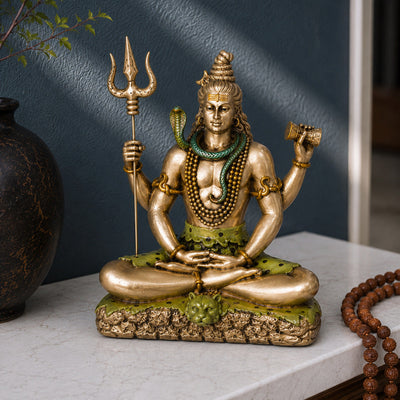
Worth remembering the next time you set up a pooja room and reach for a Vishnu murti or a Shiva idol or one of the fine brass forms these stories describe. What you place there came down through people who kept arguing about the details, in writing, and kept both sides.
Also read: Most Powerful God in Hinduism | The 7 Chiranjeevis | The 6 Brothers of Ravana | The 10 Avatars of Vishnu | Can We Keep a Standing Vishnu Idol at Home