Of all the ten avatars, Kurma is the one people skip.
Matsya has a flood. Narasimha has a pillar bursting open. Vamana has a king with nowhere left to stand. Kurma is a tortoise, and the tortoise does not fight anybody. He goes under the water and stays there. Most retellings hand him a paragraph and move on.
That is a mistake, and here is why. The episode Kurma makes possible (the samudra manthana, the churning of the ocean of milk) is the single most productive event in all of Vaishnava mythology. Goddess Lakshmi comes out of it. So does the moon-white horse Uccaihshrava, and the wish-fulfilling cow Surabhi, and the physician of the gods, and the poison that gave Shiva his blue throat. Three of Vishnu's own incarnations come out of it. None of it happens if the mountain sinks.
So what actually happened?
The setup is a stalemate. The devas have lost their strength and their fortune. The asuras are stronger. Vishnu's advice is not "fight them" but something far stranger: work with them. Churn the ocean of milk together, bring up the amrita, the nectar of immortality, and share it.
The churning stick is Mount Mandara. The rope is Vasuki, king of serpents, coiled around the mountain so both sides can pull. The two armies take opposite ends and haul.
And the mountain sinks. It has no base. There is nothing under an ocean for a mountain to stand on.
That is the moment Kurma appears. The Bhagavata Purana puts it plainly at 8.7.8: seeing the situation, the Lord took the form of a tortoise, entered the water, and lifted the great Mandara Mountain. The next verse gives the scale: the tortoise extended for eight hundred thousand miles, "like a large island".1 A lakh of yojanas. This is not an animal you would recognise as an animal. It is a landmass with a will.
Then comes the line that makes the whole story worth reading. As the gods and the demons rotate the mountain on his back, verse 8.7.10 says the tortoise accepted the rolling as a pleasing sensation, like a scratch.
A mountain is spinning on him. He is enjoying it.
Why a tortoise, of all things?
The other avatars answer a problem with force or with cleverness. Varaha dives and lifts the earth on his tusks. Narasimha answers a boon clause by clause. Vamana asks for three steps and takes the universe.
Kurma answers a problem with patience. The trouble is not an enemy. It is that the work has no foundation. Nobody needs a weapon here. What is needed is something that will hold still, under everything, without complaining, for as long as it takes.
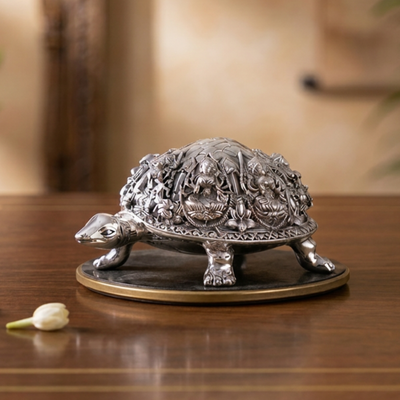
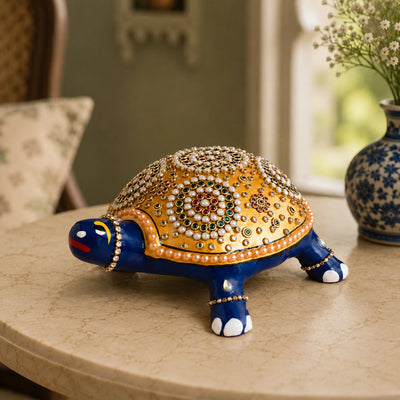
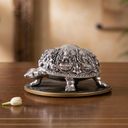
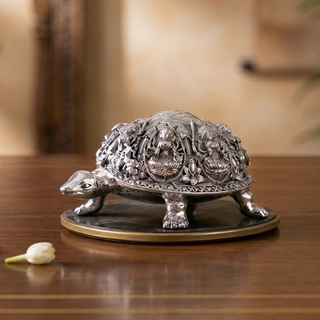
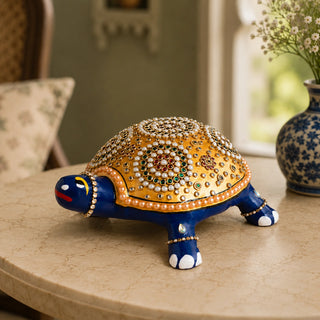
The tortoise is also the animal that can pull everything in and wait. In Indian thought that image gets used again and again for the disciplined mind: the senses drawn in the way a tortoise draws in its limbs. It is a small detail, but it is why the tortoise shows up in so many household shrines and entrances even now, and why an Ashtalakshmi tortoise (the goddess of the eight prosperities seated on a tortoise's back) reads as a compressed version of this exact story.
The rope was a serpent, and the asuras chose the wrong end
One detail from the same chapter that almost never survives the retelling.
When Vasuki was wound around the mountain, the asuras refused to hold the tail. The tail was the inauspicious portion, they said. They were high-born, they had studied, they were not going to be handed the wrong half of a snake. They demanded the head.
The Bhagavata says Vishnu smiled and agreed, and took the tail himself, with the devas following him there.
You can guess how that went. The head end of Vasuki was the end that breathed fire and smoke through the churning. The asuras were scorched by their own status. It is a very old joke, told without any commentary at all, and it is the kind of thing that gets edited out of a children's version.
The poison came before the nectar
Everyone remembers the amrita. Far fewer remember what came up first.
At 8.7.18 a poison called halahala emerges from the churned ocean, and it is worse than anything the two armies were prepared for. It spreads in every direction. The creatures of the water are the first to suffer. The gods, having started this, have no answer for it, and at 8.7.19 they go to Shiva.
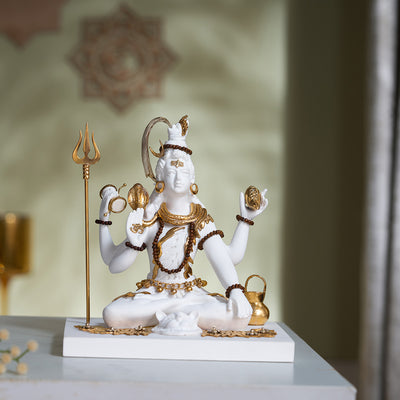
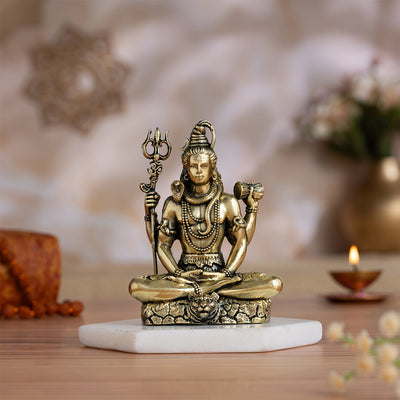
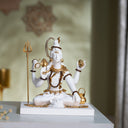
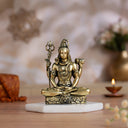
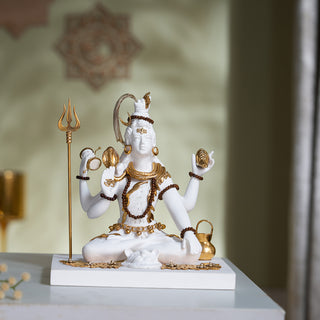
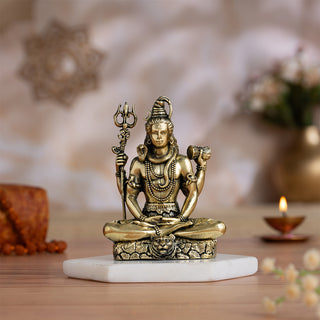
What Shiva does at 8.7.42 is the reason he is called Mahadev in a way that has nothing to do with power. He takes the whole of the poison in his palm and drinks it. The next verse says the poison showed its potency by marking his neck with a bluish line, and that the mark became an ornament.1
That is where Nilakantha comes from. The blue-throated one. Not a wound; the text calls it jewellery.
Worth saying honestly: the version most of us grew up with (Parvati gripping his throat so the poison could not descend further) is not in this chapter. It is a beloved, widely told addition and it carries a real devotional meaning. It is simply not what Canto 8 says.1 The Bhagavata's Shiva swallows and keeps it, and nobody stops him.
What rose from the ocean, in order
After the poison, the ocean starts giving. The Bhagavata lists it in sequence across 8.8.1 to 8.8.8:
- Surabhi, the cow of plenty, taken by the sages for the ghee needed in sacrifice. She is the same Kamdhenu people keep in their homes today.
- Uccaihshrava, the white horse, moon-coloured, taken by Bali.
- Airavata, the great white elephant, who becomes Indra's mount.
- Kaustubha and the other gems, which Vishnu wears.
- Parijata, the flowering tree of heaven.
- The Apsaras, who go to the celestial realms.
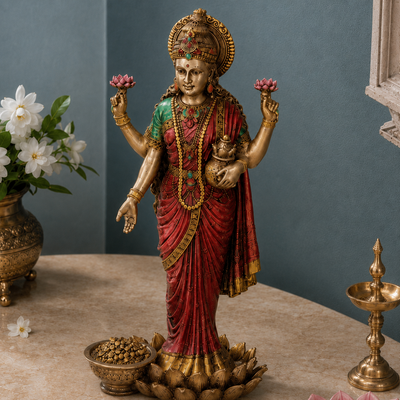
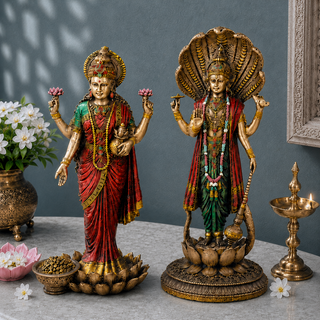
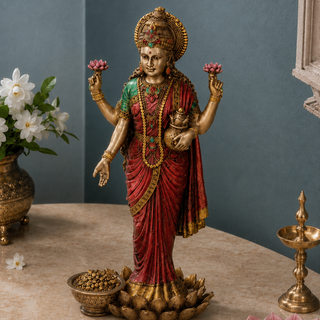
- Lakshmi herself, who surveys the whole assembly and garlands Vishnu.
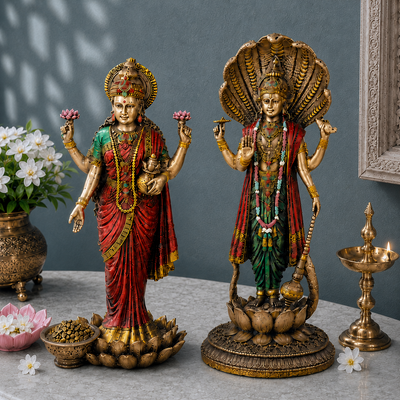
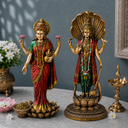
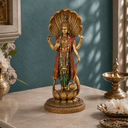
Read that list slowly and something clicks. Nearly every object of household auspiciousness in Hindu practice (the cow, the elephant, the lotus-seated goddess, the gem at Vishnu's chest) has one origin story, and it is this one. Lakshmi choosing Vishnu is why the two are almost never installed apart, and why Vishnu and Lakshmi murtis are made and sold as a pair.
The churning produced three avatars, not one
This is the part that surprises people who know the Dashavatara list well.
Kurma is not the only descent in this episode. At 8.8.31 the ocean gives up Dhanvantari, dark, strong-armed, carrying the jar of nectar. He is the physician of the gods, the figure Ayurveda traces itself to, and the Bhagavata counts him as an incarnation of Vishnu in his own right.2
Then the asuras snatch the jar and start fighting each other over it, and Vishnu takes a third form in the same episode: Mohini, the enchantress. She offers to divide the nectar fairly, and then does not. The gods drink; the asuras do not.
The Bhagavata's own primary list of descents names all three of these separately: Kurma at 1.3.16, and Dhanvantari and Mohini together at 1.3.17.3 One churning, three incarnations.
And notice what that means about the ending. The amrita is not won by strength. It is won by a disguise. The texts report this without any embarrassment at all, which tells you the tradition was never trying to sell the asuras a fair fight: the whole episode is about who is fit to hold immortality, not about who pulled harder on the snake.
Three things people get wrong about Kurma
1. "Kurma just held still while others did the work."
Two things get lost when it is told that way. The first is the scale. People picture a small tortoise under a mountain; the text describes something island-sized, big enough that a rotating mountain feels like a scratch. The second is that the tortoise is only one part Vishnu plays here. He also holds the tail of the serpent, and becomes both Dhanvantari and Mohini. He is present at four points in one story, and only one of them looks passive.
2. "Kurma is the second avatar, full stop."
Second is correct in the Dashavatara, which runs on cosmic time: Matsya first, Kurma second, Varaha third, and so on. But the Bhagavata Purana, the text most of this article is built on, gives its own enumeration in Canto 1 Chapter 3 and names twenty-two descents, not ten. In that list Matsya is tenth and Kurma is eleventh.3 The Purana then adds, at 1.3.26, that the incarnations are innumerable, "like rivulets from inexhaustible sources".
The famous ten is a later standardisation, carried by the Garuda, Agni and Padma Puranas. It is a selection, and a good one, but it is not a census, and the tradition never claimed it was.
3. "Shiva was poisoned by accident and Vishnu had to save him."
Nothing in the account supports this. Shiva is not a bystander who gets splashed. The gods go to him deliberately, as the only one who can hold what nobody else can, and he drinks it deliberately, and the text frames the mark it leaves as an ornament rather than an injury. The churning has two figures who absorb what others cannot (the tortoise underneath and Shiva at the top) and the story treats them as a matched pair. If you have ever wondered why arguments about the most powerful god in Hinduism never quite resolve, episodes like this are the reason.
Where Kurma fits in the larger arc
One of the pleasures of reading the avatars in order is noticing that they are not ten separate stories. They rhyme.
Matsya saves the seeds and the scriptures through a flood.5 Kurma gives the world a base to work on. Varaha lifts the earth back out of the water. Three water stories in a row, all about something being kept from being lost. Only after that does the sequence turn towards kings and demons and the moral tests of Rama and Krishna.
Prahlada's grandson Bali, who takes the white horse in this episode and whose side insisted on the serpent's head, turns up again as the great generous king of the Vamana story, and is one of the chiranjeevis, remembered every year at Onam. Nothing in this literature is disposable. Characters come back.
Keeping Kurma at home
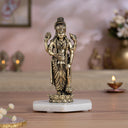
A tortoise form in a home shrine is not decoration, and it is not vastu superstition either. It is a reminder of the story itself: something that bears weight quietly, and gives everything else a base to stand on.
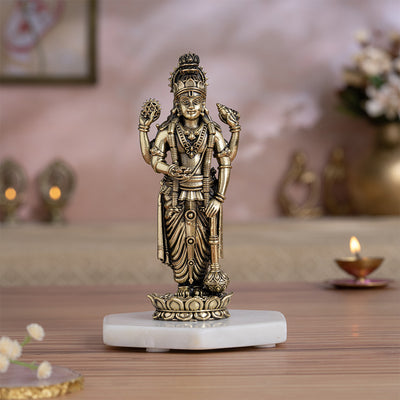
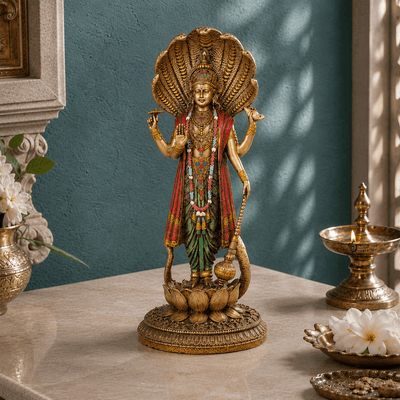
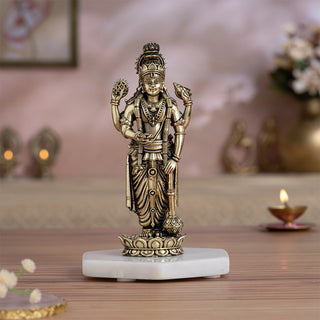
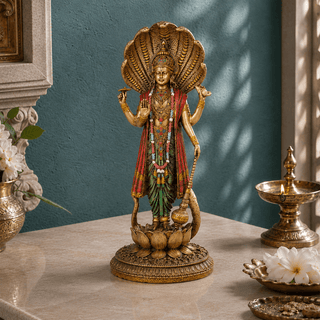
If you are placing one, the usual sensible things apply: a settled spot, kept clean, facing into the room rather than into a wall, and treated as part of daily practice rather than as an object on a shelf. Our guide to what belongs in a pooja room covers the practical side. If your shrine already has a Vishnu murti and you have been told a standing form is a problem, that is worth reading about too, the standing Vishnu question has a much simpler answer than most people are given.
And if you want the other end of the same episode, keep a Lakshmi murti nearby. She came out of the same water.
A last note on why this story keeps working
Kurma has no dialogue. He wins nothing. He is not even visible for most of the episode. He is under everything, in the dark, while the interesting things happen on the surface.
And the text makes a point of telling you he is comfortable. Not straining. Not suffering. A mountain is turning on his back and it feels like a scratch.
That is a strange, quiet thing for a scripture to bother recording. It is also, if you sit with it, the most useful line in the chapter.
Also read: Matsya Avatar: The Fish and the Flood | The 10 Avatars of Vishnu | The Story of Mohini Avatar | Who Was Vishnu's First Devotee? | Who Gave the Sudarshan Chakra to Krishna?
Cover: Kurma, the tortoise incarnation of Vishnu, from a Vishnu Avatara series, c. 1860 to 1870, Victoria and Albert Museum, public domain, via Wikimedia Commons.