There is a moment in the churning of the ocean that most retellings skip past in one line. The pot of nectar has finally come up. The asuras snatch it. The gods, who did half the work, are standing there with nothing.
And the god who fixes it does not fight for it.
He becomes a woman.
That is Mohini: the only time in the whole of Vaishnava literature that Vishnu takes a female form. Almost everything popular culture tells you about her is a mix of two different episodes from two different texts.
Who is Mohini, and why did Vishnu need a female form?
Mohini is not a separate goddess. She is Vishnu himself, wearing a woman's form, and he took it because there was a problem force could not solve.
The name comes from the Sanskrit root moha: delusion, infatuation, being charmed out of your own judgement. Mohini is, literally, "she who bewilders."
That is unusual. Look at the rest of Vishnu's descents. Matsya is a fish big enough to tow a boat through a flood. Kurma is a tortoise holding up a mountain. Varaha lifts the earth on his tusks. Narasimha tears a demon apart on a doorstep. Even Vamana, the small brahmin boy, wins by growing enormous.
Mohini wins by being looked at. She never lifts a weapon. That is the point of her, and why she sits slightly apart from the standard list of ten avatars, which runs Matsya to Kalki and leaves her out.
The churning of the ocean: what actually happened
The devas and asuras had lost their strength and their fortune. The only fix was amrita, the nectar of immortality, at the bottom of the ocean of milk. So the two sides worked together: Mount Mandara as the churning rod, the serpent Vasuki as the rope.
The Mahabharata says it plainly, in the Astika Parva portion of the Adi Parva: "the gods and the Asuras made Mandara their churning staff and Vasuki the cord, and set about churning the main for amrita."1
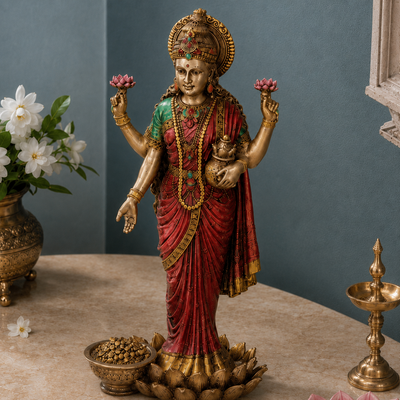
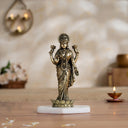
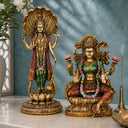
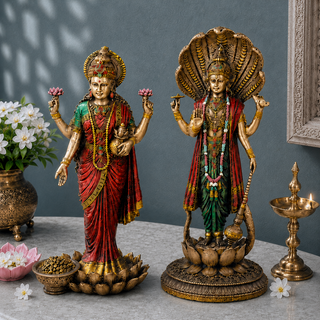
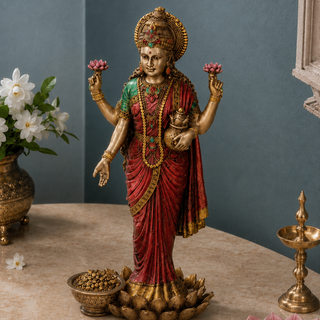
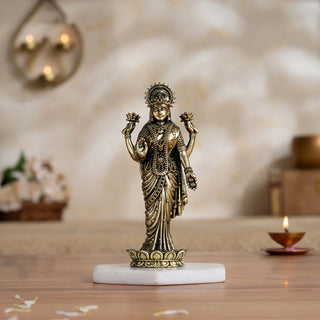
What came up first was not nectar. It was everything else: poison, treasures, the wish-fulfilling Kamdhenu cow, and then Lakshmi herself. The Bhagavata's eighth canto lingers on her arrival: elephants pour pots of sacred water over her, the ocean gives her yellow silks, and she stands holding a lotus, looking for a consort. Chapter 8 says she could not find "a single soul stable in every good quality" until she turned to Vishnu.3 That is why the two are almost always installed together in Indian homes, and why Diwali Lakshmi Puja is a Vishnu-adjacent ritual.
Then Dhanvantari rose from the water carrying the pot, and the truce died instantly. The asuras seized it, then started fighting each other over it. The Bhagavata gives them one of the most human lines in the whole text: "Me first, me first, not you, not you!"
How Mohini took the nectar back
Vishnu took the nectar back by trick, not by force. His job in the trinity is to preserve what exists. He told the gods not to grieve, and said he would arrange a dispute among the asuras so the nectar would come back. Then he assumed, in the Bhagavata's words, "the form of a supremely beautiful, wonderful woman who mystified them all."4
What follows is not a battle. It's a con, and a good one.
The asuras, already quarrelling, ask this stranger to settle their dispute. She plays hard to get: she is a wandering woman, they know nothing about her, why would they trust her? They insist. So she asks for one thing, and this is the hinge of the whole story. Canto 8, chapter 9 records her condition: "If you promise to accept Me whether I act honestly or not, I will divide this nectar."
They agree. Of course they agree. They are not listening to the words.
She seats the devas and the asuras in two separate rows, then serves the nectar entirely to the devas, holding the asuras off with sweet talk. The text says they stayed silent because they were bound by their attraction to her and by the promise they had just made. They had been warned in advance, and they still lost.
Rahu, and the head that never stopped
One asura was smarter. Rahu slipped into the devas' row in disguise and got a mouthful. The Sun and the Moon spotted him, and in the Mahabharata's telling, "when the nectar had only reached Rahu's throat," Narayana "instantly cut off with his discus the well-adorned head of the Danava who was drinking the nectar without permission."2
The nectar had already touched the head, so the head could not die. It rose into the sky screaming while the body dropped and shook the earth. This is the origin of eclipses: Rahu chasing the Sun and Moon forever, swallowing them, and losing them out of his open neck. The Bhagavata's chapter 9 makes the same point: his head became a planet.
Then the disguise ends. Narayana, "quitting his ravishing female form," picks up his weapons and finishes the fight properly, including with the Sudarshan Chakra, which "falling constantly everywhere destroyed the Daityas and the Danavas by thousands."
Notice the order. The illusion buys the outcome. The weapon only cleans up afterwards.
The one time Shiva asked to see her
Shiva asked Vishnu to show him the Mohini form, and Vishnu did. The episode is in the Bhagavata Purana, Canto 8, chapter 12.
After it's all over, Shiva hears what happened. The text has him say he would like to see "the incarnation of You in which You assume the body of a woman." Vishnu vanishes. Then a woman appears in the forest, playing with a ball.
What follows flatters nobody, which is a good sign that nobody invented it to score a point. Shiva, with Parvati standing right there, loses himself completely. The text says he was "distracted by his senses, fell victim to lust like he was a male elephant." He chases her. His seed falls on the earth, and the Bhagavata says every place it fell "became mines for silver and gold."5
Then he comes back to himself, realises what he has been shown, and stops. Vishnu praises him: not for resisting, but for recovering. The moral is blunt: maya works on everyone, even on the one god nobody can defeat in battle.
That is why the story survives. It isn't about a beautiful woman. It's about Vishnu's illusion not being a trick played on demons, but the fabric everyone lives inside, gods included. Anyone arguing about who the most powerful god in Hinduism is should read this chapter first.
Three things people get wrong about Mohini
1. Mohini did not kill Bhasmasura. The Bhagavata names Vrikasura, and Vishnu shows up as a boy.
You know the version: a demon named Bhasmasura gets a boon from Shiva that lets him burn anyone by touching their head, immediately tries it on Shiva, and Mohini appears, invites him to dance, mirrors her own hand onto her head, and he copies her and burns himself.
Go to the Bhagavata Purana, Canto 10, chapter 88. The demon is called Vrika. The boon is the same: "may everyone die upon whose head I place my hand!", and he does test it on Shiva, who runs.
But Vishnu does not arrive as Mohini. He arrives as a young brahmachari, a celibate student, described with "a belt, deerskin, rod and prayer beads." He tells Vrika that Shiva can't be trusted, and suggests he verify the boon himself: put your hand on your own head and see. Vrika, in the text's words, "no longer thought and foolishly placed his hand on his own head." His head shattered like it was hit by lightning.
No woman. No dance. The famous dance version is later and largely regional: loved in South and West Indian folk retellings, staged and filmed for a century. But it is not what the Bhagavata says, and the scriptural name is Vrikasura.6
2. In the Mahabharata, Mohini is an adjective, not a name.
An earlier version of this article said the Mahabharata never uses the word at all. That was wrong, and the Sanskrit is worth seeing:
ततो नारायणो मायां मोहिनीं समुपाश्रितः।स्त्रीरूपमद्भुतं कृत्वा दानवानभिसंश्रितः।।
In plain English: Then Narayana took on a bewildering illusion, made a wondrous female form, and went up to the danavas.
Mahabharata, Adi Parva 18.55 (Astika Parva); critical edition 1.16.39
Mohinim there attaches to mayam, the illusion: a bewildering illusion. The epic uses the same phrase for the illusions of rakshasas elsewhere. So the word is old. The person is not. Mohini as a name, with her own chapter and her own character, is a Puranic development. The Vishnu Purana carries the churning too, but it is the Bhagavata that gives her the negotiation, the two rows, and the personality.
3. Mohini is not usually counted among the ten avatars.
People often assume "only female avatar of Vishnu" means "one of the ten." It doesn't. The standard Dashavatara list (Matsya, Kurma, Varaha, Narasimha, Vamana, Parashurama, Rama, Krishna, Buddha, Kalki) has no Mohini in it. She is counted among Vishnu's forms and descents in the broader Puranic sense, which is a wider category. Both statements are true; they just aren't the same statement.
So is Ayyappa the son of Shiva and Mohini?
In South Indian temple tradition, yes. In the Bhagavata Purana, no. In Kerala and Tamil Nadu, Ayyappan (also called Hariharaputra, "son of Hari and Hara") is worshipped as the child born of Shiva's union with Vishnu-as-Mohini. Sabarimala is one of the largest pilgrimages on earth, a living and deeply serious tradition.
But the Bhagavata's own Mohini chapter, the one we just read, does not produce a son. Shiva's seed falls and becomes gold and silver in the ground. That's where that text ends the thread.
The deity Shasta, of whom Ayyappan is the best-known form, has a real and old pedigree of his own, though not quite the one usually quoted. Sanskrit tradition identifies him as Harihara-suta, the son born of Shiva and Vishnu in his Mohini form, and the Brahmanda Purana carries that identification. What you cannot do is date it. Scholarly proposals for the Brahmanda Purana run from the fourth century BCE to around 1000 CE. Ludo Rocher's standard survey concludes that no Purana as a whole can be dated. So any article telling you this is "pre-7th century" is quoting a number nobody can stand behind.
In Tamil country the evidence is older and of a different kind. Sattan, the Tamil form of the name, appears in the Silappadikaram, where Kannaki passes the temple of "the famous Sattan," listed among the gods of the village shrines rather than the Puranic pantheon. V.R. Ramachandra Dikshitar, who translated the epic in 1939, reads him as an indigenous South Indian deity. His shrines sit on the outskirts of villages, and his cult was treated as heterodox as Sanskrit culture pressed in.8
That points the arrow the other way from how it is usually drawn. The Harihara-suta identification looks like a later Sanskritic layer laid over an older local god, not the origin of him.
So: the Shiva and Mohini episode is pan-Puranic, and Shasta is genuinely ancient. But identifying that child as Ayyappan, with the Sabarimala story attached, is South Indian temple tradition. It grew alongside the Sanskrit texts rather than out of one verse in them. That does not make it less real to the millions who walk that pilgrimage. It just isn't a Bhagavata citation, and pretending otherwise helps nobody.
Some texts also connect this episode to the birth of Hanuman, a separate strand with its own complicated account of Hanuman's father. The Puranas are not one book. They disagree, and saying so is more respectful than smoothing it over.
What Mohini actually means
The asuras are not defeated because they are weak. They are stronger, and they have the pot in their hands. They lose because they want something so badly that they stop hearing what is being said to them. They were told the terms. They agreed to be deceived.
And Vishnu, whom his devotees have always described as the preserver rather than the destroyer, restores the balance without a single blow.
It's also one of the least rigid moments in Hindu thought about gender. Vishnu is not diminished by being a woman. Shiva is not diminished by desiring her. Nobody in the text treats it as scandalous, and neither should we. Set it beside Shiva's own many forms, or the composite Harihara icon, and it looks less like an oddity and more like a position.
Where you can actually see Mohini
She is rare in home shrines. You will not usually find a Mohini murti the way you find Lakshmi or Krishna. She belongs to narrative art more than to daily puja.
The most famous example is at the Chennakeshava Temple in Belur, Karnataka, consecrated in 1117 CE under the Hoysala king Vishnuvardhana.10 The date comes from the temple's own inscriptions, recorded by B. Lewis Rice in Epigraphia Carnatica. The complex kept growing for another two centuries. The temple is known for its rendering of Mohini, and one of its interior pillars (the Mohini pillar) carries bands of carving including Brahma, Vishnu, Shiva and the ten avatars.
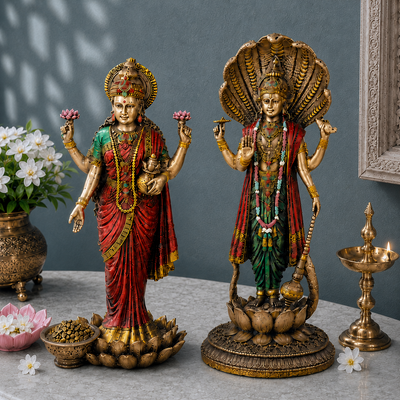
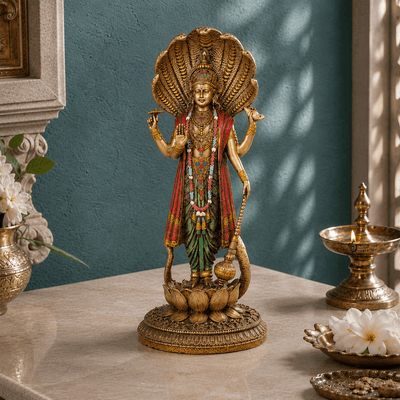
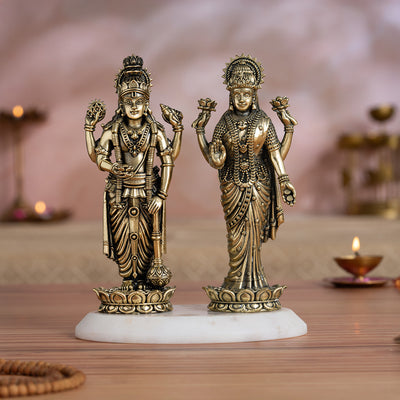
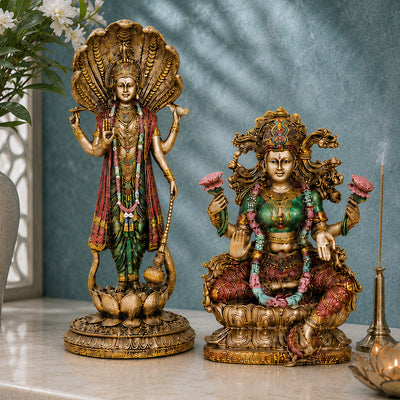
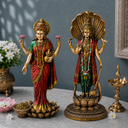
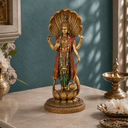
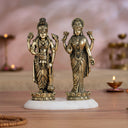
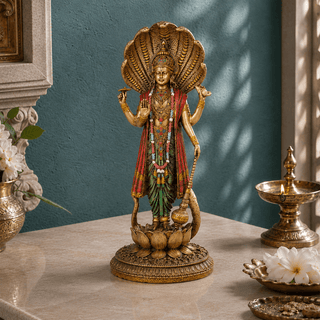
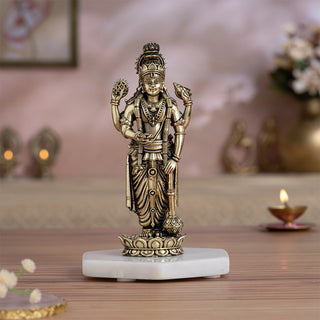
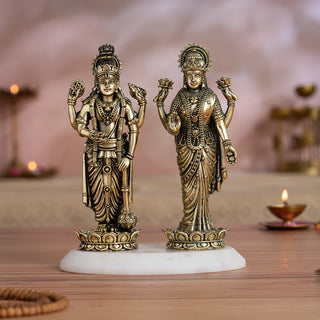
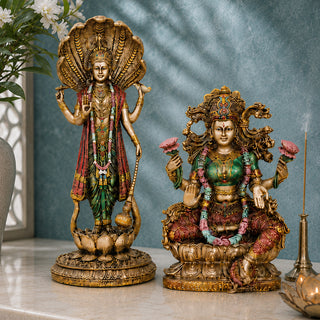
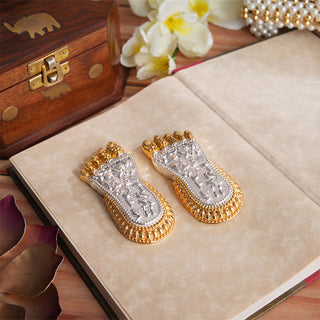
At home, the practical version of this story is a Vishnu and Lakshmi murti kept together. If you are setting one up, read how to place a standing Vishnu idol at home and how to clean an idol without damaging the finish. For Lakshmi there's a separate tradition around where to place Lakshmi Charan Paduka, the footprints marking her arrival.
Also read: The 10 Avatars of Vishnu | Kurma Avatar | Narasimha Avatar | Who Are Lord Shiva's Father & Mother | Shop Vishnu Idols | Kalki Avatar: What the Texts Actually Say