Ask when Kalki is coming and the internet will give you a year. 2025. 2026. 2032. 428,899 CE. 2898 AD, which is a film.
Not one of those numbers is in any Purana. The texts that name Kalki give no year, no century and no countdown. What they give instead is a set of conditions, an astronomical alignment, and a phrase — yuga-sandhya, the junction between ages — that is deliberately not a date.
So this piece does something the SERP does not: it separates what the oldest texts say from what one seventeenth-century book added, shows the arithmetic behind the famous 427,000 years, and then shows that the arithmetic disagrees with the very text everyone quotes.
Will Lord Kalki be born in 2026?
No text says so, and no text says otherwise, because no primary text gives a year at all.
The claim circulating hardest online — that the Vishnu Purana names 2026 — is simply false. The Vishnu Purana contains no CE dates of any kind. Neither does the Bhagavata, the Mahabharata or the Agni Purana. The Gregorian calendar postdates all of them by centuries.
What the texts actually offer is a marker you could in principle observe. Bhagavata 12.2.24: “When the moon, the sun and Brihaspati are together in the constellation Karkata, and all three enter simultaneously into the lunar mansion Pushya — at that exact moment the age of Satya, or Krita, will begin.”1 The Mahabharata gives the same alignment.4 It is a sky condition, not a calendar entry.
And the Bhagavata's own phrase for the timing is yuga-sandhyayam — “at the conjunction of two yugas” (1.3.25).2 A sandhya is itself an enormous span. The text is not being coy. It is telling you that the question does not have the kind of answer you want.
What the four oldest texts actually say
Four texts name him, and together they amount to a couple of pages.
The Mahabharata is the earliest, and it is the one with the biggest surprise in it. In the Vana Parva, Markandeya describes the end of the age and then says a brahmana named Kalki will be born in a town called Shambhala, that “vehicles and weapons, and warriors and arms, and coats of mail will be at his disposal as soon as he will think of them,” that he will exterminate the mlecchas, and that afterwards he will perform a great horse-sacrifice, give the earth to the brahmanas, and “enter a delightful forest.”4
The oldest text that names Kalki gives him no horse and no sword. He gets whatever he needs by thinking of it, and he retires to the woods. The white horse and the blazing blade are later.

The Vishnu Purana (Book IV, chapter 24) says he will be born “in the family of Vishnuyasas, an eminent Brahman of Sambhala village,” endowed with the eight superhuman faculties, and that “by his irresistible might he will destroy all the Mlechchhas and thieves.”3 Three sentences.
The Agni Purana adds one thing nobody quotes: it names Yajnavalkya as his priest, not his teacher.5 And it does not mention Shambhala at all.
The Bhagavata Purana is the fullest, and it is still only four verses. 12.2.18: he appears in the home of Vishnuyasha, the most eminent brahmana of Shambhala village. 12.2.19–20: “Lord Kalki, the Lord of the universe, will mount His swift horse Devadatta and, sword in hand, travel over the earth… He will kill by the millions those thieves who have dared dress as kings.”1
Two details from that verse worth holding on to. The Sanskrit calls the horse ashu-ga, swift — not white. And the sword is never named; the text says only asina, “with His sword.”
The Bhagavata also places him in its own enumeration, and it is not a ten. At 1.3.25 he is the twenty-second descent, right after Buddha at twenty-one. We set that list out in full in the ten avatars of Vishnu, along with why the ordinals never match between the two lists.
The signs the Bhagavata actually gives
Before the descent, Canto 12 describes the world he is coming into. It is worth reading properly, because it is nothing like the “signs” that circulate on social media.
Religion, truth, cleanliness, tolerance, mercy, lifespan, strength and memory all diminish (12.2.1). Wealth alone becomes the sign of good birth and good conduct; law is applied on the basis of power (12.2.2). A man is judged unholy if he has no money, and hypocrisy passes for virtue (12.2.5). A sacred place comes to mean no more than a distant reservoir of water, and beauty is thought to depend on one's hairstyle (12.2.6). People flee to the mountains and forests, living on leaves, roots, flesh, wild honey and seeds (12.2.9–10).1
Then the concrete ones. Maximum human lifespan falls to fifty years (12.2.11). Bodies shrink. “Cows will be like goats… all trees will appear like dwarf shami trees. Clouds will be full of lightning, homes will be devoid of piety…” The path of the Vedas is completely forgotten (12.2.12–16).
Read that list against the world outside your window. Whatever else is true of this age, human beings are not living to fifty and cows are not the size of goats. By the text's own account, the conditions are not met. That is a far better answer to “has Kalki already come?” than any argument about a particular claimant.
Where the rest of the story comes from
Almost everything else you have read about Kalki — his mother's name, his three brothers, his guru, his wives, his sons, the talking parrot, the demons he fights — comes from a single book: the Kalki Purana.
It is worth being precise about what that book is. It is an Upapurana, not one of the eighteen Mahapuranas. It was composed in Bengal. No manuscript of it is known from before the seventeenth century, and the scholarly dating puts its composition somewhere between 1500 and 1700 CE.
None of that makes it worthless. It is a real devotional text with real standing. But when a page tells you “the scriptures say Kalki's mother was Sumati,” what it means is that a book roughly four hundred years old says so, and the two-thousand-year-old ones do not.
Here is what it adds, with chapter and verse: the mother Sumati (2.4, 2.11); a birth date — the twelfth day of the waxing moon in Vaishakha (2.15); three elder brothers, Kavi, Prajna and Sumantra (2.31); Parashurama as his teacher at Mount Mahendra (3.1–6); the horse, given by Shiva and manifested from Garuda (3.25); a parrot who knows past, present and future (3.25); his wives Padmavati and Rama; and the demons Koka and Vikoka, whom Brahma tells him he must kill with his bare hands (21.27–30).
Two things in that book cut directly against the internet's version of it. It never calls the horse Devadatta and never calls it white — those are the Bhagavata's name and later iconography respectively. And it never narrates Kali's death: at 20.35–38 Kali simply flees on a chariot bearing the symbol of an owl.
What is the name of Kalki's horse, and his sword?
The horse is Devadatta, and the name is the Bhagavata Purana's, at 12.2.19–20. If you see it attributed to the Kalki Purana, that is an error — the word does not appear in that book.
It is a name with a second life, too. Devadatta is also the name of Arjuna's conch in the Bhagavad Gita (1.15). Same word, different object, and the texts are relaxed about it.
The sword has no name in any primary text. Not in the Mahabharata, not in the Vishnu Purana, not in the Agni Purana, not in the Bhagavata. The name “Ratnamaru” that circulates widely appears to be a hardened descriptive phrase: the Kalki Purana at 3.27 describes ratna-tsaru, a sword with a jewelled hilt, and somewhere along the line an adjective became a proper noun.
If you want a Vishnu form whose weapons the texts name exhaustively, that is Vishnu himself — the conch, discus, mace and lotus. Kalki gets a sword the text does not bother to name and a horse it calls simply swift.

Where is Shambhala?
The texts name a village and stop. No district, no river, no distance, no direction. Shambhala-grama is all the Bhagavata gives.
The identification with Sambhal in Uttar Pradesh is a genuine pilgrimage tradition, documented in an Archaeological Survey report of 1879, and in February 2024 the foundation stone was laid there for a Kalki temple with ten sanctums, one per avatar. That is real, living tradition, and it deserves respect. It is also tradition attaching a place to a name, rather than a text naming a place.
One separate thing worth untangling: the Buddhist Shambhala of the Kalachakra is a different tradition with different contents. Its rulers are twenty-five kings who bear Kalki or Kalkin as a royal title — a title, not Vishnu's avatar. Some of the dates that circulate in Hindu contexts have quietly leaked across from there.
So when? The arithmetic, and why it settles nothing
Here is the calculation everybody is really quoting, laid out honestly.
Manusmriti 1.67 gives the conversion: “A year is a day and a night of the gods” — one divine year equals 360 human years. Manusmriti 1.69–71 gives Kali Yuga as 1,000 divine years plus two twilights of 100 each, so 1,200.6 The Bhagavata agrees at 3.11.19 and again at 12.2.31, and the Kalki Purana agrees at 19.12–13.1
1,200 × 360 = 432,000 human years.
Not one of those texts performs that multiplication. The number 432,000 is derived, by later astronomical works and modern commentators. And 3102 BCE, the traditional start, is an astronomical epoch back-computed from a planetary conjunction — Aryabhata states in 499 CE that 3,600 years of Kali had elapsed when he was twenty-three. No Purana records the date.
So 428,899 CE is 432,000 minus 3,102 plus one. It is a subtraction, not a prophecy.
The famous “427,000 years remaining” has a similar provenance: it appears in a twentieth-century commentary on Bhagavata 1.3.25, not in the verse.
And then the arithmetic runs into the text. The Kalki Purana — the book that supplies most of the popular story — has King Maru tell Kalki to his face at 18.5–6 that about one hundred thousand years of Kali Yuga have passed. If that is right, the advent is not 427,000 years away at the far end of the age; it is somewhere in the middle of it. The single most-cited source for Kalki's story contradicts the single most-cited number about his timing.
The honest position is the one the Bhagavata takes at 1.3.26, immediately after listing the descents: they are innumerable, “like rivulets flowing from inexhaustible sources.”2 A tradition comfortable with that is not a tradition keeping a diary.
Is Kalki 2898 AD based on scripture?
Partly, and generously so — but the year is not.
The film borrows real material: the name Sumathi, the 3102 BCE epoch, Ashwatthama's deathlessness, the general shape of a world in terminal decay. Those are all traceable.
The year 2898 is a screenwriter's. No text places Kalki's appearance in the twenty-ninth century, or in any century. It has since entered Google's autocomplete as a genuine question, which is a fair measure of how well the film worked and how thin the surrounding information is.
None of that is a complaint. Mythological cinema has always invented; the Puranas themselves grew by accretion for centuries. It is only worth knowing which parts you are holding.
How Kalki is shown, and where he belongs at home
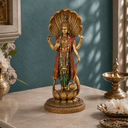
Two things about the iconography are worth knowing before you look for a murti.
First, the Kalki Purana says he is born four-armed and then, at Brahma's request through the wind-god, assumes a two-armed human form (2.18–22). Both are therefore textually defensible.
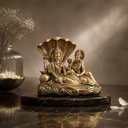
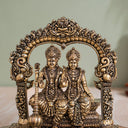
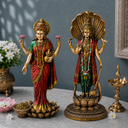
Second, and more usefully: Kalki is almost never made as a standalone household murti. He appears as the last panel of a Dashavatara set, on temple walls, in painted series — as the closing figure of a sequence rather than a deity you install and worship daily. That is not a gap in the market. It reflects how the tradition actually treats him. He is the one who has not arrived.

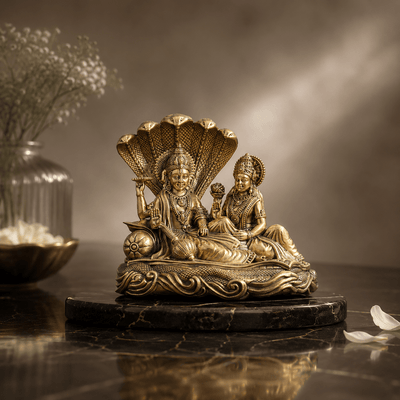
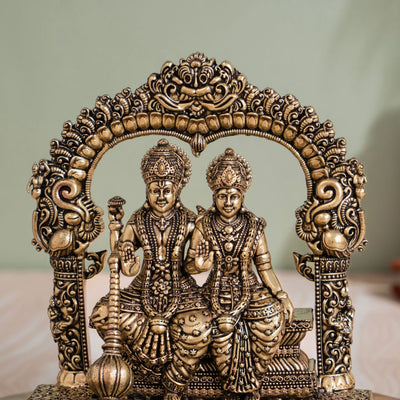
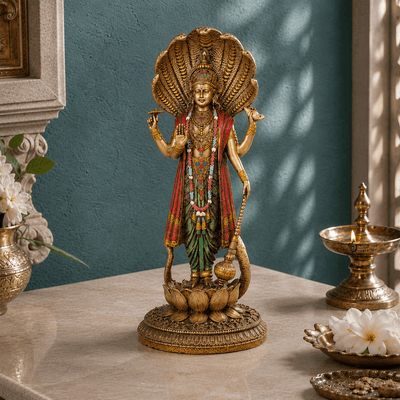
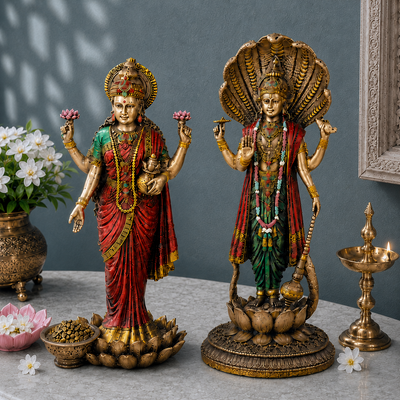
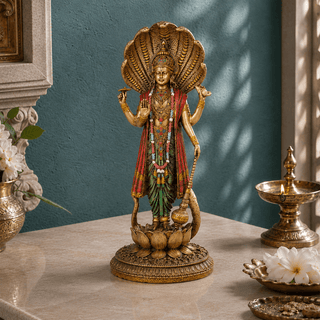
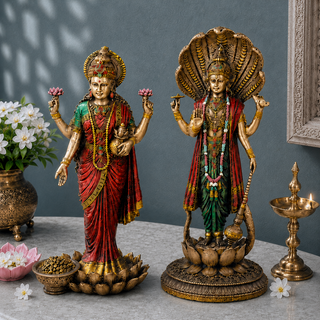
For the home shrine the practical answer is Vishnu himself — four-armed with conch, discus, mace and lotus, or reclining on Ananta — or one of the avatars people actually keep, which are Rama and Krishna. The Vishnu collection covers the standing and seated forms.
The age that gets a better press than it deserves
One last thing, because it changes the mood of the whole subject.
The Vishnu Purana ends its account of Kali Yuga not with dread but with Vyasa standing waist-deep in the Ganges, exclaiming “Excellent, excellent, is the Kali age!” His reason: what took ten years of penance in the Krita age, and a year in the Treta, and a month in the Dvapara, is obtained in the Kali age “in a day and night” — and so “in the Kali age a man displays the most exalted virtue by very little exertion.”7
That is the same text, a few chapters on from the one that promises a rider with a sword. The tradition holds both at once: an age in decline, and the easiest age in which to do something good. Whenever the horseman is coming, that part is available now.
If the longer view interests you, the seven who are said to be waiting through all of it are covered in the seven chiranjeevis — and the first avatar, at the other end of the sequence, in the Matsya avatar.
Also read: The 10 Avatars of Vishnu | The 7 Chiranjeevis | The Matsya Avatar | Is Lord Hanuman Still Alive | Who Is the Most Powerful God in Hinduism | Can We Keep Horse Statues at Home?