The short answer, and why the long one is more interesting
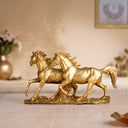
Walk into almost any office in India and you will find the same painting. Seven horses, mid-gallop, manes flying, usually going left to right. Ask why and you will hear some version of the same sentence: it's Vastu, it brings success, they must run towards the entrance.
I went looking for the text behind that sentence. I could not find one.
That is not a small thing. This is one of the most confidently repeated rules in Indian home decor. It gets quoted by interior designers, printed on the back of frames, and treated as ancient. And the classical sources (the ones that actually make up the Vastu and Puranic tradition) are silent about it.
So the honest answer to "can we keep horse statues at home" is: yes, absolutely, and there was never a rule to break. What is worth your time is understanding where the belief came from, what the texts do say about horses, and what makes a horse figure meaningful to keep once you stop treating it as a machine that produces promotions.
Where the seven-horses rule actually comes from
The usual explanation is that they are the seven horses of Surya's chariot. That part is genuinely old: the sun god's horse-drawn chariot is a real Vedic image, carrying the seven days, or colours, or metres of chanting depending on who is telling it.
But there is a leap between "the sun's chariot has horses" and "hang seven horses in your living room and money will come." Nobody makes that leap in a classical text. It looks like a twentieth-century decor convention that borrowed an old image, then borrowed Vastu's authority to explain itself.
A huge amount of what circulates as "Vastu rules for decor" turns out to be modern interior advice in old clothing, a pattern we trace in Vastu-friendly home decor ideas.
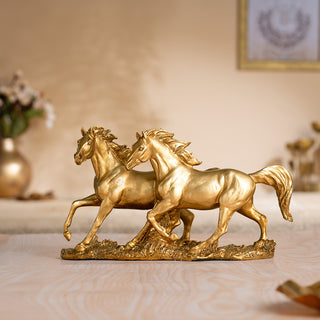
The running-horse motif is a good example, because the object itself is lovely and the claim attached to it is invented. You can keep the object and drop the claim.
The horses scripture actually names
Two horses matter in the mainstream corpus. Both are worth knowing.
The first is Uchchaihsravas. He comes out of the churning of the ocean of milk, the same event that produced the nectar, the Kaustubha gem and Lakshmi herself. The Mahabharata's description of him is one of the more beautiful lines in the Adi Parva:
अमोघबलमश्वानामुत्तमं जविनां वरम्। श्रीमन्तमजरं दिव्यं सर्वलक्षणपूजितम्।।
In plain English: Of unfailing strength, best of horses, swiftest of the swift, glorious, ageless, shining, honoured with every mark of good fortune.
Mahabharata, Adi Parva 1.17.3
Kisari Mohan Ganguli's 1883 to 1896 translation, the standard complete English Mahabharata, is what everyone else quotes, and it tracks this Sanskrit closely.1 The Bhagavata corroborates the episode at 8.8.3.3 Uchchaihsravas becomes Indra's mount. He is not somebody's showpiece.
The churning episode itself is worth reading properly: Vishnu takes the form of a tortoise to hold the mountain steady, which is the Kurma avatar, and later takes the form of Mohini to handle the nectar, which is the Mohini avatar. Both sit inside the ten avatars of Vishnu. The horse arrives in the middle of all that, alongside Airavata the white elephant.
The second horse is Devadatta, and he belongs to the last avatar rather than an early one. The Bhagavata Purana, Canto 12, describes Kalki at the end of the age:
अश्वम् आशुगम् आरुह्य देवदत्तं जगत्पतिः । असिनासाधुदमनम् अष्टैश्वर्यगुणान्वितः ॥
In plain English: Riding the swift horse Devadatta, the Lord of the world, sword in hand, holding the eight great powers, puts down the wicked.
Bhagavata Purana 12.2.19–20
Again: a mount, in a narrative, carrying a god somewhere.
Notice what neither passage does. Neither one tells you to keep a horse. Neither one gives a direction, a count, a material or a room. The horses in scripture are characters, and characters do not come with placement instructions.
What the Vastu texts are actually about
The Brihat Samhita of Varahamihira is the classical authority people are gesturing at when they say "Vastu Shastra." Look at what it actually covers. Chapter 58 is House-Building. Chapter 59 is Exploration of Water Springs. Chapter 62 is Description of Temples. Chapter 64 is Description of Idols. Chapter 66 is Installation of Idols.6
Read that list again. It is a book about construction. Where to build, how to site a house, how to find water, how to raise a temple, how to make and consecrate the images that go inside a temple. There is no chapter on ornaments in a living room, because ornaments in a living room were not the subject.
(Chapter numbers shift between editions, Kern's 1865 edition numbers differently from Subrahmanya Sastri's 1946 translation. The structure is the point, not the number.)
And even the core of the tradition is not one settled rulebook. A comparative study by Apte and Supekar in the Bulletin of the Deccan College Research Institute compared how the Vastu-Purusha-Mandala (the grid at the heart of Vastu) is handled in the Paushkara Samhita versus the Brihat Samhita, and found real divergence. Classical Vastu is an argument between texts, not a single list of dos and don'ts.
So when someone tells you Vastu Shastra prescribes where your horse statue must face, the accurate response is that Vastu Shastra does not discuss horse statues at all.
Three things people get wrong about horse statues
1. "Seven horses are a Vastu remedy." No classical Vastu or Puranic text we consulted prescribes horse figures in a dwelling.6 The corpus is enormous and we are reporting an absence, not proving a negative, but the absence is in exactly the places you would expect the rule to live, and it isn't there. The seven-horse motif is decor convention with Vastu language applied afterwards.
2. "The horses must run in a particular direction or it reverses the effect." The one genuine directional instruction in the deity-worship chapter of the Bhagavata Purana governs the worshipper, not the object: lay the seat with kusha grass pointing east, then sit facing east or north, or simply face the deity (11.27.19).5 That is it. The elaborate facing rules for idols and objects are later domestic convention. We make the same point in our guide to which direction a Ganesh idol should face, because the confusion is identical there.
3. "It must be brass or marble to count." The Bhagavata's chapter on deity worship lists eight legitimate materials for a sacred image: stone, wood, metal, a smearable substance like clay, painted, sand, jewels, and an image held purely in the mind (11.27.12).5 Sand and a mental image sit in the same sentence as gold. Material hierarchy is a market idea, not a textual one, and if that is true for a murti, it is certainly true for a decorative horse.
There is a fourth misconception worth naming, because it comes up constantly with animal figures: the idea that once you place something you must never move it. Scripture actually says the opposite for most objects. It recognises two classes of image (the moved and the not-moved) and only the formally installed one is bound to stay in place (11.27.13). A horse on your console table is not an installed deity. Move it whenever you like.
So how should you keep a horse statue at home?
Since there is no rule, this becomes a design question and a common-sense question. Both have decent answers.
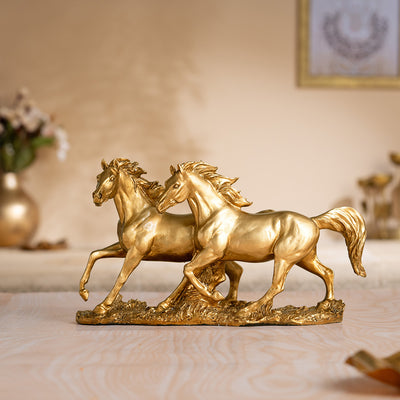
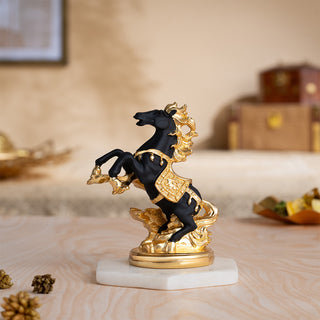
- Give it room to be seen. A running horse reads as movement. Movement needs empty space around it. Crowding it against six other objects kills the one thing it is good at.
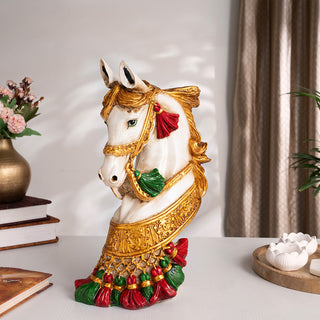
- One good piece beats a herd. The seven-horse convention pushes people towards quantity. A single well-sculpted horse at eye level does more for a room.
- Keep it out of the pooja room. Not because it is forbidden, but because a shrine is for the objects of your worship, and a decorative animal dilutes that. If you want to think about what genuinely belongs there, our piece on things to keep in the pooja room works through what the texts actually name.
- Entrances, consoles, study tables, office desks. These are where a horse has always sat well, and this is design logic, not scripture. Say so honestly and the advice is more useful, not less.
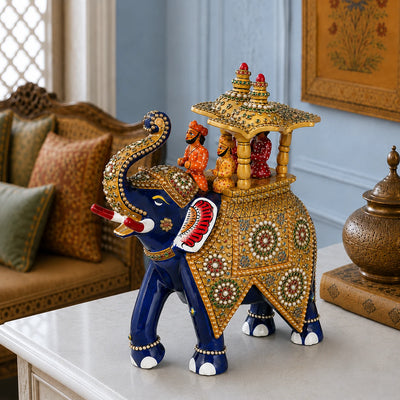
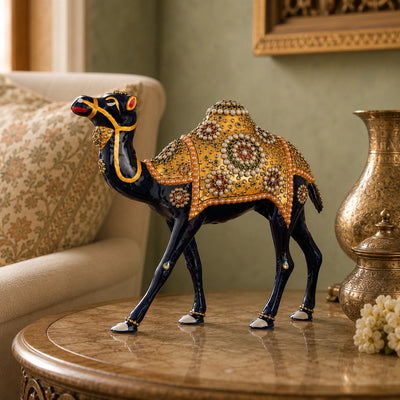
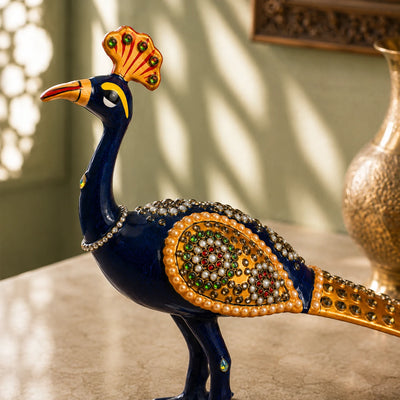
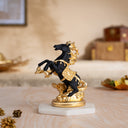
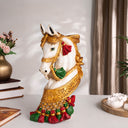
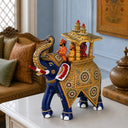
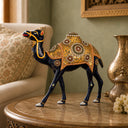
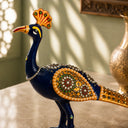
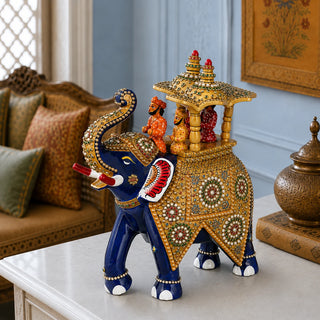
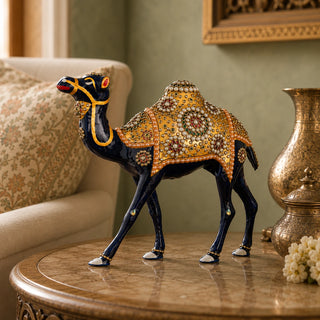
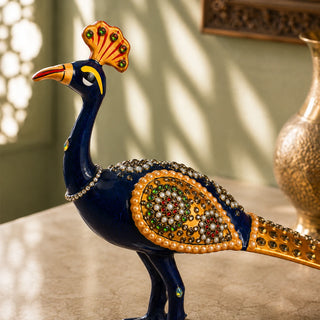
The same reasoning applies to the other animal figures people keep: elephants, camels, peacocks, tortoises. They are handsome objects with cultural weight. Our animal decor pieces sit in exactly that category, and so does most of what people file under Vastu and Feng Shui decor, worth keeping for what they are, not for a promised outcome.
What a horse is actually worth keeping for
Uchchaihsravas is described as perpetually young and of irresistible vigour. Devadatta carries the avatar who ends an age. The Vedic sun crosses the sky behind horses. Across all of it, the horse means the same handful of things: speed, vitality, and the carrying of something greater than itself.
That is not nothing. A person who keeps a horse figure on their desk because it stands for momentum has a better reason than a person who keeps seven of them because a blog said it unlocks a salary hike. The first reason survives scrutiny. The second one falls apart the moment you look for the source.
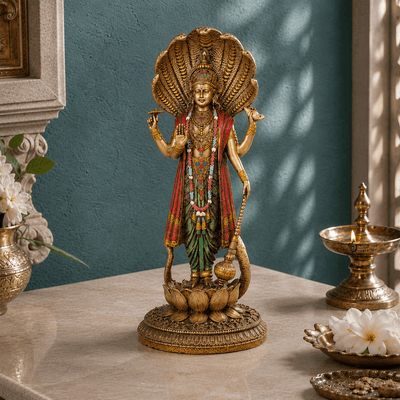
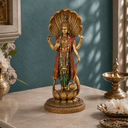
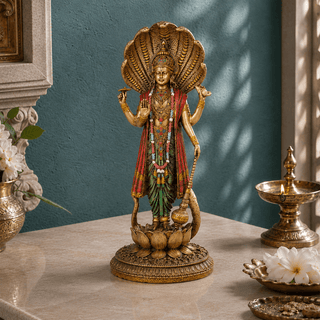
This is also the difference between an object you actually enjoy and an object you are anxious about. Half the questions we get about placement (which way Lakshmi's charan paduka should point, whether a Shiva statue can be kept at home, whether a standing Vishnu idol is permitted) come from a fear of getting it wrong. Almost always, the text is far more relaxed than the internet.
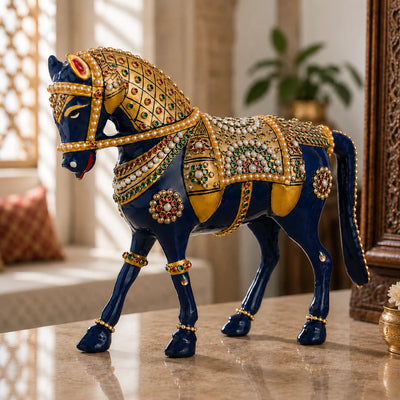
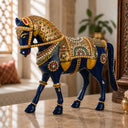
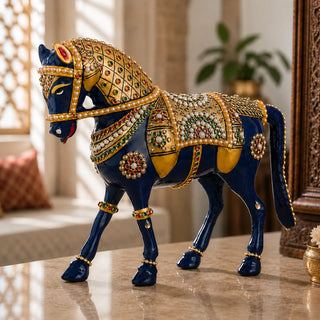
Craft is a better reason than luck, too. A hand-enamelled Meenakari horse carries the Jaipur enamel tradition on its flanks: cobalt blue, gold outlines, done by hand. That is a real thing to own. It does not need a Vastu claim stapled to it, and the rest of the Meenakari collection works the same way.
Looking after it
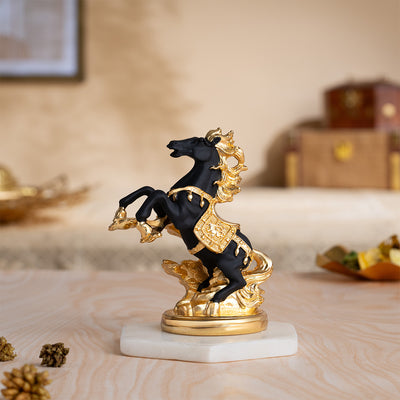
Practical, and rarely covered. Antique-finish and polyresin horses want a dry dusting: a soft dry cloth, no water sitting in the crevices, no chemical polish on a plated surface. Gold-plated and silver-plated pieces should be kept out of direct sunlight, which dulls the finish faster than anything else. Meenakari enamel is glass; it chips if it falls, so give it a stable surface, not a narrow ledge.
If you also keep stone or marble pieces, our guide on how to clean a marble idol covers the things that quietly ruin them. And if you are furnishing a room around a piece like this, budget-friendly living room decor and luxury table decoration ideas approach it as design rather than as ritual, which is the correct frame here.
The one-line version
Keep the horse. Drop the rule. There is no scriptural instruction to keep a horse statue and no scriptural instruction not to, which means the decision is yours, and it should be made the way you would make any other decision about your home: does it look good, does it mean something to you, and is it well made?
That is a much better basis than a rule nobody can source. And it is the same standard we would apply to a Kamdhenu cow, a Shree Yantra, a shankh, or anything else in the wider world of home decor that gets sold with a promise attached.
Also read: Vastu-Friendly Home Decor Ideas | Can We Keep a Kamdhenu Cow at Home | Things to Keep in the Pooja Room | Keeping a Murti in Your Car: What Scripture Actually Says | The 10 Avatars of Vishnu