Almost nobody searches this question out of curiosity. People search it because someone scared them.
An aunt says a Shiva murti at home invites destruction. A blog says the Nataraja is the dance that ends the universe, so keep it away from children. Someone else insists that once you bring a lingam in, you can never miss a day of puja, and missing one is worse than never starting.
So before buying a Shiva idol for the home, most people go looking for permission. The strange part is that the permission has sat in the Shiva Purana for about a thousand years, in unusually warm language, and hardly anyone quotes it.
What the Shiva Purana actually says about worshipping Shiva at home
The relevant chapter is in the Vidyeshvara-samhita, the opening section of the Shiva Purana, and it reads less like a rulebook and more like a text worried that ordinary people will feel shut out.
On where to keep the image, it says the site should be a holy centre, a riverbank, "or anywhere facilitating a daily worship" (Vidyeshvara-samhita 11.2 to 3).1 That last clause is the whole answer. The text's placement criterion is not a compass direction. It is access. Somewhere you will actually stand every morning.
On what the image can be made of, the same chapter is startling if you have only ever heard the expensive version of this tradition:
मृत्पिष्टगोशकृत्पुष्पैः करवीरेण वा फलैः। गुडेन नवनीतेन भस्मनान्नैर्यथारुचि
In plain English: A lingam may be made of clay, flour, cow dung, flowers, oleander or fruit; or of jaggery, butter, ash or cooked food, as you please.
Shiva Purana, Vidyeshvara-samhita 11.32 to 33
Cooked rice. Ashes from the hearth. The older English translations actually trim this list: the Sanskrit adds oleander and plain fruit to it. This is scripture written for households with nothing, not for people who can afford marble. Elsewhere it says worship should be done "with such modes of service as are easily available" (Vidyeshvara-samhita 19.18). If a lingam pressed out of clay by hand qualifies, a murti on your shelf is not going to offend Shiva.
It is a very different tone from the anxious lists people find online. And it is consistent with how the same book treats Shiva everywhere else: as a god who is famously easy to please, which is exactly why he is called Bholenath, the simple-hearted lord.
How big should a Shiva idol at home be?
This is the second most common worry, usually phrased as "is my idol too big for a house?"
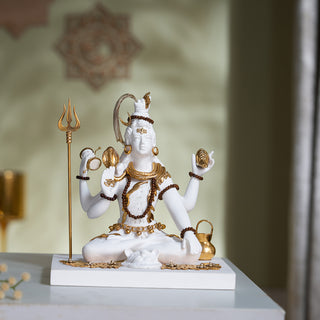
The Shiva Purana gives a measure, and the measure is personal. The ideal length of a lingam, it says, is twelve fingers of the devotee's own hand. Shorter than that is "less efficacious." Longer than that does "no harm" (Vidyeshvara-samhita 11.8).4
Read that again, because it dissolves the entire "correct height" industry. The unit is your hand, not a fixed number of inches, so the right size for a tall man and a small child differ by design. And the text bothers to say that going bigger causes no problem at all. It only warns against something so tiny it becomes a token.
For a murti rather than a lingam, no height rule appears in these chapters at all. Practical sense is the only guide: a piece you can reach to bathe, dress and offer to, on a surface not shared with keys and chargers. Most advice in a good pooja room checklist is about that daily practicality, not mystical danger.
Where should you place a Shiva statue in the house?
The Shiva Purana's answer is "anywhere facilitating a daily worship." It cares that the spot is clean, that an altar is properly made (19.19), and that worship happens at the three junctures of the day: morning, midday, evening (19.20). It does not name a direction.
The direction rules (north-east for the shrine, the lingam's spout draining north, the deity facing west so the worshipper faces east) come from Vastu Shastra and long household practice. That is a living tradition with its own logic, and following it is reasonable. It is simply not the Shiva Purana speaking. The same goes for the directional guidance for other deities, whether which way a Ganesh idol should face or the debate about keeping a standing Vishnu idol at home.
A fair way to hold both: follow the Vastu placement if it brings you peace of mind, and do not panic if your flat's layout makes it impossible. The text you would be quoting to justify the panic does not contain the rule.
Three things people get wrong about keeping Shiva at home
1. "A Nataraja at home brings destruction"
This one is everywhere, and it has no scriptural source in the chapters that govern Shiva worship. The Vidyeshvara-samhita chapters on installing and worshipping Shiva's image name no forbidden form, no banned posture, and no limit on how many images a household may keep. The tandava is not a threat aimed at your living room; in Shaiva theology it is the rhythm of creation and dissolution together, which is why the same texts that describe it also describe Shiva's many incarnations as protective rather than destructive.
To be careful: no prohibition in two chapters is not proof that no text anywhere says otherwise. The Agamas and Shilpa Shastra, which govern temple installation, were not consulted here. But if someone tells you the Shiva Purana forbids a Nataraja at home, they have not read it.
2. "Never offer tulsi to Shiva, because of Vrinda's curse"
This is the one that surprises people most, because the story is usually told backwards. Open the Shiva Purana's own Tulasi chapter and Vrinda's curse falls on Vishnu (that he become a rock, the shalagrama) for deceiving her while her husband Jalandhara was being fought (Yuddha-khanda 41.30, 41.33 to 35).2 Not on Shiva, and not on Shiva's worship.
A few verses later Shiva himself grants that Tulasi shall become "the most important constituent of the materials of worship of the gods" (41.45). The blanket "no tulsi for Shiva" rule is temple and household custom. It is widely followed and worth respecting (households keep many such rules, like the well-known reason tulsi is not offered to Ganesha) but it is not stated in this chapter of the Shiva Purana.
3. "If you keep Shiva at home you must do elaborate puja daily, or else"
Daily worship is genuinely the condition the text attaches (11.24). But read the next line. An abbreviated sequence (from the water offering through to the food offering) is explicitly accepted (11.29). The Purana anticipates that people are busy, poor, tired, travelling, and it builds the shortcut in.
The same generosity shows up on Maha Shivratri. The Shiva Purana's Shivaratri chapter sets out four three-hour worship periods through the night, tells the devotee to stay awake gladly, and has him pass the time till daybreak in songs, music and dance (Kotirudra-samhita 38.35, 38.74).3 It lists no penalty for sleeping and none for eating.5 The long "avoid" list that circulates every year is custom layered on top of a rite whose one real requirement is the night vigil.
The one flower Shiva actually turned away, and what he did next
There is exactly one well-known exclusion in these chapters, and even it comes with a twist that almost nobody repeats.
After the Ketaki flower bore false witness for Brahma in the contest over the pillar of fire, Shiva calls it a cheat and tells it to go, and says it will have no place in his worship from then on (Vidyeshvara-samhita 8.15). Harsh. But within a few verses he softens it. He says it is not right for him to wear the flower, then adds that his attendants may wear it and that it may decorate the canopy over his image (8.19 to 21):
त्वं वै वितानव्याजेन ममोपरि भविष्यसि
In plain English: You will still stand above me, in the form of the canopy.
Vidyeshvara-samhita 8.20
Ketaki is barred from the offering, not from the shrine. Brahma gets the same treatment in the same chapter: he loses his temple and his festival, but keeps a share of every sacrifice, without which no sacrifice bears fruit (8.9 to 14). Even the punishments in this book are negotiated downward. That is the temperament people miss when they turn Shiva into a deity you must not risk annoying, the same temperament visible in how the texts describe devotion to Shiva, and in why so many traditions call him the most powerful god while also calling him the easiest to reach.
What to look for when choosing a murti
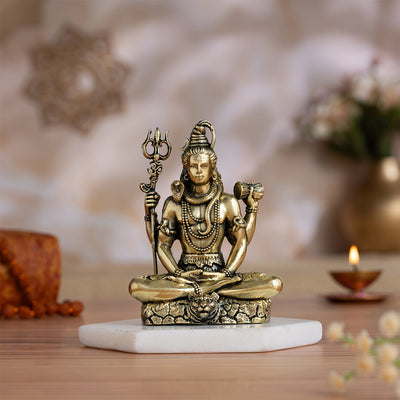
The Shiva Purana has one detail here that is genuinely useful and almost never mentioned in buying guides. A mobile image (one meant to be picked up, carried, moved) should be made of a single piece. A fixed, installed image is made of two (Vidyeshvara-samhita 19.28 to 30).1 Permitted materials in the same passage include gems, gold, mercury and crystal.
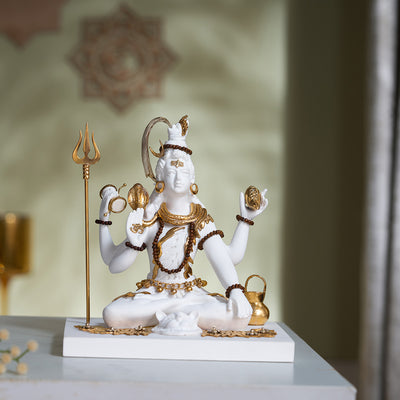
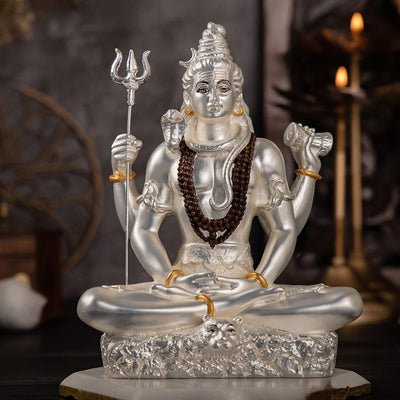
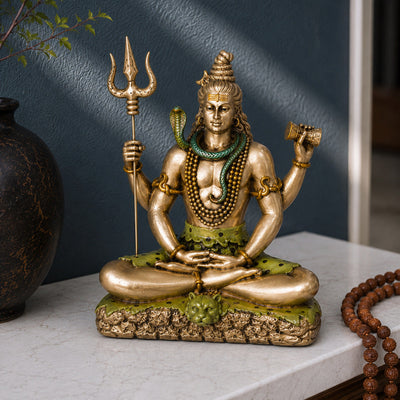
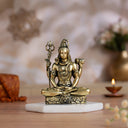
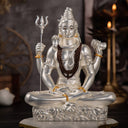
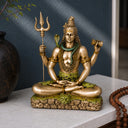
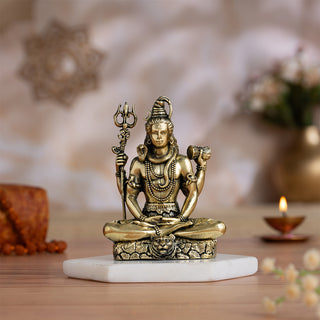
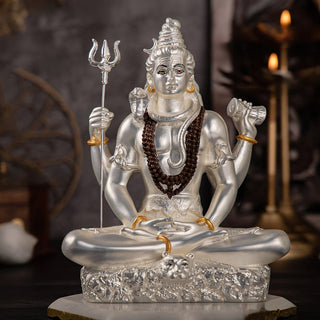
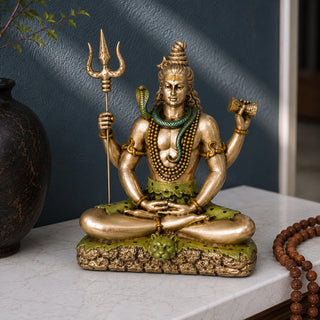
For a home shelf, that points toward a murti cast as one piece. A one-piece brass Shiva in meditation sits squarely inside what the text describes, and a brass murti ages well and takes abhisheka without damage. Marble-dust and plated pieces are lighter and hold fine detail, and mostly want dry cleaning rather than water: this guide to cleaning a marble idol applies to them too.
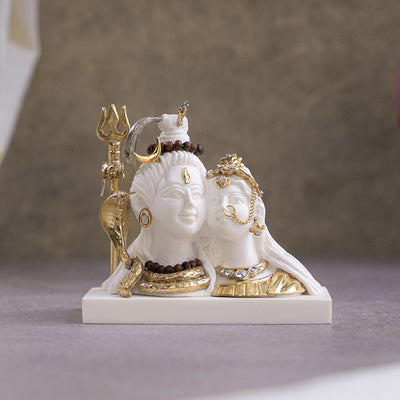
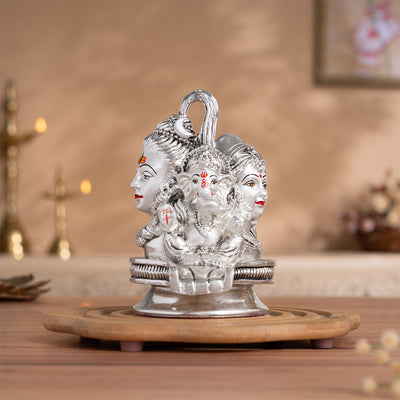
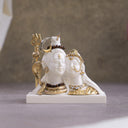
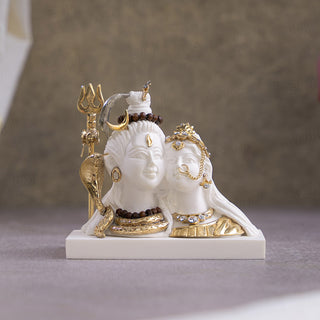
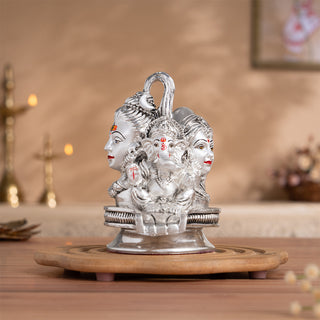
Beyond that, the choice is aesthetic and personal, exactly as it is when people pick a Ganesha idol for the home. A meditating Shiva suits a quiet corner. Shiva with Parvati suits a family shrine. There is no scriptural hierarchy between them.
What daily worship realistically looks like in a flat
Strip it down to what the text asks for and it is short.
- Water. Abhisheka with plain water is the core offering to Shiva, and 11.29's abbreviated sequence starts here.
- Bilva leaves, when you have them. Three leaves on one stalk, offered smooth side down, is the common practice.
- Bhasma or a little sandal paste, applied in three lines.
- A mantra: the Panchakshara, "Om Namah Shivaya," is enough. Five syllables.
- Food offering, however small, to close the sequence.
That is a five-minute rite, and the Purana explicitly permits it when capacity is limited. The rest (the full sixteen-step upachara, the lamp arrangements, keeping a shankh in the pooja room, the festival offerings of a Mahashivratri observance) is enrichment, not the entry ticket.
Missing a day is not a catastrophe either. No verse in these chapters describes a punishment for a lapse. That fear appears to be modern.

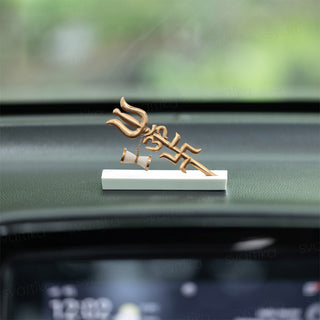
So, can we keep a Shiva statue at home?
Yes, and the tradition is more relaxed about it than the internet is.
The book that governs the question tells you the image may be clay, that longer than twelve fingers does no harm, that the right spot is wherever daily worship is practical, and that the short version of the puja counts. It names one flower it does not want, and then finds a place for even that flower in the canopy.
Most of what frightens people about keeping Shiva at home is not scripture. It is inherited nervousness, hardened over generations into rules nobody traced back. The texts themselves (the ones that also record his contested origins, his disputed family, and the great arguments about who could ever defeat him) describe a god who accepted worship from a rakshasa king who had just tried to lift his mountain, and from Ravana's whole line after that.
If Shiva accepted that, he will accept a Mahadev murti on your shelf and five honest minutes each morning.
Also read: Who Are Lord Shiva's Father & Mother | How Many Avatars of Shiva Are There | Things to Avoid on Maha Shivratri | Things to Keep in the Pooja Room | Who Is the Biggest Devotee of Lord Shiva