There is a line that gets repeated on almost every page about this story: "Jalandhara, the demon son of Lord Shiva." It sounds dramatic. It also isn't what the text says.
I went looking for the verse where the Purana calls Jalandhara a son of Shiva in any ordinary sense. It doesn't exist.1 What exists is stranger and better: a story about anger thrown away, coming back grown up.
So was Jalandhara really Shiva's son?
Not in the way the phrase suggests. He comes out of Shiva, which is not the same thing as being fathered by him.
The account sits in the Shiva Purana's Rudra-samhita, in the fifth section called the Yuddha-khanda: the war book. Chapter 14 opens the whole episode. Indra and Brihaspati go to Kailasa and behave badly, Shiva's anger flares from the third eye, and then this:
अथो शिवस्य तत्तेजो भालनेत्रसमुद्भवम्। क्षिप्तं च लवणाम्भोधौ सद्यो बालत्वमाप ह
In plain English: The fire from the eye in Shiva's forehead was thrown into the salt sea. At once it took the shape of a boy.
Shiva Purana, Yuddha-khanda 14.4
Read that again. Cast off. The Sanskrit word is kshiptam, thrown away. The energy is not given, blessed or acknowledged. It is discarded into the sea like something you no longer want in the house.
If you have read our piece on Shiva's own father and mother, you will recognise the pattern. These texts are not doing biology. They are describing how power moves from one form into another, and later readers turn that into a family tree because a family tree is easier to remember.
The boy at the mouth of the Ganga
Brahma named the boy, and the name came out of Brahma's own tears.
Where the Ganga meets the sea, the fierce-looking boy cried and cried.
Yuddha-khanda 14.5
A child, alone, at the exact place where the river meets the sea. The gods come running because the crying is unbearable. Brahma arrives, and the boy grabs him, and Brahma's eyes fill with tears from the grip. That is where the name comes from:
नेत्राभ्यां विधृतं यस्मादनेनैव जलं मव। तस्माज्जलंधरेतीह ख्यातो नाम्ना भवत्वसौ
In plain English: He made water come from my two eyes. So let him be known by the name Jalandhara.
Yuddha-khanda 14.24
Brahma names him. Not Shiva. That single fact undoes most of the internet's version of this story. In Sanskrit, jala is water and dhara means holding or bearing. He is the one born of water, held by water. The Ocean then takes him home:
Gladly he raised the boy by every great means he had. The boy grew into a handsome young man, finely built and shining.
Yuddha-khanda 14.32
A few verses later the text gives him a title it never gives him anywhere else: "Jalandhara, the brave son of the ocean" (14.35). The Purana has already told you whose son it thinks he is.
Vrinda, and why nobody could kill him
Jalandhara marries Vrinda, daughter of the asura Kalanemi, in the Brahma rite (14.35). This marriage turns out to be the hinge of the entire war.
Vrinda's pativrata (her absolute fidelity) becomes a kind of armour around her husband. As long as she holds it, weapons don't finish him. This idea recurs across the epics. The strongest asura in the three worlds is invincible not through his own austerity, but through somebody else's faithfulness. His power is borrowed.
And he uses it the way asuras in these stories always do. He conquers heaven, humiliates the devas, and eventually sends a messenger to Kailasa demanding that Shiva hand over Parvati. It is the same arrogance that gets Ravana's family into trouble in the Ramayana: enormous power, no sense of a limit.
Shiva refuses. War begins. And the gods cannot win it by fighting.
How the gods actually won, and why it's uncomfortable
They win by breaking Vrinda's chastity. Vishnu (the same god who is celebrated for taking ten famous forms to protect dharma) takes the form of Jalandhara and comes to her. She receives her husband. The armour falls, and on the battlefield Jalandhara becomes killable.3
The text does not hide from this. When Vrinda realises what happened, she says exactly what a reader is thinking:
पाषाणसदृशस्त्वं च दयाहीनो यतः खलः। तस्मात्पाषाणरूपस्त्वं मच्छापेन भवाधुना
In plain English: You are like stone, cruel and without pity. So by my curse, become stone yourself.
Yuddha-khanda 41.34
That curse is why the shalagrama stone is worshipped as a form of Vishnu, and why Vrinda is remembered afterwards as Tulasi. It is one of the few places in the Puranas where a wronged woman gets to name the wrong out loud and have it stick.
People often use this episode to argue that tulsi must never be offered to Shiva. That rule is real household and temple custom, and there is nothing wrong with following it, but the Shiva Purana's own chapter says something almost opposite. A few verses after the curse, Shiva himself grants that "Tulasī (holy basil) will be the most important constituent of the materials of worship of the gods" (41.45). We go through this in more detail in our piece on what to actually avoid on Maha Shivratri, and a similar custom-versus-scripture question comes up with tulsi and Ganesha.
The discus Shiva made with his toe
Chapter 24 is the kill, and it is short and very physical.
कोपं कृत्वा परं शूली पादांगुष्ठेन लीलया। महांभसि चकाराशु रथांगं रौद्रमद्भुतम्
In plain English: Furious, the trident-bearer drew a terrible, wonderful wheel in the deep water with his big toe, as if playing.
Yuddha-khanda 24.26
Shiva does not summon a weapon. He draws one in the sea with his toe, the way a bored person draws a circle in sand. Then:
Shiva took up the Sudarshana wheel he had made with his toe, ready to kill him.
Yuddha-khanda 24.45
प्रदहद्रोदसी वेगात्तदासाद्य जलंधरम्। जहार तच्छिरो वेगान्महदायतलोचनम्
In plain English: Burning sky and earth, it rushed at Jalandhara and tore off his great wide-eyed head.
Yuddha-khanda 24.47
Two things worth noticing. First, this is a Shaiva account of where Sudarshana comes from: the Vaishnava tradition tells it differently, which we cover in who gave the Sudarshan Chakra to Krishna. Second, the toe. Shiva's toe shows up again in Valmiki's Ramayana, when Ravana tries to lift Kailasa and Shiva presses the mountain down with his great toe and crushes his arms.6 It is a deliberate image: the thing that ends you took no effort at all.
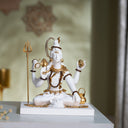
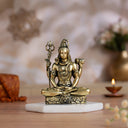
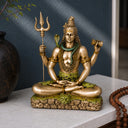
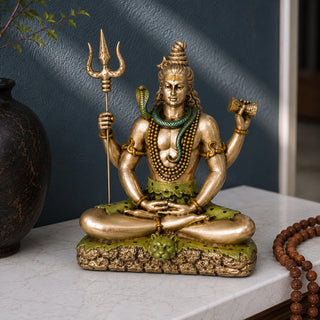
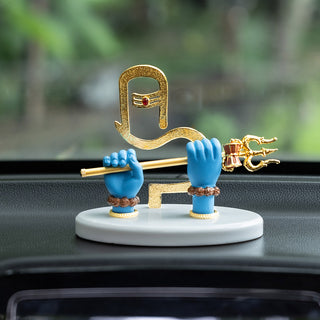
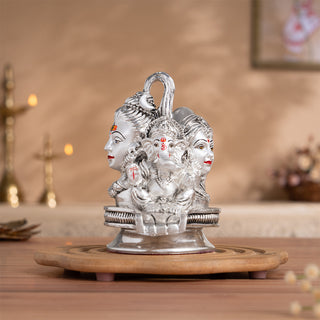
There is a reason so many Shiva murtis are made in a seated, half-closed-eyed meditating form rather than a fighting one. The tradition's picture of his power is stillness that does not need to move.
The line almost nobody quotes
Jalandhara's fire goes back into Shiva at the end. That is the last thing that happens to him:
तत्तेजो निर्गतं देहाद्रुद्रे च लयमागमत्। वृन्दादेहोद्भवं यद्वद्गौर्य्यां हि विलयं गतम्
In plain English: The fire that left his body sank back into Shiva, just as what rose from Vrinda's body sank back into Parvati.
Yuddha-khanda 24.52
What came from Shiva goes back to Shiva. What came from Vrinda goes back to Parvati. The story is a loop, not a lineage.
That is really where the "son" idea comes from. Something of Shiva was in him from the first verse to the last. But calling that fatherhood flattens the point. The Purana is describing what happens to anger you refuse to own. It goes somewhere. It gets fed, it grows up, and one day it comes back to your door asking for your wife.
Read that way, Jalandhara is closer to a mirror than a child.
Four things people get wrong about Jalandhara
1. "He is Shiva's son." No verse says it. He is born from discarded brilliance, named by Brahma, raised by the Ocean, and titled "son of the ocean" by the text itself (14.4, 14.24, 14.32, 14.35). Shiva never once acknowledges him as a son, and remember that the reliably attested children of Shiva are Kartikeya and Ganesha, both of whom the texts are extremely clear about. Even the widely shared "daughters" list has almost no scriptural footing, as we found when we checked the five daughters of Shiva.
2. "Jalandhar city in Punjab is named after him." This is local tradition. It is old, it is worth respecting, and it has no textual basis in the Shiva Purana's account. Treat it as living folklore, not scripture.
3. "Vrinda cursed Shiva, which is why tulsi is banned in Shiva worship." The curse in the text falls on Vishnu, not Shiva, and it is specifically that he become a rock (41.33 to 35). Shiva then blesses tulsi's place in worship (41.45). The no-tulsi-for-Shiva rule is custom layered on top of the story.
4. "This proves Shiva is the strongest, since he killed an asura Vishnu couldn't." Careful. The Shiva Purana is a Shaiva text and it writes Shiva as supreme. The Bhagavata Purana writes the exact mirror: Krishna bewildering Shiva with a "yawning" weapon at Banasura's city, and Shiva's fever weapon taking refuge with Krishna (10.63.14, 10.63.22 to 29). Both are sectarian claims answering each other. We laid the two sides out side by side in who can defeat Lord Shiva and in the most powerful god in Hinduism. The Shaiva answer to Narasimha is Sharabha; the Vaishnava answer to Sharabha is Krishna.5 Neither is a scoreboard.
Why the "demon son" label stuck anyway
Partly translation. "Born from Shiva's third eye" becomes "born of Shiva" becomes "son of Shiva" in about three retellings, and once it is on one page it is on a thousand. Partly because a father forced to kill his own son is a myth shape people already know.
And partly because these texts do treat everything as coming from Shiva. The same Purana lists his forms chapter after chapter with no consistent number, which we went through in how many avatars Shiva actually has.4 In a book where the trees, the ash and the eleven Rudras are all "of Shiva", a demon born from his eye slots in easily.
But origin is not paternity. The Purana knew the difference. It kept calling him the son of the ocean.
Where this story is still alive
You meet Jalandhara more often than you think. Every tulsi plant kept in an Indian courtyard carries Vrinda's name. Every shalagrama on a puja chowki carries her curse. And the story quietly explains why Mahashivratri observance treats Shiva's anger as something to be cooled with water rather than praised: the whole episode began when that heat had nowhere to go.
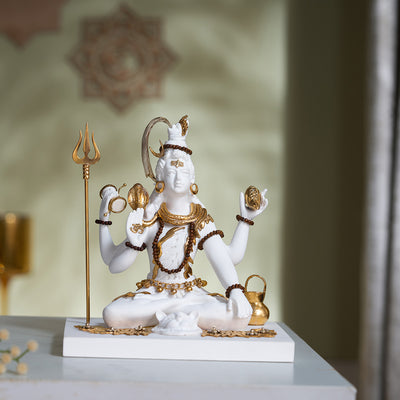
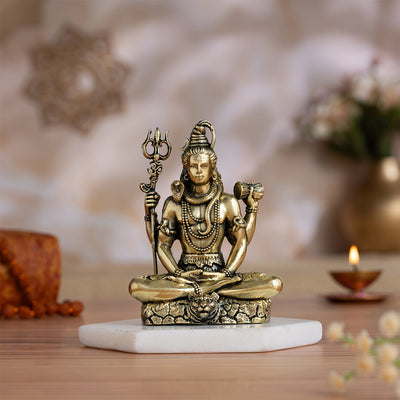
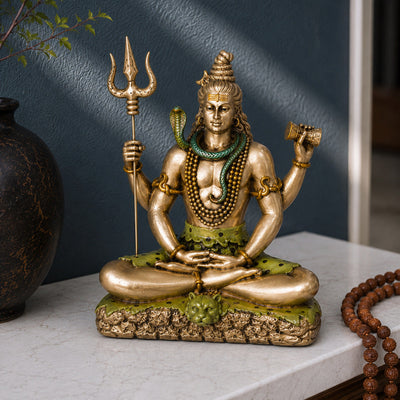
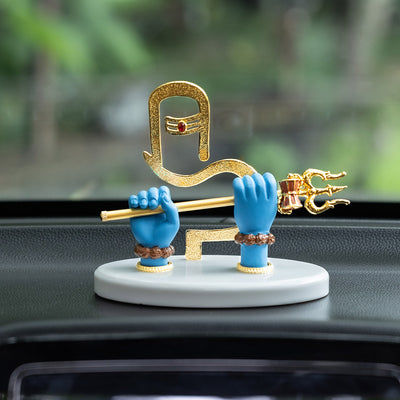
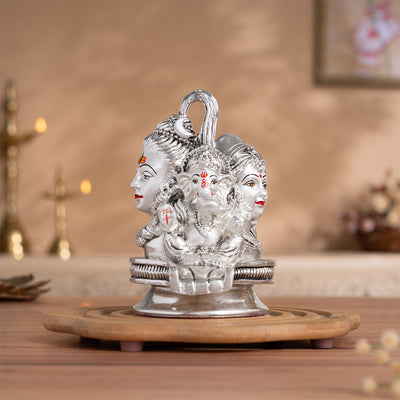
If you keep a Shiva murti at home, it is usually one of the calm forms: meditating, seated, sometimes a brass murti, sometimes marble dust. That choice is not accidental. The tradition's most-loved image of Mahadev is the one where the third eye stays shut. We wrote about the practical side of that in can we keep a Shiva statue at home, and about what real devotion to him looks like in who is the biggest devotee of Shiva.
Jalandhara is the story of what happens when it opens.
Also read: Who Are Lord Shiva's Father & Mother | How Many Avatars of Shiva | Who Can Defeat Lord Shiva | The 5 Daughters of Lord Shiva | Things to Avoid on Maha Shivratri