Watch anyone lay out a puja tray on Chaturthi and you will see the same small decision made without a word. Flowers, yes. Modak, yes. A fistful of durva grass, definitely. And the tulsi plant sitting right there by the window, untouched.
Nobody explains it. It gets passed down as a thing you simply do not do, like not pointing your feet at the shrine. So when people finally go looking for the reason, they usually find a story about a curse and then wonder whether someone made it up last year for a blog post.
They didn't. This is one of the rare cases where the popular belief holds up against the text, and after spending a while checking Ganesha claims that fall apart the moment you open the source, it is genuinely nice to report one that doesn't.
The short answer: Tulsi and Ganesha cursed each other
The story lives in the Brahmavaivarta Purana, in the section devoted entirely to Ganesha, the Ganesa Khanda. Rajendra Nath Sen translated it into English in 1922 for the Sacred Books of the Hindus. Chapter XLVI is titled as a description of the mutual curses of Tulsi and Ganesa, and it is framed around the sage Bhargava worshipping Ganesha without using holy basil leaves.
Brahmavaivarta Purana, Ganesa Khanda, chapter XLVI
In the version told across most of India, Tulsi comes upon Ganesha deep in tapasya by a riverbank and wants him as a husband. He refuses: he is in penance, and marriage is not what he is there for. Both take the exchange badly. She curses him; he curses her back. The two of them part on terms that have never quite been repaired, and from that day his worship goes ahead without her leaves.
Here I have to be straight with you about the limits of what I checked. I verified the chapter and its framing in an actual printed translation. I could not read the full narrative body of that chapter in the scan available to me. So I am not going to hand you invented dialogue or a verse number that would look impressive and be wrong. The chapter exists, its subject is exactly this, and that is the part I can stand behind.
Why tulsi belongs to Vishnu
Tulsi is Vishnu's leaf above all else. In Vaishnava practice she is not treated as a plant that happens to be useful in worship. She is treated as a presence. Prasadam is considered incomplete without her. Anyone who has watched a proper Krishna puja knows the leaf goes on the offering before anything else does, which is why she turns up in almost every guide to how Lord Krishna is worshipped and in the observances around each of the ten avatars of Vishnu.
Hindu worship is full of these assignments. Bilva to Shiva. Red hibiscus to Devi and to Hanuman. Durva to Ganesha. Tulsi to Vishnu. It is one of the tidiest systems in the whole tradition, and once you notice it you start seeing it everywhere on a well-set pooja thali.
So the curse story and the way plants are shared out between gods point the same way. Read chapter XLVI as the cause of the practice, or as a story that grew up to explain one already in place. Either way, the tray looks the same.
What Ganesha does get: durva grass, and a lot of it
Durva grass is the offering the texts actually insist on. Count the chapters they spend on it.
The Ganesa Purana, in its Upasanakhanda (the section on worship), gives chapter 63 to the tale of durva grass, and then keeps going. Chapters 64 to 68 form a full Durvamahatmya, a glorification of durva in its own right. Six chapters, for a weed that grows in every unmown patch in India. That is in Greg Bailey's academic translation, published by Harrassowitz in 1995 and reissued in India by Motilal Banarsidass.
No flower gets anything close to that treatment. Which makes the popular question (what is Ganesha's favourite flower) quietly the wrong question. The honest answer is that the texts are far more emphatic about a grass than about any flower at all.
The custom of offering twenty-one blades, tied in bunches of three, is household practice rather than a Puranic instruction.2 It is lovely practice, and it is very old. It is just worth knowing which category it belongs to.
Three things people get wrong about this
1. "The tulsi story is a modern invention"
This is the one I expected to find true, and it isn't. The urge to debunk a devotional belief is a good instinct, but it misfires here. Brahmavaivarta Purana, Ganesa Khanda, chapter XLVI. It is in the 1922 translation. It is not folklore that leaked into the internet.
2. "Red hibiscus is his scriptural favourite flower"
Jaswand is beautiful on a Ganpati and it is genuine practice, particularly in Maharashtra and Bengal. But red hibiscus is far more strongly associated with Devi and with Hanuman, and no Purana declares it Ganesha's favourite. Six chapters go to durva. Zero go to hibiscus.2 Offer it happily. Just don't call it scripture.
3. "Krishna was blamed for the Syamantaka theft because he saw the moon on Chaturthi, and the Bhagavata Purana says so"
It does not. I read both chapters of the Bhagavata's Syamantaka narrative (Canto 10, chapters 56 and 57) end to end, and then checked the Sanskrit. There is no moon, no fourth lunar day and no Ganesha in them.5 There is cursing, but of the ordinary human kind: at 10.56.31 Krishna speaks of wiping off a mithyabhishapa, a false accusation. He falls under suspicion because Satrajit's brother Prasena vanishes in the forest wearing the gem, Satrajit publicly accuses him, and the rumour spreads through Dvaraka. The scandal is entirely social.
The moon material is real, but it lives somewhere else: the Ganesa Purana's Upasanakhanda, chapter 62, titled as a description of the moon's curse and favour. Two genuine stories from two different texts, welded together later by tradition. If that surprises you, the full working is in our piece on what to do if you see the moon on Ganesh Chaturthi.
I mention these two alongside the tulsi rule for a reason. Any claim about Ganesha is worth testing the same way, and the ones about who actually broke his tusk or about which way his trunk should curve come apart much faster than this one does.
So what do you actually put on the tray?
Nothing here is a rule with a penalty attached. This is what long practice has settled on, and it works.
- Durva grass: the single most textually-supported offering there is. Fresh, rinsed, in bunches of three.
- Modak or ladoo: his own, and no argument anywhere about it.
- Red flowers: jaswand, marigold, whatever is in season and unwilted.
- Sindoor: a smear on the forehead of the murti, in the older Maharashtrian style.
- A lit diya and clean water: the two things every puja starts with.
- Not tulsi: and now you know the chapter it comes from.
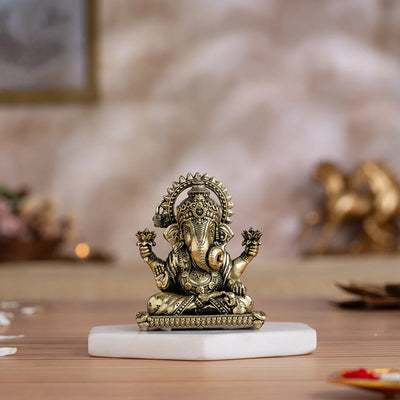
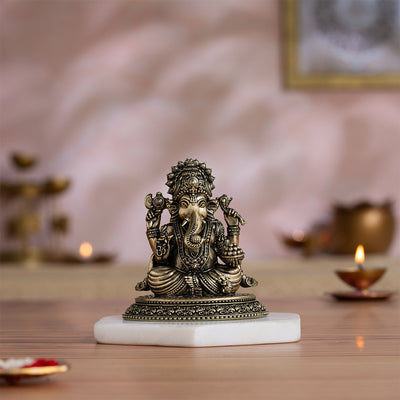
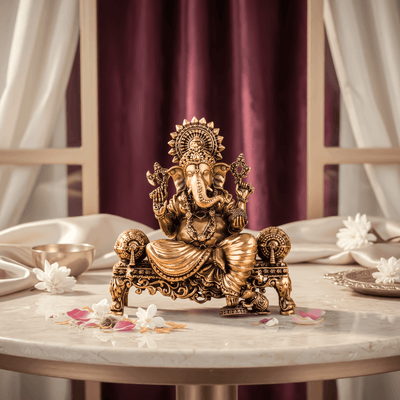
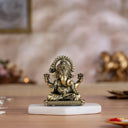
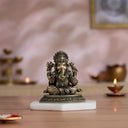
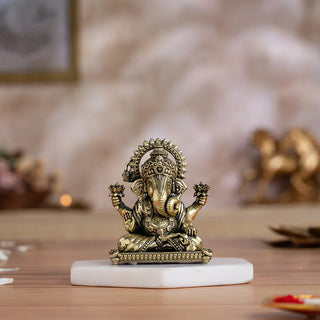
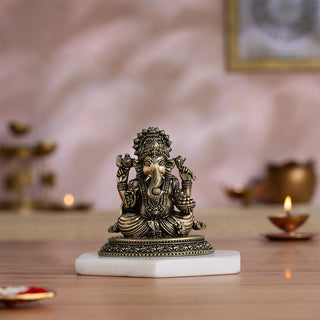
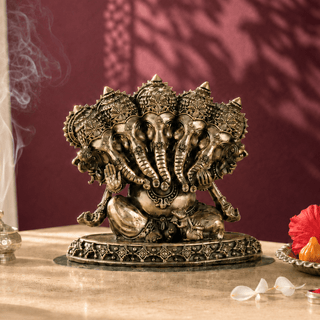
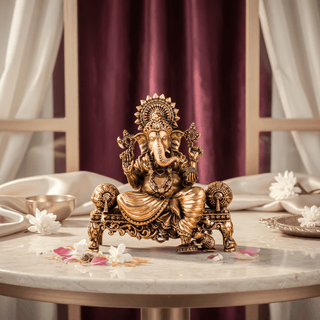
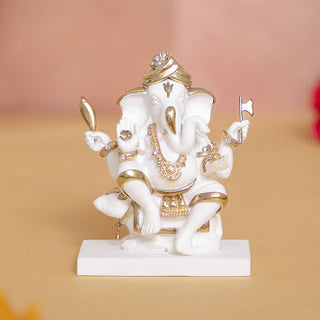
A small brass sitting Ganesha is what most homes end up doing this in front of, and there is a practical reason for that beyond looks: brass takes daily sindoor, ghee and water without complaint, which marble and plated resin do not. If you do use a marble-dust murti, keep our note on how to clean a marble idol handy before the sindoor sets.
What if you have already offered tulsi by mistake?
Then nothing has gone wrong, and no text says otherwise.
I looked for a scriptural passage attaching a consequence to offering tulsi to Ganesha (a dosha, a penalty, a remedy) and there isn't one. The chapter tells a story about why the leaf is withheld. It does not legislate a punishment for a grandmother who put one on the tray without thinking.
Remove it gently, put it back at the plant, carry on. This is the same category as the anxieties that bring people to questions like which direction a Ganesh idol should face: real traditions with real reasoning behind them, but not commands with consequences bolted on. Devotion does not fail on a technicality.
Why this one holds up when so many don't
Most of what circulates about Ganesha is a mix of temple custom, Vastu advice and genuine scripture, all wearing the same confident tone. Sorting them takes opening the books.
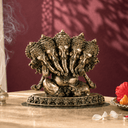
Do that across this whole subject and a pattern shows up. His birth is told two completely different ways: Parvati makes him herself in the Siva Purana's Kumarakhanda, while the Brahmavaivarta has him come after a boon from Krishna, with the head lost to Shani's gaze rather than Shiva's blade.3 That is why the question of the relation between Ganpati and Gauri is more interesting than it first sounds. His forms are classified by name in the iconographic literature (Heramba, Nritta, Lakshmi, Uchchhishta, Prasanna) and never once by the curve of a trunk, which is worth remembering when reading a guide to which Ganesha idol is good for home.4 And the popular meanings assigned to seeing Ganesha in a dream have no scriptural backing at all that I could find.
Against all that, tulsi stands out. Named text. Named translator. Named chapter. Whatever you make of curses between a plant and a god, the belief your grandmother handed you was not invented on the internet, and the fact that it is kept from Kerala to Kolkata shows how old and settled it is.
Which is a good thing to carry into the rest of the festival. Whether you are working out the Ganesh Chaturthi tithi and visarjan dates, planning decorations at home, choosing Ganesh Chaturthi gifts, or reading up on how to immerse the idol at home when the ten days are up, it pays to know which parts are scripture, which are custom, and which are simply what your family does. All three are worth keeping. They just are not the same thing.
And if you are setting up the space itself (a shelf, a chowki, a corner that becomes the shrine) our notes on what to keep in a pooja room, on placing Ganesh and Lakshmi together, and the everyday pooja essentials that go with a Ganesh murti or a brass idol will save you a fair bit of second-guessing.
Also read: Favourite Flower of Lord Ganesha | Who Broke the Tooth of Lord Ganesha | Ganesha Trunk Right or Left Meaning | Moon on Ganesh Chaturthi | Relation Between Ganpati and Gauri