The invitation says dhoti function. Your cousin on the phone says panchala function. The card itself says upanayanam, in Sanskrit, above a photo of a boy with a shaved head.
That is all one afternoon, under three names that are not interchangeable.
What families call it
| Where | What families call it |
|---|---|
| Andhra Pradesh, Telangana | Panchala function · pancha kattu · dhoti function · puttu panchalu · panchalu |
| Tamil Nadu | Poonal · poonool, the word for the thread, used for the whole day |
| Karnataka | Dhoti function · upanayana |
| Maharashtra | Munji |
| Hindi belt, north India | Janeu · yagnopavit |
| Nepal | Bratabandha |
| Sanskrit, on the card | Upanayanam · brahmopadesham |
| Indian English | Sacred thread ceremony · thread ceremony |
Pancha is the Telugu word for the dhoti. Kattu means to tie. Pancha kattu is literally the tying of the dhoti, which is exactly what the function is. Veshti is the Tamil word for the same cloth, though veshti kattu in Tamil usually means the practical business of tying one, not the name of the day.
North and west of that, the day is named for the thread or the girdle instead of the cloth. Janeu and yagnopavit both point at the yajnopavita. Maharashtra's munji is the munja grass the boy's girdle is twisted from. The same Āśvalāyana chapter that fixes the garment by varna gives the Brahmana a girdle "made of Muñja grass".1
The word dhoti has no settled English spelling, so cards and family groups carry dhothi, dothi and doti as well. Same cloth, same day.

At what age is the dhoti function held?
Between seven and thirteen in most families. Around eleven is the most common in practice.
The date moves for ordinary reasons. Families wait for a muhurat, then work backwards from school exams and from when relatives can travel. Two brothers are very often done on the same morning, and a boy's function and a girl cousin's half saree function get clubbed onto one date more than people admit.
There is no age police. When a family misses the window, they do it later rather than not at all: at fifteen, at twenty, sometimes in the run-up to the boy's wedding.
The dhoti function is one step of the upanayanam, not another name for it
The upanayanam is the rite. Its centre is the thread, the yajnopavita, fine cotton strands twisted and knotted into one loop worn over the left shoulder, and the moment the father or the acharya speaks the Gayatri into the boy's ear. That instruction is what brahmopadesham means. A fire is lit for it and a priest runs it.
The dhoti function is the dressing. The boy comes out of shorts and is tied into a pancha for the first time, in front of everyone, and photographed in it.

In the classical rite the two were never separate. The initiation chapter of the Āśvalāyana Gṛhya Sūtra spends as much space on what the boy wears as on what he is told, specifying the garment, the girdle, the skin and the staff for each varna.1 New clothes were part of the ceremony, not an event standing beside it.
What changed is that in Telugu families the dressing grew its own life. It gets a card, a backdrop, a cake, a photographer. And in a good number of families it is now held on its own, with no thread and no homam at all, as the boys' answer to the girls' function.
So if you need to know which one you are attending, look for three things: a priest, a fire, and a thread. All three and it is an upanayanam, with the dhoti as one step inside it. Only a new pancha, photos and lunch, and it is a dhoti function, which is a celebration rather than a rite.
Is it in the scriptures?
The upanayanam is. It sits on the classical list of sixteen samskaras, and it is the one that opens a boy's Vedic study.2 The sixteen are a later tidying-up: the household manuals themselves run to different counts, and Gautama's Dharmasūtra lists forty.
That is a real difference from the girls' side. Those same lists contain no coming-of-age rite for girls, which is why the half saree function is regional custom held together by families, while this one has a text behind it.
The dhoti function under that name is not in any text. It is the clothing step of a scriptural rite, given a Telugu name and a stage.

Those texts also fix the age by varna rather than by the boy. In Hermann Oldenberg's 1886 translation, the Āśvalāyana initiation chapter puts it in the eighth year for a Brahmana, the eleventh for a Kshatriya and the twelfth for a Vaishya, with outer limits of sixteen, twenty-two and twenty-four, past which a boy is called patitasāvitrīka, fallen from the Savitri.1 Manu's code gives the same three ages, counted from conception instead of from birth.3
Two honest notes on that. The eleven you hear from families today happens to be the Kshatriya number, and nobody arrived at it that way. And very few families now choose the date by varna at all.
What happens on the day
The order shifts by family and by priest, but the shape holds.
- Mangala snanam. A ceremonial bath at first light, often with turmeric. Telugu cards frequently name it as its own item.
- The head. Traditionally shaved, leaving a tuft. Plenty of families now only trim.
- The pancha. The boy is dressed in the new dhoti. This is the part everyone photographs.
- The homam. A fire in a small brick altar, fed with ghee and mango wood.
- The thread. The yajnopavita goes over the left shoulder.
- Brahmopadesham. The Gayatri is taught, usually with father and son under a cloth so nobody else hears it.
- Bhiksha. The boy asks for alms, and by custom his mother must be the first to give, with rice poured into his bag before he goes on to the other elders. It is the part that makes mothers cry.

Who gives the pancha
The maternal uncle. In most Telugu and Tamil families the boy's mama brings the new dhoti, usually silk, and the clothes for the day come from the mother's side generally. He has a visible role beyond the cloth: carrying the boy in, standing with him, being in the photograph when the pancha is handed over.
That is custom rather than text. No Gṛhya Sūtra names an uncle. But it holds firmly enough across the south that if you are the mama the cloth is your job, and if you are not, do not buy one; you will duplicate the one gift that was already spoken for.
The girls' side runs the same way: the mama gives the langa voni, and everyone else brings small keepsakes for her half saree function. The pattern shows up at a seemantham and at a naming ceremony too: one relative owns the headline gift, and everybody else gives something smaller that lasts.
What everyone else gives
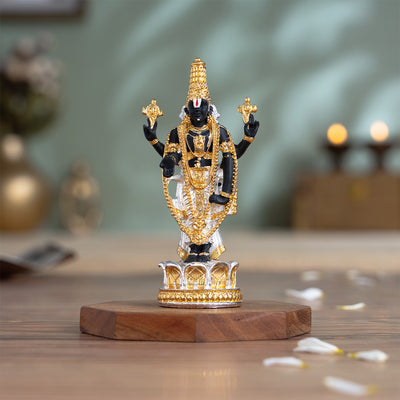
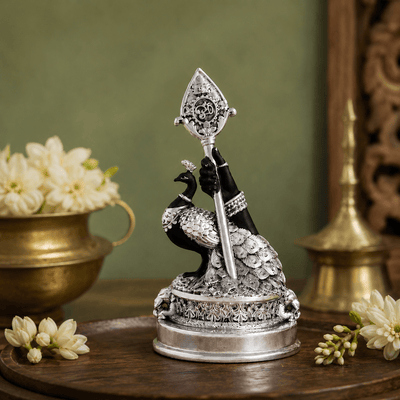
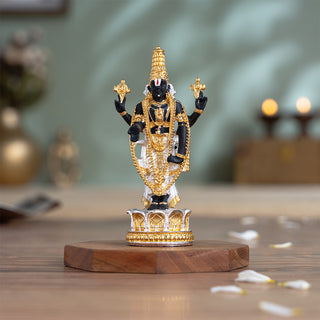
Something small and lasting, and not clothes. An eleven-year-old is a few years from a hostel room, so the pieces that survive are the small metal ones: a plated Balaji idol, a Murugan, Balaji's feet in a charan paduka, or the pocket temple that folds shut and travels with him. All of it sits in what we stock for the dhoti function.
Balaji is the default in Telugu households, and the story of Venkateswara at Tirumala is one the boy already knows. For a Tamil family Murugan is the more natural choice. If the family keeps Ganesha at the centre instead, the form matters more than the size, and a Ganesh shankh is something he can actually use in the pooja room, where most of what he is handed that day ends up by evening.
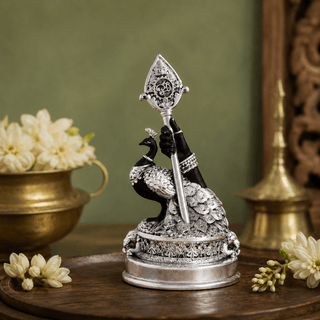
Budgets, what to give the boy versus the family, return gifts under ₹500, and what to do when the problem is eighty guests and not one gift: that is all in our guide to what to actually carry to one of these.
Also read: Upanayanam and Dhoti Function Gifts | Half Saree Function Meaning | 10 Tirumala Temple Secrets | Where to Place a Charan Paduka at Home | 12 Wedding Return Gift Ideas | What to Keep in a Pooja Room