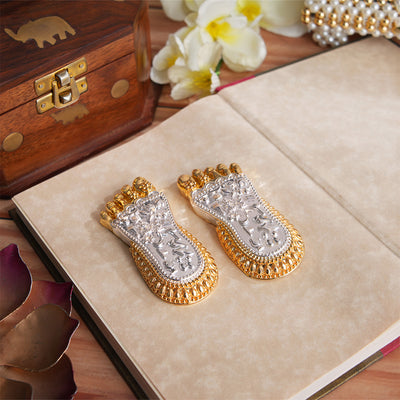
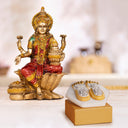
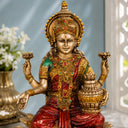
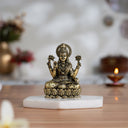
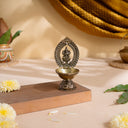
There is a small ritual that happens in lakhs of Indian homes every Diwali morning. Someone opens the front door, wipes the threshold, and sets down a pair of tiny silver or gold feet, angled carefully so the toes point inward. Never outward. Outward, the aunties will tell you, means she is leaving.
I went looking for that rule in the texts: the Bhagavata Purana, the Mahabharata, and the Brihat Samhita, the oldest surviving authority people mean by "Vastu Shastra".
I could not find it in any of them.
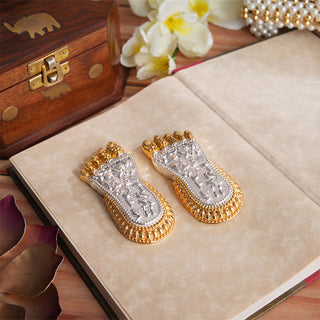
What I found instead was better. Laxmi Charan Paduka are small metal footprints of the Goddess Lakshmi, usually silver or gold plated, kept as a sign that she has entered and settled in the house. Where you put them is custom. What scripture says about her is far more interesting than a direction rule.
Where to place Laxmi Charan Paduka at home: the practice
Across most of India, charan paduka are kept in one of three places:
- At the main entrance, on the floor just inside the threshold, or on a small ledge beside the door. Toes pointing into the house.
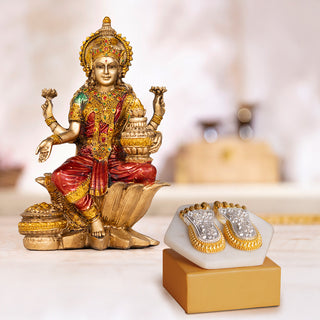
- In the pooja room, in front of the Laxmi murti or beside it, often on a small chowki or plate.
- In the locker, safe, or cash drawer, a Gujarati and Marwari habit especially, and the one that makes the most emotional sense to me. You put the feet where the household's money actually lives.
Some families do all three with separate pairs. Some keep one pair and move it: entrance on Diwali, pooja room the rest of the year. No rule is being broken, because there is no rule.
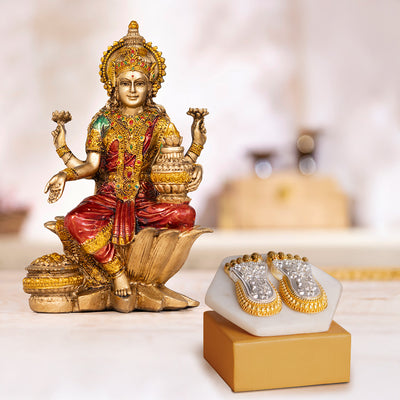
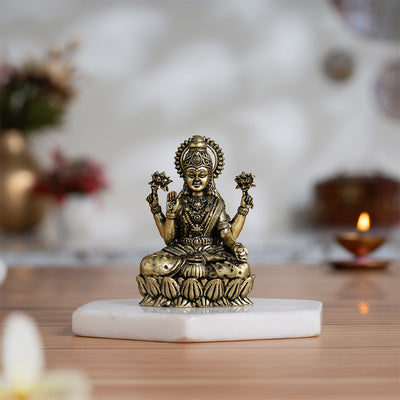
The inward-facing convention is the one part everybody agrees on. It reads as a welcome. You are not diagramming a magnetic field; you are laying out a small silent invitation, the same way you would put slippers at the door facing in for a guest you hope will stay. If you keep a Ganesh Lakshmi murti nearby, the paduka usually sits at their feet, which is exactly where feet belong.
That is the honest version of the placement advice. What follows is what the texts say, which is where this gets good.
What the Bhagavata Purana actually says about where Lakshmi lives
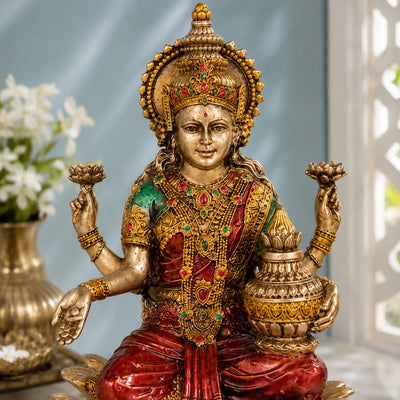
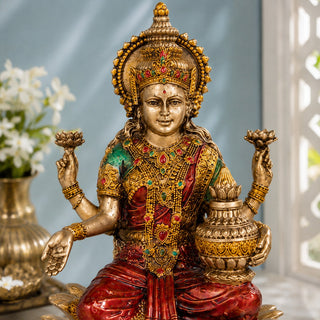
The Goddess's arrival is described during the churning of the ocean: the Kurma avatar episode, when gods and demons churn the sea using a mountain as the rod. Out of that churning, one after another, come the Moon, the white steed Uchchaihsravas, the elephant Airavata, the Kaustubha gem, the physician Dhanvantari with the nectar. And Lakshmi. The Mahabharata's own account of the churning, in the Adi Parva, lists her plainly among them: "Lakshmi dressed in white."3
Here is the part almost nobody quotes. She does not simply appear and bless everyone. She inspects them.
विलोकयन्ती निरवद्यमात्मनः पदं ध्रुवं चाव्यभिचारिसद्गुणम् । गन्धर्वसिद्धासुरयक्षचारण त्रैपिष्टपेयादिषु नान्वविन्दत् ॥
In plain English: Looking for a faultless, lasting home for herself, one with qualities that never fail, she searched among the Gandharvas, Siddhas, Asuras, Yakshas, Charanas and the gods of heaven, and did not find it.
Bhagavata Purana 8.8.19 to 22
The verses that follow read like an audit. One being has austerity but has not conquered anger. Another has knowledge but is still attached. Another has power but is bound by material nature. Some are excellent in every field and still lack devotion. She looks at the entire assembly of gods and finds none of them qualified.1
Then she chooses Vishnu (8.8.23). And the text says something remarkable about where she settles:
तस्याः श्रियस् त्रिजगतो जनको जनन्या वक्षो निवासम् अकरोत् परमं विभूतेः । श्रीः स्वाः प्रजाः सकरुणेन निरीक्षणेन यत्र स्थितैधयत साधिपतींस् त्रिलोकान् ॥
In plain English: The father of the three worlds made his own chest the home of this Lakshmi, the mother, the highest form of all abundance. Resting there, her kind glance nourished her children and the rulers of the three worlds.
Bhagavata Purana 8.8.25
Her address, scripturally speaking, is Vishnu's chest. Not a corner of a room. Not a direction. This is why Vishnu and Lakshmi are so often kept together: the pairing is textual, not decorative.
And a few verses later, the flip side:
निःसत्त्वा लोलुपा राजन् निरुद्योगा गतत्रपाः । यदा चोपेक्षिता लक्ष्म्या बभूवुर्दैत्यदानवाः ॥
In plain English: When Lakshmi passed the Daityas and Danavas over, they were left without strength, greedy, without drive, and without shame.
Bhagavata Purana 8.8.29
Notice what makes her withdraw in that line. Not a badly angled object. Aching greed.
Three things people get wrong about Laxmi Charan Paduka
1. "Point the feet inward or she will walk out"
This is the big one, and it is custom rather than scripture. The Lakshmi of the Bhagavata surveys every deity in creation, rejects the lot of them on grounds of character, and then chooses. She is not a presence that can be steered by the angle of a metal object on your floor.
There is a sneering way to say this, and I do not mean it that way. The custom is good. Turning the feet inward every morning is a daily act of welcome, and daily attention is exactly what the text describes her responding to. Keep doing it. Just know you are keeping a family practice, not obeying a verse, and that if you set them down sideways one Tuesday, nothing has been broken.
2. "Vastu Shastra prescribes where devotional objects go"
Classical Vastu is architecture. The Brihat Samhita, Varahamihira's sixth-century compendium and the oldest detailed authority in this line, gives a chapter to house-building and another to locating water springs. Its chapters on idols and on the installation of idols sit after its chapter on temples: they are about temple images and their consecration.5
There is no classical chapter on ornaments in a living room. Scholars who have compared the Vastu-Purusha-Mandala across texts, like Apte and Supekar in their 1983 study for the Deccan College research bulletin, find the classical sources disagreeing with each other about even the basic construction grid.6 It is a comparative, argued tradition: not one settled rulebook that also happens to have opinions about where your paduka goes. Most of what circulates as Vastu decor rules is twentieth-century interior advice wearing a very old name. The same thing has happened to horse statues and to the Shree Yantra material rankings.
The gap between what families do and what the texts prescribe runs right through the ceremonies too, and it is worth being relaxed about there as well. A girl's half saree function is regional custom that the classical samskara lists leave out entirely, which does not make it one bit less real to the family holding it.
3. "Silver is auspicious, other materials are not"
The Bhagavata's own chapter on deity worship lists eight legitimate materials for a sacred image: stone, wood, metal, a smearable substance like clay, painted, sand, jewels, and an image held purely in the mind (11.27.12). Sand sits in the same sentence as jewels. A mental image sits in the same list as gold.
Silver and gold-plated paduka are beautiful and they last, which is a genuinely good reason to choose them. They are not holier. The tradition never priced devotion, and the same broad-mindedness applies to everything else on your pooja shelf.
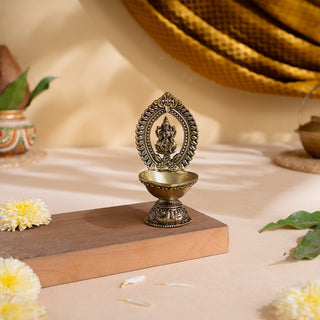
Why you are allowed to move a paduka at all
Moving a paduka is fine. That is the one genuinely useful rule the texts give here.
The same chapter of the Bhagavata divides deity images into two classes: the moved and the not-moved. Of the second kind it says the installed deity "is for His worship not taken away or again brought forward" (11.27.13). A formally installed, consecrated temple image stays where it is. That is the whole scope of the fixity rule.
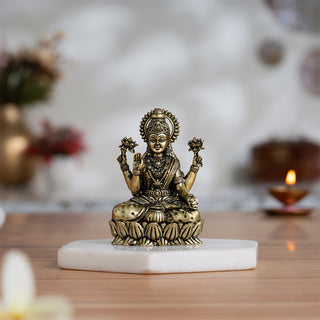
A charan paduka bought for a home is a non-installed image. It belongs to the portable class by design, which is not a compromise or a lesser category: the text names it as a proper kind of image in its own right. So you may pick it up, clean it, carry it to a new house, take it out for Diwali and put it back after. Nothing is being violated. The same logic is why a dashboard idol is textually unproblematic.
The one directional instruction in that chapter, by the way, is about you, not the object: lay your seat with kusha grass pointing east, and sit facing east or north, or simply face the deity, however it happens to be turned (11.27.19). The elaborate rules about which way an image must face are later domestic convention.
Living with charan paduka: what actually matters
What matters is upkeep, not direction.
Keep them clean. Plated metal dulls, and a tarnished pair of feet at the door says something you did not mean to say. A soft dry cloth is all a plated pair should get, most days and before Diwali Lakshmi Puja alike, since an acidic paste lifts plating. The rules for cleaning a marble idol apply in spirit here too: gentle, regular, never harsh.
Keep them off the floor if the floor gets walked on. Not because a text says so, but because feet in Indian devotional grammar are the object of reverence: the whole point of a paduka is that you are honouring the place where the divine stood. Krishna's lotus feet carry the same idea. A small ledge, a chowki, a plate from your pooja essentials: anything that lifts them out of traffic.
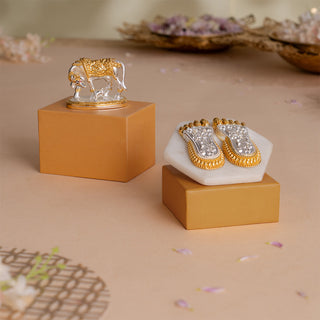
Keep them where you will see them. A paduka in a cupboard does nothing for anybody. In a locker it works because you open the locker. At the entrance it works because you cross the entrance. The Maa Lakshmi charan paduka we make does best on a small plate or chowki for exactly this reason: it gives the pair a defined seat instead of leaving them loose on a shelf. It is also one of the standard things people carry to a half saree function, on the logic that a girl of thirteen will still have it at thirty.
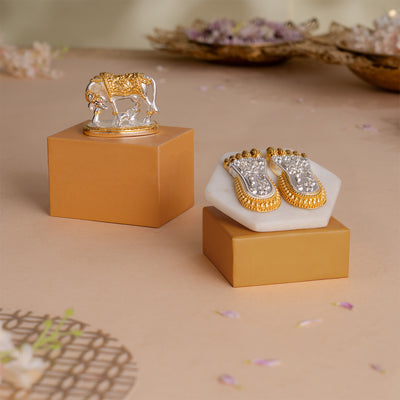
Pair them if you like. Households often set the paduka beside a Lakshmi idol, a Kamdhenu cow, or Kubera. None of this is prescribed either, but a shelf that tells a coherent story is easier to sit in front of every morning, and sitting in front of it is the practice.
So what is the real answer?
Place them at your entrance or in your pooja room, toes turned in, somewhere clean and visible and out of the way of feet. That is the custom, it is a good custom, and there is nothing wrong with keeping it.
But do not carry the anxiety that comes attached to it. The Goddess in the Bhagavata is not watching your doorframe geometry. She audited the entire assembly of gods on character and found almost all of them wanting, and the beings she turned away from were turned away for greed, not for architecture.
Which means the honest Vastu advice for charan paduka is the least marketable advice there is: the placement is the easy part. The rest is how the household is actually run.
Also read: Ganesh Laxmi Murti Position Guide | Things to Keep in Pooja Room | Half Saree Function Meaning | Can We Keep Kamdhenu Cow at Home | How to Keep Shankh in Pooja Room | The 10 Avatars of Vishnu